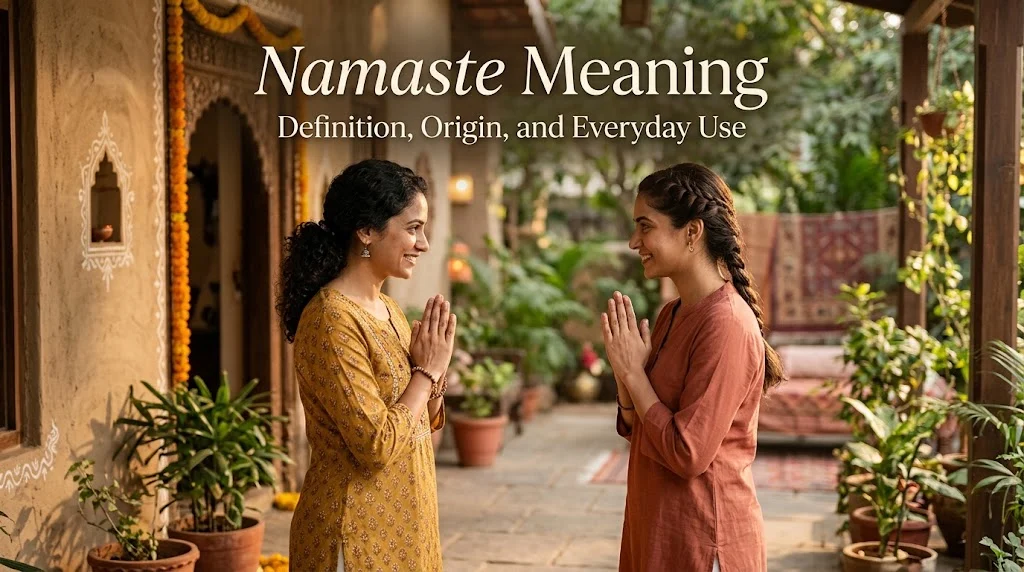
When someone greets you with “Namaste,” you might wonder whether it simply means hello or carries a deeper message of respect. The namaste meaning is commonly understood as “I bow to you,” and the word is widely used as a respectful greeting in South Asian cultures.
People may use it when meeting someone, saying goodbye, or acknowledging another person politely. The greeting is also familiar in yoga classes, online conversations, and wellness communities.
Understanding its meaning, cultural background, and accompanying hand gesture can help you use it naturally and respectfully in different situations.
What Does Namaste Mean?
Namaste is a respectful greeting commonly translated as “I bow to you” or understood as “greetings to you.” It expresses respect, acknowledgment, and goodwill toward another person.
The word comes from Sanskrit and is widely associated with Indian and other South Asian languages and traditions. People commonly accompany it with a gesture called Añjali Mudrā, in which they bring their palms together near the chest and may slightly bow their head.
Here is a quick overview of its meaning and usage.
| Detail | Explanation |
|---|---|
| Main meaning | A respectful greeting or salutation |
| Literal interpretation | “I bow to you” |
| Language origin | Sanskrit |
| Common gesture | Palms pressed together, sometimes with a slight bow |
| Tone | Respectful, warm, and polite |
| Usage | Greetings, farewells, and expressions of respect |
Unlike internet abbreviations such as “LOL” or “BRB,” namaste is not an acronym or text abbreviation. It is a traditional greeting that people also use in modern digital communication.
What Is the Meaning of Namaste in Simple Words?
In simple words, namaste means “I greet you with respect.” It acknowledges the person you are addressing and can communicate politeness, warmth, and goodwill.
For example, imagine entering a yoga studio and greeting your instructor with a gentle smile and your palms together. Saying “Namaste” in this setting offers a respectful way to acknowledge the instructor and other participants.
The greeting does not automatically express romantic interest, religious belief, or a special emotional connection. Its intended message depends on the situation, the relationship between the speakers, and the way it is used.
What Does Namaste Mean Literally?
The word namaste comes from Sanskrit. It is commonly explained through two elements: namas, associated with bowing or paying respect, and te, meaning “to you.”
Together, these elements give rise to the familiar translation “I bow to you.” This translation describes the greeting’s respectful nature, although its use in everyday conversation is often closer to saying “hello” or “greetings.”
Some spiritual interpretations connect namaste with recognizing the dignity or shared humanity of another person. These interpretations are meaningful in certain settings, particularly some yoga and spiritual communities, but they should not be treated as the only definition of the word.
How Is Namaste Used in Everyday Conversations?
Namaste can function as both a greeting and a farewell. Its meaning is usually easy to understand from the surrounding conversation.
Common situations include:
- Meeting someone: You can say namaste as a polite way to greet another person.
- Showing respect: It can acknowledge an elder, teacher, guest, or respected individual.
- Ending a conversation: Some people use namaste when saying goodbye.
- Attending a yoga class: Instructors or participants may use it to acknowledge one another or close a session.
- Communicating online: People sometimes write namaste in messages, comments, or captions to offer a respectful greeting.
For instance, a person might begin a message to a yoga group with “Namaste, everyone!” Here, the word functions as a warm, inclusive greeting rather than specialized slang.
It can sound traditional, spiritual, formal, or friendly depending on the context. However, it remains understandable as a greeting even when the speaker does not intend a spiritual message.
Namaste Meaning in Different Contexts
Although the basic meaning remains consistent, the tone and purpose of namaste can change slightly depending on where you encounter it.
| Context | Likely meaning | Typical tone |
|---|---|---|
| Face-to-face greeting | Hello or greetings | Friendly and respectful |
| Greeting an elder or teacher | An expression of respect | Polite |
| Yoga class | Greeting, acknowledgment, or closing salutation | Calm and reflective |
| Social media caption | A greeting or cultural expression | Warm or celebratory |
| Text message | A written greeting or respectful acknowledgment | Polite and friendly |
The word does not have a separate, widely established slang meaning on social media. If someone sends it in a text, the safest interpretation is usually that they are greeting you or expressing respect.
What Does Namaste Mean in Text Messages?
In text messages, namaste usually means hello, greetings, or a respectful acknowledgment. The sender may use it because it reflects their cultural background, suits the conversation, or simply feels more personal than a standard “hi.”
For example:
“Namaste! I hope your day is going well.”
This message is a polite greeting followed by a friendly expression of goodwill. It does not necessarily carry a hidden meaning.
What Does Namaste Mean on Social Media?
On platforms such as Instagram, TikTok, WhatsApp, and Facebook, namaste is generally used as a greeting, a caption, or an expression associated with Indian culture and spiritual practices.
Someone might include the word in a travel post, a yoga video, a cultural celebration, or a photo with friends. The platform does not change the word’s basic meaning.
A folded-hands emoji, 🙏, may accompany namaste. Depending on the message, this emoji can communicate respect, gratitude, prayer, or a polite greeting. The emoji alone does not establish which meaning the sender intends.
Real Conversation Examples
These examples show how namaste can appear naturally in everyday interactions.
Example 1: Meeting a new person
Person A: “Namaste! It’s nice to meet you.”
Person B: “Namaste! Nice to meet you too.”
Meaning: Both people are using namaste as a respectful and friendly greeting.
Example 2: A yoga class
Person A: “Thank you for joining today’s session. Namaste.”
Person B: “Thank you. Namaste.”
Meaning: The word serves as a closing acknowledgment. Depending on the instructor and group, it may also have a reflective or spiritual tone.
Example 3: A family group chat
Person A: “Namaste, everyone! Sending warm wishes to the whole family.”
Person B: “Namaste! Wishing you all the same.”
Meaning: Here, namaste is a warm group greeting. It helps set a respectful and welcoming tone for the conversation.
Is Namaste Rude or Offensive?
Namaste is generally considered a respectful greeting, not a rude or offensive word. Used appropriately, it can express goodwill and acknowledgment.
However, cultural context matters. Some people use namaste regularly, while others prefer greetings such as “hello,” “hi,” or a greeting in their own language. You should not assume that everyone from India, Nepal, or a particular religious background uses the word in the same way.
It is also worth avoiding exaggerated spiritual explanations when the situation calls for an ordinary greeting. Treating namaste as a simple expression of respect is often the clearest and most considerate approach.
Is Namaste a Religious Word?
Namaste has roots in Sanskrit and appears in Hindu and other South Asian cultural or spiritual contexts. It may carry spiritual significance for some people, but it is also used as an everyday greeting.
Therefore, hearing or saying namaste does not automatically indicate someone’s religion or personal beliefs. Its meaning depends on the cultural and social setting.
Is Namaste Flirty?
Namaste is not inherently flirty. It usually communicates respect or a greeting rather than romantic interest.
If someone sends you “Namaste 😊,” the smile may make the message feel warmer or friendlier, but it does not prove attraction. Consider the full conversation and your existing relationship before interpreting it romantically.
How to Reply to Namaste
The easiest response is to say “Namaste” back. You can also choose another greeting that feels natural for the relationship and setting.
Friendly Replies
Use these responses when greeting a friend, acquaintance, or group.
- “Namaste! How are you?”
- “Hello! It’s nice to hear from you.”
- “Namaste to you too!”
- “Hi! Hope you’re doing well.”
Polite Replies
For a respectful introduction, a conversation with an elder, or a formal cultural setting, these replies can work well.
- “Namaste. It’s a pleasure to meet you.”
- “Greetings to you as well.”
- “Namaste, and thank you for your kind greeting.”
- “Hello, it’s lovely to meet you.”
You do not need to imitate the hand gesture if it feels unfamiliar. A friendly verbal response is usually enough, and following the other person’s lead can help you respond comfortably.
When Should You Use Namaste?
Namaste is suitable when you want to offer a respectful greeting in a cultural, social, or personal setting where the word feels natural.
You might use it when meeting someone who already uses the greeting, attending a yoga class, greeting a group, or participating in a cultural event. It can also work in a text message or social media caption when the context supports it.
Consider your audience before choosing the word. If you are unsure whether the other person will understand it, beginning with “hello” is equally acceptable.
When Should You Avoid Using Namaste?
You do not need to avoid namaste altogether, but some situations call for a more familiar or direct greeting.
In a professional email, job application, client message, or academic document, “Hello,” “Dear,” or “Good morning” may better match the expected tone. The goal is not to treat namaste as inappropriate, but to choose wording that suits the audience and purpose.
Avoid using the word mockingly or imitating a cultural gesture to make fun of someone. As with any greeting, respectful intent and awareness of context matter.
Common Mistakes About Namaste
People sometimes misunderstand the greeting because its everyday use and spiritual interpretations overlap.
| Common Mistake | Correct Understanding |
|---|---|
| Assuming namaste is an acronym | It is a traditional greeting derived from Sanskrit. |
| Believing it always has a religious meaning | It can be used as an ordinary greeting or a spiritual salutation. |
| Assuming it always means goodbye | It is commonly used to greet someone and can also be used when parting. |
Another common misunderstanding is that everyone who says namaste intends a deep spiritual message. In everyday conversation, the sender may simply be saying hello politely.
Similar Greetings and Their Differences
Several greetings may seem similar to namaste because they communicate respect or welcome. However, they are not always interchangeable.
| Greeting | General Meaning | Main Difference |
|---|---|---|
| Namaskar | A respectful greeting | Closely related in usage, with regional and contextual differences |
| Pranam | A respectful salutation or bow | Often conveys particular respect, especially toward elders or revered people |
| Hello | A general greeting | Widely used in everyday and professional English |
| Salaam | A greeting associated with peace | Has its own linguistic and cultural background |
The best choice depends on your audience, language, and setting. If you do not know which greeting is appropriate, a simple hello is a reliable option.
Origin and Cultural Significance of Namaste
Namaste has its roots in Sanskrit and has been used in South Asian linguistic and cultural traditions. The word is associated with bowing or paying respect, which helps explain why it is often accompanied by a gesture of bringing the palms together.
The gesture may be called Añjali Mudrā in yoga and related traditions. It can accompany a greeting, an expression of respect, or a moment of reflection. Its exact significance depends on the tradition and situation.
Namaste has also become familiar internationally through yoga, travel, cultural exchange, and online communication. Its wider recognition does not erase its cultural background, so it is helpful to understand the greeting rather than treating it as merely decorative wording.
Quick Recap
- Namaste meaning: A respectful greeting commonly translated as “I bow to you.”
- Origin: The word comes from Sanskrit and is widely used in South Asian cultures.
- In text: It generally means hello or offers a respectful acknowledgment.
- Tone: It is usually polite and friendly, though context can give it a spiritual or reflective tone.
- How to reply: Saying “Namaste” back or offering a friendly hello is usually appropriate.
Frequently Asked Questions
What does namaste mean in text?
Namaste usually means hello, greetings, or a respectful acknowledgment when someone uses it in a text message.
What does namaste mean literally?
Namaste is commonly translated as “I bow to you,” expressing respect toward the person being greeted.
Is namaste a religious word?
Namaste has cultural and spiritual associations but is also widely used as an everyday greeting without a specific religious intention.
How should you reply to namaste?
Reply with “Namaste,” “Namaste to you too,” or a friendly hello that suits your relationship and the conversation.
Can namaste have different meanings?
Namaste can function as a greeting, farewell, or respectful salutation, while its deeper significance varies across cultural and spiritual contexts.
Final Thoughts
The namaste meaning is best understood as a respectful greeting that commonly translates to “I bow to you.” Its roots are in Sanskrit, and it is used in everyday conversations as well as cultural, yoga, and spiritual settings. You can say namaste when meeting someone, greeting a group, or acknowledging another person politely. In text messages and social media posts, it generally carries the same meaning rather than a special slang definition. When responding, a simple “Namaste” or “Hello” works well. By considering the audience and context, you can use this greeting naturally and respectfully.

John Green is an American writer who contributes to QuickResponsess.com, creating clear and practical content on English grammar, vocabulary and everyday language. His goal is to make learning English simple, engaging and easy to apply.