Quick Answer:
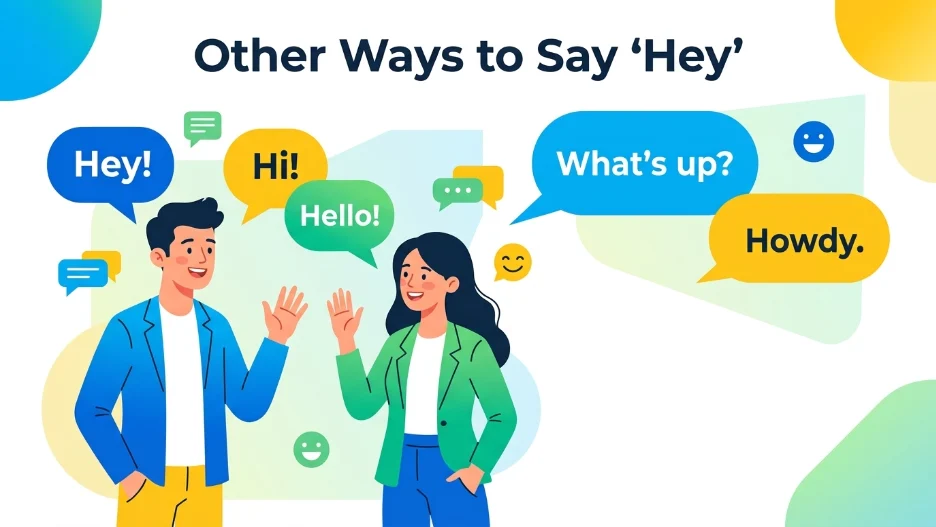
Top alternatives include: Hello, Hi, Good morning/afternoon, Hey there, What’s up?
“Hey” is one of the most common greetings in English, but it is not suitable for every situation. While it works perfectly in casual settings, using it in professional emails or formal meetings can create the wrong impression. Understanding alternatives to “hey” helps you communicate with greater precision and cultural awareness.
Learning other ways to say “hey” improves your fluency and confidence across different contexts. Whether you need to express excitement in English with friends or maintain professionalism in the workplace, having a range of greetings at your disposal ensures you are always prepared.
Quick Categories
Formal Alternatives to “Hey”
- Good morning / Good afternoon / Good evening
- Hello
- How do you do?
- Greetings
- Nice to meet you
Casual Alternatives
- Hey there
- What’s up?
- How’s it going?
- What’s happening?
- Yo
Professional Alternatives
- Dear [name]
- Good morning/afternoon
- Hello [name]
- Hi [name]
- Greetings
Informal Expressions
- Hiya
- Heya
- Sup
- Howdy
- What’s new?
“The right greeting sets the tone for your entire conversation.”
Common Mistakes When Using “Hey”
| Mistake | Example |
| Using “hey” in formal job interviews | “Hey, I’m here for the interview.” |
| Writing “hey” in professional emails to senior executives | “Hey Mr. Johnson, I need your approval.” |
| Using “hey” with strangers in formal settings | “Hey, do you know where the conference room is?” |
| Overusing “hey” repeatedly in one conversation | “Hey, so hey, I was thinking hey…” |
| Assuming “hey” works across all cultures | “Hey professor, can you explain this?” |
What Does “Hey” Mean?
Definition: “Hey” is an informal interjection used primarily as a greeting to attract attention or express sudden reaction.
Grammar note: “Hey” functions as an interjection and is not grammatically connected to the rest of the sentence. It is often followed by a comma before the name of the person you are addressing.
Example:
“Hey, Sarah, nice to see you too!”
When to Use “Hey”
- Greeting friends and family
- Starting conversations in casual social settings
- Text messages and instant messaging
- Attracting someone’s attention
- Informal emails to colleagues you know well
Spoken vs Written: “Hey” is primarily spoken but widely used in text messages, social media, and casual emails. Avoid using it in formal written communication.
Formal vs Informal: Informal — rarely appropriate in professional or formal situations.
Is It Professional or Polite to Say “Hey”?
Polite? ✔️ Yes — among friends and familiar colleagues
Professional? ❌ No — in formal business contexts
Using “hey” in a professional setting can appear too casual. For business emails, greetings like “Dear,” “Good morning,” or “Hello” are safer choices.
Business example:
“Hi Dan, thanks for the information on [project].”
“Using ‘hey’ with someone you’ve just met can feel too familiar. When in doubt, start more formal and adjust based on their response.”
Pros and Cons of Using “Hey”
Pros:
✅ Simple and natural
✅ Friendly and warm tone
✅ Common in everyday usage
✅ Easy to understand
Cons:
❌ Too informal for professional work
❌ Overused and generic
❌ Limited emotional range
❌ Not suitable for formal writing
Other Ways to Say “Hey” (With Examples)
These alternatives will help you sound more fluent, confident, and natural in different situations. Use them according to tone, context, and audience to express excitement, admiration, or approval.
Formal Greetings
1. Phrase: Good morning / Good afternoon / Good evening
Meaning: Polite greetings based on the time of day.
Explanation: These are classic, respectful greetings appropriate in professional and formal settings.
Example Sentence: “Good morning, I’m Ana García from Marketing. Pleased to meet you.”
Best Use: Business meetings
Worst Use: Casual chats with friends
Tone: Polite and respectful
Context Variability: Formal situations, emails, customer service
2. Phrase: Hello
Meaning: A standard, neutral greeting.
Explanation: Slightly more formal than “hi” and appropriate in most situations.
Example Sentence: “Hello, is this the customer service department?”
Best Use: Mixed environments
Worst Use: Very casual settings
Tone: Neutral and polite
3. Phrase: How do you do?
Meaning: A traditional, formal greeting.
Explanation: Typically used when meeting someone for the first time in a formal setting.
Example Sentence: “How do you do? I’m delighted to make your acquaintance.”
Best Use: Formal introductions
Worst Use: Daily office greetings
Tone: Very formal and traditional
4. Phrase: Greetings
Meaning: A general, somewhat formal hello.
Explanation: Works for group situations or when the recipient’s name is unknown.
Example Sentence: “Greetings, everyone. Thank you for joining today’s meeting.”
Best Use: Professional events
Worst Use: Close friends
Tone: Formal and respectful
5. Phrase: Nice to meet you
Meaning: A polite greeting for first time introductions.
Explanation: Essential when meeting someone new and wanting to make a positive impression.
Example Sentence: “Nice to meet you, Sarah. I’ve heard great things about your work.”
Best Use: First meetings
Worst Use: People you already know
Tone: Courteous and warm
6. Phrase: Pleased to meet you
Meaning: A polite and slightly formal greeting for introductions.
Explanation: Similar to “nice to meet you” but more traditional.
Example Sentence: “Pleased to meet you, Dr. Roberts. Thank you for your time.”
Best Use: Professional introductions
Worst Use: Casual settings
Tone: Polite and respectful
Professional Greetings
7. Phrase: Dear [name]
Meaning: A traditional professional email salutation.
Explanation: The most widely accepted way to start a professional email.
Example Sentence: “Dear Mr. Johnson, I am writing to follow up on our previous conversation.”
Best Use: Formal emails
Worst Use: Text messages
Tone: Professional and respectful
8. Phrase: Hello [name]
Meaning: A professional but friendly email greeting.
Explanation: Acceptable for both formal and informal emails.
Example Sentence: “Hello Lisa, could you please review the attached document?”
Best Use: Work emails
Worst Use: Extremely formal documents
Tone: Professional and approachable
9. Phrase: Hi [name]
Meaning: A standard office greeting.
Explanation: The most common greeting for workplace emails and conversations.
Example Sentence: “Hi Dan, thanks for the information on the project timeline.”
Best Use: Office communication
Worst Use: Formal correspondence
Tone: Professional yet friendly
10. Phrase: Good morning/afternoon
Meaning: Time based professional greetings.
Explanation: Polite and respectful, suitable for formal and casual emails.
Example Sentence: “Good afternoon, Mr. Smith. I hope you are well today.”
Best Use: Business emails
Worst Use: Text messages
Tone: Polite and professional
11. Phrase: Hi team
Meaning: A group greeting for workplace colleagues.
Explanation: Works well for emails sent to a group you work closely with.
Example Sentence: “Hi team, please find the meeting agenda attached.”
Best Use: Group emails
Worst Use: One on one communication
Tone: Collaborative and friendly
Casual Greetings
12. Phrase: Hey there
Meaning: A casual, friendly greeting.
Explanation: Familiar and used in spoken English, texts, and casual emails.
Example Sentence: “Hey there, how have you been? I haven’t seen you in weeks.”
Best Use: Friends and acquaintances
Worst Use: Formal situations
Tone: Warm and informal
13. Phrase: What’s up?
Meaning: A casual greeting asking what’s happening.
Explanation: Very common among friends and in relaxed settings.
Example Sentence: “What’s up, Mark? Haven’t seen you in a while!”
Best Use: Friends and peers
Worst Use: Professional meetings
Tone: Very casual and friendly
14. Phrase: How’s it going?
Meaning: A casual alternative asking about general well being.
Explanation: Common in informal conversations.
Example Sentence: “How’s it going, buddy? Long time no talk!”
Best Use: Casual interactions
Worst Use: Formal introductions
Tone: Relaxed and friendly
15. Phrase: What’s happening?
Meaning: A youthful, casual greeting.
Explanation: Popular among younger speakers in informal settings.
Example Sentence: “What’s happening, everyone? Ready for the weekend?”
Best Use: Social gatherings
Worst Use: Workplace settings
Tone: Casual and energetic
16. Phrase: Good to see you
Meaning: A friendly greeting expressing pleasure at meeting someone.
Explanation: Often used when you have not seen someone for a while.
Example Sentence: “Good to see you! It feels like forever since we last caught up.”
Best Use: Reunions and meetings
Worst Use: First time introductions
Tone: Warm and genuine
17. Phrase: Long time no see
Meaning: A playful greeting for someone you haven’t seen in a while.
Explanation: Works as a great icebreaker.
Example Sentence: “Long time no see! What have you been up to?”
Best Use: Old friends
Worst Use: Professional settings
Tone: Playful and friendly
“A simple shift from ‘hey’ to ‘good morning’ can make you sound much more professional at work.”
Informal Expressions
18. Phrase: Hiya
Meaning: A very casual variant of “hi.”
Explanation: Friendly and relaxed, often used in British English.
Example Sentence: “Hiya! How’s your day going so far?”
Best Use: Casual conversations
Worst Use: Professional emails
Tone: Very casual and warm
19. Phrase: Heya
Meaning: Another casual variant of “hey.”
Explanation: Slightly playful, used among friends.
Example Sentence: “Heya, what’s new with you?”
Best Use: Friends and close colleagues
Worst Use: Formal communication
Tone: Playful and informal
20. Phrase: Sup
Meaning: A shortened version of “what’s up.”
Explanation: Very casual and commonly used in text messages.
Example Sentence: “Sup, dude? You coming to the party tonight?”
Best Use: Close friends
Worst Use: Any professional context
Tone: Extremely casual
21. Phrase: Howdy
Meaning: A friendly, informal greeting originating in the southern United States.
Explanation: Associated with American Western culture.
Example Sentence: “Howdy, neighbor! Great weather we’re having.”
Best Use: Informal settings
Worst Use: Professional environments
Tone: Friendly and folksy
22. Phrase: What’s new?
Meaning: A casual greeting asking for updates.
Explanation: Works well when you haven’t talked to someone in a while.
Example Sentence: “What’s new with you? Any exciting plans lately?”
Best Use: Catching up
Worst Use: Professional meetings
Tone: Casual and curious
23. Phrase: How’s everything?
Meaning: A casual way of asking about general well being.
Explanation: Similar to “how are things?”
Example Sentence: “How’s everything at home? Everyone doing well?”
Best Use: Friends and family
Worst Use: Formal settings
Tone: Warm and caring
24. Phrase: Nice to see you
Meaning: A friendly greeting when meeting someone.
Explanation: A more specific way to greet someone you are happy to see.
Example Sentence: “Nice to see you, Karen! You look great!”
Best Use: Social gatherings
Worst Use: First meetings
Tone: Friendly and warm
25. Phrase: Yo
Meaning: A very informal greeting.
Explanation: Common in urban and youth culture.
Example Sentence: “Yo, what’s good, man?”
Best Use: Very casual settings
Worst Use: Any professional context
Tone: Extremely informal
26. Phrase: Look who it is
Meaning: A playful greeting for someone you haven’t seen recently.
Explanation: Expresses pleasant surprise at meeting someone.
Example Sentence: “Well, look who it is! Haven’t seen you in ages!”
Best Use: Surprise encounters
Worst Use: Professional meetings
Tone: Playful and warm
27. Phrase: Welcome back
Meaning: A greeting for someone returning.
Explanation: Shows you noticed their absence and are happy to see them.
Example Sentence: “Welcome back! We missed you at the office.”
Best Use: Returning colleagues
Worst Use: Meeting someone new
Tone: Warm and inclusive
28. Phrase: Well, hello there
Meaning: A friendly, slightly emphatic greeting.
Explanation: Adds enthusiasm to a standard greeting.
Example Sentence: “Well, hello there! Fancy meeting you here!”
Best Use: Surprise meetings
Worst Use: Formal situations
Tone: Warm and playful
29. Phrase: Ahoy
Meaning: A nautical greeting, similar to hello.
Explanation: Playful and rare in everyday speech.
Example Sentence: “Ahoy, mate! Ready to set sail?”
Best Use: Playful contexts
Worst Use: Professional settings
Tone: Playful and quirky
30. Phrase: How are things?
Meaning: A casual way of asking about someone’s situation.
Explanation: Similar to “how’s everything?”
Example Sentence: “How are things at the new job?”
Best Use: Friends and acquaintances
Worst Use: Formal introductions
Tone: Casual and caring
31. Phrase: Ciao
Meaning: Italian greeting meaning “hi” or “bye.”
Explanation: Works well in informal international contexts.
Example Sentence: “Ciao, everyone! Thanks for coming!”
Best Use: Casual gatherings
Worst Use: Professional emails
Tone: International and friendly
“Having a broad vocabulary of greetings demonstrates linguistic flexibility. It’s a sign of a confident English speaker.”
Mini Quiz / Self Check
Test your understanding of when to use different greetings:
- You are emailing your company’s CEO for the first time. Which greeting is most appropriate?
- A. Hey there
- B. Yo
- C. Good morning
- D. What’s up?
- You run into a close friend at a coffee shop. Which greeting fits best?
- A. Greetings
- B. Long time no see!
- C. How do you do?
- D. Dear friend
- Which phrase is professional enough for a job interview?
- A. Good afternoon
- B. Sup
- C. Heya
- D. Hey
- You’re sending a casual text to a coworker you know well. Which is acceptable?
- A. Dear Mr. Smith
- B. How do you do?
- C. Hey, just checking in
- D. Greetings and salutations
(Answers: 1 C, 2 B, 3 A, 4 C)
Comparison Table: Top Alternatives
| Phrase | Tone | Best Use |
| Good morning | Formal | Professional meetings |
| Dear [name] | Professional | Formal emails |
| Hello [name] | Professional | Work emails |
| How do you do? | Very formal | Formal introductions |
| Hi there | Neutral | Mixed environments |
| Hey there | Casual | Friends and acquaintances |
| What’s up? | Very casual | Friends |
| How’s it going? | Casual | Informal conversations |
| Nice to see you | Warm | Social gatherings |
| Good to see you | Friendly | Reunions |
FAQs
1. Is “hey” rude or impolite?
“Hey” is not inherently rude when used among friends or in casual settings. However, it can come across as too informal or disrespectful in professional or formal situations.
2. Can I say “hey” in a professional email?
You can use “hey” in professional emails only if you have an established, casual relationship with the recipient. For formal emails or first time contacts, use “Dear,” “Good morning,” or “Hello.”
3. What is a good professional alternative to “hey”?
“Good morning,” “Good afternoon,” “Hello [name],” and “Dear [name]” are excellent professional alternatives.
4. Is “hey” more casual than “hi”?
Yes, “hey” is generally more casual and familiar than “hi.” “Hi” is a balanced choice for most situations, while “hey” is best reserved for people you know well.
5. Why do native speakers say “hey” so often?
Native speakers use “hey” frequently because it is short, natural, and friendly. It also serves multiple functions beyond greeting, such as getting attention or expressing surprise.
Conclusion
Learning alternatives to “hey” is one of the fastest ways to improve your English communication skills. Each situation calls for a specific tone, and using the right greeting shows cultural awareness and linguistic competence. Whether you are sending a professional email or meeting a friend, having a broad vocabulary of greetings at your disposal builds confidence.
Practice incorporating these alternatives into your daily conversations and writing. Over time, choosing the appropriate greeting will become second nature, and your English will sound more fluent, polished and professional.

John Green is an American writer who contributes to QuickResponsess.com, creating clear and practical content on English grammar, vocabulary and everyday language. His goal is to make learning English simple, engaging and easy to apply.