Quick Answer 🔥
The best alternatives to “on the other hand” include “however,” “conversely,” “in contrast,” “by contrast,” and “alternatively.” Use “however” for general contrast, “conversely” for a direct opposite, and “alternatively” when presenting another option.
The phrase “on the other hand” is one of the most common transition phrases in English. It introduces a contrasting idea, an alternative perspective, or the other side of an argument. While it’s a reliable and widely understood phrase, relying on it too heavily can make your writing feel repetitive and uninspired.
Learning alternatives to “on the other hand” will help you sound more fluent, confident, and natural. Whether you’re writing a professional email, an academic essay, or simply having a conversation, having a variety of professional reaction phrases at your disposal allows you to tailor your language to the specific tone and context of your communication.
Quick Categories
Formal Alternatives to “On the Other Hand”
- Conversely
- Nevertheless
- By contrast
- In contrast
- Notwithstanding
- Whereas
- That said
- Nonetheless
Casual Alternatives
- Then again
- On the flip side
- Still
- Yet
- But then
- At the same time
Professional Alternatives
- However
- Alternatively
- Even so
- All the same
- In any case
Informal Expressions
- Mind you
- On second thought
- The flip side of that
- In another light
Common Mistakes to Avoid
1. Using “on the contrary” when you mean “on the other hand”
Mistake: “I don’t like spicy food. On the contrary, I prefer mild dishes.”
Correction: “I don’t like spicy food. On the other hand, I prefer mild dishes.”
(Explanation: “On the contrary” contradicts a previous statement, while “on the other hand” presents a different consideration.)
2. Using “on the other hand” without an “on the one hand” in formal writing
Mistake: “The proposal has merit. On the other hand, it needs revision.”
Correction: In formal writing, this is often acceptable, but be cautious as some editors consider it incomplete.
3. Overusing the phrase in a single paragraph
Mistake: Using “on the other hand” three times in one paragraph.
Correction: Use a variety of transition phrases to maintain reader engagement.
4. Using it when the next idea doesn’t actually contrast
Mistake: “The company grew revenue. On the other hand, it hired new staff.”
Correction: This isn’t a contrast; it’s an addition. Use “furthermore” or “additionally.”
5. Confusing “conversely” with simply offering an alternative
Mistake: “You could drive to work. Conversely, you could cycle.”
Correction: “Alternatively” is better here, as these aren’t opposites—they’re choices.
What Does “On the Other Hand” Mean?
“On the other hand” introduces a point that contrasts with or qualifies something you’ve just said. It signals to the reader that you’re presenting an alternative view, a competing consideration, or the second side of a comparison.
Technically, it’s the second half of a pair: it answers an earlier “on the one hand.” In everyday usage, many writers use it alone to mean “however,” and this is widely accepted—particularly in general and business writing.
Example: “I’d like to eat out, but on the other hand, I should be trying to save money.”
When to Use “On the Other Hand”
- In balanced arguments where you’re weighing two sides
- When presenting a different perspective on an issue
- In debates and discussions to show opposing viewpoints
- In written communication such as essays, articles, and reports
- Spoken contexts: common but can sound repetitive with overuse
- Written contexts: useful but best varied with alternatives
Is It Professional or Polite to Say “On the Other Hand”?
Yes, the phrase is generally professional and polite. It’s a neutral way to present a counterpoint or a different perspective.
Business example: “We can meet the deadline if we work overtime. On the other hand, this might affect team morale.”
✔️ Polite? Yes
❌ Professional? Yes, but overuse can make your communication sound formulaic
Pros and Cons of Using “On the Other Hand”
Pros ✔️
- Simple and natural
- Friendly tone
- Common usage—everyone understands it
- Easy to understand
Cons ❌
- Can sound too informal for formal academic writing when used without its counterpart
- Overused—can become a verbal tic
- Limited emotional range
- Not suitable for every context
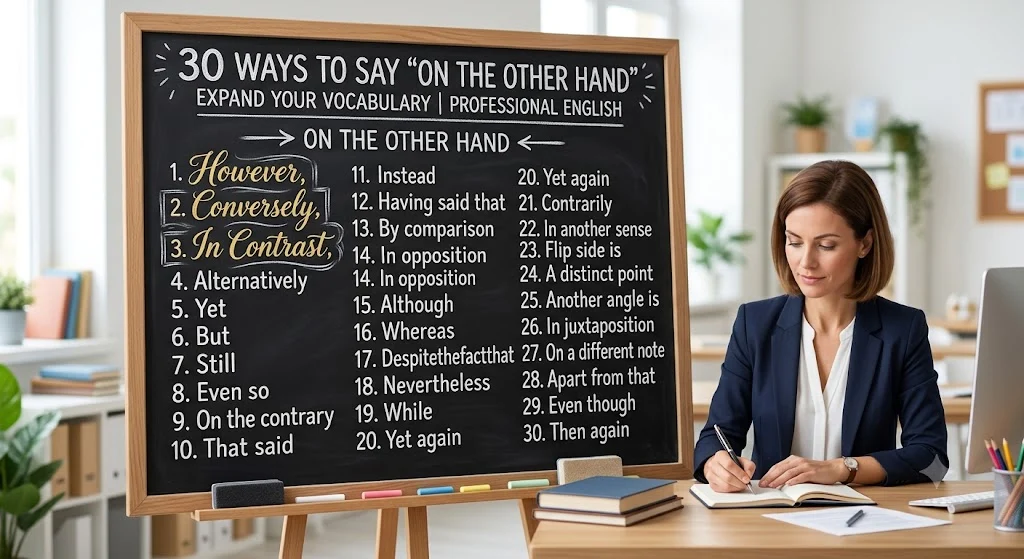
30 Other Ways to Say “On the Other Hand” (With Examples)
These alternatives will help you sound more fluent, confident, and natural in different situations. Use them according to tone, context, and audience.
1. Phrase: Conversely
Meaning: States the opposite viewpoint or situation.
Explanation: A concise and formal alternative that highlights a direct contrast between two ideas. Often used in academic and analytical writing.
Example Sentence: “The study found higher engagement among first year students. Conversely, final year students reported declining participation.”
Best Use: Academic essays
Worst Use: Casual conversation
Tone: Formal, precise
Context Variability: Professional / Formal
2. Phrase: However
Meaning: Introduces a contrasting or qualifying statement.
Explanation: The closest one word substitute—neutral, flexible, and works in almost any register.
Example Sentence: “The proposal is strong overall. However, the budget section needs more detail before we present it.”
Best Use: Professional writing
Worst Use: When you want a more forceful contrast
Tone: Neutral, professional
Context Variability: Casual / Professional / Formal
3. Phrase: In contrast
Meaning: Highlights a clear difference between two things.
Explanation: A slightly longer phrase that clearly signals a difference; ideal for analytical writing.
Example Sentence: “The first model prioritized accuracy. In contrast, the second prioritized speed.”
Best Use: Reports, essays
Worst Use: Everyday conversation
Tone: Formal, clear
Context Variability: Professional / Formal
4. Phrase: By contrast
Meaning: Highlights a clear difference between two things.
Explanation: Similar to “in contrast,” it often works better when comparing entire situations rather than individual elements.
Example Sentence: “Urban districts received the bulk of the funding. By contrast, rural districts saw their budgets fall.”
Best Use: Reports, essays
Worst Use: Casual conversation
Tone: Formal, clear
Context Variability: Professional / Formal
5. Phrase: Alternatively
Meaning: Introduces another option or choice.
Explanation: Perfect when you’re presenting a different possibility rather than direct opposition.
Example Sentence: “We could launch in the first quarter. Alternatively, we could wait for the new product line to be ready.”
Best Use: Advisory content
Worst Use: When highlighting direct opposition
Tone: Balanced, neutral
Context Variability: Casual / Professional
6. Phrase: Nevertheless
Meaning: Emphasizes contrast despite the circumstances previously mentioned.
Explanation: A strong, formal connector that stresses a point remains valid despite earlier concessions.
Example Sentence: “The sample size was small. Nevertheless, the results were consistent across all three sites.”
Best Use: Persuasive writing, academic work
Worst Use: Casual conversation
Tone: Formal, strong
Context Variability: Professional / Formal
7. Phrase: Nonetheless
Meaning: Contrasts despite prior conditions.
Explanation: Similar to “nevertheless,” but often used to acknowledge a previous point before introducing an opposing one.
Example Sentence: “The methodology has limitations. Nonetheless, the findings align with the existing literature.”
Best Use: Professional writing
Worst Use: Informal situations
Tone: Formal, respectful
Context Variability: Professional / Formal
8. Phrase: That said
Meaning: Concedes a previous point while introducing an opposing or balancing idea.
Explanation: Helps when trying to sound fair and balanced in discussions.
Example Sentence: “The framework is widely cited. That said, several recent studies have questioned its core assumptions.”
Best Use: Business writing, reviews
Worst Use: Very formal academic writing
Tone: Balanced, diplomatic
Context Variability: Professional / Formal
9. Phrase: On the flip side
Meaning: Presents the opposing or lighter side of something in a friendly way.
Explanation: A casual, warm alternative that adds personality to your message.
Example Sentence: “Remote work cut our office costs. On the flip side, it made onboarding new hires harder.”
Best Use: Blogs, casual content
Worst Use: Formal reports
Tone: Casual, friendly
Context Variability: Casual
10. Phrase: Then again
Meaning: Indicates reconsideration or re evaluation of a previous thought.
Explanation: A relaxed, reflective expression that works well in conversation or friendly writing.
Example Sentence: “I was going to skip the event. Then again, half my team will be there.”
Best Use: Everyday conversation
Worst Use: Formal academic writing
Tone: Casual, reflective
Context Variability: Casual
11. Phrase: At the same time
Meaning: Balances two sides of a thought.
Explanation: Makes your message sound understanding and empathetic.
Example Sentence: “I’m happy with my job. At the same time, I want new challenges.”
Best Use: Conversations, personal reflections
Worst Use: Technical writing
Tone: Balanced, thoughtful
Context Variability: Casual / Professional
12. Phrase: Even so
Meaning: Emphasizes that despite circumstances, an outcome was unexpected or contrary.
Explanation: Great for acknowledging a fact but still offering another perspective.
Example Sentence: “The quarter missed its target. Even so, the pipeline for next quarter looks strong.”
Best Use: Business writing
Worst Use: Very formal contexts
Tone: Professional, encouraging
Context Variability: Professional / Casual
13. Phrase: Whereas
Meaning: Introduces a contrast within a sentence.
Explanation: Often used to directly compare two elements side by side in the same sentence.
Example Sentence: “Some people like fat meat, whereas others hate it.”
Best Use: Comparative writing
Worst Use: Informal conversation
Tone: Formal, clear
Context Variability: Formal
14. Phrase: Having said that
Meaning: Softens the transition before introducing a contrasting idea.
Explanation: Similar to “that said,” it creates a more conversational flow while still maintaining professionalism.
Example Sentence: “He forgets most things, but having said that, he always remembers my birthday.”
Best Use: Professional conversations, presentations
Worst Use: Very concise writing
Tone: Diplomatic, balanced
Context Variability: Casual / Professional
15. Phrase: Notwithstanding
Meaning: Conveys that something happened despite a previous fact or obstacle.
Explanation: A more formal, legalistic sounding alternative.
Example Sentence: “He still went home, notwithstanding the midnight hour.
Best Use: Legal documents, formal writing
Worst Use: Everyday conversation
Tone: Very formal
Context Variability: Formal
16. Phrase: On the contrary
Meaning: Contradicts a previous statement outright.
Explanation: This is not a synonym for “on the other hand”—it’s stronger and directly opposes what was just said.
Example Sentence: “The data did not support the hypothesis. On the contrary, the relationship ran in the opposite direction.”
Best Use: When directly opposing a point
Worst Use: When simply offering a different perspective
Tone: Formal, assertive
Context Variability: Formal
17. Phrase: In any case
Meaning: Moves forward with a point despite differences.
Explanation: Expresses decision or acceptance, while acknowledging another side.
Example Sentence: “He may disagree. In any case, I’ll do my part.”
Best Use: Moving conversations forward
Worst Use: Formal writing
Tone: Firm but polite
Context Variability: Casual / Professional
18. Phrase: All the same
Meaning: Expresses contrast gently without sounding firm.
Explanation: Creates a soft, balanced contrast.
Example Sentence: “I’m not likely to run out of money, but all the same, I’m careful.”
Best Use: Softening a point
Worst Use: Direct opposition
Tone: Gentle, calm
Context Variability: Casual
19. Phrase: Yet
Meaning: Shows a surprising or unexpected contradiction.
Explanation: Short and effective in both conversational and narrative writing.
Example Sentence: “She trains daily. Yet, she feels underprepared for the competition.”
Best Use: Narrative writing, conversation
Worst Use: Very formal settings
Tone: Soft, reflective
Context Variability: Casual / Professional
20. Phrase: Still
Meaning: Acknowledges a fact but gently adds contrast.
Explanation: Short but emotionally rich—shows contrast without sounding harsh.
Example Sentence: “The reviews were mixed. Still, the film made a fortune.”
Best Use: Informal writing, speeches
Worst Use: Formal reports
Tone: Casual, reflective
Context Variability: Casual
21. Phrase: Mind you
Meaning: Adds a qualifying contrast.
Explanation: An informal, conversational connector that softens a point.
Example Sentence: “The hike was exhausting. Mind you, the view at the top made up for it.”
Best Use: Blog posts, friendly conversations
Worst Use: Formal academic writing
Tone: Casual, conversational
Context Variability: Casual
22. Phrase: Be that as it may
Meaning: Concedes a point while pivoting to a contrast.
Explanation: A formal concession phrase that sounds sophisticated but can feel dated.
Example Sentence: “Be that as it may, we still need to address the budget concerns.”
Best Use: Formal debates, persuasive writing
Worst Use: Everyday conversation
Tone: Formal, sophisticated
Context Variability: Formal
23. Phrase: At any rate
Meaning: Shifts to a contrasting conclusion.
Explanation: Used when moving past a point to focus on something else.
Example Sentence: “Jim broke the window—or maybe it was John? At any rate, the window’s broken now.”
Best Use: Casual conversation, narratives
Worst Use: Formal writing
Tone: Casual, dismissive
Context Variability: Casual
24. Phrase: But then
Meaning: Softens the contrast, often reflecting hesitation or inner conflict.
Explanation: Works well in conversational writing, personal reflections, or storytelling.
Example Sentence: “She could have accepted the job. But then, it would’ve meant relocating.”
Best Use: Storytelling, personal reflection
Worst Use: Formal reports
Tone: Reflective, casual
Context Variability: Casual
25. Phrase: On second thought
Meaning: Introduces reconsideration of a previous statement.
Explanation: A casual alternative that indicates you’ve changed your mind or want to add nuance.
Example Sentence: “We could go to the Italian place. On second thought, let’s try the new Thai restaurant.”
Best Use: Everyday conversation
Worst Use: Formal writing
Tone: Casual, conversational
Context Variability: Casual
26. Phrase: In another light
Meaning: Asks someone to see something differently.
Explanation: Softens contrast and encourages kind and patient communication.
Example Sentence: “The decision felt harsh. In another light, it was necessary.”
Best Use: Reframing discussions
Worst Use: Direct contrasts
Tone: Empathetic, understanding
Context Variability: Casual / Professional
27. Phrase: From a different perspective
Meaning: Presents a new or contrasting viewpoint thoughtfully.
Explanation: An excellent choice for discussions, meetings, or peaceful conversations.
Example Sentence: “It seems like a problem. From a different perspective, it’s a chance to grow.”
Best Use: Meetings, discussions
Worst Use: Very concise writing
Tone: Open minded, balanced
Context Variability: Professional / Casual
28. Phrase: In opposition
Meaning: Expresses clear disagreement or resistance.
Explanation: Appropriate for political, legal, or organizational contexts where two sides are directly opposed.
Example Sentence: “The board supports the policy. In opposition, the employees are protesting.”
Best Use: Political, legal writing
Worst Use: Everyday conversation
Tone: Formal, assertive
Context Variability: Formal
29. Phrase: Rather
Meaning: Refutes a previous assumption and replaces it with another viewpoint.
Explanation: Well suited for academic or persuasive writing when clarifying a misinterpretation.
Example Sentence: “He didn’t ignore the issue. Rather, he waited for the right moment to speak up.”
Best Use: Persuasive writing, clarifications
Worst Use: Simple contrasts
Tone: Formal, clarifying
Context Variability: Professional / Formal
30. Phrase: Even though
Meaning: Introduces a concession that contrasts with the main clause.
Explanation: Often used to begin a sentence—creates a balanced comparison.
Example Sentence: “Even though the first option is cheaper, the second offers better quality.”
Best Use: Balanced arguments
Worst Use: Very concise writing
Tone: Neutral, balanced
Context Variability: Casual / Professional / Formal
“The right tone makes your English sound professional and confident.”
Mini Quiz: Check Your Understanding
1. Which phrase would you use to directly oppose a previous statement?
A) On the flip side
B) On the contrary
C) Alternatively
2. Which is the best alternative for a formal academic essay?
A) Conversely
B) On second thought
C) Mind you
3. True or False: “On the other hand” can always be used interchangeably with “on the contrary.”
A) True
B) False
4. Which phrase is best for presenting a different option without direct opposition?
A) In contrast
B) Alternatively
C) Nevertheless
Answers: 1 B, 2 A, 3 B, 4 B
Comparison Table: Top 10 Alternatives
| Phrase | Tone | Best Use |
| Conversely | Formal | Direct opposite situations |
| However | Neutral | All purpose pivot |
| In contrast | Formal | Clear differences |
| By contrast | Formal | Comparing situations |
| Alternatively | Neutral | Presenting options |
| Nevertheless | Formal | Strong concession |
| That said | Professional | Balanced concessions |
| On the flip side | Casual | Friendly contrasts |
| Then again | Casual | Reconsideration |
| Yet | Reflective | Unexpected contradictions |
FAQs
1. What is the most formal alternative to “on the other hand”?
“Conversely” and “nevertheless” are among the most formal alternatives, particularly suitable for academic writing and formal reports.
2. Is “on the other hand” professional to use in business emails?
Yes, it is professional, but using varied alternatives like “however” or “that said” can make your writing more engaging and less repetitive.
3. What’s the difference between “on the other hand” and “on the contrary”?
“On the contrary” contradicts a previous statement outright, while “on the other hand” presents a different consideration without denying the first point.
4. Can I use “on the flip side” in professional writing?
It’s best reserved for informal contexts like blog posts or casual emails. For professional reports, use “however,” “by contrast,” or “conversely”.
5. What’s the best way to avoid overusing “on the other hand”?
Build a repertoire of alternatives grouped by tone use “conversely” and “nevertheless” for formal work, “however” and “alternatively” for professional contexts, and “then again” and “on the flip side” for casual communication.
Conclusion
Learning alternatives to “on the other hand” is a simple yet powerful way to elevate your English communication. You’ll sound more fluent, natural, and confident—whether you’re writing a professional report, an academic essay, or simply having a conversation. The key is to choose the right phrase for the right context: formal situations call for “conversely” and “nevertheless,” while casual conversations welcome “then again” and “on the flip side.”
Practice incorporating these alternatives to “on the other hand” into your daily speech and writing. With time, using these varied professional reaction phrases will become second nature. Remember, the goal isn’t to replace every instance of “on the other hand” but to have more options available when you need to express excitement in English and contrast ideas naturally.

Sally Rooney is an American writer who contributes to QuickResponsess.com, creating clear and practical content for English learners. Her articles help readers build confidence in using words and expressions accurately in everyday and professional communication.