Quick Answer
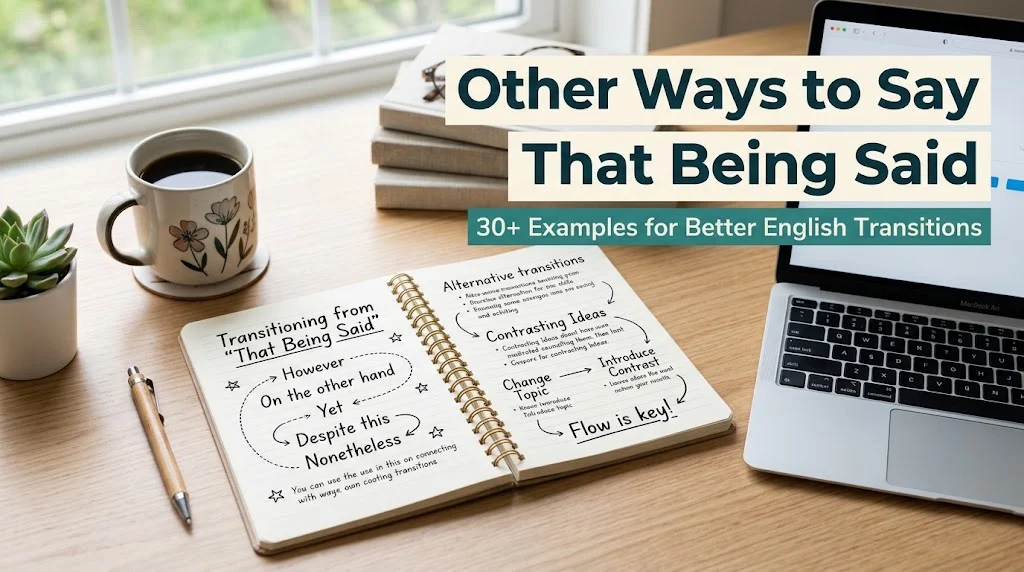
“That being said” is a transition phrase used to introduce a contrasting or qualifying point after acknowledging something. For more variety and precision, try alternatives like “That said,” “Having said that,” “Nevertheless,” “Even so,” “With that in mind,” or “Be that as it may.”
“That being said” is one of the most useful transition phrases in English. It allows a speaker or writer to acknowledge one point and then introduce a contrasting or qualifying idea. It appears in meetings, essays, emails, debates, and everyday conversation. Because it is so effective, many learners use it in almost every paragraph, which makes writing feel repetitive and slightly mechanical.
This guide presents 30 practical alternatives with meanings, examples, and clear notes on tone and context. Whether you are writing an essay, leading a discussion, or drafting a professional email, these options will help your English sound more fluent and natural.
Pull Quote: “A good transition does not just connect ideas. It tells the reader how to feel about them.”
Quick Categories
Formal alternatives to “That being said”
- Nevertheless
- Notwithstanding
- Be that as it may
- In spite of the foregoing
Pro Tip: Formal alternatives suit academic writing, legal documents, and official reports.
Casual alternatives
- Still
- Then again
- But hey
- Mind you
Pro Tip: Casual options work in spoken English, texts, and informal conversations.
Professional alternatives
- That said
- Having said that
- With that in mind
- Even so
Pro Tip: Professional alternatives should feel balanced and neutral so they work in most workplace contexts.
Informal expressions
- All the same
- That being the case
- But still
- Having said so
Pro Tip: Informal expressions belong in conversations and chat messages with familiar contacts.
Pull Quote: “The right tone makes your English sound professional and confident.”
Common Mistakes
- Using it too often in one paragraph.
Example: “That being said, the results were good. That being said, costs rose. That being said, we succeeded.” Repetition weakens flow. - Using it when no contrast actually exists.
Example: “The plan is clear. That being said, the plan is clear.” The phrase signals contrast where there is none. - Using it at the start of an essay.
Example: “That being said, I will now discuss the main argument.” The phrase requires a preceding point. - Mixing register awkwardly.
Example: “Dear Sir, that being said, cheers.” The tone clashes badly. - Using it to soften a point that needs to be direct.
Example: “That being said, you are fired.” The phrase delays clarity where directness is required.
What Does “That Being Said” Mean?
Definition
It is a transitional phrase meaning “despite what has just been said” or “even though that is true.” It introduces a contrasting, qualifying, or limiting point.
Grammar Explanation
The phrase combines the demonstrative pronoun “that,” the participle “being,” and the past participle “said.” It functions as a discourse marker, which is a word or phrase that organises speech or writing rather than adding meaning to a single sentence.
Example Sentence
“The plan is ambitious. That being said, the timeline may need adjustment.”
When to Use “That Being Said”
Common Contexts
- Academic writing: Introducing a counterargument.
- Business meetings: Acknowledging a point before adding a concern.
- Debates: Shifting the direction of an argument.
- Emails: Softening a disagreement.
- Conversation: Balancing a compliment with a criticism.
Spoken vs Written
- Spoken: Common in meetings, discussions, and presentations.
- Written: Very common in essays, reports, and professional correspondence.
Formal vs Informal
- Formal: Standard in academic and professional writing.
- Informal: Acceptable but often replaced by “still” or “then again” in casual speech.
Is It Professional or Polite to Say “That Being Said”?
Politeness vs Professionalism
The phrase is both polite and professional. It softens disagreement and shows that you have considered both sides. However, it can sound overused in professional writing, so varying your transition phrases improves readability.
Business-Style Example
“The proposal is well structured. That said, we should review the budget assumptions.”
Polite? Yes
Professional? Yes, in most contexts
Pull Quote: “A thoughtful transition shows you have considered both sides of the argument.”
Pros and Cons of Using “That Being Said”
Pros
- Simple and natural: Easy to use in both speech and writing.
- Friendly tone: Softens disagreement and shows balance.
- Common usage: Recognised in every English register.
- Easy to understand: Requires no advanced vocabulary.
Cons
- Too informal for work: Rarely an issue, but can sound conversational in formal writing.
- Overused: Loses impact through repetition.
- Limited emotional range: Cannot express strong contrast or emphasis.
- Not suitable for formal writing: Acceptable, but more precise alternatives often read better.
Other Ways to Say “That Being Said” (With Examples)
These alternatives will help you sound more fluent, confident, and natural in different situations. Use them according to tone, context, and audience to express excitement, admiration, or approval.
1. That said
Meaning: A shorter version of the same phrase.
Explanation: Common in both speech and writing.
Example Sentence: “The proposal is strong. That said, we need more data.”
Best Use: General transition
Worst Use: Legal documents
Tone: Neutral, concise, standard
Context Variability: Professional and casual
2. Having said that
Meaning: Acknowledging a point before adding a contrast.
Explanation: Slightly more formal than that said.
Example Sentence: “Having said that, we should still consider the risks.”
Best Use: Meetings, essays
Worst Use: Quick texts
Tone: Formal, balanced, neutral
Context Variability: Professional and written
3. Nevertheless
Meaning: In spite of that.
Explanation: Formal and decisive in tone.
Example Sentence: “The costs are high. Nevertheless, the investment is worthwhile.”
Best Use: Academic writing
Worst Use: Casual chats
Tone: Formal, decisive, serious
Context Variability: Professional and written
4. Nonetheless
Meaning: A slightly softer version of nevertheless.
Explanation: Common in professional and academic writing.
Example Sentence: “The data is limited. Nonetheless, the trend is clear.”
Best Use: Reports, essays
Worst Use: Spoken English
Tone: Formal, measured, neutral
Context Variability: Professional and written
5. However
Meaning: Introducing a contrasting point.
Explanation: The most common formal transition.
Example Sentence: “The plan is sound. However, the timing is wrong.”
Best Use: Academic, professional
Worst Use: Overused in one text
Tone: Neutral, formal, standard
Context Variability: Professional and written
6. Even so
Meaning: Despite that fact.
Explanation: Emphatic and slightly conversational.
Example Sentence: “The risks are real. Even so, we should proceed.”
Best Use: Meetings, debates
Worst Use: Legal writing
Tone: Direct, emphatic, neutral
Context Variability: Professional and spoken
7. All the same
Meaning: In spite of everything.
Explanation: Slightly old fashioned and gentle.
Example Sentence: “It was difficult. All the same, we finished on time.”
Best Use: Narrative writing
Worst Use: Formal reports
Tone: Gentle, reflective, informal
Context Variability: Casual and written
8. Be that as it may
Meaning: Even if that is true.
Explanation: Very formal and slightly literary.
Example Sentence: “Be that as it may, the decision has already been made.”
Best Use: Formal debates
Worst Use: Casual chats
Tone: Formal, literary, firm
Context Variability: Professional and written
9. With that in mind
Meaning: Considering that fact.
Explanation: Forward looking and practical.
Example Sentence: “With that in mind, let us revise the timeline.”
Best Use: Meetings, planning
Worst Use: Casual messages
Tone: Practical, professional, neutral
Context Variability: Professional and written
10. In spite of that
Meaning: Despite that fact.
Explanation: Clear and slightly formal.
Example Sentence: “In spite of that, the team delivered excellent results.”
Best Use: Reports, essays
Worst Use: Quick texts
Tone: Formal, neutral, serious
Context Variability: Professional and written
11. Regardless
Meaning: Without being affected by that.
Explanation: Firm and decisive.
Example Sentence: “Regardless, we must move forward with the launch.”
Best Use: Business decisions
Worst Use: Gentle conversations
Tone: Firm, decisive, neutral
Context Variability: Professional and spoken
12. Notwithstanding
Meaning: In spite of that.
Explanation: Very formal and legal in tone.
Example Sentence: “Notwithstanding the delay, the contract remains valid.”
Best Use: Legal writing
Worst Use: Everyday speech
Tone: Very formal, legal, precise
Context Variability: Professional and written
13. On the other hand
Meaning: Introducing an alternative perspective.
Explanation: Balanced and standard.
Example Sentence: “The salary is lower. On the other hand, the benefits are excellent.”
Best Use: Comparisons
Worst Use: Single point arguments
Tone: Balanced, neutral, formal
Context Variability: Professional and written
14. Then again
Meaning: Introducing a counterpoint casually.
Explanation: Conversational and reflective.
Example Sentence: “It might work. Then again, we could be wrong.”
Best Use: Casual conversation
Worst Use: Formal writing
Tone: Casual, reflective, informal
Context Variability: Casual and spoken
15. Still
Meaning: Despite that.
Explanation: Short and conversational.
Example Sentence: “The odds are against us. Still, we should try.”
Best Use: Spoken English
Worst Use: Formal reports
Tone: Casual, firm, brief
Context Variability: Casual and spoken
16. Yet
Meaning: Introducing a contrast.
Explanation: Very short and formal.
Example Sentence: “The task was difficult, yet the team succeeded.”
Best Use: Academic writing
Worst Use: Casual chats
Tone: Formal, concise, literary
Context Variability: Professional and written
17. But then
Meaning: Introducing a counterpoint casually.
Explanation: Common in spoken English.
Example Sentence: “She is talented. But then, so is everyone here.”
Best Use: Casual conversation
Worst Use: Formal writing
Tone: Casual, conversational, informal
Context Variability: Casual and spoken
18. That being the case
Meaning: Given that situation.
Explanation: Formal and logical.
Example Sentence: “That being the case, we should reconsider the offer.”
Best Use: Formal discussions
Worst Use: Casual chats
Tone: Formal, logical, neutral
Context Variability: Professional and written
19. In any case
Meaning: Regardless of the situation.
Explanation: Neutral and practical.
Example Sentence: “In any case, we need to decide by Friday.”
Best Use: Business, planning
Worst Use: Emotional contexts
Tone: Neutral, practical, decisive
Context Variability: Professional and spoken
20. At the same time
Meaning: While also acknowledging another point.
Explanation: Balanced and diplomatic.
Example Sentence: “The policy is fair. At the same time, it needs clearer guidelines.”
Best Use: Meetings, essays
Worst Use: Quick texts
Tone: Balanced, diplomatic, formal
Context Variability: Professional and written
21. In contrast
Meaning: Introducing an opposing idea.
Explanation: Formal and analytical.
Example Sentence: “In contrast, the second study found no effect.”
Best Use: Academic writing
Worst Use: Casual chats
Tone: Formal, analytical, precise
Context Variability: Professional and written
22. Conversely
Meaning: Introducing the opposite case.
Explanation: Formal and logical.
Example Sentence: “Conversely, lower prices could reduce perceived value.”
Best Use: Academic, business
Worst Use: Everyday speech
Tone: Formal, logical, precise
Context Variability: Professional and written
23. Mind you
Meaning: A casual warning or qualifier.
Explanation: Very conversational and often humorous.
Example Sentence: “It is a great deal. Mind you, there are hidden fees.”
Best Use: Casual conversation
Worst Use: Formal writing
Tone: Casual, warning, informal
Context Variability: Casual and spoken
24. Still and all
Meaning: In spite of everything.
Explanation: Old fashioned and gentle.
Example Sentence: “Still and all, it was a good year for the company.”
Best Use: Narrative writing
Worst Use: Modern business
Tone: Gentle, traditional, informal
Context Variability: Casual and written
25. For all that
Meaning: Despite everything.
Explanation: Literary and slightly formal.
Example Sentence: “For all that, the outcome was better than expected.”
Best Use: Literature, essays
Worst Use: Casual chats
Tone: Literary, reflective, formal
Context Variability: Professional and written
26. After all
Meaning: Considering everything.
Explanation: Justifying or concluding a point.
Example Sentence: “After all, we cannot control the weather.”
Best Use: Conversation, essays
Worst Use: Technical reports
Tone: Reflective, explanatory, neutral
Context Variability: Professional and casual
27. Having said so
Meaning: Acknowledging a point before adding a contrast.
Explanation: Slightly old fashioned but clear.
Example Sentence: “Having said so, we still need to review the numbers.”
Best Use: Formal discussions
Worst Use: Casual chats
Tone: Formal, measured, neutral
Context Variability: Professional and written
28. That being so
Meaning: Given that fact.
Explanation: Formal and logical.
Example Sentence: “That being so, the committee must reconsider.”
Best Use: Formal debates
Worst Use: Everyday speech
Tone: Formal, logical, serious
Context Variability: Professional and written
29. Despite that
Meaning: In spite of that fact.
Explanation: Clear and neutral.
Example Sentence: “Despite that, the project was completed on time.”
Best Use: Reports, essays
Worst Use: Quick texts
Tone: Neutral, formal, direct
Context Variability: Professional and written
30. Even still
Meaning: A casual version of even so.
Explanation: Common in spoken American English.
Example Sentence: “Even still, I think we should try.”
Best Use: Casual conversation
Worst Use: Formal writing
Tone: Casual, firm, conversational
Context Variability: Casual and spoken
Pull Quote: “Professional reaction phrases and balanced transitions both show the same thing: you have thought carefully about the issue.”
Mini Quiz / Self-Check
- Scenario: You are writing an academic essay and want to introduce a counterargument. Which fits best?
- A) Then again.
- B) Nevertheless.
- C) Mind you.
- Scenario: You are in a meeting and want to acknowledge a point before raising a concern. Which is most natural?
- A) Having said that, we should review the risks.
- B) Mind you, there are risks.
- C) Be that as it may, risks exist.
- Scenario: You are chatting with a friend about a plan. Which is most appropriate?
- A) Notwithstanding the difficulties, we proceed.
- B) Then again, it might not work.
- C) In contrast, the second option differs.
- Scenario: Which phrase is the most formal?
- A) Still.
- B) Notwithstanding.
- C) Then again.
Comparison Table: Top Alternatives
| Phrase | Tone | Best Use |
| That said | Neutral, concise | General transition |
| Having said that | Formal, balanced | Meetings, essays |
| Nevertheless | Formal, decisive | Academic writing |
| Nonetheless | Formal, measured | Reports, essays |
| However | Neutral, formal | Academic, professional |
| Even so | Direct, emphatic | Meetings, debates |
| With that in mind | Practical, professional | Meetings, planning |
| Be that as it may | Formal, literary | Formal debates |
| On the other hand | Balanced, neutral | Comparisons |
| Then again | Casual, reflective | Casual conversation |
FAQs
1. What is a formal alternative to “that being said”?
“Nevertheless,” “Nonetheless,” and “Notwithstanding” are strong formal alternatives suitable for academic writing, legal documents, and official reports.
2. How do I use “that being said” correctly?
Use it after acknowledging a point to introduce a contrasting or qualifying idea, for example “The plan is strong. That being said, we need more data.”
3. Is “that being said” too informal for business writing?
It is acceptable in most professional contexts, but more precise alternatives such as “That said” or “Having said that” often read better in formal correspondence.
4. What can I say instead of “that being said” in casual conversation?
“Then again,” “Still,” and “Mind you” are natural and informal alternatives for everyday speech.
5. What is the difference between “that being said” and “having said that”?
Both mean the same thing, but “having said that” is slightly more formal and is often preferred in professional and academic writing.
Conclusion
Learning other ways to say that being said gives you greater control over the flow and tone of your English. Whether you are writing an academic essay, leading a business discussion, or chatting with a friend, the right transition helps your reader or listener follow your thinking with ease. These alternatives to that being said help you move beyond one overused phrase and into more varied, precise expression.
Practise by choosing one new transition phrase each day and using it in a real sentence. Pay close attention to tone and audience, because the right phrase depends on the register and the purpose of your message. With steady practice, these informal expressions in English and their formal counterparts will become part of your everyday .

John Green is an American writer who contributes to QuickResponsess.com, creating clear and practical content on English grammar, vocabulary and everyday language. His goal is to make learning English simple, engaging and easy to apply.