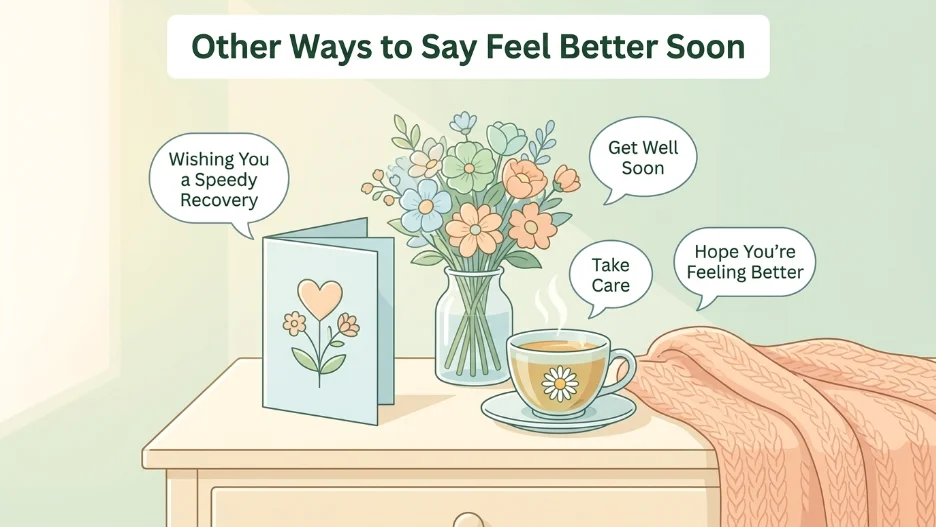
Quick Answer:Other ways to say “feel better soon” include: “Wishing you a speedy recovery,” “Take care of yourself,” “Get well soon,” “Hope you’re back on your feet soon,” and “Sending healing thoughts your way.”
“Feel better soon” is one of the most common phrases used to express care when someone is unwell, recovering from surgery, or going through a health challenge. While it’s warm and well intentioned, relying on it alone can feel repetitive and impersonal, especially in professional settings or with close friends and family.
Learning alternatives to “feel better soon” allows you to tailor your message to the situation, relationship, and seriousness of the illness. Whether you’re sending a professional email to a colleague, a warm note to a friend, or a formal message to a client, having varied phrases helps you express care in English with greater nuance and authenticity.
Quick Categories
Formal Alternatives
- Wishing you a speedy recovery
- May you experience a swift return to health
- Please take all the time you need to heal
- Our best wishes for your recovery
- Hoping you find strength and comfort during this time
Casual Alternatives
- Get well soon
- Hope you feel better
- Take it easy
- Sending healing vibes
- Rest up and get well
Professional Alternatives
- We look forward to your healthy return
- The team wishes you a quick recovery
- Please prioritize your health and wellbeing
- We hope you’re feeling better soon
- Your health is our priority
Informal Expressions
- Feel better
- Take care of yourself
- Hope you’re back to normal soon
- Sending good thoughts
- Catch you when you’re better
Pro Tip: Always match your tone to how well you know the person and the seriousness of their condition. A close friend appreciates warmth, while a client needs professional distance.
Common Mistakes
1. Being Too Dismissive
Mistake: “It’s probably nothing serious.”
Better Approach: Acknowledge the person’s experience without minimizing it.
Example: “Wishing you a speedy recovery” is more respectful than “It’s probably nothing.”
2. Offering Unsolicited Medical Advice
Mistake: “You should try taking this supplement.”
Better Approach: Offer emotional support, not medical guidance.
Example: “Take care of yourself” is appropriate; “You should try…” is not.
3. Using Overly Casual Language in Professional Contexts
Mistake: “Feel better, buddy!”
Better Approach: Maintain professional tone in workplace communication.
Example: “We wish you a quick recovery” is better for colleagues than “Feel better.”
4. Pressuring Someone to Return to Work
Mistake: “Hope you’re back soon, we need you!”
Better Approach: Prioritize their health, not workplace demands.
Example: “Please focus on your recovery” is more supportive.
5. Making It About Yourself
Mistake: “I hate being sick too.”
Better Approach: Keep the focus on the person who is unwell.
Example: “Wishing you a peaceful recovery” is better than shifting focus to yourself.
What Does “Feel Better Soon” Mean?
Definition: “Feel better soon” is a caring expression used to wish someone a swift recovery from illness, injury, or emotional distress.
Grammar Note: It’s typically used in the present simple tense. The phrase can be modified: “I hope you feel better soon” or simply “Feel better.”
Example: “Feel better soon—we’re all thinking of you.”
When to Use “Feel Better Soon”
- When a friend calls in sick Casual, supportive
- When a colleague is on medical leave Professional, caring
- After surgery or medical treatment Recovery focused
- During emotional difficulty Emotional support
- In get well cards and messages Written expressions
Spoken vs Written: Works well in both, but written messages can be more thoughtful.
Formal vs Informal: It leans casual, so avoid it in very formal communications.
Is It Professional or Polite to Say “Feel Better Soon”?
Polite? ✔️ Yes The phrase is universally considered courteous and caring.
Professional? ❌ No It’s too casual for formal business communication. Professional settings require more structured expressions that focus on recovery and wellbeing.
Business Style Example: “We hope you’re feeling better soon. Please let us know how we can support your recovery.”
“In professional settings, how you express care reflects your company’s culture and values.”
Pros and Cons of Using “Feel Better Soon”
✅ Pros
- Simple and instantly understood
- Warm and friendly tone
- Common across all English speaking contexts
- Easy to remember and use
❌ Cons
- Too informal for professional correspondence
- Overused to the point of feeling generic
- Limited emotional range fails to convey deeper care
- Not suitable for formal written communications
Other Ways to Say “Feel Better Soon” (With Examples)
These alternatives will help you sound more fluent, confident, and natural in different situations. Use them according to tone, context, and audience to express care, support, and genuine concern.
1. Phrase: Wishing you a speedy recovery
Meaning: A formal wish for a quick return to health.
Explanation: This is one of the most respectful ways to express care in formal situations.
Example: “Wishing you a speedy recovery. Please don’t worry about work.”
Best Use: Professional emails
Worst Use: Casual texts
Tone: Formal, respectful
Context Variability: professional / written / formal
2. Phrase: May you experience a swift return to health
Meaning: A hopeful wish for rapid healing.
Explanation: This is an elegant, formal expression that conveys sincere hope.
Example: “May you experience a swift return to health during this time.”
Best Use: Official correspondence
Worst Use: Casual conversations
Tone: Very formal, poetic
Context Variability: professional / written / formal
3. Phrase: Please take all the time you need to heal
Meaning: You’re encouraging them to prioritize recovery.
Explanation: This removes pressure to return quickly.
Example: “Please take all the time you need to heal. We have everything covered.”
Best Use: Workplace messages
Worst Use: Casual chats
Tone: Supportive, professional
Context Variability: professional / written / formal
4. Phrase: Our best wishes for your recovery
Meaning: Collective good wishes from a group.
Explanation: This represents shared concern from a team or organization.
Example: “Our best wishes for your recovery. The team misses you.”
Best Use: Group messages
Worst Use: Personal notes
Tone: Professional, caring
Context Variability: professional / written / formal
5. Phrase: Hoping you find strength and comfort during this time
Meaning: A wish for both emotional and physical resilience.
Explanation: This addresses the whole person, not just physical health.
Example: “Hoping you find strength and comfort during this time of healing.”
Best Use: Serious illness
Worst Use: Minor colds
Tone: Compassionate, formal
Context Variability: professional / written / formal
Pro Tip: In formal messages, pair your well wish with a specific offer of support, such as “Please let us know how we can assist during your recovery.”
Professional Alternatives (Expressions for Workplaces)
6. Phrase: We look forward to your healthy return
Meaning: The organization anticipates your recovery.
Explanation: This balances professional expectations with care.
Example: “We look forward to your healthy return when you’re ready.”
Best Use: Workplace emails
Worst Use: Personal conversations
Tone: Professional, encouraging
Context Variability: professional / written / formal
7. Phrase: The team wishes you a quick recovery
Meaning: Colleagues are united in their concern.
Explanation: This shows collective support from the workplace community.
Example: “The team wishes you a quick recovery and sends their warmest regards.”
Best Use: Group communications
Worst Use: Individual chats
Tone: Professional, warm
Context Variability: professional / written / formal
8. Phrase: Please prioritize your health and wellbeing
Meaning: Your health should come before work.
Explanation: This gives permission to focus on recovery.
Example: “Please prioritize your health and wellbeing. Everything else can wait.”
Best Use: Manager to employee
Worst Use: Casual conversations
Tone: Professional, caring
Context Variability: professional / written / formal
9. Phrase: We hope you’re feeling better soon
Meaning: A professional expression of care.
Explanation: This is the professional version of the casual phrase.
Example: “We hope you’re feeling better soon and look forward to seeing you.”
Best Use: General workplace
Worst Use: Very formal settings
Tone: Professional, warm
Context Variability: professional / written / formal
10. Phrase: Your health is our priority
Meaning: The organization values your wellbeing above all.
Explanation: This conveys genuine concern from leadership.
Example: “Your health is our priority. Please take whatever time you need.”
Best Use: HR communications
Worst Use: Personal notes
Tone: Professional, compassionate
Context Variability: professional / written / formal
Pro Tip: When writing to colleagues who are ill, always emphasize that work can wait. This relieves anxiety about returning too soon.
Warm and Personal Alternatives (Expressions for Close Relationships)
11. Phrase: Take care of yourself
Meaning: A gentle reminder to prioritize self care.
Explanation: This is warm, caring, and encourages positive action.
Example: “Take care of yourself and don’t rush back.”
Best Use: Close friends
Worst Use: Formal correspondence
Tone: Warm, caring
Context Variability: spoken / casual
12. Phrase: Sending healing thoughts your way
Meaning: You’re mentally sending positive energy.
Explanation: This conveys emotional support and connection.
Example: “Sending healing thoughts your way. You’ve got this.”
Best Use: Close relationships
Worst Use: Professional contexts
Tone: Warm, supportive
Context Variability: spoken / casual
13. Phrase: I’m thinking of you and hoping you’re comfortable
Meaning: You’re considering their physical comfort.
Explanation: This shows specific care about their immediate experience.
Example: “I’m thinking of you and hoping you’re comfortable at home.”
Best Use: Personal messages
Worst Use: Formal settings
Tone: Tender, caring
Context Variability: spoken / casual
14. Phrase: I’m here if you need anything
Meaning: You’re offering practical and emotional support.
Explanation: This extends beyond words to action.
Example: “I’m here if you need anything—groceries, company, or just to talk.”
Best Use: Close relationships
Worst Use: Professional contexts
Tone: Supportive, warm
Context Variability: spoken / casual
15. Phrase: Sending you all my love
Meaning: You’re offering love and care.
Explanation: This is deeply personal and emotionally rich.
Example: “Sending you all my love and hoping you feel better soon.”
Best Use: Family and close friends
Worst Use: Professional contexts
Tone: Warm, affectionate
Context Variability: spoken / casual
Gentle and Supportive Alternatives (Expressions for Offering Comfort)
16. Phrase: Rest up and get well
Meaning: A gentle encouragement to rest.
Explanation: This emphasizes the importance of rest in healing.
Example: “Rest up and get well. Take all the time you need.”
Best Use: All contexts
Worst Use: Formal settings
Tone: Gentle, caring
Context Variability: spoken / casual
17. Phrase: Hope you’re resting comfortably
Meaning: You’re wishing for their physical comfort.
Explanation: This focuses on their immediate comfort rather than rushing recovery.
Example: “Hope you’re resting comfortably. Thinking of you.”
Best Use: Personal messages
Worst Use: Formal communications
Tone: Gentle, warm
Context Variability: spoken / casual
18. Phrase: Thinking of you and hoping for a quick recovery
Meaning: You’re keeping them in your thoughts.
Explanation: This combines thoughtfulness with a recovery wish.
Example: “Thinking of you and hoping for a quick recovery. You’re in my prayers.”
Best Use: All contexts
Worst Use: None
Tone: Warm, supportive
Context Variability: spoken / written / casual
19. Phrase: Take your time healing
Meaning: There’s no pressure to recover quickly.
Explanation: This removes the stress of rushing back.
Example: “Take your time healing—we’ll be here when you’re ready.”
Best Use: Close relationships
Worst Use: Professional contexts
Tone: Patient, caring
Context Variability: spoken / casual
20. Phrase: I hope each day brings you closer to feeling better
Meaning: A wish for steady improvement.
Explanation: This acknowledges that recovery is gradual.
Example: “I hope each day brings you closer to feeling better. One step at a time.”
Best Use: Long term illness
Worst Use: Quick illness
Tone: Patient, hopeful
Context Variability: spoken / written / casual
Casual and Supportive Alternatives (Expressions for Close Friends)
21. Phrase: Get well soon
Meaning: A classic, friendly expression.
Explanation: This is the most common alternative, always appropriate among friends.
Example: “Get well soon! Can’t wait to see you back.”
Best Use: Friends and family
Worst Use: Formal contexts
Tone: Friendly, warm
Context Variability: spoken / casual
22. Phrase: Hope you feel better
Meaning: A simple, sincere wish.
Explanation: This is direct, caring, and very common in casual settings.
Example: “Hope you feel better. Let me know if you need anything.”
Best Use: Casual conversations
Worst Use: Formal correspondence
Tone: Simple, sincere
Context Variability: spoken / casual
23. Phrase: Take it easy
Meaning: A reminder to rest and not overdo things.
Explanation: This encourages relaxation and patience.
Example: “Take it easy and don’t rush back to work.”
Best Use: Close friends
Worst Use: Professional settings
Tone: Casual, caring
Context Variability: spoken / casual
24. Phrase: Sending healing vibes
Meaning: You’re sending positive energy.
Explanation: This is modern, casual, and warm.
Example: “Sending healing vibes your way. Feel better!”
Best Use: Young friends
Worst Use: Formal contexts
Tone: Modern, warm
Context Variability: spoken / casual
25. Phrase: Rest up
Meaning: A simple encouragement to rest.
Explanation: This is brief, casual, and caring.
Example: “Rest up and don’t worry about anything.”
Best Use: Casual messages
Worst Use: Formal communications
Tone: Casual, caring
Context Variability: spoken / casual
Short and Simple Alternatives (Expressions for Quick Messages)
26. Phrase: Feel better
Meaning: The shortened version of “feel better soon.”
Explanation: This is perfect for quick, casual messages.
Example: “Feel better! Talk soon.”
Best Use: Quick messages
Worst Use: Formal notes
Tone: Simple, warm
Context Variability: spoken / casual
27. Phrase: Take care
Meaning: A brief expression of care.
Explanation: This works for many contexts, not just illness.
Example: “Take care. Hope you’re feeling better.”
Best Use: All contexts
Worst Use: None
Tone: Warm, brief
Context Variability: spoken / written / casual
28. Phrase: Hoping you’re better
Meaning: A simple wish for improvement.
Explanation: This is casual and assumes they’re on the mend.
Example: “Hoping you’re better. Miss seeing you.”
Best Use: Casual messages
Worst Use: Formal communications
Tone: Casual, warm
Context Variability: spoken / casual
29. Phrase: Wishing you well
Meaning: A general wish for good health.
Explanation: This is versatile and can be used in many contexts.
Example: “Wishing you well during your recovery.”
Best Use: All contexts
Worst Use: None
Tone: Warm, versatile
Context Variability: spoken / written / casual
30. Phrase: Look after yourself
Meaning: A gentle reminder to self care.
Explanation: This is common in British English and very warm.
Example: “Look after yourself and get plenty of rest.”
Best Use: Personal messages
Worst Use: American formal contexts
Tone: Gentle, caring
Context Variability: spoken / casual
“Small variations in language can transform a routine expression into a genuinely caring message.”
Mini Quiz: Test Your Understanding
1. Which phrase is most appropriate for a formal business email?
- A) “Feel better soon”
- B) “Take it easy”
- C) “Wishing you a speedy recovery”
- D) “Sending healing vibes”
2. What should you avoid when someone is unwell?
- A) Acknowledging their illness
- B) Offering unsolicited medical advice
- C) Wishing them well
- D) Offering support
3. “Take care of yourself” is best used with:
- A) A formal client
- B) A close friend
- C) A business partner
- D) A formal letter recipient
4. Which of the following is too casual for a professional work email?
- A) “We look forward to your healthy return”
- B) “The team wishes you a quick recovery”
- C) “Feel better soon”
- D) “Please prioritize your health and wellbeing”
5. What’s the most common mistake in expressing care to someone who is ill?
- A) Being too warm
- B) Using overused phrases
- C) Being too brief
- D) Being too caring
👉 Check Your Answers:
- C “Wishing you a speedy recovery” is the most formal option.
- B Avoid offering unsolicited medical advice.
- B This warm phrase is best for close relationships.
- C “Feel better soon” is too casual for professional emails.
- B Relying exclusively on “feel better soon” can feel impersonal.
Comparison Table: Top 10 Alternatives
| Phrase | Tone | Best Use |
| Wishing you a speedy recovery | Very Formal | Professional emails |
| May you experience a swift return to health | Very Formal | Official correspondence |
| We look forward to your healthy return | Professional | Workplace communications |
| Take care of yourself | Warm, Caring | Close relationships |
| Sending healing thoughts your way | Warm, Supportive | Personal messages |
| Please prioritize your health | Professional, Caring | Manager to employee |
| Rest up and get well | Gentle, Warm | All contexts |
| Get well soon | Friendly, Warm | Friends and family |
| Take it easy | Casual, Caring | Close friends |
| Wishing you well | Warm, Versatile | All contexts |
FAQs
1. What is the best alternative to “feel better soon”?
The best alternative depends on your relationship with the person. “Wishing you a speedy recovery” works well for formal situations, while “Get well soon” is perfect for friends and family.
2. Is “feel better soon” still appropriate?
Yes, it remains a perfectly appropriate and widely accepted expression of care. The problem is overusing it, not using it at all.
3. How do professionals express care to ill colleagues?
Professionals should use phrases like “We hope you’re feeling better soon” or “Please prioritize your health and wellbeing” and always offer concrete support.
4. What should I not say when someone is unwell?
Avoid minimizing their illness, offering unsolicited medical advice, pressuring them to return, or making it about yourself.
5. How do you end a get well message?
End with a warm closing like “Thinking of you,” “Wishing you well,” or “Take care,” followed by your name.
Conclusion
Learning alternatives to “feel better soon” empowers you to respond to illness and recovery with authenticity and grace. Whether you need a formal expression for a professional setting, a warm message for a close friend, or a simple acknowledgment for a casual conversation, having a variety of phrases allows you to match your words to the moment.
Practice using different expressions based on your relationship to the person and the context. Pay attention to tone, and always prioritize sincerity over perfection. Your genuine care matters more than any specific phrase.

John Green is an American writer who contributes to QuickResponsess.com, creating clear and practical content on English grammar, vocabulary and everyday language. His goal is to make learning English simple, engaging and easy to apply.