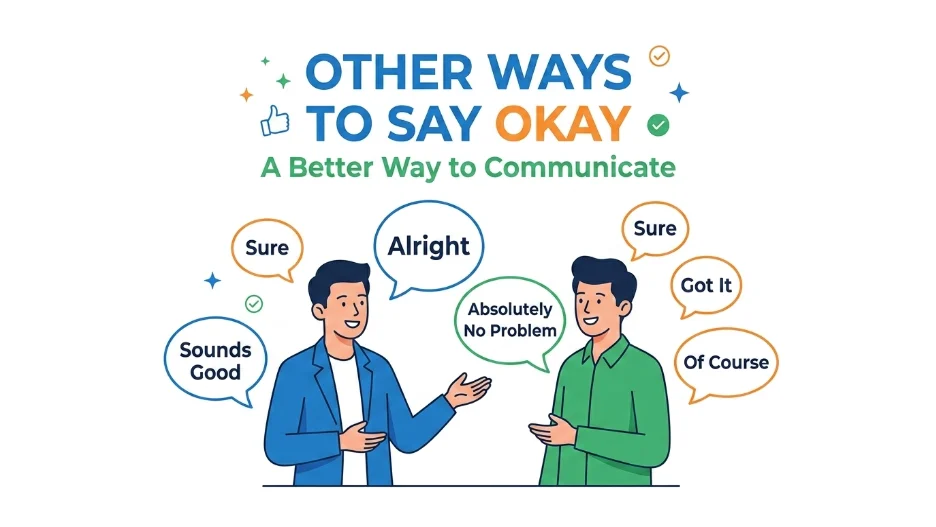
Quick Answer: Alright, Sure thing, Absolutely, Sounds good, and Got it are five powerful alternatives to “okay” that instantly upgrade your English. Use them to sound more professional, confident, and engaged in any conversation.
“Okay” is the Swiss Army knife of English versatile, useful, and incredibly overused. It appears in nearly every conversation, from casual chats with friends to professional emails. While it gets the job done, relying on it too heavily can make your speech sound flat, disinterested, or even dismissive.
Learning alternatives to “okay” is one of the fastest ways to sound more fluent and engaging. When you swap a single word for a more expressive phrase, you instantly convey enthusiasm, professionalism, or empathy—depending on what the situation calls for. Whether you want to express excitement in English or simply acknowledge someone with warmth, the right phrase makes all the difference .
Quick Categories
Formal Alternatives to “Okay”
- Certainly
- Very well
- Affirmative
- Duly noted
- I concur
Casual Alternatives
- Cool
- Sounds good
- Works for me
- All good
- Sure thing
Professional Alternatives
- Understood
- Noted
- Absolutely
- I’m on it
- Consider it done
Informal Expressions
- You bet
- No worries
- I’m down
- Right on
- Gotcha
💡 Pro Tip: Match your phrase to your audience. Formal settings demand precision; casual settings reward warmth. When in doubt, lean slightly more formal it’s easier to dial down than to recover from sounding unprofessional.
Common Mistakes to Avoid
- Using “no problem” when “you’re welcome” is expected
- ❌ Boss: “Thanks for finishing that report.” You: “No problem.”
- ✅ Boss: “Thanks for finishing that report.” You: “My pleasure.”
- Saying “okay” in response to emotional confessions
- ❌ Friend: “I’m really stressed about this.” You: “Okay.”
- ✅ Friend: “I’m really stressed about this.” You: “I hear you.”
- Overusing “sounds good” in professional emails
- ❌ Every response: “Sounds good, sounds good, sounds good.”
- ✅ Vary your language: “Noted,” “Understood,” “I’ll proceed.”
- Using “sure” when you mean “yes, enthusiastically”
- ❌ “Can you help me move this weekend?” “Sure.” (sounds reluctant)
- ✅ “Can you help me move this weekend?” “Absolutely!”
- Forgetting tone matters more than the word itself
- ❌ “Fine.” (said with a sigh = anything but fine)
- ✅ “Fine with me!” (cheerful tone = genuine agreement)
“The right tone makes your English sound professional and confident.”
What Does “Okay” Mean?
Definition: “Okay” signals acknowledgment, agreement, or acceptance. It can mean “yes,” “I understand,” “that’s acceptable,” or “let’s proceed.”
Grammar: “Okay” functions as an adjective, adverb, interjection, and even a verb (“to OK a proposal”). Its flexibility is both its strength and its weakness it fits everywhere but expresses very little.
Example Sentence:
“Okay, I’ll send the email by 5 PM.”
When to Use “Okay”
- Acknowledging instructions – “Okay, I’ll do that.”
- Agreeing casually – “Okay, let’s go.”
- Transitioning in conversation – “Okay, so what’s next?”
- Checking understanding – “Okay? Do you follow?”
Spoken vs Written: “Okay” is common in spoken English and informal writing like texts. In formal writing (reports, official emails), it should be avoided.
Formal vs Informal: “Okay” is decidedly informal. Use it with friends and coworkers you know well, but choose alternatives for professional or formal communications .
Is It Professional or Polite to Say “Okay”?
- Polite? ✔️ Yes—it’s widely considered polite in casual contexts.
- Professional? ❌ No—in most cases, it sounds too casual for business settings.
Business Example:
- ❌ “Okay, I’ll handle the client meeting.”
- ✅ “Understood, I’ll prepare the client presentation.”
Pros and Cons of Using “Okay”
| Pros | Cons |
|---|---|
| Simple and universally understood | Too informal for professional settings |
| Friendly and approachable tone | Overused—makes you sound unengaged |
| Works in virtually any casual context | Lacks emotional depth or warmth |
| Easy to say and write | Doesn’t communicate enthusiasm |
Other Ways to Say “Okay” (With Examples)
These 30 alternatives will help you sound more fluent, confident, and natural in different situations. Use them according to tone, context, and audience—whether you want to express excitement, admiration, or professional approval.
1. Phrase: Absolutely
Meaning: Strong, enthusiastic agreement.
Explanation: Shows you’re completely on board and excited about the idea.
Example Sentence: “Absolutely, I’d love to help with the project.”
Best Use: Enthusiastic agreement
Worst Use: Reluctant acceptance
Tone: Confident, positive
Context Variability: Professional / Casual / Spoken
2. Phrase: Sounds Good
Meaning: You agree with the proposed idea.
Explanation: Friendly and upbeat—a go-to for casual and collaborative settings.
Example Sentence: “Sounds good, I’ll meet you at 3 PM.”
Best Use: Agreeing to plans
Worst Use: Formal reports
Tone: Friendly, agreeable
Context Variability: Casual / Professional / Spoken
3. Phrase: Got It
Meaning: You understand and will act on the information.
Explanation: Quick and efficient—perfect for confirming instructions.
Example Sentence: “Got it, I’ll follow up on that task.”
Best Use: Confirming understanding
Worst Use: Expressing empathy
Tone: Clear, efficient
Context Variability: Professional / Casual / Spoken
4. Phrase: Certainly
Meaning: Formal, polite agreement.
Explanation: Respectful and professional—ideal for business correspondence.
Example Sentence: “Certainly, I’ll send the report by noon.”
Best Use: Formal requests
Worst Use: Casual chats
Tone: Polite, respectful
Context Variability: Professional / Written
5. Phrase: No Problem
Meaning: It’s not an inconvenience.
Explanation: Reassuring and helpful—makes the other person feel at ease.
Example Sentence: “No problem, I’ll take care of that.”
Best Use: Responding to thanks
Worst Use: Formal business writing
Tone: Helpful, friendly
Context Variability: Casual / Spoken
6. Phrase: Understood
Meaning: You fully comprehend the message.
Explanation: Professional acknowledgment—shows you’re paying attention.
Example Sentence: “Understood. I’ll adjust the timeline.”
Best Use: Receiving instructions
Worst Use: Emotional conversations
Tone: Serious, professional
Context Variability: Professional / Written
7. Phrase: Sure Thing
Meaning: Enthusiastic agreement.
Explanation: Friendly and confident—works well in both casual and semi-formal contexts.
Example Sentence: “Sure thing, I’ll have it ready for you.”
Best Use: Quick agreements
Worst Use: Formal writing
Tone: Confident, casual
Context Variability: Casual / Professional / Spoken
8. Phrase: Works for Me
Meaning: The plan or suggestion is acceptable.
Explanation: Laid-back and agreeable—very natural in everyday conversation.
Example Sentence: “Works for me, I’ll be there at 2 PM.”
Best Use: Agreeing to plans
Worst Use: Formal proposals
Tone: Relaxed, agreeable
Context Variability: Casual / Spoken
9. Phrase: I’m On It
Meaning: You’re actively handling the task.
Explanation: Shows initiative and proactiveness—great for workplace settings.
Example Sentence: “I’m on it, you don’t have to worry.”
Best Use: Task confirmation
Worst Use: Abstract agreement
Tone: Proactive, enthusiastic
Context Variability: Professional / Casual / Spoken
10. Phrase: Very Well
Meaning: Formal, somewhat old-fashioned acceptance.
Explanation: Respectful and classic—appropriate for very formal or literary contexts.
Example Sentence: “Very well, I’ll proceed as instructed.”
Best Use: Formal acceptance
Worst Use: Casual conversations
Tone: Classic, formal
Context Variability: Formal / Written
11. Phrase: Consider It Done
Meaning: Complete confidence that something will be finished.
Explanation: Asserts reliability and competence.
Example Sentence: “Consider it done, I’ll handle the arrangements.”
Best Use: Task completion
Worst Use: Uncertainty
Tone: Confident, assertive
Context Variability: Professional / Spoken
12. Phrase: Alright
Meaning: Casual agreement or acknowledgment.
Explanation: A slightly more natural alternative to “okay” in casual settings.
Example Sentence: “Alright, I’ll see you at the meeting.”
Best Use: Casual conversation
Worst Use: Formal writing
Tone: Relaxed, friendly
Context Variability: Casual / Spoken
13. Phrase: I’m Good With That
Meaning: You’re happy with the plan.
Explanation: Laid-back and cooperative—very natural in spoken English.
Example Sentence: “I’m good with that, let’s move forward.”
Best Use: Agreeing casually
Worst Use: Formal business emails
Tone: Easygoing, agreeable
Context Variability: Casual / Spoken
14. Phrase: That Works
Meaning: The proposal is acceptable.
Explanation: Practical and straightforward—common in planning discussions.
Example Sentence: “That works, let’s go with that.”
Best Use: Planning coordination
Worst Use: Emotional responses
Tone: Practical, neutral
Context Variability: Casual / Professional / Spoken
15. Phrase: You Bet
Meaning: Enthusiastic, confident agreement.
Explanation: Adds energy and warmth—perfect for friendly interactions.
Example Sentence: “You bet, I’ll get it done.”
Best Use: Energetic agreement
Worst Use: Formal settings
Tone: Energetic, warm
Context Variability: Casual / Spoken
16. Phrase: I Understand
Meaning: You comprehend the situation or emotion.
Explanation: Empathetic and validating—good for sensitive conversations.
Example Sentence: “I understand, that sounds really frustrating.”
Best Use: Emotional or serious conversations
Worst Use: Casual agreement
Tone: Empathetic, serious
Context Variability: Professional / Casual / Spoken
17. Phrase: Noted
Meaning: You’ve acknowledged the information.
Explanation: Brief and professional—common in emails and meetings.
Example Sentence: “Noted, I’ll adjust the budget.”
Best Use: Professional acknowledgment
Worst Use: Warm or emotional responses
Tone: Brief, professional
Context Variability: Professional / Written
18. Phrase: Of Course
Meaning: Eager, obvious willingness.
Explanation: Reassuring and warm—shows you’re happy to help.
Example Sentence: “Of course, I can handle that.”
Best Use: Responding to requests
Worst Use: Formal documents
Tone: Reassuring, warm
Context Variability: Casual / Professional / Spoken
19. Phrase: Count Me In
Meaning: Enthusiastic agreement to participate.
Explanation: Shows excitement and engagement—great for group activities.
Example Sentence: “Count me in, I’m excited for this!”
Best Use: Events and activities
Worst Use: Formal work tasks
Tone: Enthusiastic, engaged
Context Variability: Casual / Spoken
20. Phrase: Right On
Meaning: Strong agreement and encouragement.
Explanation: Slightly retro but still common—cheerful and affirming.
Example Sentence: “Right on, let’s do it!”
Best Use: Energized agreement
Worst Use: Professional writing
Tone: Upbeat, casual
Context Variability: Casual / Spoken
21. Phrase: I Concur
Meaning: Formal agreement with a statement.
Explanation: Quite formal—appropriate for official minutes or serious discussions.
Example Sentence: “I concur with the assessment.”
Best Use: Formal meetings
Worst Use: Daily conversation
Tone: Formal, measured
Context Variability: Professional / Written
22. Phrase: All Good
Meaning: Everything is fine—no problems.
Explanation: Relaxed and reassuring—common among younger speakers.
Example Sentence: “All good, I’ve got it covered.”
Best Use: Casual reassurance
Worst Use: Professional documents
Tone: Easygoing, calm
Context Variability: Casual / Spoken
23. Phrase: I’m Down
Meaning: Enthusiastic, informal agreement.
Explanation: Very casual—use with friends, not bosses.
Example Sentence: “I’m down for that, let’s do it!”
Best Use: Social plans
Worst Use: Professional settings
Tone: Informal, excited
Context Variability: Casual / Spoken
24. Phrase: Duly Noted
Meaning: Acknowledged and will be remembered.
Explanation: Slightly formal—shows you’ve taken something seriously.
Example Sentence: “Duly noted, I’ll keep that in mind.”
Best Use: Receiving feedback
Worst Use: Quick agreement
Tone: Formal, attentive
Context Variability: Professional / Written
25. Phrase: Sure
Meaning: Positive but neutral agreement.
Explanation: Slightly warmer than “okay” when said with a smile.
Example Sentence: “Sure, I can help with that.”
Best Use: Simple agreements
Worst Use: Enthusiastic responses
Tone: Positive, neutral
Context Variability: Casual / Professional / Spoken
26. Phrase: Makes Sense
Meaning: What you said is logical and understandable.
Explanation: Thoughtful acknowledgment—shows you’re engaged.
Example Sentence: “Makes sense, I’ll follow that approach.”
Best Use: Understanding explanations
Worst Use: Agreeing to plans
Tone: Thoughtful, understanding
Context Variability: Professional / Casual / Spoken
27. Phrase: Cool
Meaning: Informal acceptance.
Explanation: Very casual—great with friends, avoid at work.
Example Sentence: “Cool, I’ll see you later.”
Best Use: Friends and peers
Worst Use: Professional emails
Tone: Chill, casual
Context Variability: Casual / Spoken
28. Phrase: Affirmative
Meaning: Formal, often military or technical agreement.
Explanation: Very direct and official—sounds professional but a bit stiff.
Example Sentence: “Affirmative, I’ll proceed as instructed.”
Best Use: Formal confirmation
Worst Use: Friendly conversation
Tone: Formal, direct
Context Variability: Professional / Written
29. Phrase: Fine By Me
Meaning: Acceptance without strong feelings.
Explanation: Laid-back and slightly indifferent—use when you truly don’t mind.
Example Sentence: “Fine by me, let’s go with that.”
Best Use: When you have no preference
Worst Use: Enthusiastic moments
Tone: Easygoing, neutral
Context Variability: Casual / Spoken
30. Phrase: I Hear You
Meaning: Acknowledging and validating someone’s point.
Explanation: More emotional and empathetic than “okay.”
Example Sentence: “I hear you, that sounds really tough.”
Best Use: Emotional support
Worst Use: Task confirmation
Tone: Compassionate, validating
Context Variability: Casual / Professional / Spoken
Mini Quiz: Test Your Knowledge
1. You’re in a meeting and your boss asks if you can handle the new client. Which response sounds most professional?
- A. “Okay.”
- B. “Sure thing.”
- C. “Certainly, I’ll take care of it.”
- D. “Cool.”
Answer: C
2. Your friend invites you to a concert. You’re excited. Which response fits best?
- A. “Noted.”
- B. “I’m so in—count me in!”
- C. “Very well.”
- D. “Okay.”
Answer: B
3. A coworker shares a personal frustration. Which response shows empathy?
- A. “Got it.”
- B. “I hear you, that sounds really stressful.”
- C. “Sounds good.”
- D. “No worries.”
Answer: B
“Swapping ‘okay’ for a more deliberate phrase shows you care. It transforms passive acknowledgment into active engagement.”
Comparison Table: Top 10 Alternatives
| Phrase | Tone | Best Use |
|---|---|---|
| Absolutely | Enthusiastic, confident | Strong agreement |
| Certainly | Formal, polite | Professional correspondence |
| Sounds Good | Friendly, upbeat | Agreeing to plans |
| Got It | Clear, efficient | Confirming instructions |
| Understood | Professional, serious | Workplace communication |
| I Hear You | Empathetic, validating | Emotional support |
| Works for Me | Relaxed, agreeable | Casual planning |
| I’m On It | Proactive, enthusiastic | Task confirmation |
| You Bet | Energetic, warm | Friendly agreement |
| Consider It Done | Confident, reassuring | Task completion promises |
FAQs
1. What is the best formal alternative to “okay” in emails?
Certainly, Understood, or Noted are strong formal alternatives. Use them when you need to sound professional and attentive.
2. Is “sounds good” too casual for work?
It’s acceptable in most workplaces, especially with colleagues you know. For formal reports or client communication, choose “Certainly” or “Understood” instead.
3. Why should I stop saying “okay” so often?
Overusing “okay” can make you sound indifferent or disengaged. Replacing it with more intentional language helps you communicate confidence, warmth, and professionalism.
4. Can I use “sure” instead of “okay” in professional settings?
Yes, but be mindful of tone. A cheerful “Sure, I’d be happy to” works well; a flat “Sure” can sound reluctant.
5. What’s the difference between “okay,” “alright,” and “sounds good”?
“Alright” is slightly more casual than “okay.” “Sounds good” is more enthusiastic and shows you’re engaged with the idea. Choose based on the energy you want to project.
Conclusion
Learning alternatives to “okay” is one of the simplest ways to upgrade your English. Each alternative adds a layer of nuance whether you want to sound more professional, empathetic, enthusiastic, or just more engaged. Start small: pick two or three phrases from this list and practice them this week. Then add more as you get comfortable.
Remember, word choice shapes perception. The next time you’re tempted to say “okay,” pause and ask yourself: What tone do I want to set? Your English will sound more polished, and your conversations will feel more connected.

Stephen King is an American writer and language enthusiast who enjoys creating clear, practical content that helps readers communicate with confidence. His work at QuickResponsess.com focuses on making English easier to understand through simple explanations and everyday examples.