Quick Answer
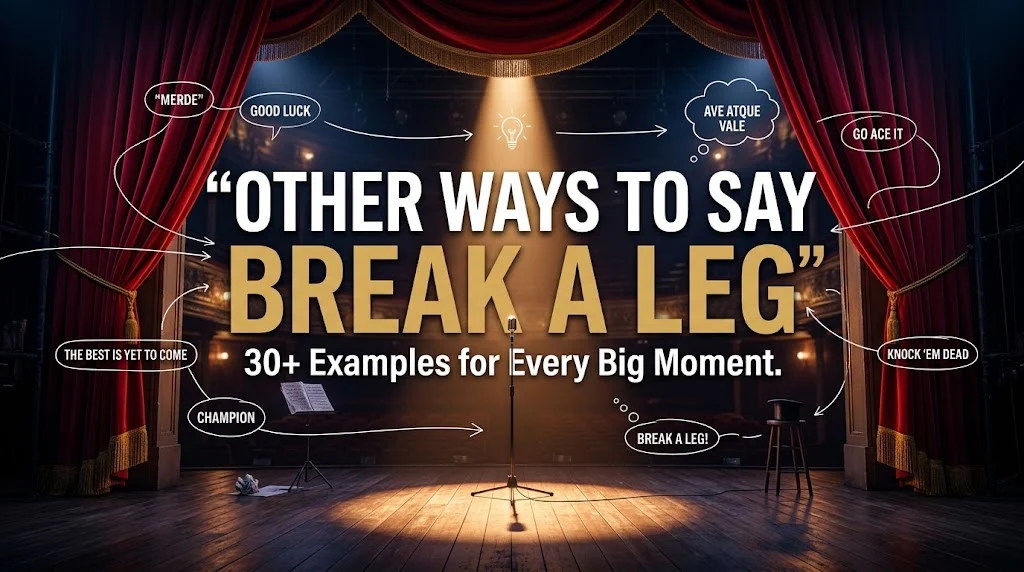
Break a leg is a theatrical idiom used to wish someone good luck before a performance or high stakes event. For more variety and precision, try alternatives like “Knock them dead,” “You have got this,” “Show them what you are made of,” “I am rooting for you,” or “The stage is yours.”
“Break a leg” is one of the most fascinating idioms in English. On the surface it sounds like a threat, but it actually means good luck. It originated in the theatre world, where saying “good luck” out loud was considered bad luck. Actors began using the opposite phrase to protect themselves from misfortune.
Learning the alternatives to break a leg gives you flexibility. You can sound theatrical with actors, professional with colleagues, and warm with friends. You can also express excitement in English when someone is about to do something impressive. This guide offers 30 practical options with clear guidance on tone, context, and audience.
Pull Quote: “The right phrase at the right moment can turn nervous energy into quiet confidence.”
Quick Categories
Formal alternatives to “Break a leg”
- I wish you every success.
- May you achieve great things.
- I wish you the very best.
- I hope all goes well.
Pro Tip: Formal options suit interviews, presentations, and occasions where professionalism matters more than theatre.
Casual alternatives
- Knock them dead.
- Go get them.
- Fingers crossed.
- You have got this.
Pro Tip: Casual options work with friends and familiar colleagues in relaxed settings.
Professional alternatives
- I am confident you will do well.
- Wishing you success in your endeavor.
- I hope the meeting goes smoothly.
- Best of luck with the launch.
Pro Tip: Professional alternatives should be specific so the reader knows exactly what you are supporting.
Informal expressions
- Show them what you are made of.
- Rock it.
- Nail it.
- Go slay.
Pro Tip: Informal expressions belong in texts, chats, and spoken English with close contacts.
Pull Quote: “The right tone makes your English sound professional and confident.”
Common Mistakes
- Using “break a leg” in a formal business email.
Example: “Dear Sir, break a leg at the board meeting.” This sounds far too theatrical for corporate writing. - Saying it to someone who does not know the idiom.
Example: “Break a leg!” to a non native speaker who thinks you are wishing them harm. - Using it before a routine task.
Example: “Break a leg with your grocery shopping.” The stakes are too low for the idiom. - Using it in a serious or sensitive context.
Example: “Break a leg with your surgery.” The phrase is completely inappropriate here. - Forgetting that it is specific to performances and high stakes events.
Example: “Break a leg on your holiday.” The phrase does not fit a leisure activity.
What Does “Break a Leg” Mean?
Definition
It is a theatrical idiom used to wish someone good luck, especially before a performance or important event.
Grammar Explanation
The phrase is an imperative sentence using the verb “break” and the noun “leg.” It functions as a complete wish or greeting and is usually said on its own. In written form, it often appears with an exclamation mark.
Example Sentence
“You are on stage in ten minutes, so break a leg!”
When to Use “Break a Leg”
Common Contexts
- Theatre: Before a play, musical, or dance performance.
- Music: Before a concert or recital.
- Presentations: Before a major speech or pitch.
- Exams: Before a difficult test, though this is less traditional.
- Sports: Before a big match, though other phrases are more common.
Spoken vs Written
- Spoken: Extremely common in theatre and informal conversation.
- Written: Used in messages and cards but rare in formal writing.
Formal vs Informal
- Formal: Rarely appropriate outside the performing arts.
- Informal: The standard choice in theatre and among friends.
Is It Professional or Polite to Say “Break a Leg”?
Politeness vs Professionalism
The phrase is polite and encouraging in the right context, but it is not professional in most corporate settings. It carries theatrical connotations that can sound out of place in a formal business environment. Use it with colleagues you know well or in creative industries.
Business-Style Example
“I wish you every success with the client presentation tomorrow.”
Polite? Yes
Professional? No, in most corporate settings
Pull Quote: “An idiom that fits the theatre can feel out of place in a boardroom.”
Pros and Cons of Using “Break a Leg”
Pros
- Simple and natural: Easy to say and memorable.
- Friendly tone: Warm and encouraging.
- Common usage: Widely recognised in English speaking countries.
- Easy to understand: Requires no advanced vocabulary once learned.
Cons
- Too informal for work: Rarely appropriate in corporate writing.
- Overused: Loses impact when repeated.
- Limited emotional range: Cannot express deep sincerity.
- Not suitable for formal writing: Avoid in reports, letters, and official documents.
Other Ways to Say “Break a Leg” (With Examples)
These alternatives will help you sound more fluent, confident, and natural in different situations. Use them according to tone, context, and audience to express excitement, admiration, or approval.
1. Knock them dead
Meaning: Impress them greatly and perform brilliantly.
Explanation: Energetic and confident, often used before presentations.
Example Sentence: “Go into that pitch and knock them dead.”
Best Use: Presentations, pitches
Worst Use: Funerals
Tone: Energetic, confident, informal
Context Variability: Casual and spoken
2. You have got this
Meaning: You have the ability to succeed.
Explanation: Confidence boosting and modern.
Example Sentence: “Do not worry about the difficulty. You have got this.”
Best Use: Motivation, exams
Worst Use: Formal reports
Tone: Empowering, supportive, modern
Context Variability: Casual and spoken
3. Show them what you are made of
Meaning: Demonstrate your true ability.
Explanation: Encourages someone to display their skills.
Example Sentence: “Get out there and show them what you are made of.”
Best Use: Competitions, auditions
Worst Use: Routine tasks
Tone: Motivating, bold, confident
Context Variability: Casual and spoken
4. I am rooting for you
Meaning: I am supporting you and hoping you succeed.
Explanation: Warm and personal.
Example Sentence: “I know the audition is tough, but I am rooting for you.”
Best Use: Personal support
Worst Use: Formal emails
Tone: Supportive, warm, personal
Context Variability: Casual and spoken
5. The stage is yours
Meaning: It is your moment to shine.
Explanation: Theatrical and empowering.
Example Sentence: “The stage is yours, go and deliver that speech.”
Best Use: Performances, speeches
Worst Use: Written reports
Tone: Dramatic, empowering, theatrical
Context Variability: Creative and spoken
6. Go get them
Meaning: Go and achieve success.
Explanation: Short and energetic.
Example Sentence: “The panel is waiting. Go get them.”
Best Use: Interviews, competitions
Worst Use: Formal writing
Tone: Action oriented, informal
Context Variability: Casual and spoken
7. Fingers crossed
Meaning: Hoping for a positive outcome.
Explanation: Refers to the superstition of crossing fingers for luck.
Example Sentence: “I have my final interview today. Fingers crossed.”
Best Use: Personal hopes
Worst Use: Academic writing
Tone: Hopeful, casual, nervous
Context Variability: Casual and spoken
8. Best of luck
Meaning: A standard wish for success.
Explanation: The classic alternative and widely understood.
Example Sentence: “Best of luck with your presentation tomorrow.”
Best Use: General situations
Worst Use: Trivial tasks
Tone: Standard, warm, neutral
Context Variability: Professional and casual
9. I wish you every success
Meaning: A formal wish for achievement.
Explanation: Very polite and slightly distant.
Example Sentence: “As you launch this new venture, I wish you every success.”
Best Use: Business letters
Worst Use: Texting friends
Tone: Formal, respectful, dignified
Context Variability: Professional and written
10. May you achieve great things
Meaning: A broad and ambitious wish.
Explanation: Inspirational and forward looking.
Example Sentence: “As you graduate today, may you achieve great things.”
Best Use: Graduations, milestones
Worst Use: Casual chats
Tone: Formal, inspirational, elevated
Context Variability: Professional and written
11. Rock it
Meaning: Perform with energy and confidence.
Explanation: Modern and musical in origin.
Example Sentence: “You have rehearsed enough. Now go rock it.”
Best Use: Performances, presentations
Worst Use: Formal writing
Tone: Energetic, modern, informal
Context Variability: Casual and spoken
12. Nail it
Meaning: Perform perfectly.
Explanation: Short and punchy.
Example Sentence: “This is your moment. Nail it.”
Best Use: Auditions, interviews
Worst Use: Formal correspondence
Tone: Confident, direct, informal
Context Variability: Casual and spoken
13. Crush it
Meaning: Perform exceptionally well.
Explanation: Very modern and energetic.
Example Sentence: “You have prepared for weeks. Go crush it.”
Best Use: Sports, sales
Worst Use: Formal letters
Tone: Energetic, bold, informal
Context Variability: Casual and spoken
14. Smash it
Meaning: Succeed brilliantly.
Explanation: Common in British English.
Example Sentence: “Good luck with the exam. Smash it.”
Best Use: Exams, competitions
Worst Use: Business reports
Tone: Energetic, encouraging, informal
Context Variability: Casual and spoken
15. Own it
Meaning: Take control and perform with confidence.
Explanation: Empowering and modern.
Example Sentence: “Walk in there and own it.”
Best Use: Presentations, interviews
Worst Use: Formal writing
Tone: Confident, empowering, modern
Context Variability: Casual and spoken
16. Go slay
Meaning: Go and achieve something impressive.
Explanation: Popular in contemporary English, especially online.
Example Sentence: “The meeting is in five minutes. Go slay.”
Best Use: Social media, friends
Worst Use: Corporate emails
Tone: Playful, confident, modern
Context Variability: Casual and spoken
17. Do your thing
Meaning: Perform naturally in your own way.
Explanation: Relaxed and reassuring.
Example Sentence: “You always deliver. Just go do your thing.”
Best Use: Friends, colleagues
Worst Use: Formal writing
Tone: Relaxed, supportive, informal
Context Variability: Casual and spoken
18. You will be amazing
Meaning: Expressing confidence in someone’s performance.
Explanation: Warm and reassuring.
Example Sentence: “You will be amazing on that stage tonight.”
Best Use: Performances, speeches
Worst Use: Business reports
Tone: Warm, confident, supportive
Context Variability: Casual and spoken
19. Make us proud
Meaning: Perform in a way that brings honour.
Explanation: Emotional and communal.
Example Sentence: “Go out there and make us proud.”
Best Use: Sports, competitions
Worst Use: Casual chats
Tone: Emotional, motivational, proud
Context Variability: Casual and spoken
20. Give it your all
Meaning: Put maximum effort into the task.
Explanation: Focuses on effort rather than outcome.
Example Sentence: “Whatever happens, just give it your all.”
Best Use: Sports, exams
Worst Use: Trivial tasks
Tone: Encouraging, sincere, supportive
Context Variability: Casual and spoken
21. Blow them away
Meaning: Impress everyone greatly.
Explanation: Dramatic and confident.
Example Sentence: “Your portfolio is strong. Go blow them away.”
Best Use: Interviews, pitches
Worst Use: Formal writing
Tone: Dramatic, confident, informal
Context Variability: Casual and spoken
22. You were born for this
Meaning: You are naturally suited to this challenge.
Explanation: Highly encouraging and personal.
Example Sentence: “You were born for this role. Go and prove it.”
Best Use: Personal encouragement
Worst Use: Routine tasks
Tone: Inspirational, personal, warm
Context Variability: Casual and spoken
23. Go forth and conquer
Meaning: A dramatic way to say go and succeed.
Explanation: Humorous or very motivational.
Example Sentence: “The sales floor is yours. Go forth and conquer.”
Best Use: Motivation, teams
Worst Use: Sad news
Tone: Dramatic, humorous, motivational
Context Variability: Casual and spoken
24. May the force be with you
Meaning: A pop culture reference wishing luck.
Explanation: Humorous and references Star Wars.
Example Sentence: “You are facing the board today. May the force be with you.”
Best Use: Pop culture fans
Worst Use: Formal business
Tone: Humorous, playful, geeky
Context Variability: Casual and spoken
25. Sending good vibes
Meaning: Sending positive energy or thoughts.
Explanation: Modern and slightly spiritual.
Example Sentence: “Sending good vibes for your recital tonight.”
Best Use: Social media, texts
Worst Use: Corporate memos
Tone: Modern, spiritual, casual
Context Variability: Casual and written
26. I am in your corner
Meaning: I am supporting you from the sidelines.
Explanation: Boxing metaphor for loyalty.
Example Sentence: “Whatever the result, I am in your corner.”
Best Use: Personal loyalty
Worst Use: Formal reports
Tone: Loyal, supportive, warm
Context Variability: Casual and spoken
27. We are all behind you
Meaning: A group is supporting you.
Explanation: Communal and reassuring.
Example Sentence: “The whole team is behind you for this pitch.”
Best Use: Team support
Worst Use: Individual tasks
Tone: Supportive, communal, warm
Context Variability: Professional and spoken
28. Bring it home
Meaning: Finish the task successfully.
Explanation: Common in sports and competitions.
Example Sentence: “You are ahead in the race. Bring it home.”
Best Use: Sports, competitions
Worst Use: Casual chats
Tone: Motivating, competitive, energetic
Context Variability: Casual and spoken
29. Make it count
Meaning: Use the opportunity well.
Explanation: Focuses on the importance of the moment.
Example Sentence: “This is your big chance. Make it count.”
Best Use: Opportunities, milestones
Worst Use: Routine tasks
Tone: Serious, motivational, focused
Context Variability: Professional and spoken
30. Show time
Meaning: The moment to perform has arrived.
Explanation: Theatrical and energetic.
Example Sentence: “The curtain is going up. Show time.”
Best Use: Performances, events
Worst Use: Formal writing
Tone: Theatrical, energetic, dramatic
Context Variability: Casual and spoken
Pull Quote: “Professional reaction phrases and theatrical idioms both work best when the audience expects them.”
Mini Quiz / Self-Check
- Scenario: You are writing a formal email to a colleague before their big client presentation. Which fits best?
- A) Break a leg.
- B) I wish you every success with the presentation.
- C) Go slay.
- Scenario: Your friend is about to perform in a play. Which is the most traditional response?
- A) Break a leg.
- B) I am confident you will do well.
- C) May you achieve great things.
- Scenario: You want to encourage a nervous colleague before an interview. Which is most natural?
- A) You have got this.
- B) May the force be with you.
- C) I extend my best wishes.
- Scenario: Which phrase is generally too informal for a business email?
- A) Best of luck.
- B) Go crush it.
- C) I wish you success.
Comparison Table: Top Alternatives
| Phrase | Tone | Best Use |
| Knock them dead | Energetic, confident | Presentations, pitches |
| You have got this | Empowering, modern | Motivation, exams |
| I am rooting for you | Supportive, warm | Personal support |
| I wish you every success | Formal, respectful | Business letters |
| The stage is yours | Dramatic, theatrical | Performances, speeches |
| Rock it | Energetic, modern | Performances |
| Best of luck | Standard, warm | General situations |
| Fingers crossed | Hopeful, casual | Personal hopes |
| Make us proud | Emotional, motivational | Sports, competitions |
| May the force be with you | Humorous, playful | Pop culture fans |
FAQs
1. What is a formal alternative to “break a leg”?
“I wish you every success” or “I wish you the very best” are strong formal alternatives suitable for business letters and professional emails.
2. Why do people say “break a leg” instead of “good luck”?
The phrase originated in the theatre, where saying “good luck” out loud was considered bad luck. Actors began using the opposite phrase to protect themselves from misfortune.
3. Is it okay to say “break a leg” in an office?
It is acceptable in creative industries or with colleagues you know well. In a traditional corporate environment, “Best of luck” or “I am confident you will do well” is safer.
4. What can I say instead of “break a leg” before an exam?
“You have got this,” “Give it your all,” or “Smash it” are natural and encouraging alternatives for students.
5. What does “knock them dead” mean?
“Knock them dead” means to impress an audience or group greatly, and it is commonly used before presentations, auditions, and performances.
Conclusion
Learning other ways to say break a leg gives you the range to encourage anyone in any situation. A theatrical idiom suits the stage, while a formal phrase suits the boardroom. These alternatives to break a leg help you match your words to the moment, whether you are supporting a friend, a colleague, or a performer.
Practise by choosing one new phrase each week and using it in a real conversation. Pay close attention to tone and audience, because the right phrase depends on who is listening. With steady practice, these informal expressions in English and their formal counterparts will become part of your everyday fluency.

Stephen King is an American writer and language enthusiast who enjoys creating clear, practical content that helps readers communicate with confidence. His work at QuickResponsess.com focuses on making English easier to understand through simple explanations and everyday examples.