Quick Answer 🔥
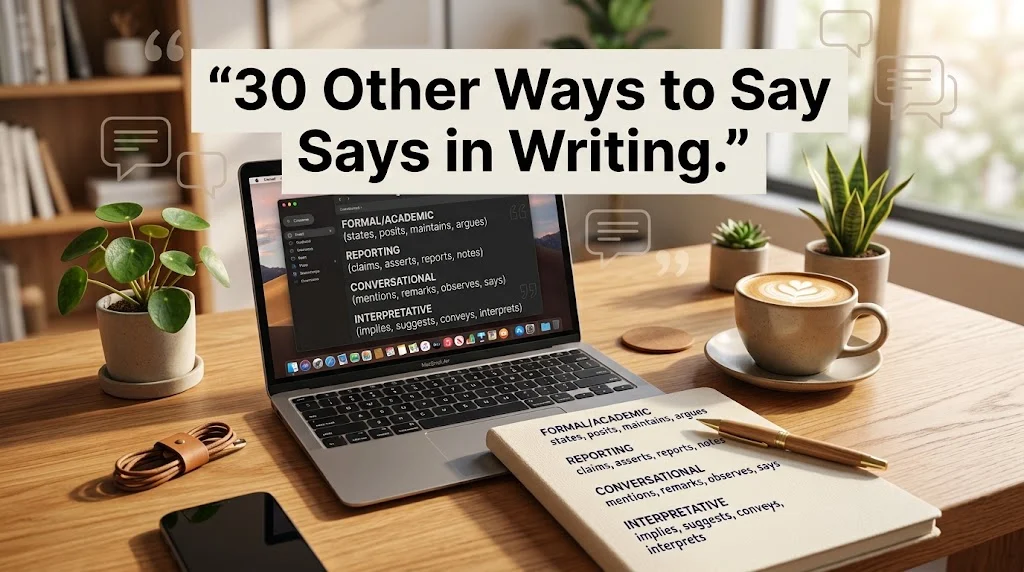
Replace “says” with states, mentions, declares, asserts, remarks, announces, claims, explains, suggests, replies, observes, comments, notes, adds, acknowledges, admits, confirms, insists, proposes, argues, advises, recommends, clarifies, elaborates, discloses, reveals, conveys, expresses, articulates, and maintains.
Finding other ways to say says in writing helps you communicate with greater precision and professionalism. Different situations call for different tones, and having a rich vocabulary allows you to express excitement in English, convey authority, or maintain a neutral stance depending on your audience.
Quick Categories
Formal Alternatives to “Says”
- States / Declares / Asserts / Affirms
- Articulates / Conveys / Expresses
- Proposes / Advises / Recommends
- Clarifies / Elaborates / Explains
Professional Alternatives to “Says”
- Mentions / Notes / Observes
- Announces / Reports / Informs
- Confirms / Acknowledges / Admits
- Responds / Replied / Answers
Casual Alternatives to “Says”
- Mentions / Adds / Shares
- Puts it / Comes out with
- Tells / Says (neutral)
Informal Expressions
- Comes out with / Pipes up
- Chips in / Weighs in
- Puts forward / Throws out
💡 Pro Tip: Choose your verb based on the strength of the statement. Use states for neutral facts, argues for debatable points, and declares for strong announcements.
Common Mistakes People Make Using “Says”
1: Overusing “says” in every sentence
- ❌ The report says sales are up. The manager says we should celebrate. The team says thank you.
- ✅ The report indicates sales are up. The manager announced we should celebrate. The team expressed their gratitude.
2: Using overly dramatic words in formal writing
- ❌ The researcher exclaimed that the data was conclusive.
- ✅ The researcher stated that the data was conclusive.
3: Confusing “says” with “tells”
- ❌ She says me the truth.
- ✅ She tells me the truth. (Use tell when the listener is mentioned.)
4: Using “says” to quote without attribution verbs
- ❌ The author says, “Climate change is urgent.”
- ✅ The author warns, “Climate change is urgent.”
5: Forgetting tone consistency
- ❌ In a business email: “I says we should proceed.”
- ✅ In a business email: “I suggest we proceed.”
What Does “Says” Mean?
Says is the third person singular present tense of the verb say. It means to utter words, express an opinion, or convey information in speech or writing.
Grammar note: Says is used with he, she, it, or singular nouns. The past tense is said.
Example: The CEO says the company will expand next year.
When to Use “Says”
- Spoken English: Everyday conversations, casual dialogue
- Informal writing: Personal emails, text messages, blog comments
- News reporting: Direct quotes from sources (neutral tone)
- Fiction: Dialogue tags (though varied alternatives are better)
Formal vs Informal: “Says” is neutral but leans informal in professional writing. In academic or business contexts, stronger, more precise verbs are preferred.
Is It Professional or Polite to Say “Says”?
Polite? ✔️ Yes – it is neutral and non offensive.
Professional? ❌ No – in most formal or business writing, it is too vague and overused.
Business style example: Instead of The report says we need to cut costs, write The report recommends we cut costs or The report indicates we need to cut costs.
Pros and Cons of Using “Says”
Pros:
- Simple and natural
- Friendly tone
- Common usage – everyone understands it
- Easy to understand
Cons:
- Too informal for work
- Overused – makes writing repetitive
- Limited emotional range
- Not suitable for formal writing
Other Ways to Say “Says” in Writing (With Examples)
These 30 alternatives will help you sound more fluent, confident, and natural in different situations. Use them according to tone, context, and audience to express excitement, admiration, or approval.
1. Phrase: States
Meaning: Expresses something clearly and formally.
Explanation: A neutral, professional verb for presenting facts or information.
Example Sentence: The report states that revenue increased by 15%.
Best Use: Formal reports
Worst Use: Casual conversation
Tone: Formal, neutral
Context Variability: professional / formal
2. Phrase: Mentions
Meaning: Refers to something briefly without going into detail.
Explanation: Useful when the information is secondary or supplementary.
Example Sentence: She mentions the new policy in her presentation.
Best Use: Brief references
Worst Use: Emphasizing key points
Tone: Casual, neutral
Context Variability: casual / professional
3. Phrase: Declares
Meaning: Announces something officially or emphatically.
Explanation: Implies authority and certainty.
Example Sentence: The governor declares a state of emergency.
Best Use: Official announcements
Worst Use: Everyday small talk
Tone: Authoritative, formal
Context Variability: formal / professional
4. Phrase: Asserts
Meaning: States something confidently and forcefully.
Explanation: Used when the speaker is defending or insisting on a point.
Example Sentence: The lawyer asserts that her client is innocent.
Best Use: Arguments, legal contexts
Worst Use: Neutral statements
Tone: Confident, firm
Context Variability: formal / professional
5. Phrase: Remarks
Meaning: Makes a brief, casual observation or comment.
Explanation: Less formal than states, more casual than declares.
Example Sentence: He remarks that the weather is unusually warm.
Best Use: Observations, comments
Worst Use: Formal reports
Tone: Casual, conversational
Context Variability: casual / spoken
6. Phrase: Announces
Meaning: Makes something known publicly or officially.
Explanation: Implies news or information being shared with an audience.
Example Sentence: The company announces a new product launch.
Best Use: Public statements, news
Worst Use: Private conversations
Tone: Formal, official
Context Variability: professional / formal
7. Phrase: Claims
Meaning: States something as true, often without proof.
Explanation: Implies the statement may be disputed or unverified.
Example Sentence: The researcher claims that the treatment is effective.
Best Use: Controversial or unproven statements
Worst Use: Established facts
Tone: Neutral, sometimes skeptical
Context Variability: academic / professional
8. Phrase: Explains
Meaning: Makes something clear or easy to understand.
Explanation: Focuses on providing reasons or details.
Example Sentence: The teacher explains the grammar rule to the class.
Best Use: Teaching, clarifying
Worst Use: Simple statements
Tone: Informative, helpful
Context Variability: casual / professional / academic
9. Phrase: Suggests
Meaning: Puts forward an idea or proposal for consideration.
Explanation: Implies a recommendation rather than a command.
Example Sentence: The data suggests a different approach is needed.
Best Use: Proposals, recommendations
Worst Use: Certain facts
Tone: Tentative, polite
Context Variability: professional / academic
10. Phrase: Replied
Meaning: Answered or responded to someone.
Explanation: Used specifically in response to a question or comment.
Example Sentence: She replied that she would attend the meeting.
Best Use: Dialogue, Q&A
Worst Use: Opening statements
Tone: Neutral, responsive
Context Variability: casual / professional / spoken
11. Phrase: Observes
Meaning: Notices or comments on something based on observation.
Explanation: Implies careful attention or analysis.
Example Sentence: The analyst observes a shift in consumer behavior.
Best Use: Analytical writing, commentary
Worst Use: Casual chit chat
Tone: Analytical, formal
Context Variability: professional / academic
12. Phrase: Comments
Meaning: Expresses an opinion or reaction about something.
Explanation: A neutral verb for sharing thoughts.
Example Sentence: The critic comments on the film’s cinematography.
Best Use: Opinions, reviews
Worst Use: Facts or data
Tone: Neutral, opinionated
Context Variability: casual / professional
13. Phrase: Notes
Meaning: Draws attention to something or observes it.
Explanation: A subtle way to highlight information.
Example Sentence: The author notes the importance of early education.
Best Use: Highlighting points
Worst Use: Strong arguments
Tone: Neutral, understated
Context Variability: academic / professional
14. Phrase: Adds
Meaning: Includes extra information to what has already been said.
Explanation: Useful for supplementary points.
Example Sentence: She adds that the project is ahead of schedule.
Best Use: Additional information
Worst Use: Main statements
Tone: Neutral, supplementary
Context Variability: casual / professional
15. Phrase: Acknowledges
Meaning: Accepts or admits the existence or truth of something.
Explanation: Implies recognition or acceptance.
Example Sentence: The CEO acknowledges the team’s hard work.
Best Use: Recognition, admissions
Worst Use: Strong assertions
Tone: Humble, respectful
Context Variability: professional / formal
16. Phrase: Admits
Meaning: Confesses or acknowledges something, often reluctantly.
Explanation: Implies the statement may be sensitive or negative.
Example Sentence: He admits that he made a mistake.
Best Use: Confessions, honesty
Worst Use: Positive news
Tone: Vulnerable, honest
Context Variability: casual / professional
17. Phrase: Confirms
Meaning: Establishes the truth or correctness of something.
Explanation: Implies verification or validation.
Example Sentence: The spokesperson confirms the date of the event.
Best Use: Verification, official statements
Worst Use: Speculation
Tone: Official, certain
Context Variability: professional / formal
18. Phrase: Insists
Meaning: Demands something forcefully or persists in stating something.
Explanation: Implies strong conviction or pressure.
Example Sentence: She insists that the deadline be extended.
Best Use: Strong demands, unwavering statements
Worst Use: Neutral observations
Tone: Forceful, determined
Context Variability: professional / spoken
19. Phrase: Proposes
Meaning: Puts forward a plan, idea, or suggestion.
Explanation: Often used in formal or professional settings.
Example Sentence: The committee proposes a new budget plan.
Best Use: Formal suggestions, plans
Worst Use: Casual remarks
Tone: Formal, constructive
Context Variability: professional / academic
20. Phrase: Argues
Meaning: Presents reasons for or against something.
Explanation: Implies a debate or persuasive intent.
Example Sentence: The philosopher argues that free will exists.
Best Use: Debates, persuasive writing
Worst Use: Neutral statements
Tone: Persuasive, assertive
Context Variability: academic / professional
21. Phrase: Advises
Meaning: Offers recommendations or guidance.
Explanation: Implies expertise or authority.
Example Sentence: The consultant advises the company to rebrand.
Best Use: Recommendations, guidance
Worst Use: Simple information sharing
Tone: Authoritative, helpful
Context Variability: professional / formal
22. Phrase: Recommends
Meaning: Suggests something as being suitable or beneficial.
Explanation: Stronger than suggests, implies endorsement.
Example Sentence: The doctor recommends regular exercise.
Best Use: Endorsements, advice
Worst Use: Neutral statements
Tone: Supportive, authoritative
Context Variability: professional / formal
23. Phrase: Clarifies
Meaning: Makes something less confusing or more understandable.
Explanation: Focuses on removing ambiguity.
Example Sentence: The manager clarifies the new policy details.
Best Use: Explanations, resolving confusion
Worst Use: Simple statements
Tone: Helpful, clear
Context Variability: professional / academic
24. Phrase: Elaborates
Meaning: Provides more detail or expands on a topic.
Explanation: Implies going beyond a basic statement.
Example Sentence: The professor elaborates on the theory in the next chapter.
Best Use: Detailed explanations
Worst Use: Brief comments
Tone: Informative, thorough
Context Variability: academic / professional
25. Phrase: Discloses
Meaning: Reveals information that was previously secret or unknown.
Explanation: Implies confidentiality or new information.
Example Sentence: The whistleblower discloses the company’s malpractice.
Best Use: Revealing secrets, sensitive information
Worst Use: Ordinary announcements
Tone: Serious, dramatic
Context Variability: formal / professional
26. Phrase: Reveals
Meaning: Makes something known that was hidden or unknown.
Explanation: Similar to discloses, but can be less dramatic.
Example Sentence: The survey reveals surprising customer preferences.
Best Use: New information, discoveries
Worst Use: Routine statements
Tone: Informative, sometimes dramatic
Context Variability: casual / professional / academic
27. Phrase: Conveys
Meaning: Communicates or expresses an idea, feeling, or information.
Explanation: Focuses on the successful transmission of meaning.
Example Sentence: Her tone conveys genuine enthusiasm.
Best Use: Expressing emotions or subtle meanings
Worst Use: Direct facts
Tone: Nuanced, expressive
Context Variability: professional / academic
28. Phrase: Expresses
Meaning: Conveys thoughts, feelings, or opinions in words.
Explanation: A versatile verb for any form of communication.
Example Sentence: The artist expresses her vision through painting.
Best Use: Emotions, opinions, creativity
Worst Use: Dry facts
Tone: Expressive, emotional
Context Variability: casual / professional / academic
29. Phrase: Articulates
Meaning: Expresses an idea clearly and effectively in words.
Explanation: Implies precision and eloquence.
Example Sentence: The CEO articulates the company’s vision with clarity.
Best Use: Clear, persuasive communication
Worst Use: Casual conversation
Tone: Eloquent, formal
Context Variability: formal / professional
30. Phrase: Maintains
Meaning: Continues to assert or uphold a position or opinion.
Explanation: Implies persistence or consistency over time.
Example Sentence: The defendant maintains his innocence throughout the trial.
Best Use: Consistent positions, repeated assertions
Worst Use: New information
Tone: Firm, consistent
Context Variability: formal / professional
“The right tone makes your English sound professional and confident.”
Mini Quiz / Self Check
1. Which verb is best for a formal business report?
- A) Says
- B) States
- C) Chips in
- Answer: B) States
2. Which verb implies the statement may be unproven?
- A) Claims
- B) Announces
- C) Confirms
- Answer: A) Claims
3. Which verb should you use when offering guidance or recommendations?
- A) Advises
- B) Remarks
- C) Mentions
- Answer: A) Advises
4. In a casual conversation with friends, which is most appropriate?
- A) Articulates
- B) Says
- C) Declares
- Answer: B) Says
Comparison Table: Top 10 Alternatives
| Phrase | Tone | Best Use |
| States | Formal, neutral | Reports, official documents |
| Declares | Authoritative | Official announcements |
| Asserts | Confident, firm | Arguments, legal contexts |
| Claims | Neutral, skeptical | Unverified statements |
| Explains | Informative, helpful | Teaching, clarifying |
| Suggests | Tentative, polite | Proposals, recommendations |
| Observes | Analytical | Commentary, analysis |
| Acknowledges | Humble, respectful | Recognition, admissions |
| Conveys | Nuanced, expressive | Emotions, subtle meanings |
| Articulates | Eloquent, formal | Clear, persuasive communication |
FAQs
1. What are other ways to say “says” in writing?
Common alternatives include states, mentions, declares, asserts, remarks, announces, claims, explains, suggests, and replies. Choose based on tone and context.
2. Is “says” too informal for academic writing?
Yes, in most academic contexts, says is considered too vague. Use more precise verbs like states, argues, suggests, or observes to convey authority and clarity.
3. What is the best synonym for “says” in professional emails?
States, advises, recommends, or confirms are excellent choices for professional emails, depending on whether you are sharing facts, giving advice, or verifying information.
4. Can I use “says” in creative writing?
Yes, but sparingly. Creative writing benefits from varied dialogue tags like whispered, shouted, murmured, or exclaimed to convey emotion and tone.
5. What is the difference between “says” and “tells”?
Says focuses on the words spoken, while tells requires a listener or object (e.g., She tells me the story). Use says for general statements and tells when directing speech to someone.
Conclusion
Learning other ways to say says in writing is one of the simplest ways to upgrade your English fluency. By replacing this overused verb with more precise alternatives, you will sound more professional, confident, and engaging in every context from business emails to academic essays.
Start by practicing just three new alternatives this week. Pay attention to the tone of each situation and choose your words accordingly. With consistent practice, these professional reaction phrases will become second nature, and your writing will never feel repetitive again.
“Strong writing is built on word choice not complexity.”

John Green is an American writer who contributes to QuickResponsess.com, creating clear and practical content on English grammar, vocabulary and everyday language. His goal is to make learning English simple, engaging and easy to apply.