Quick Answer 🔥
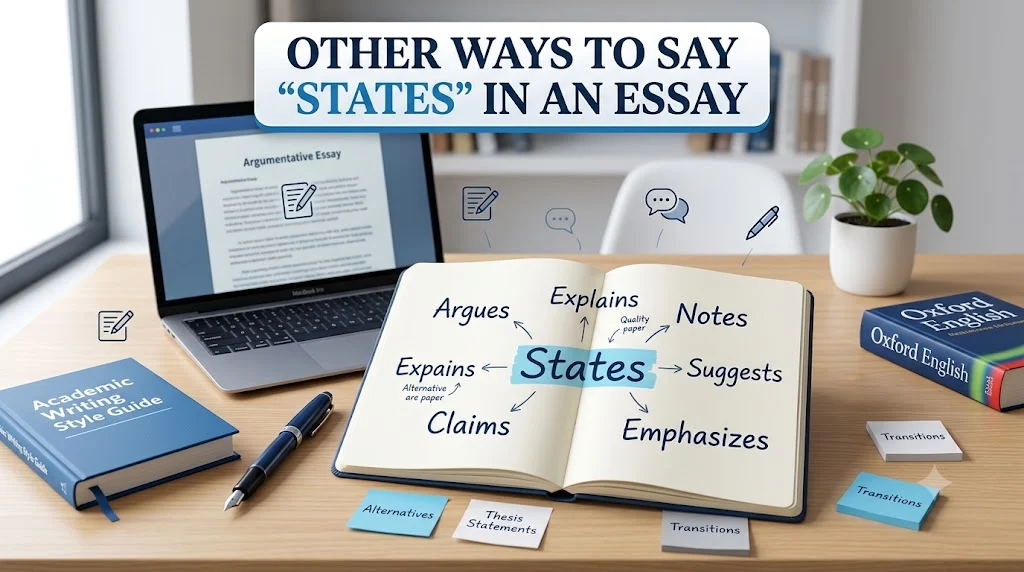
Other ways to say “states” in an essay include argues, explains, notes, suggests, claims, mentions, asserts, emphasizes, indicates, and observes. The best alternative depends on the author’s tone and the context, helping make your academic writing more varied and engaging.
The verb “states” is the workhorse of academic writing. It introduces claims, positions, and established facts. But relying on it too heavily makes your essay feel repetitive and dull . Learning alternatives to “states” can instantly elevate your prose and demonstrate a more sophisticated command of English.
By choosing the right synonym, you don’t just avoid repetition; you add precision to your argument. Whether you need to express excitement in English for a persuasive piece or maintain a neutral tone in a research paper, the right verb frames your entire position. These alternatives help you express ideas with the nuance and confidence expected in professional and academic settings.
Quick Categories
Formal Alternatives
Asserts, contends, affirms, maintains, elucidates, articulates
Academic Reporting Verbs
Argues, proposes, hypothesises, verifies, demonstrates, indicates
Professional Alternatives
Declares, confirms, specifies, conveys, discloses
Informal Expressions
Says, mentions, notes, points out
Formal Alternatives
1. Asserts
Meaning: To state a fact or belief confidently and forcefully.
Explanation: Often used when the writer is presenting an idea that may be challenged.
Example Sentence: The researcher asserts that the findings are conclusive.
Best Use: Debates, arguments
Worst Use: Neutral, undisputed facts
Tone: Confident, forceful
2. Contends
Meaning: To argue or state something is true, especially in a debate.
Explanation: Implies there is a counter argument or opposing view.
Example Sentence: The author contends that economic growth is the primary driver of change.
Best Use: Persuasive essays
Worst Use: Objective summaries
Tone: Argumentative, intellectual
3. Affirms
Meaning: To state something as a fact, typically to confirm or validate.
Explanation: Used to emphasize the truth or validity of a previous statement.
Example Sentence: The data affirms the link between diet and health.
Best Use: Supporting evidence
Worst Use: Introducing new arguments
Tone: Confirming, supportive
4. Maintains
Meaning: To assert something consistently and firmly.
Explanation: Shows the author’s unwavering commitment to an idea.
Example Sentence: The scholar maintains that the text is historically inaccurate.
Best Use: Long standing positions
Worst Use: Casual conversation
Tone: Steadfast, consistent
5. Elucidates
Meaning: To make something clear by explaining it in more detail.
Explanation: Used when an author is clarifying a complex point, not just stating it.
Example Sentence: The professor elucidates the theory in the final chapter .
Best Use: Complex explanations
Worst Use: Simple facts
Tone: Clarifying, academic
6. Articulates
Meaning: To express an idea or feeling fluently and coherently.
Explanation: Suggests the subject communicated an idea clearly and effectively .
Example Sentence: He articulates the company’s vision with great passion.
Best Use: Expressing ideas clearly
Worst Use: Casual remarks
Tone: Clear, fluent
💡 Pro Tip: In academic writing, use “asserts,” “contends,” or “maintains” to show you are engaging with a debate, not just repeating facts.
Professional & Business Alternatives
7. Declares
Meaning: To announce something officially or formally.
Explanation: More formal than “states” and often used for announcements or policy changes .
Example Sentence: The CEO declares the new policy will take effect next month.
Best Use: Official announcements
Worst Use: Casual conversation
Tone: Official, formal
8. Confirms
Meaning: To establish the truth or correctness of something.
Explanation: This is a strong alternative to “states” when validating information.
Example Sentence: The report confirms the company’s financial stability .
Best Use: Validating data
Worst Use: Original ideas
Tone: Validating, sure
9. Specifies
Meaning: To identify clearly and definitely.
Explanation: Used when providing precise details within a larger statement.
Example Sentence: The contract specifies the terms of payment.
Best Use: Legal, technical
Worst Use: General ideas
Tone: Precise, clear
10. Conveys
Meaning: To communicate or make known.
Explanation: Focuses on the transmission of the message rather than the act of speaking.
Example Sentence: The tone of his voice conveys a sense of urgency.
Best Use: Communication of feelings
Worst Use: Facts or data
Tone: Communicative, expressive
11. Discloses
Meaning: To make something known that was previously secret.
Explanation: Often used for confidential or new information.
Example Sentence: The investigation discloses new evidence .
Best Use: New, confidential info
Worst Use: Public knowledge
Tone: Revealing, investigative
💡 Pro Tip: “Specifies” is your go to word in legal or technical writing when precision is required.
Academic Reporting Verbs
12. Argues
Meaning: To state a point of view with supporting reasons.
Explanation: Unlike “states,” “argues” implies the author is building a case .
Example Sentence: The author argues that the policy is ineffective.
Best Use: Persuasive writing
Worst Use: Uncontroversial facts
Tone: Persuasive, reasoned
13. Proposes
Meaning: To put forward an idea or plan for consideration.
Explanation: Used when the author is offering a new idea, not just stating an old one.
Example Sentence: The scientist proposes a new model for climate change.
Best Use: New hypotheses
Worst Use: Established facts
Tone: Suggestive, innovative
14. Hypothesises
Meaning: To state something as a hypothesis or theory.
Explanation: A specific term for presenting a testable theory .
Example Sentence: The researcher hypothesises that sleep improves memory.
Best Use: Research papers
Worst Use: Confirmed theories
Tone: Speculative, scientific
15. Verifies
Meaning: To make sure or demonstrate that something is true.
Explanation: Indicates the author has checked the facts.
Example Sentence: The study verifies the effectiveness of the drug .
Best Use: Scientific evidence
Worst Use: Hypotheses
Tone: Factual, certain
16. Demonstrates
Meaning: To clearly show the existence or truth of something.
Explanation: Often uses evidence or examples to prove a point.
Example Sentence: The experiment demonstrates the principle of gravity .
Best Use: Evidence based writing
Worst Use: Opinions
Tone: Logical, evidential
17. Indicates
Meaning: To point out or show something.
Explanation: Less forceful than “demonstrates”; suggests evidence points in a certain direction.
Example Sentence: The data indicates a trend toward smaller families .
Best Use: Suggesting trends
Worst Use: Absolute conclusions
Tone: Suggestive, neutral
💡 Pro Tip: Use “argues” or “proposes” to identify a writer’s original contribution, and “indicates” or “demonstrates” when discussing their evidence.
Neutral & Common Alternatives
18. Says
Meaning: To express in words.
Explanation: The most common and versatile synonym for “states.”
Example Sentence: The letter says the meeting has been cancelled .
Best Use: General writing
Worst Use: Formal reports
Tone: Neutral, common
19. Mentions
Meaning: To refer to something briefly.
Explanation: Used when something is not discussed in depth.
Example Sentence: The author mentions the event but does not elaborate .
Best Use: Brief references
Worst Use: Key arguments
Tone: Casual, brief
20. Notes
Meaning: To pay attention to or record something.
Explanation: Slightly more formal than “mentions” but less intense than “argues.”
Example Sentence: The author notes a discrepancy in the data.
Best Use: Observations
Worst Use: Strong conclusions
Tone: Observant, calm
21. Observes
Meaning: To notice or make a comment based on observation.
Explanation: Carries a sense of watching or analyzing.
Example Sentence: The therapist observes a change in the patient’s mood.
Best Use: Analyzing behavior
Worst Use: Simple statements
Tone: Analytical, careful
22. Points Out
Meaning: To draw someone’s attention to a fact.
Explanation: A neutral phrasal verb for highlighting information.
Example Sentence: She points out the flaws in the argument.
Best Use: Identifying mistakes
Worst Use: Formal writing
Tone: Clarifying, direct
23. Expresses
Meaning: To convey a thought or feeling.
Explanation: Focuses on the underlying sentiment or idea .
Example Sentence: The poem expresses a longing for the past.
Best Use: Feelings, opinions
Worst Use: Statistics
Tone: Emotional, personal
24. Reports
Meaning: To give an account of something.
Explanation: Often used for news or official findings .
Example Sentence: The paper reports a decline in stock prices.
Best Use: News, official data
Worst Use: Opinions
Tone: Objective, factual
💡 Pro Tip: If you are unsure, “says” and “notes” are almost always safe and widely understood.
Informal Expressions
25. Mentions
Meaning: To refer to something briefly.
Explanation: Less formal than “states,” used for casual references.
Example Sentence: He mentions the party in passing.
Best Use: Casual conversation
Worst Use: Formal reports
Tone: Casual, brief
26. Points Out
Meaning: To highlight or draw attention to something.
Explanation: A conversational phrasal verb.
Example Sentence: She points out the mistake.
Best Use: Everyday conversation
Worst Use: Academic writing
Tone: Direct, informal
27. Says
Meaning: The simplest verb for speech.
Explanation: Overused but always correct in informal contexts.
Example Sentence: He says he’ll be late.
Best Use: Direct speech, stories
Worst Use: Formal essays
Tone: Natural, informal
28. Tells (tells us)
Meaning: To inform or communicate.
Explanation: Requires an indirect object (e.g., “tells us”).
Example Sentence: The author tells us the story of the war.
Best Use: Narratives
Worst Use: Academic prose
Tone: Storytelling, informal
29. Shares
Meaning: To communicate an idea or feeling.
Explanation: Conveys a collaborative, open tone.
Example Sentence: He shares his thoughts on leadership.
Best Use: Blogs, personal essays
Worst Use: Scientific writing
Tone: Open, personal
30. Recounts
Meaning: To describe events or experiences.
Explanation: Used for telling stories or detailed accounts.
Example Sentence: She recounts her childhood memories.
Best Use: Anecdotes, autobiographies
Worst Use: Facts, arguments
Tone: Narrative, descriptive
Common Mistakes to Avoid
1. Being too informal for the context
Avoid: “The study just says exercise is good for you.”
Better: “The study demonstrates that exercise is beneficial.”
2. Using the wrong nuance
Avoid: “The scientist hypothesises the sky is blue.”
Better: “The scientist hypothesises that the substance is toxic.”
3. Overusing the word ‘states’
Avoid: “Smith states… Jones states… Brown states…”
Better: “Smith argues… Jones maintains… Brown contends…”
4. Mixing up ‘argues’ and ‘asserts’
Avoid: “The encyclopedia argues that water is wet.”
Better: “The encyclopedia states that water is wet.”
5. Using too many advanced words
Avoid: “The author elucidates the fact that it is raining.”
Better: “The author mentions that it is raining.”
What Does “States” Mean?
Definition: As a verb, “states” means to express something clearly and firmly in speech or writing . It is used to introduce a fact, opinion, or claim.
Grammar: It is a transitive verb, meaning it always takes a direct object.
- Example: “The author states the main argument.
When to Use “States”
Use “states” when you need a neutral, clear, and unemotional way to introduce information.
- Contexts:
- Essays: Introducing a fact or quote.
- Spoken: In presentations or lectures to present a point.
- Formal: In reports to state findings.
- Informal: In everyday conversation as a simple reporting verb.
- Spoken vs Written: Used in both, but “states” is more common in formal writing than everyday speech.
- Formal vs Informal: It is acceptable in both, though it often sounds bland in creative writing.
Is It Professional or Polite to Say “States”?
Politeness: Yes, it is polite and respectful to the author you are citing.
Professionalism: Yes, it is professional, but it lacks the persuasive power of stronger alternatives. Overusing it can make your writing seem simple or lazy .
Business Example:
“The contract states that the work must be completed by Friday.”
- Polite? ✔️ Yes
- Professional? ⚠️ Yes, but can be improved.
Pros and Cons of Using “States”
Pros:
- Safe and universally understood.
- Neutral and objective.
- Common and easy to use.
- Grammatically straightforward.
Cons:
- It is overused and can make writing feel dull.
- Too neutral; doesn’t show your perspective.
- Lacks the precision of more specific verbs.
- Weakens your argument in a persuasive essay.
Comparison Table: Top 10 Alternatives
| Phrase | Tone | Best Use |
| Argues | Persuasive | Debates and opinions |
| Asserts | Confident | Making bold claims |
| Contends | Argumentative | Countering a point |
| Maintains | Steadfast | Long held beliefs |
| Verifies | Factual | Confirming data |
| Demonstrates | Evidential | Proving with examples |
| Says | Neutral | General, everyday writing |
| Proposes | Suggestive | Introducing ideas |
| Notes | Observant | Highlighting observations |
| Declares | Official | Formal announcements |
Mini Quiz
1. Which verb is best to state a hypothesis in a scientific paper?
A. Says
B. Hypothesises
C. Mentions
Answer: B
2. Which word implies the author has evidence to back up their claim?
A. Argues
B. States
C. Observes
Answer: A
3. What is the best word for an official government announcement?
A. Declares
B. Says
C. Points out
Answer: A
4. Which verb is too informal for a job application?
A. Details
B. States
C. Says
Answer: C
FAQs
1. What is the best formal alternative to “states”?
“Declares” or “asserts” are excellent formal alternatives when you need an authoritative tone. “Articulates” is best for clear expression.
2. What is a strong verb to use instead of “states”?
“Argues,” “contends,” and “maintains” are strong verbs that signal you are actively engaging with an idea .
3. What is the difference between “states” and “asserts”?
“States” is neutral and objective, while “asserts” is forceful, implying the author is confident in their claim.
4. Can I use “says” in an academic essay?
It is best to avoid “says” in formal academic writing. Use “states,” “argues,” or “proposes” instead. “Says” is more appropriate for casual contexts .
5. Which word is best to describe a writer’s original idea?
“Proposes” or “hypothesises” are ideal for original ideas, while “verifies” is better for established knowledge.
Conclusion
Learning alternatives to “states” is a simple but powerful way to improve your writing. By choosing a more precise verb, you can add depth to your argument and demonstrate a stronger command of the language.
Start by practicing just two or three new words. Swap “states” for “argues” in your next persuasive paragraph, or use “demonstrates” when presenting evidence. Over time, the right word will come to you naturally. Remember to always consider your tone—what works in a professional report won’t always work in a casual email.

John Green is an American writer who contributes to QuickResponsess.com, creating clear and practical content on English grammar, vocabulary and everyday language. His goal is to make learning English simple, engaging and easy to apply.