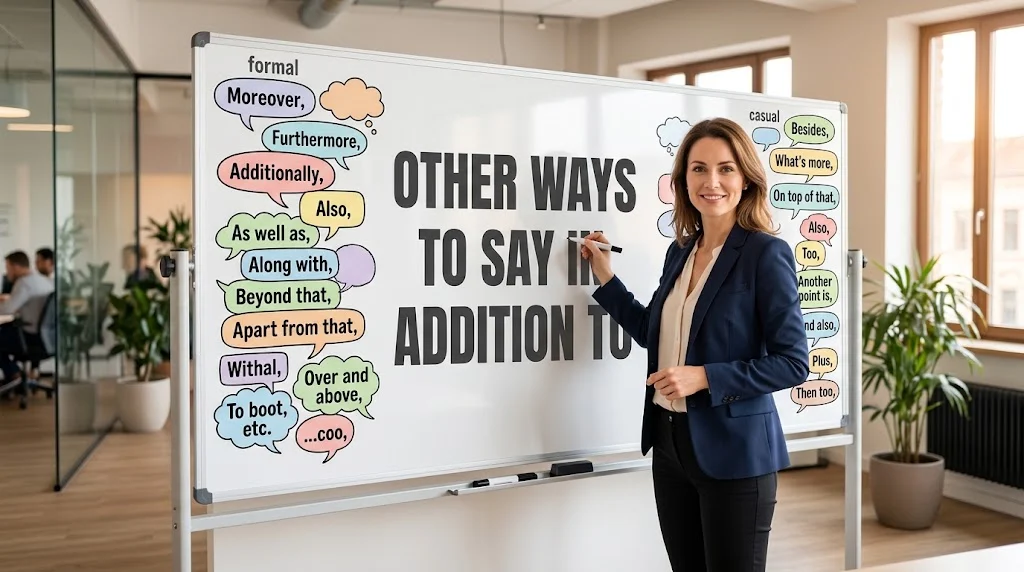
Quick Answer
Here are the top 5: Moreover, Furthermore, Additionally, As well as, and Along with. Each works in different contexts from formal reports to casual conversations.
The phrase “in addition to” is one of the most common expressions in English. It helps you add information, connect ideas, and build arguments. But using it repeatedly can make your speech or writing sound monotonous and even unprofessional.
That’s why learning alternatives to “in addition to” is essential for anyone who wants to sound fluent, confident, and natural. Whether you’re writing a business email, delivering a presentation, or having a casual conversation, having a rich vocabulary of professional reaction phrases and transitional expressions will set you apart.
In this guide, you’ll discover 30+ powerful ways to express excitement in English through varied transitions, along with clear explanations, real examples, and practical tips for every situation.
Quick Categories
Formal Alternatives to “In Addition To”
- Moreover
- Furthermore
- Additionally
- In conjunction with
- Over and above
Casual Alternatives
- Plus
- Also
- Too
- What’s more
- On top of that
Professional Alternatives
- As well as
- Along with
- Coupled with
- Together with
- In the same vein
Informal Expressions
- Besides
- Not to mention
- To boot
- Into the bargain
- As an extra
💡 Pro Tip: Match your phrase to your audience. Use formal alternatives in academic writing and professional reports. Save casual and informal expressions for emails to colleagues you know well or everyday conversations.
Common Mistakes Using “In Addition To”
1. Using a verb after “to” instead of a gerund
- ❌ In addition to give a general introduction, the course also provides practical experience.
- ✅ In addition to giving a general introduction, the course also provides practical experience.
2. Using “in addition to” as a sentence starter without a noun/gerund
- ❌ In addition to, we need more data.
- ✅ In addition, we need more data. (drop the “to”)
3. Confusing “in addition to” with “in addition”
- ❌ In addition to, she speaks French.
- ✅ In addition, she speaks French. OR In addition to English, she speaks French.
4. Overusing the phrase in a single paragraph
- ❌ In addition to the budget, we need more staff. In addition to staff, we need better equipment.
- ✅ Use alternatives like Moreover and Furthermore for variety.
5. Using it in overly casual contexts
- ❌ In addition to pizza, I want soda. (too formal for a food order)
- ✅ Plus, I want soda. OR I want soda too.
What Does “In Addition To” Mean?
In addition to is a prepositional phrase that means “as well as” or “besides.” It introduces extra information that complements or extends what has already been mentioned.
Grammar Note: “In addition to” functions as a preposition, so it must be followed by a noun, pronoun, or gerund ( ing form). It cannot be followed by a base verb.
Example: In addition to managing the team, she also handles client relations.
When to Use “In Addition To”
- Adding supporting points in an argument or explanation
- Listing multiple items or features
- Connecting related ideas in writing
- Providing extra context in both spoken and written English
| Context | Suitability |
| Spoken English | ✅ Common and natural |
| Written English | ✅ Very common |
| Formal writing | ⚠️ Acceptable but overused |
| Informal writing | ⚠️ Can sound stiff |
Is It Professional or Polite to Say “In Addition To”?
Polite? ✔️ Yes it’s a courteous way to add information.
Professional? ❌ Not in most cases it’s acceptable but overused in business settings.
Business Example: In addition to your salary, you will receive a performance bonus. (Correct but plain consider Along with your salary or On top of your salary for more impact.)
Pros and Cons of Using “In Addition To”
Pros:
- Simple and natural easy for all English levels
- Friendly and approachable tone
- Extremely common everyone understands it
- Easy to use in most sentence structures
Cons:
- Too informal for high level professional or academic work
- Overused makes writing feel repetitive and lazy
- Limited emotional range doesn’t add emphasis or weight
- Not suitable for formal legal or scientific writing
Other Ways to Say “In Addition To” (With Examples)
These alternatives will help you sound more fluent, confident, and natural in different situations. Use them according to tone, context, and audience to express excitement in English, add emphasis, or simply vary your vocabulary.
1. Phrase: Moreover
Meaning: Adds a point that strengthens the previous argument.
Explanation: “Moreover” doesn’t just add information it reinforces what you just said with something equally or more important.
Example Sentence: The proposal is cost effective. Moreover, it requires minimal implementation time.
Best Use: Persuasive writing
Worst Use: Casual texting
Tone: Formal, emphatic
Context Variability: Professional, academic, spoken in formal presentations
2. Phrase: Furthermore
Meaning: Introduces an additional point that builds on the previous one.
Explanation: Often used interchangeably with “moreover,” but “furthermore” is slightly more common in academic and professional writing to add evidence or examples.
Example Sentence: He has five years of experience in the field. Furthermore, he holds a master’s degree from a top university.
Best Use: Academic essays
Worst Use: Quick emails
Tone: Formal, logical
Context Variability: Academic, professional, written reports
3. Phrase: Additionally
Meaning: Adds another piece of information.
Explanation: A direct, versatile synonym that works in almost any context from formal reports to everyday conversations.
Example Sentence: The museum offers free entry for students. Additionally, guided tours are available at a reduced cost.
Best Use: Listing features
Worst Use: Emotional arguments
Tone: Neutral, versatile
Context Variability: All contexts formal, professional, casual
4. Phrase: As well as
Meaning: Includes something extra alongside the main point.
Explanation: Often used within a sentence rather than at the start. It’s slightly less formal than “in addition to”.
Example Sentence: The course covers basic accounting, as well as advanced financial modeling.
Best Use: Describing combinations
Worst Use: Starting sentences
Tone: Neutral, slightly informal
Context Variability: Professional, casual, written
5. Phrase: Along with
Meaning: Together with; in addition to.
Explanation: A natural, smooth alternative that works well in both professional and casual contexts.
Example Sentence: We need to consider the budget, along with the project timeline.
Best Use: Business discussions
Worst Use: Academic papers (too casual)
Tone: Neutral, friendly
Context Variability: Professional, casual, spoken
6. Phrase: Coupled with
Meaning: Combined together with something else.
Explanation: Emphasizes that two or more things work together to create a result.
Example Sentence: The new software, coupled with better training, will significantly improve productivity.
Best Use: Cause and effect explanations
Worst Use: Simple lists
Tone: Formal, analytical
Context Variability: Professional, academic, reports
7. Phrase: Together with
Meaning: In combination with; as well as.
Explanation: A straightforward, professional alternative that emphasizes unity or combination.
Example Sentence: Together with our partners, we will deliver this project on time.
Best Use: Collaborative contexts
Worst Use: Casual speech
Tone: Professional, formal
Context Variability: Business, formal writing, speeches
8. Phrase: On top of that
Meaning: Adds another significant detail, often unexpected.
Explanation: Very common in spoken English. It adds emphasis and often signals a surprise or additional burden/benefit.
Example Sentence: He finished the project early, and on top of that, he exceeded all expectations.
Best Use: Storytelling
Worst Use: Formal reports
Tone: Casual, emphatic
Context Variability: Casual conversations, emails to colleagues
9. Phrase: Plus
Meaning: Adds an extra advantage or detail.
Explanation: Short, punchy, and modern. Perfect for casual writing and speaking.
Example Sentence: The design is simple, plus it’s incredibly affordable.
Best Use: Casual writing
Worst Use: Academic or formal documents
Tone: Friendly, modern
Context Variability: Texts, casual emails, blogs
10. Phrase: What’s more
Meaning: Introduces an interesting or surprising extra point.
Explanation: A conversational phrase that adds a layer of emphasis or excitement.
Example Sentence: The new system saves time. What’s more, it’s completely free to use.
Best Use: Persuasive conversations
Worst Use: Formal writing
Tone: Conversational, persuasive
Context Variability: Casual, presentations, blogs
11. Phrase: Besides
Meaning: In addition to; as well as.
Explanation: Can be used to add extra information, often as an afterthought. It’s more informal than “in addition to”.
Example Sentence: Besides Italian, she also speaks French and Spanish.
Best Use: Adding minor details
Worst Use: Formal writing
Tone: Informal, conversational
Context Variability: Casual, semi formal
12. Phrase: Not to mention
Meaning: Adds an important point that is almost too obvious to state.
Explanation: Emphasizes the extra point by suggesting it’s so significant it hardly needs saying.
Example Sentence: The city is famous for its architecture and history, not to mention its incredible food.
Best Use: Emphasizing benefits
Worst Use: Academic writing
Tone: Conversational, emphatic
Context Variability: Casual, persuasive, blogs
13. Phrase: In conjunction with
Meaning: Working together with; in combination with.
Explanation: A formal phrase often used in professional and technical contexts.
Example Sentence: In conjunction with our marketing team, we’ll launch the campaign next month.
Best Use: Business and technical writing
Worst Use: Casual conversation
Tone: Formal, professional
Context Variability: Business, legal, academic
14. Phrase: Over and above
Meaning: In addition to; beyond what is expected.
Explanation: Emphasizes that something goes beyond the usual or required amount.
Example Sentence: Costs have increased 7% over and above inflation.
Best Use: Financial contexts
Worst Use: Casual speech
Tone: Formal, precise
Context Variability: Business, reports, legal
15. Phrase: In the same vein
Meaning: In a similar way; adding a related point.
Explanation: Used when the additional information is connected in style or theme to what came before.
Example Sentence: The first chapter introduces the theory. In the same vein, the second chapter explores practical applications.
Best Use: Academic writing
Worst Use: Quick conversations
Tone: Formal, structured
Context Variability: Academic, professional, essays
16. Phrase: Alongside
Meaning: Next to; together with.
Explanation: A modern, slightly more formal alternative to “along with”.
Example Sentence: Alongside your application, please submit your portfolio.
Best Use: Professional emails
Worst Use: Very casual texts
Tone: Professional, neutral
Context Variability: Business, formal writing
17. Phrase: To say nothing of
Meaning: Not to mention; in addition to.
Explanation: Emphasizes that there’s even more to consider.
Example Sentence: The renovation will cost $50,000, to say nothing of the time required.
Best Use: Persuasive writing
Worst Use: Short emails
Tone: Formal, emphatic
Context Variability: Formal writing, arguments
18. Phrase: To boot
Meaning: In addition; as an extra.
Explanation: An old fashioned but charming informal phrase meaning “as a bonus”.
Example Sentence: He fixed the car quickly, and to boot, he charged less than expected.
Best Use: Casual storytelling
Worst Use: Professional writing
Tone: Informal, old fashioned
Context Variability: Casual, humorous
19. Phrase: Into the bargain
Meaning: In addition; as an extra benefit.
Explanation: Similar to “to boot” informal and slightly old fashioned.
Example Sentence: The apartment is spacious, and into the bargain, it has a beautiful garden.
Best Use: Casual descriptions
Worst Use: Formal contexts
Tone: Informal, conversational
Context Variability: Casual, British English
20. Phrase: Also
Meaning: In addition; as well.
Explanation: The simplest and most versatile alternative. Works in almost every context.
Example Sentence: She also suggested a different approach to the problem.
Best Use: Everyday conversation
Worst Use: Formal essays (too basic)
Tone: Neutral, simple
Context Variability: All contexts (less formal)
💡 Pro Tip: “Also” is your go to for everyday speech. Save “furthermore” and “moreover” for when you need to sound more sophisticated.
21. Phrase: Too
Meaning: Also; in addition.
Explanation: Very casual and friendly. Often placed at the end of a sentence.
Example Sentence: I’ll bring snacks, and drinks too.
Best Use: Casual conversations
Worst Use: Formal writing
Tone: Casual, friendly
Context Variability: Texts, casual speech
22. Phrase: As an additional point
Meaning: Introducing another point to consider.
Explanation: A clear, structured way to add information in presentations or formal writing.
Example Sentence: As an additional point, we should review the budget before finalizing the plan.
Best Use: Presentations
Worst Use: Casual chats
Tone: Formal, structured
Context Variability: Professional, academic
23. Phrase: By the same token
Meaning: In a similar way; for the same reason.
Explanation: Adds a point that follows the same logic or reasoning as the previous one.
Example Sentence: We need to reduce costs. By the same token, we should also look for new revenue streams.
Best Use: Logical arguments
Worst Use: Simple lists
Tone: Formal, analytical
Context Variability: Academic, professional
24. Phrase: In like manner
Meaning: In a similar way.
Explanation: A formal way to add a point that mirrors the previous one.
Example Sentence: The first department has met its targets. In like manner, the second department should do the same.
Best Use: Formal comparisons
Worst Use: Casual speech
Tone: Very formal
Context Variability: Academic, legal, official
25. Phrase: Supplementarily
Meaning: As a supplement; in addition.
Explanation: A rare but precise formal term meaning “serving as an addition”.
Example Sentence: Supplementarily, we recommend a review of existing policies.
Best Use: Technical writing
Worst Use: Everyday speech
Tone: Highly formal, technical
Context Variability: Academic, legal, scientific
26. Phrase: In tandem with
Meaning: Together with; alongside.
Explanation: Emphasizes that two things are happening simultaneously or working together.
Example Sentence: In tandem with the new software, we’re introducing updated training materials.
Best Use: Project management
Worst Use: Casual conversation
Tone: Professional, coordinated
Context Variability: Business, technical
27. Phrase: Apart from
Meaning: Besides; in addition to.
Explanation: Often used to add exceptions or extra points.
Example Sentence: Apart from the initial setup cost, the system is very affordable.
Best Use: Adding exceptions
Worst Use: Formal academic writing
Tone: Neutral, slightly formal
Context Variability: Professional, casual
28. Phrase: In addition to this/that
Meaning: Adding to this specific point.
Explanation: A slightly longer but clearer version of “in addition to”.
Example Sentence: In addition to this, we must also consider the environmental impact.
Best Use: Building arguments
Worst Use: Quick notes
Tone: Neutral, clear
Context Variability: All contexts
29. Phrase: On another note
Meaning: Switching to a different but related topic.
Explanation: Useful when the additional point is somewhat separate from the main discussion.
Example Sentence: The quarterly results are strong. On another note, we should discuss the upcoming merger.
Best Use: Meetings
Worst Use: Academic essays
Tone: Professional, conversational
Context Variability: Business, casual
30. Phrase: As an extension
Meaning: Building on what was just said.
Explanation: Suggests the additional point naturally follows from or extends the previous idea.
Example Sentence: As an extension of our current work, we’ll explore new markets next year.
Best Use: Strategic planning
Worst Use: Simple additions
Tone: Professional, forward looking
Context Variability: Business, professional
31. Phrase: Along the same lines
Meaning: In a similar way; related to what was just said.
Explanation: Used to add a point that is connected in theme or approach.
Example Sentence: The marketing team is focusing on social media. Along the same lines, we should update our website.
Best Use: Coordinated planning
Worst Use: Casual texts
Tone: Professional, collaborative
Context Variability: Business, formal
32. Phrase: Beyond this
Meaning: In addition to this; going further.
Explanation: Suggests there is more beyond what has already been mentioned.
Example Sentence: Beyond this initial phase, we’ll need additional funding.
Best Use: Strategic discussions
Worst Use: Everyday chat
Tone: Formal, forward looking
Context Variability: Business, planning
💡 Pro Tip: When in doubt about formality, default to “Additionally” it works in almost every context and never sounds out of place.
Mini Quiz / Self Check
1. Which alternative is most appropriate for an academic research paper?
- A) Plus
- B) On top of that
- C) Furthermore
- D) To boot
Answer: C “Furthermore” is formal and commonly used in academic writing.
2. You’re sending a quick text to a friend. Which phrase sounds most natural?
- A) In conjunction with
- B) Moreover
- C) Plus
- D) In addition to
Answer: C “Plus” is short, casual, and perfect for texts.
3. Which sentence uses “in addition to” correctly?
- A) In addition to learn English, she studies French.
- B) In addition to learning English, she studies French.
- C) In addition to, she studies French.
Answer: B “In addition to” must be followed by a noun or gerund ( ing).
4. You’re writing a business email to a client. Which phrase is most professional?
- A) Not to mention
- B) Along with
- C) What’s more
- D) On top of that
Answer: B “Along with” is professional yet natural.
Comparison Table: Top 10 Alternatives
| Phrase | Tone | Best Use |
| Moreover | Formal | Persuasive arguments |
| Furthermore | Formal | Academic writing |
| Additionally | Neutral | All contexts |
| As well as | Neutral | Describing combinations |
| Along with | Professional | Business discussions |
| Plus | Casual | Texts and casual emails |
| On top of that | Casual | Storytelling |
| What’s more | Conversational | Persuasive speaking |
| Not to mention | Informal | Emphasizing benefits |
| In conjunction with | Very formal | Legal/technical writing |
FAQs
1. What is the most professional alternative to “in addition to”?
“Moreover” and “furthermore” are the most professional alternatives. They add weight to your arguments and are commonly used in academic and business writing.
2. Can I use “as well as” instead of “in addition to”?
Yes, but they are not always interchangeable. “As well as” is slightly less formal and is typically used within a sentence rather than at the beginning.
3. Is “besides” a good alternative to “in addition to”?
Yes, but “besides” is more informal and often implies the added point is less important. For formal writing, “in addition to” or “additionally” are better choices.
4. What’s the difference between “moreover” and “furthermore”?
They are very similar, but “moreover” tends to add a point that strengthens the argument, while “furthermore” simply adds another point. Both are formal.
5. Can I start a sentence with “in addition to”?
No “in addition to” is a preposition and must be followed by a noun or gerund. To start a sentence, use “In addition,” without the “to”.
Conclusion
Learning other ways to say “in addition to” is one of the fastest ways to elevate your English. It makes your speech more engaging, your writing more professional, and your overall communication more confident. Each alternative carries its own tone and nuance and knowing which one to use in which situation is what separates advanced learners from intermediate ones.
Start by choosing just three new alternatives and practice using them this week. Swap out “in addition to” for “additionally” in your emails, try “what’s more” in conversations, and use “furthermore” in your next report. With consistent practice, these phrases will become second nature and you’ll sound more fluent and polished every time you speak or write.

Sally Rooney is an American writer who contributes to QuickResponsess.com, creating clear and practical content for English learners. Her articles help readers build confidence in using words and expressions accurately in everyday and professional communication.