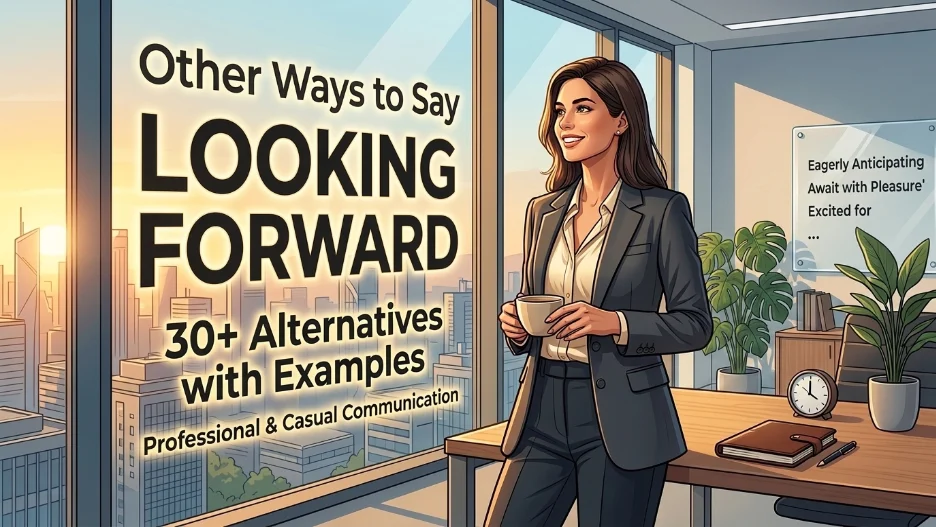
Quick Answer :Looking to replace “looking forward”? Here are five powerful alternatives: “Eagerly anticipating,” “Counting down the days,” “Can’t wait,” “Excited about,” and “Awaiting with interest.” Each
fits different tones, from formal emails to casual conversations.
The phrase “looking forward” is one of the most common expressions in English. We use it daily in emails, conversations, and professional correspondence to express anticipation about future events. But here’s the truth relying on it too often makes your communication feel repetitive and flat .
Alternatives to “looking forward” give you the power to match your tone to your audience. Whether you’re writing a formal business proposal or texting a friend, the right phrase can help you express excitement in English more naturally and confidently .
Quick Categories
Formal Alternatives to “Looking Forward”
- Eagerly anticipating
- Awaiting with interest
- Keen to
- Expecting to
- I anticipate with pleasure
Professional Alternatives
- Looking forward to our collaboration
- Eager to connect
- Keen to participate
- Awaiting your response
Casual Alternatives
- Can’t wait
- Counting down the days
- Pumped for this
- Sounds exciting
Informal Expressions
- I’m stoked
- Bring it on
- I’m all about it
- I’m hyped
💡 Pro Tip
Always match your tone to your audience. Use “eagerly anticipating” with clients, “can’t wait” with friends, and “keen to” with colleagues. The right phrase builds stronger connections.
Common Mistakes to Avoid
- Using “look forward” without the preposition “to”
❌ I look forward meet you.
✅ I look forward to meeting you. - Mixing up verb forms incorrectly
❌ I am look forward to it.
✅ I am looking forward to it. or I look forward to it. - Using “expect” when you mean “look forward”
❌ I expect to see you at the party. (sounds like an obligation)
✅ I’m excited to see you at the party. - Making “looking forward” too casual in formal writing
❌ Can’t wait for your reply. (in a job application)
✅ I look forward to your response. - Forgetting to include the action or event
❌ I’m looking forward. (incomplete)
✅ I’m looking forward to the meeting.
What Does “Looking Forward” Mean?
“Looking forward” is an idiomatic phrase used to express anticipation or eagerness about a future event. It conveys positive expectations and enthusiasm toward something that is about to happen .
Grammar note: The phrase is always followed by a noun, pronoun, or gerund ( ing form). For example, I look forward to hearing from you or I look forward to the meeting .
Example sentence:
“I am looking forward to our vacation next month.”
When to Use “Looking Forward”
Common contexts:
- Ending emails and letters
- Expressing excitement about meetings or events
- Professional correspondence
- Social conversations about future plans
| Context | Style |
| Spoken | Often used casually with friends and family |
| Written | Common in both formal and informal writing |
| Formal | More appropriate in its full form: “I look forward to…” |
| Informal | Usually appears as “looking forward to…” |
Is It Professional or Polite to Say “Looking Forward”?
Polite? ✔️ Yes – it’s always courteous and respectful.
Professional? ❌ Not always – it can be too casual in formal business writing.
Example in a business setting:
“I look forward to discussing this matter further.” – Acceptable but not impressive.
For higher professionalism, choose alternatives like “I eagerly anticipate the opportunity to collaborate with your team on this project” .
Pros and Cons of Using “Looking Forward”
Pros
- Simple and natural for everyday use
- Friendly tone that builds rapport
- Common usage makes it easy to understand
- Universally accepted in most situations
Cons
- Too informal for executive level communication
- Overused and lacks impact
- Limited emotional range – doesn’t convey excitement intensity
- Not suitable for formal writing or important documents
Other Ways to Say “Looking Forward” (With Examples)
These alternatives will help you sound more fluent, confident, and natural in different situations. Use them according to tone, context, and audience to express excitement, admiration, or approval.
1. Phrase: Eagerly anticipating
Meaning: Waiting with great enthusiasm and excitement.
Explanation: This is a formal, polished way to express anticipation, ideal for professional settings.
Example Sentence: “I am eagerly anticipating our meeting next Tuesday to finalize the project details.”
Best Use: Formal emails
Worst Use: Casual texts
Tone: Professional, enthusiastic
Context Variability: Professional, formal
2. Phrase: Can’t wait
Meaning: Expressing strong eagerness and impatience.
Explanation: Perfect for casual conversations where you want to show genuine enthusiasm.
Example Sentence: “I can’t wait to see you at the concert this weekend!”
Best Use: Friends and family
Worst Use: Business correspondence
Tone: Enthusiastic, informal
Context Variability: Casual, spoken
3. Phrase: Excited about
Meaning: Feeling enthusiasm and positive energy toward something.
Explanation: A straightforward way to share your excitement in both professional and personal contexts.
Example Sentence: “I’m excited about the new project and the opportunities it brings.”
Best Use: Neutral to enthusiastic
Worst Use: Very formal situations
Tone: Positive, warm
Context Variability: Professional, casual
4. Phrase: Keen to
Meaning: Showing strong interest and willingness.
Explanation: This is a professional yet friendly alternative, commonly used in British English.
Example Sentence: “I’m keen to learn more about your company’s approach to sustainability.”
Best Use: Professional emails
Worst Use: Very casual chats
Tone: Interested, professional
Context Variability: Professional, formal
5. Phrase: Awaiting with interest
Meaning: Waiting patiently but with curiosity and anticipation.
Explanation: A polished, formal phrase for professional correspondence.
Example Sentence: “I am awaiting with interest your feedback on the proposal.”
Best Use: Formal written communication
Worst Use: Casual spoken English
Tone: Formal, respectful
Context Variability: Formal, written
6. Phrase: Counting down the days
Meaning: Marking time until an event with excitement.
Explanation: Emphasizes intense anticipation and is perfect for enthusiastic situations.
Example Sentence: “I’m counting down the days until our team retreat!”
Best Use: Enthusiastic contexts
Worst Use: Formal business letters
Tone: Excited, personal
Context Variability: Casual, spoken
7. Phrase: Anticipate
Meaning: Expect with eagerness and prepare for.
Explanation: A concise, formal alternative that conveys readiness.
Example Sentence: “We anticipate a productive discussion at the upcoming conference.”
Best Use: Formal and professional contexts
Worst Use: Casual conversations
Tone: Formal, confident
Context Variability: Professional, formal
8. Phrase: Pumped for
Meaning: Highly energized and enthusiastic.
Explanation: An informal, high energy expression for casual settings.
Example Sentence: “I’m pumped for the game tonight!”
Best Use: Friends, casual teams
Worst Use: Professional emails
Tone: Energetic, casual
Context Variability: Casual, spoken
9. Phrase: Expecting to
Meaning: Believing something will happen.
Explanation: A straightforward, neutral alternative for professional settings.
Example Sentence: “I am expecting to receive the report by Friday.”
Best Use: Workplace communication
Worst Use: Emotional or personal contexts
Tone: Neutral, professional
Context Variability: Professional, written
10. Phrase: Hope for
Meaning: Wishing for a positive outcome.
Explanation: Gentle and optimistic, suitable for personal and professional contexts.
Example Sentence: “I’m hoping for a positive response from the client.”
Best Use: Supportive communication
Worst Use: Confident, assertive situations
Tone: Optimistic, warm
Context Variability: Professional, casual
11. Phrase: I’m all in
Meaning: Fully committed and enthusiastic.
Explanation: Shows dedication and excitement simultaneously.
Example Sentence: “For the new marketing campaign? I’m all in!”
Best Use: Team discussions
Worst Use: Formal written communication
Tone: Committed, enthusiastic
Context Variability: Professional, casual
12. Phrase: Eager to dive in
Meaning: Ready and excited to start something.
Explanation: Shows both enthusiasm and readiness for action.
Example Sentence: “I’m eager to dive in and start working on this project.”
Best Use: Work projects
Worst Use: Personal casual chats
Tone: Energetic, proactive
Context Variability: Professional, written
13. Phrase: Thrilled about
Meaning: Extremely excited and happy.
Explanation: A strong, positive way to express intense anticipation.
Example Sentence: “I’m thrilled about the opportunity to present at the conference.”
Best Use: Personal or professional enthusiasm
Worst Use: Understated situations
Tone: Enthusiastic, positive
Context Variability: Professional, casual
14. Phrase: This should be fun
Meaning: Expressing optimistic expectation.
Explanation: Casual and positive, good for team or social settings.
Example Sentence: “Working together on this? This should be fun!”
Best Use: Collaborative environments
Worst Use: Formal presentations
Tone: Optimistic, friendly
Context Variability: Casual, professional
15. Phrase: I’ve been anticipating this
Meaning: Looking forward to something for a while.
Explanation: Shows sustained interest and preparation.
Example Sentence: “I’ve been anticipating this meeting for weeks.”
Best Use: Important events
Worst Use: Everyday conversations
Tone: Professional, thoughtful
Context Variability: Professional, formal
16. Phrase: Wait for
Meaning: Holding off until something happens.
Explanation: Simple and everyday, suitable for casual speech.
Example Sentence: “I’ll wait for your call before making a decision.”
Best Use: Casual conversations
Worst Use: Formal writing
Tone: Neutral, casual
Context Variability: Casual, spoken
17. Phrase: Stay tuned for
Meaning: Expect more information or updates soon.
Explanation: A popular phrase for announcements and updates.
Example Sentence: “Stay tuned for more details about our upcoming event.”
Best Use: Announcements
Worst Use: One on one conversations
Tone: Anticipatory, engaging
Context Variability: Professional, written
18. Phrase: I’m ready for it
Meaning: Prepared and willing.
Explanation: Assertive and confident, shows you’re on board.
Example Sentence: “The challenge? I’m ready for it.”
Best Use: Motivational contexts
Worst Use: Uncertain situations
Tone: Confident, ready
Context Variability: Professional, casual
19. Phrase: This is going to be great
Meaning: Predicting a positive experience.
Explanation: Optimistic and supportive, good for team morale.
Example Sentence: “With this team, this is going to be great!”
Best Use: Team contexts
Worst Use: Formal reports
Tone: Optimistic, encouraging
Context Variability: Professional, casual
20. Phrase: Sounds like a plan
Meaning: Agreeing with and looking forward to a suggestion.
Explanation: Casual and agreeable expression of anticipation.
Example Sentence: “Meeting at 6? Sounds like a plan!”
Best Use: Casual agreement
Worst Use: Formal communication
Tone: Agreeable, casual
Context Variability: Casual, spoken
21. Phrase: I’m on board
Meaning: Agreeing and looking forward to participating.
Explanation: Shows support and enthusiasm for an idea or plan.
Example Sentence: “I’m on board with the new strategy—let’s make it happen.”
Best Use: Team discussions
Worst Use: Social events
Tone: Supportive, professional
Context Variability: Professional, written
22. Phrase: I’m excited to experience
Meaning: Eager about a new experience or opportunity.
Explanation: Focuses on the experiential aspect of anticipation.
Example Sentence: “I’m excited to experience what this new role has to offer.”
Best Use: New opportunities
Worst Use: Routine events
Tone: Curious, enthusiastic
Context Variability: Professional, casual
23. Phrase: I’m genuinely looking forward to it
Meaning: Sincere, heartfelt anticipation.
Explanation: A warmer version of the standard phrase with added sincerity.
Example Sentence: “I’m genuinely looking forward to working with you all.”
Best Use: Building relationships
Worst Use: Casual texts
Tone: Sincere, warm
Context Variability: Professional, casual
24. Phrase: Let’s do this
Meaning: Encouraging action with enthusiasm.
Explanation: Motivational and bold, often used to start something new.
Example Sentence: “We have a deadline to meet? Let’s do this!”
Best Use: Team motivation
Worst Use: Formal emails
Tone: Motivational, energetic
Context Variability: Professional, casual
25. Phrase: I’m absolutely delighted
Meaning: Very pleased and happy.
Explanation: Formal and refined way to express pleasure.
Example Sentence: “I’m absolutely delighted to accept your invitation.”
Best Use: Formal responses
Worst Use: Everyday chats
Tone: Refined, formal
Context Variability: Formal, written
26. Phrase: I’m psyched
Meaning: Extremely excited.
Explanation: A casual, high energy expression common in American English.
Example Sentence: “I’m psyched for the concert this weekend!”
Best Use: Enthusiastic casual contexts
Worst Use: Professional communication
Tone: High energy, casual
Context Variability: Casual, spoken
27. Phrase: I’m buzzing with anticipation
Meaning: Filled with excited energy.
Explanation: A vivid, expressive way to share intense excitement.
Example Sentence: “I’m buzzing with anticipation about the big reveal tomorrow.”
Best Use: Exciting announcements
Worst Use: Formal writing
Tone: Vibrant, enthusiastic
Context Variability: Casual, spoken
28. Phrase: I’m keen on participating in
Meaning: Very interested in taking part.
Explanation: Professional phrase showing active interest.
Example Sentence: “I’m keen on participating in the upcoming industry event.”
Best Use: Professional interests
Worst Use: Social invitations
Tone: Professional, interested
Context Variability: Professional, written
29. Phrase: I’m curious to see
Meaning: Wanting to learn or discover something.
Explanation: Shows intellectual interest and openness.
Example Sentence: “I’m curious to see how the new software performs.”
Best Use: New developments
Worst Use: Social events
Tone: Inquisitive, open
Context Variability: Professional, casual
30. Phrase: I’ll be there
Meaning: Confirming attendance with commitment.
Explanation: Simple but confident confirmation.
Example Sentence: “The meeting is at 3? I’ll be there.”
Best Use: RSVPs and confirmations
Worst Use: Expressing strong excitement
Tone: Confident, reliable
Context Variability: Professional, casual
31. Phrase: Anticipating good things
Meaning: Expecting positive outcomes.
Explanation: Optimistic and versatile phrase.
Example Sentence: “With this strategy, I’m anticipating good things.”
Best Use: Uncertain but hopeful situations
Worst Use: Formal documents
Tone: Optimistic, confident
Context Variability: Professional, casual
32. Phrase: I can’t wait to catch up
Meaning: Eager to reconnect with someone.
Explanation: Perfect for reconnecting with friends or colleagues.
Example Sentence: “It’s been so long—I can’t wait to catch up with you!”
Best Use: Reconnecting
Worst Use: First time meetings
Tone: Warm, friendly
Context Variability: Casual, spoken
“The right tone makes your English sound professional and confident.”
“Expanding your vocabulary transforms you from a repeat performer into a skilled communicator.”
“Mastering tone awareness—not just words—is the key to fluency.”
Self Check Quiz
Question 1: Which phrase is most appropriate for a formal job application email?
A) Can’t wait to hear back
B) I am eagerly anticipating your response
C) I’m pumped to hear from you
D) Bring it on!
Correct answer: B – “Eagerly anticipating” is the most professional choice .
Question 2: You’re texting a friend about a concert. Which phrase sounds most natural?
A) I anticipate with pleasure the concert
B) I eagerly await the musical performance
C) I can’t wait for the concert!
D) I am keen on participating in the concert
Correct answer: C – “Can’t wait” fits casual conversations perfectly .
Question 3: Which sentence is grammatically correct?
A) I look forward meeting you
B) I look forward to meeting you
C) I look forward meet you
D) I looking forward meeting you
Correct answer: B – “Look forward to” must be followed by a gerund .
Question 4: Which phrase shows the highest level of enthusiasm?
A) I’m excited
B) I’m thrilled
C) I’m looking forward
D) Sounds fine
Correct answer: B – “Thrilled” expresses stronger emotion than the others .
Comparison Table: Top 10 Alternatives
| Phrase | Tone | Best Use |
| Eagerly anticipating | Formal, professional | High stakes business emails |
| Can’t wait | Casual, enthusiastic | Conversations with friends |
| Keen to | Professional, interested | British workplace communication |
| Excited about | Warm, positive | Both professional and casual |
| Awaiting with interest | Formal, respectful | Important written correspondence |
| Pumped for | Energetic, casual | Team motivation, social events |
| Counting down the days | Enthusiastic, personal | Exciting anticipated events |
| I’m all in | Committed, supportive | Project discussions |
| Thrilled about | Strong, positive | Expressing intense excitement |
| Anticipate | Formal, confident | Professional predictions |
Frequently Asked Questions
1. What is the best formal alternative to “looking forward”?
The best formal alternatives are “eagerly anticipating,” “awaiting with interest,” and “keen to.” These phrases maintain professionalism while expressing anticipation .
2. Can I say “looking forward” in a professional email?
Yes, but it’s considered too casual in formal settings. Use “I look forward to” instead of “I’m looking forward to” for a more professional tone . For higher formality, choose alternatives like “eagerly anticipating.”
3. What’s the difference between “look forward to” and “looking forward to”?
“Look forward to” is more formal and often used in written communication. “Looking forward to” is less formal and common in spoken English. Both mean the same thing .
4. Is it rude to say “I’m expecting” instead of “looking forward”?
“I’m expecting” can sound demanding or entitled, especially when used with others. It implies a sense of obligation. In contrast, “looking forward” is warm and respectful .
5. What casual phrases can replace “looking forward” in texting?
Try “Can’t wait,” “Pumped for,” “Counting down the days,” or “So excited” for friendly, energetic texts .
Conclusion
Mastering different ways to say “looking forward” will instantly elevate your communication skills. You’ll sound more fluent, confident, and adaptable in every situation—from formal business emails to casual conversations with friends. The key is choosing the right phrase for the right audience.
Your challenge: Practice using at least three new alternatives today. Write them in emails, use them in conversations, and pay attention to the reactions you receive. The more you practice, the more natural these alternatives will become.

Stephen King is an American writer and language enthusiast who enjoys creating clear, practical content that helps readers communicate with confidence. His work at QuickResponsess.com focuses on making English easier to understand through simple explanations and everyday examples.