Quick Answer
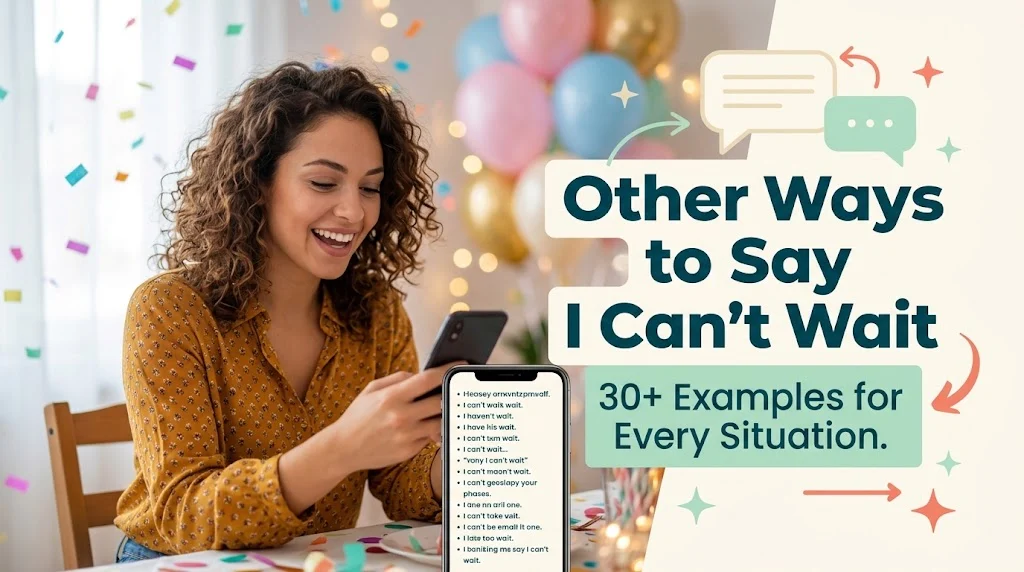
“I can’t wait” is an enthusiastic expression of excitement and anticipation. For more variety and precision, try alternatives like “I am really looking forward to it,” “I am counting down the days,” “I am so excited,” “I am eagerly awaiting,” or “I am buzzing with excitement.”
“I can’t wait” is one of the most natural expressions of excitement in English. People use it before holidays, weddings, concerts, job starts, and reunions. It appears in texts, emails, social media captions, and everyday conversation. It is short, warm, and universally understood.
This guide provides 30 practical alternatives with clear notes on tone, context, and audience. You will learn how to express excitement in English with precision, whether you are writing formally to a client or texting a close friend. These options will help you sound natural, confident, and genuinely enthusiastic.
Pull Quote: “Excitement has levels. The words you choose show exactly how high yours goes.”
Quick Categories
Formal alternatives to “I can’t wait”
- I look forward to it with great anticipation.
- I am eagerly awaiting the opportunity.
- I anticipate this with great enthusiasm.
- I am very much looking forward to it.
Pro Tip: Formal alternatives suit client emails, official invitations, and professional correspondence.
Casual alternatives
- I am so excited.
- I cannot wait for this.
- I am counting down the days.
- I am buzzing.
Pro Tip: Casual options work with friends, family, and familiar colleagues.
Professional alternatives
- I am looking forward to this.
- I am keen to get started.
- I am excited about this opportunity.
- I am eager to begin.
Pro Tip: Professional alternatives should sound enthusiastic without becoming overly emotional.
Informal expressions
- I am dying to see this.
- I am hyped.
- Bring it on.
- I am counting the hours.
Pro Tip: Informal expressions belong in texts, chats, and spoken English with close contacts.
Pull Quote: “The right tone makes your English sound professional and confident.”
Common Mistakes
- Using “I can’t wait” in a formal email.
Example: “Dear Sir, I can’t wait for the meeting.” This sounds too casual for formal correspondence. - Using it for something trivial.
Example: “I can’t wait for my dentist appointment.” The phrase feels exaggerated here. - Using it when the tone should be patient or respectful.
Example: “I can’t wait for your reply.” This can sound demanding rather than polite. - Repeating it in the same message.
Example: “I can’t wait. I really can’t wait. I can’t wait for this.” Repetition weakens impact. - Using it for something negative.
Example: “I can’t wait for this project to end.” This sounds sarcastic or unprofessional.
What Does “I Can’t Wait” Mean?
Definition
It is an expression of strong enthusiasm or anticipation for something that is going to happen.
Grammar Explanation
The phrase uses the modal verb “can,” the negative adverb “not,” and the base verb “wait.” It literally means “I am unable to wait,” but it functions idiomatically to express excitement rather than impatience.
Example Sentence
“I can’t wait to see you at the wedding next month.”
When to Use “I Can’t Wait”
Common Contexts
- Personal events: Weddings, birthdays, and reunions.
- Travel: Upcoming holidays and trips.
- Work: New jobs, projects, and launches.
- Entertainment: Concerts, films, and releases.
- Daily life: Small pleasures like weekends and meals.
Spoken vs Written
- Spoken: Extremely common in daily conversation.
- Written: Common in texts and social media, less so in formal writing.
Formal vs Informal
- Formal: Rarely appropriate in professional correspondence.
- Informal: The default choice in everyday speech.
Is It Professional or Polite to Say “I Can’t Wait”?
Politeness vs Professionalism
The phrase is polite and friendly in casual settings, but it is not professional in most business contexts. In formal writing, it can sound childish or overly emotional. A more measured phrase such as “I am looking forward to it” works better.
Business-Style Example
“I am very much looking forward to our meeting next week.”
Polite? Yes
Professional? No, in most formal contexts
Pull Quote: “Enthusiasm is welcome at work. Overexcitement is not.”
Pros and Cons of Using “I Can’t Wait”
Pros
- Simple and natural: Easy to say and understand.
- Friendly tone: Warm and enthusiastic.
- Common usage: Recognised in every English speaking country.
- Easy to understand: Requires no advanced vocabulary.
Cons
- Too informal for work: Rarely appropriate in professional writing.
- Overused: Loses impact through repetition.
- Limited emotional range: Cannot express calm anticipation or patient hope.
- Not suitable for formal writing: Avoid in reports, letters, and official documents.
Other Ways to Say “I Can’t Wait” (With Examples)
These alternatives will help you sound more fluent, confident, and natural in different situations. Use them according to tone, context, and audience to express excitement, admiration, or approval.
1. I am really looking forward to it
Meaning: I am anticipating this with pleasure.
Explanation: A safe, professional alternative that works in almost any context.
Example Sentence: “I am really looking forward to the conference next week.”
Best Use: Professional, formal
Worst Use: Casual texts
Tone: Warm, polite, professional
Context Variability: Professional and written
2. I am counting down the days
Meaning: I am eagerly waiting for something to happen.
Explanation: Vivid and emotional.
Example Sentence: “I am counting down the days until our holiday.”
Best Use: Personal events
Worst Use: Formal writing
Tone: Excited, eager, warm
Context Variability: Casual and spoken
3. I am so excited
Meaning: I feel strong enthusiasm.
Explanation: Simple and widely used.
Example Sentence: “I am so excited about the new project.”
Best Use: General enthusiasm
Worst Use: Formal reports
Tone: Enthusiastic, warm, friendly
Context Variability: Casual and professional
4. I am eagerly awaiting
Meaning: I am waiting with great interest.
Explanation: Formal and slightly dramatic.
Example Sentence: “I am eagerly awaiting your response.”
Best Use: Formal correspondence
Worst Use: Casual chats
Tone: Formal, polite, expectant
Context Variability: Professional and written
5. I am buzzing with excitement
Meaning: I am full of nervous, happy energy.
Explanation: Very expressive and British in flavour.
Example Sentence: “I am buzzing with excitement about the launch.”
Best Use: Personal, celebratory
Worst Use: Formal emails
Tone: Excited, energetic, informal
Context Variability: Casual and spoken
6. I cannot wait for this
Meaning: A slightly more emphatic version of the standard phrase.
Explanation: Adds stress without changing meaning.
Example Sentence: “I cannot wait for this trip.”
Best Use: Friends, family
Worst Use: Business emails
Tone: Enthusiastic, casual, warm
Context Variability: Casual and spoken
7. I am keen to get started
Meaning: I am ready and eager to begin.
Explanation: Common in workplace settings.
Example Sentence: “I am keen to get started on the new role.”
Best Use: Workplace
Worst Use: Personal events
Tone: Professional, eager, focused
Context Variability: Professional and spoken
8. I am dying to see this
Meaning: I am extremely eager to experience something.
Explanation: Hyperbolic and informal.
Example Sentence: “I am dying to see the new season.”
Best Use: Entertainment
Worst Use: Formal writing
Tone: Eager, informal, expressive
Context Variability: Casual and spoken
9. I am hyped
Meaning: I am very excited and enthusiastic.
Explanation: Modern and youthful.
Example Sentence: “I am so hyped for the concert.”
Best Use: Social media, friends
Worst Use: Professional emails
Tone: Energetic, modern, informal
Context Variability: Casual and spoken
10. I am counting the hours
Meaning: I am waiting with intense anticipation.
Explanation: Stronger than counting the days.
Example Sentence: “I am counting the hours until the weekend.”
Best Use: Personal events
Worst Use: Formal writing
Tone: Eager, intense, informal
Context Variability: Casual and spoken
11. I look forward to it
Meaning: A professional expression of anticipation.
Explanation: Standard and safe in business contexts.
Example Sentence: “I look forward to our next meeting.”
Best Use: Professional emails
Worst Use: Casual chats
Tone: Formal, polite, professional
Context Variability: Professional and written
12. I am excited about this opportunity
Meaning: I am enthusiastic about a chance offered to me.
Explanation: Common in interviews and applications.
Example Sentence: “I am excited about this opportunity to join your team.”
Best Use: Interviews, careers
Worst Use: Casual conversations
Tone: Professional, enthusiastic, formal
Context Variability: Professional and written
13. I am eager to begin
Meaning: I am ready and willing to start.
Explanation: Formal and forward looking.
Example Sentence: “I am eager to begin the training programme.”
Best Use: Workplace, education
Worst Use: Leisure activities
Tone: Formal, motivated, positive
Context Variability: Professional and written
14. I can hardly wait
Meaning: A softer but still enthusiastic version.
Explanation: Slightly more formal than the base phrase.
Example Sentence: “I can hardly wait to hear the results.”
Best Use: General enthusiasm
Worst Use: Formal writing
Tone: Excited, warm, standard
Context Variability: Casual and spoken
15. I am on the edge of my seat
Meaning: I am waiting with intense suspense.
Explanation: Dramatic and vivid.
Example Sentence: “I am on the edge of my seat waiting for the finale.”
Best Use: Entertainment
Worst Use: Business contexts
Tone: Dramatic, suspenseful, informal
Context Variability: Casual and spoken
16. I am thrilled about this
Meaning: I am extremely pleased and excited.
Explanation: Warm and professional.
Example Sentence: “I am thrilled about this partnership.”
Best Use: Business, personal
Worst Use: Routine tasks
Tone: Enthusiastic, warm, professional
Context Variability: Professional and spoken
17. I am itching to get started
Meaning: I am impatient to begin.
Explanation: Informal but expressive.
Example Sentence: “I am itching to get started on the new design.”
Best Use: Creative work
Worst Use: Formal reports
Tone: Eager, informal, energetic
Context Variability: Casual and spoken
18. I cannot contain my excitement
Meaning: My enthusiasm is hard to control.
Explanation: Slightly dramatic and emotional.
Example Sentence: “I cannot contain my excitement about the news.”
Best Use: Personal events
Worst Use: Formal correspondence
Tone: Emotional, dramatic, warm
Context Variability: Casual and spoken
19. I am looking forward to this
Meaning: A neutral and professional expression.
Explanation: Safe in almost every context.
Example Sentence: “I am looking forward to this collaboration.”
Best Use: Professional, formal
Worst Use: Very casual chats
Tone: Neutral, polite, professional
Context Variability: Professional and written
20. I am counting on it
Meaning: I am relying on this happening.
Explanation: Different meaning but often confused.
Example Sentence: “I am counting on it going well.”
Best Use: Expectations
Worst Use: Excitement
Tone: Expectant, practical, neutral
Context Variability: Casual and spoken
21. I am very much looking forward to it
Meaning: A formal and emphatic expression of anticipation.
Explanation: Adds sincerity and respect.
Example Sentence: “I am very much looking forward to working with you.”
Best Use: Business letters
Worst Use: Text messages
Tone: Formal, sincere, polite
Context Variability: Professional and written
22. I am enthusiastic about this
Meaning: I feel strong interest and excitement.
Explanation: Professional and measured.
Example Sentence: “I am enthusiastic about this new initiative.”
Best Use: Workplace
Worst Use: Personal events
Tone: Professional, positive, formal
Context Variability: Professional and written
23. I cannot wait to get there
Meaning: I am eager to arrive or begin.
Explanation: Specific to travel or events.
Example Sentence: “I cannot wait to get there and see everyone.”
Best Use: Travel, reunions
Worst Use: Formal writing
Tone: Excited, warm, informal
Context Variability: Casual and spoken
24. The anticipation is killing me
Meaning: The waiting feels almost unbearable.
Explanation: Dramatic and humorous.
Example Sentence: “The anticipation is killing me. When does it start?”
Best Use: Entertainment, friends
Worst Use: Formal emails
Tone: Dramatic, humorous, informal
Context Variability: Casual and spoken
25. I am excited beyond words
Meaning: My excitement is too strong for words.
Explanation: Emotional and expressive.
Example Sentence: “I am excited beyond words about your visit.”
Best Use: Personal events
Worst Use: Business reports
Tone: Emotional, warm, sincere
Context Variability: Casual and spoken
26. I am ready for this
Meaning: I am prepared and eager.
Explanation: Confident and simple.
Example Sentence: “I am ready for this challenge.”
Best Use: Sports, workplace
Worst Use: Passive contexts
Tone: Confident, eager, direct
Context Variability: Professional and spoken
27. I am raring to go
Meaning: I am extremely eager to begin.
Explanation: Informal and energetic.
Example Sentence: “The team is raring to go on the new campaign.”
Best Use: Sports, teamwork
Worst Use: Formal writing
Tone: Energetic, eager, informal
Context Variability: Casual and spoken
28. I am super excited
Meaning: A very enthusiastic expression.
Explanation: Common in modern English.
Example Sentence: “I am super excited about the wedding.”
Best Use: Personal, social
Worst Use: Formal reports
Tone: Enthusiastic, modern, informal
Context Variability: Casual and spoken
29. I am beside myself with excitement
Meaning: I am overwhelmed with joy.
Explanation: Idiomatic and emotional.
Example Sentence: “She was beside herself with excitement when she heard the news.”
Best Use: Personal events
Worst Use: Business writing
Tone: Emotional, dramatic, warm
Context Variability: Casual and written
30. I am looking forward to seeing you
Meaning: A warm and specific expression of anticipation.
Explanation: Common in both personal and professional contexts.
Example Sentence: “I am looking forward to seeing you at the event.”
Best Use: Networking, personal
Worst Use: Formal complaints
Tone: Warm, polite, sincere
Context Variability: Professional and personal
Pull Quote: “Professional reaction phrases and genuine excitement both show the same thing: you are fully present in the moment.”
Mini Quiz / Self-Check
- Scenario: You are writing a formal email to a client about an upcoming meeting. Which fits best?
- A) I am dying to see this.
- B) I am very much looking forward to it.
- C) The anticipation is killing me.
- Scenario: You are texting a friend about a concert next week. Which is most natural?
- A) I am eagerly awaiting the opportunity.
- B) I am so hyped for this.
- C) I look forward to it.
- Scenario: You are writing a cover letter for a job you really want. Which is most appropriate?
- A) I am excited about this opportunity.
- B) I am buzzing with excitement.
- C) I am counting the hours.
- Scenario: Which phrase is generally too informal for a business email?
- A) I am looking forward to it.
- B) I am hyped.
- C) I am excited about this opportunity.
Comparison Table: Top Alternatives
| Phrase | Tone | Best Use |
| I am really looking forward to it | Warm, professional | Professional emails |
| I am counting down the days | Excited, eager | Personal events |
| I am so excited | Enthusiastic, friendly | General enthusiasm |
| I am eagerly awaiting | Formal, polite | Formal correspondence |
| I am buzzing with excitement | Excited, energetic | Personal, celebratory |
| I am keen to get started | Professional, focused | Workplace |
| I look forward to it | Neutral, polite | Business emails |
| I am thrilled about this | Enthusiastic, warm | Business, personal |
| I am super excited | Enthusiastic, modern | Personal, social |
| I cannot contain my excitement | Emotional, dramatic | Personal events |
FAQs
1. What is a formal alternative to “I can’t wait”?
“I am very much looking forward to it” or “I am eagerly awaiting this” are strong formal alternatives suitable for business emails and official correspondence.
2. How do I express excitement professionally in an email?
Use measured phrases such as “I am excited about this opportunity” or “I am keen to get started” to sound enthusiastic without becoming overly emotional.
3. What can I say instead of “I can’t wait” in a text message?
“I am so hyped,” “I am counting down the days,” and “I cannot wait for this” are natural and friendly options for texts.
4. Is “I can’t wait” too informal for business emails?
Yes, it is generally too informal for professional correspondence. A more measured phrase such as “I am looking forward to it” works better.
5. What is the difference between “I can’t wait” and “I am looking forward to it”?
“I can’t wait” expresses strong, emotional excitement, while “I am looking forward to it” is calmer and more professional.
Conclusion
Learning other ways to say I can’t wait gives you the ability to express excitement with precision, warmth, and professionalism. Whether you are writing to a client, texting a friend, or speaking at an event, the right phrase makes your English sound intentional rather than automatic. These alternatives to I can’t wait help you move beyond one overused expression and into richer, more varied communication.
Practise by choosing one new phrase each week and using it in a real conversation or message. Pay close attention to tone and audience, because the right phrase depends on the situation and the relationship. With steady practice, these informal expressions in English and their formal counterparts will become part of your everyday fluency.

John Green is an American writer who contributes to QuickResponsess.com, creating clear and practical content on English grammar, vocabulary and everyday language. His goal is to make learning English simple, engaging and easy to apply.