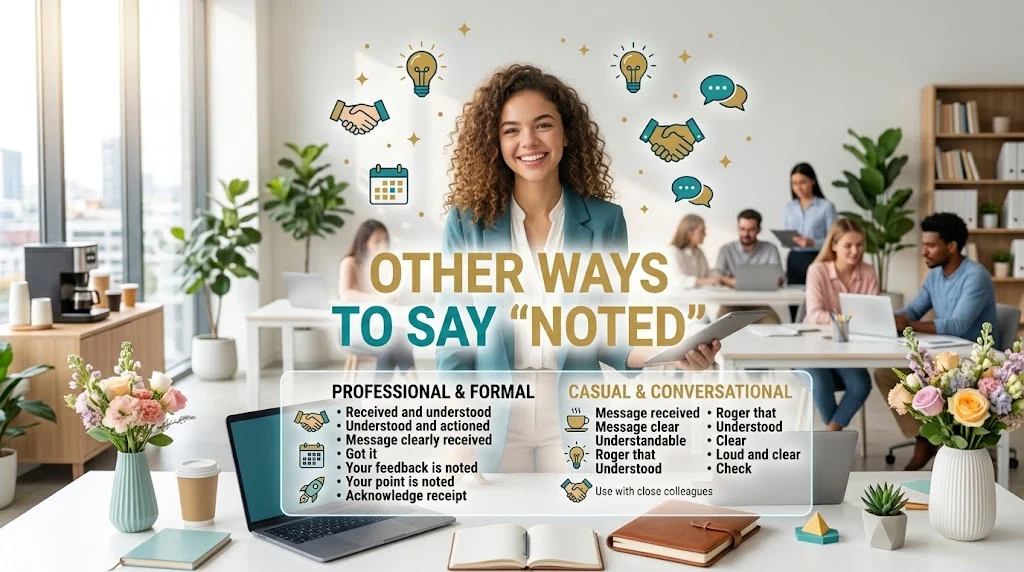
🔥 Quick Answer
The best alternatives to “noted” include “Acknowledged,” “Understood,” “I’ve taken note of this,” “Duly noted,” and “Thank you for the update.” These options help you express acknowledgment with the right tone for any situation.
The word “noted” is a staple in everyday English. It’s a quick, simple way to say, “I have received and understood your message.” But as a professional or an English learner, relying on just one word can make your communication feel robotic, dismissive, or even lazy.
Why should you care about alternatives to “noted” ? Because the words you choose shape how others perceive you. Using the same phrase repeatedly can make you sound unengaged. In contrast, selecting the right alternative shows emotional intelligence, professionalism, and a strong command of the language. Whether you want to express excitement in English about a new project or simply confirm a routine task, varying your vocabulary is key.
Quick Categories
Formal Alternatives to “Noted”
- Acknowledged
- Duly noted
- I have taken note of this
- This has been received and understood
- Your message has been recorded
Casual Alternatives to “Noted”
- Got it
- Okay, noted
- I see
- All clear
- Cool, thanks
Professional Alternatives to “Noted”
- Thank you for the information
- I’ll keep that in mind
- I appreciate the update
- Point taken
- I’ll act on this accordingly
Informal Expressions
- Roger that
- Copy that
- Sounds good
- Right on
- Fair enough
Common Mistakes to Avoid
1. Using “noted” in a thank you note.
“Noted for the gift” is incorrect. “Noted” means acknowledgment, not gratitude.
2. Overusing “duly noted” sarcastically.
In spoken English, “duly noted” can sound sarcastic if your tone is flat. Use it carefully.
3. Forgetting to add action.
“Noted” without follow up can seem passive. Instead, say “Noted, I will send the report by 3 PM.”
4. Using it in response to bad news.
Replying “Noted” to someone’s personal problem sounds cold. Choose a warmer phrase.
5. Confusing “noted” with “noteworthy.”
These are different. “Noted” means acknowledged; “noteworthy” means important or remarkable.
What Does “Noted” Mean?
“Noted” is the past tense of the verb “to note.” It means to have observed, recognized, or paid attention to something. In modern communication, it’s used as a standalone response to confirm that a message has been received and understood.
- Grammar: It functions as a verb (past tense) or an adjective (meaning well known).
- Example Sentence: “Your feedback has been noted, and we will implement the changes.”
When to Use “Noted”
- Spoken vs Written: More common in written communication (emails, texts) but used in spoken English too.
- Formal vs Informal: Generally informal. It’s acceptable in casual work settings but too brief for formal reports.
- Common Contexts:
- Acknowledging instructions
- Confirming receipt of information
- Responding to a colleague’s update
- Quick replies in chat applications
Is It Professional or Polite to Say “Noted”?
Polite? ✔️ Yes it acknowledges the other person’s effort.
Professional? ❌ No in most cases, it’s too brief and can seem dismissive.
- Business Example: “Noted, I will review the proposal and get back to you by Friday.” (Better to add action.)
Pros and Cons of Using “Noted”
Pros:
- Simple and natural
- Friendly tone
- Common usage
- Easy to understand
Cons:
- Too informal for work
- Overused
- Limited emotional range
- Not suitable for formal writing
Other Ways to Say “Noted” (With Examples)
These alternatives will help you sound more fluent, confident, and natural in different situations. Use them according to tone, context, and audience to express acknowledgment clearly.
1. Phrase: Acknowledged
Meaning: Confirms you have received and understood the message.
Explanation: A formal and direct way to say “noted.”
Example Sentence: “Acknowledged. I’ll proceed with the next steps.”
Best Use: Formal emails
Worst Use: Casual chats
Tone: Formal, direct
Context Variability: Professional
2. Phrase: Understood
Meaning: You comprehend the information given.
Explanation: Clear and concise, often used in instructions.
Example Sentence: “Understood, I’ll adjust the timeline accordingly.”
Best Use: Task confirmation
Worst Use: Expressing gratitude
Tone: Neutral, clear
Context Variability: Professional / Casual
3. Phrase: I’ve taken note of this
Meaning: You have recorded or remembered the information.
Explanation: A more personal and complete way to say “noted.”
Example Sentence: “I’ve taken note of this and will include it in the report.”
Best Use: Detailed follow ups
Worst Use: Quick replies
Tone: Professional, thorough
Context Variability: Professional
4. Phrase: Duly noted
Meaning: Formally and properly acknowledged.
Explanation: Adds a layer of respect and formality.
Example Sentence: “Your concerns are duly noted and will be addressed.”
Best Use: Formal correspondence
Worst Use: Casual conversations (can sound sarcastic)
Tone: Formal, respectful
Context Variability: Formal written
5. Phrase: Thank you for the update
Meaning: Expresses gratitude while acknowledging new information.
Explanation: Combines acknowledgment with appreciation.
Example Sentence: “Thank you for the update. I’ll review it shortly.”
Best Use: Email responses
Worst Use: When no update was given
Tone: Grateful, polite
Context Variability: Professional
6. Phrase: Got it
Meaning: Informal way to say you understand.
Explanation: Very common in spoken and casual written English.
Example Sentence: “Got it, I’ll handle the booking.”
Best Use: Team chats
Worst Use: Formal reports
Tone: Casual, friendly
Context Variability: Casual
7. Phrase: Point taken
Meaning: You accept or agree with someone’s argument.
Explanation: Often used in discussions or debates.
Example Sentence: “Point taken. I’ll reconsider my approach.”
Best Use: Feedback sessions
Worst Use: Acknowledging simple tasks
Tone: Respectful, agreeable
Context Variability: Professional / Casual
8. Phrase: I’ll keep that in mind
Meaning: You will remember the information for future reference.
Explanation: Shows you value the input and will act on it later.
Example Sentence: “I’ll keep that in mind for the next project.”
Best Use: Future planning
Worst Use: Immediate action items
Tone: Thoughtful, considerate
Context Variability: Professional
9. Phrase: I appreciate the information
Meaning: You are thankful for the data shared.
Explanation: Warm and professional acknowledgment.
Example Sentence: “I appreciate the information; it’s very helpful.”
Best Use: When receiving detailed data
Worst Use: Very brief updates
Tone: Grateful, warm
Context Variability: Professional
10. Phrase: Noted with thanks
Meaning: Acknowledged with gratitude.
Explanation: A polite hybrid of “noted” and “thank you.”
Example Sentence: “Noted with thanks. I’ll get back to you soon.”
Best Use: Email replies
Worst Use: Verbal conversations
Tone: Polite, appreciative
Context Variability: Professional
11. Phrase: I understand your point
Meaning: You comprehend the other person’s perspective.
Explanation: Shows empathy and active listening.
Example Sentence: “I understand your point, and I’ll take it into consideration.”
Best Use: Conflict resolution
Worst Use: Routine updates
Tone: Empathetic, clear
Context Variability: Professional
12. Phrase: This has been noted
Meaning: A slightly more formal version of “noted.”
Explanation: Adds a passive tone, often used in official documents.
Example Sentence: “This has been noted for the records.”
Best Use: Official minutes
Worst Use: Personal conversations
Tone: Formal, detached
Context Variability: Formal written
13. Phrase: Received and understood
Meaning: Confirms both receipt and comprehension.
Explanation: Thorough and unambiguous.
Example Sentence: “Received and understood. I’ll start the work now.”
Best Use: Military or technical settings
Worst Use: Casual chats
Tone: Direct, clear
Context Variability: Professional
14. Phrase: I’ll make a note of that
Meaning: You will write it down for future use.
Explanation: Indicates you are taking the information seriously.
Example Sentence: “I’ll make a note of that for our next meeting.”
Best Use: Action planning
Worst Use: When no action is needed
Tone: Organized, reliable
Context Variability: Professional
15. Phrase: Consider it noted
Meaning: A confident way to say it’s been acknowledged.
Explanation: Informal but assertive.
Example Sentence: “Consider it noted. I’ll take care of it.”
Best Use: Team conversations
Worst Use: Formal letters
Tone: Confident, casual
Context Variability: Casual / Professional
16. Phrase: Roger that
Meaning: Radio communication slang for “message received.”
Explanation: Very informal, often used in playful or team contexts.
Example Sentence: “Roger that. I’ll be there in five.”
Best Use: Informal team settings
Worst Use: Business emails
Tone: Playful, informal
Context Variability: Casual
17. Phrase: Copy that
Meaning: Similar to “roger that,” means you heard and understood.
Explanation: Originates from radio communication.
Example Sentence: “Copy that. We’ll proceed as planned.”
Best Use: Quick verbal confirmations
Worst Use: Written reports
Tone: Informal, efficient
Context Variability: Casual
18. Phrase: All clear
Meaning: Everything is understood and there are no issues.
Explanation: Often used when confirming that instructions are clear.
Example Sentence: “All clear. I’ll start the implementation.”
Best Use: Task handovers
Worst Use: Formal meetings
Tone: Reassuring, clear
Context Variability: Casual / Professional
19. Phrase: Sounds good
Meaning: You agree and acknowledge the plan.
Explanation: A friendly, casual way to show approval.
Example Sentence: “Sounds good. Let’s move forward with that.”
Best Use: Planning discussions
Worst Use: Serious or formal contexts
Tone: Friendly, agreeable
Context Variability: Casual
20. Phrase: I see
Meaning: You understand the situation.
Explanation: Very common in spoken English.
Example Sentence: “I see. That changes things a bit.”
Best Use: Conversations
Worst Use: Written business communication
Tone: Neutral, understanding
Context Variability: Casual / Spoken
21. Phrase: Noted and actioned
Meaning: Acknowledged and acted upon.
Explanation: Shows proactive follow through.
Example Sentence: “Noted and actioned. The file has been updated.”
Best Use: Task management
Worst Use: When no action is taken
Tone: Efficient, professional
Context Variability: Professional
22. Phrase: I have registered that
Meaning: You have consciously noted the information.
Explanation: A more formal and deliberate way to say “noted.”
Example Sentence: “I have registered that, and I’ll consider it.”
Best Use: Official meetings
Worst Use: Casual texts
Tone: Formal, deliberate
Context Variability: Formal
23. Phrase: Your input is appreciated
Meaning: You value the other person’s contribution.
Explanation: Warm and professional.
Example Sentence: “Your input is appreciated and will be incorporated.”
Best Use: Team feedback
Worst Use: When no input was given
Tone: Grateful, inclusive
Context Variability: Professional
24. Phrase: I’m on it
Meaning: You acknowledge the task and are taking action.
Explanation: Shows initiative and readiness.
Example Sentence: “I’m on it. I’ll have the report ready by noon.”
Best Use: Quick task assignments
Worst Use: Formal written communication
Tone: Proactive, confident
Context Variability: Casual / Professional
25. Phrase: Fair enough
Meaning: You accept the other person’s point or decision.
Explanation: Often used when you agree but may have reservations.
Example Sentence: “Fair enough. Let’s try it your way.”
Best Use: Negotiations
Worst Use: Acknowledging simple facts
Tone: Agreeable, slightly informal
Context Variability: Casual / Professional
26. Phrase: Message received
Meaning: Confirms that you have received the communication.
Explanation: Direct and unambiguous.
Example Sentence: “Message received. I’ll follow up tomorrow.”
Best Use: Written confirmations
Worst Use: Expressing gratitude
Tone: Direct, neutral
Context Variability: Professional / Casual
27. Phrase: I’ll take that on board
Meaning: You will consider or act on the information.
Explanation: A common British English phrase.
Example Sentence: “I’ll take that on board for the next phase.”
Best Use: Collaborative settings
Worst Use: Quick replies
Tone: Collaborative, thoughtful
Context Variability: Professional
28. Phrase: Right, got it
Meaning: Acknowledges understanding with a hint of readiness.
Explanation: Friendly and conversational.
Example Sentence: “Right, got it. I’ll start straight away.”
Best Use: Verbal conversations
Worst Use: Formal emails
Tone: Enthusiastic, casual
Context Variability: Casual
29. Phrase: That’s clear
Meaning: You have understood the information without confusion.
Explanation: Reassures the speaker that their message was clear.
Example Sentence: “That’s clear. I’ll proceed with the changes.”
Best Use: Clarification moments
Worst Use: When you disagree
Tone: Clear, reassuring
Context Variability: Professional / Casual
30. Phrase: I acknowledge receipt
Meaning: Formal confirmation that you have received something.
Explanation: Often used in legal or official contexts.
Example Sentence: “I acknowledge receipt of the documents.”
Best Use: Official correspondence
Worst Use: Everyday conversations
Tone: Formal, official
Context Variability: Formal written
“The right tone makes your English sound professional and confident.”
“Varying your vocabulary isn’t just about sounding smart it’s about being understood.”
“In professional communication, how you say something is just as important as what you say.”
“Every alternative you learn is another tool for building stronger relationships.”
Mini Quiz: Test Your Knowledge
1. Which phrase is best for a formal email to a client?
A) Got it
B) Duly noted
C) Sounds good
Answer: B
2. Your colleague gives you a quick task in a team chat. What’s the best reply?
A) I acknowledge receipt
B) I’m on it
C) Your input is appreciated
Answer: B
3. You’re in a meeting and want to show you understand a complex point. Which is most appropriate?
A) Roger that
B) Point taken
C) Fair enough
Answer: B
4. You receive an update from your manager. Which reply shows the most professionalism?
A) Thank you for the update
B) Noted
C) Cool
Answer: A
Comparison Table: Top 10 Alternatives
| Phrase | Tone | Best Use |
| Acknowledged | Formal | Official emails |
| Understood | Neutral | Task confirmation |
| I’ve taken note of this | Professional | Detailed follow ups |
| Duly noted | Formal | Respectful acknowledgment |
| Thank you for the update | Grateful | Email responses |
| Got it | Casual | Team chats |
| Point taken | Respectful | Feedback sessions |
| I’ll keep that in mind | Thoughtful | Future planning |
| Noted with thanks | Polite | Email replies |
| I’m on it | Proactive | Quick task assignments |
Frequently Asked Questions
1. Is “noted” rude in an email?
“Noted” can seem rude if used alone because it’s very brief. Adding a thank you or action plan makes it more polite.
2. What is the best formal alternative to “noted”?
“Acknowledged” and “Duly noted” are excellent formal alternatives that maintain professionalism.
3. Can I use “noted” in a cover letter?
No. “Noted” is too casual for a cover letter. Use phrases like “I have taken note of” or “I acknowledge.”
4. What does “duly noted” mean?
“Duly noted” means properly and formally acknowledged. It is often used in official or respectful contexts.
5. How do I respond to “noted” in a professional way?
You can reply with “Thank you for confirming” or “I appreciate your acknowledgment” to keep the conversation warm and professional.
Conclusion
Learning other ways to say “noted” is a small change that makes a big difference. It helps you avoid sounding repetitive, shows respect for your listeners, and allows you to match your tone to the situation. Whether you’re writing an email, attending a meeting, or chatting with colleagues, choosing the right phrase builds trust and clarity.
Start by practicing one or two new alternatives each day. Pay attention to the tone of the conversation and adjust accordingly. With time, these phrases will become second nature, and your English communication will feel more polished, confident, and professional.

Sally Rooney is an American writer who contributes to QuickResponsess.com, creating clear and practical content for English learners. Her articles help readers build confidence in using words and expressions accurately in everyday and professional communication.