Quick Answer 🔥
Try these professional phrases: I concur, I share your perspective, I am in full agreement, Your point is well taken, and I support this approach.
“I agree with you” is a clear and useful phrase. It tells the other person that you share their opinion or support their idea. But when you use it repeatedly, your English can sound flat, repetitive, or even unprofessional.
Learning alternatives to “I agree with you” helps you sound more confident, articulate, and context aware. Native speakers rarely stick to one phrase—they adjust their language to match the setting, the relationship, and the tone of the conversation. Whether you are writing a business email, participating in a meeting, or having a formal discussion, having a range of professional reaction phrases at your disposal will elevate your communication.
“The right tone makes your English sound professional and confident.”
Quick Categories
Formal alternatives to “I agree with you”
- I concur
- I share your perspective
- I am in full agreement
- Your point is well taken
Casual alternatives
- Exactly
- You’re right
- That’s true
- I’m with you
Professional alternatives
- I support this approach
- That aligns with my thinking
- I endorse your view
- I am aligned with your position
Informal expressions
- Totally
- Couldn’t agree more
- Right on
- I feel the same way
Formal Alternatives to “I Agree With You”
1. Phrase: I concur.
Meaning: I formally agree with your opinion or conclusion.
Explanation: This is a classic, concise way to express agreement in professional and academic settings.
Example Sentence: “I concur with your assessment of the quarterly results.”
Best Use: Formal meetings
Worst Use: Casual chats
Tone: Formal, authoritative
2. Phrase: I share your perspective.
Meaning: I view the situation in the same way you do.
Explanation: This phrase shows thoughtful alignment and respect for the other person’s viewpoint.
Example Sentence: “I share your perspective on the need for better client communication.”
Best Use: Collaborative discussions
Worst Use: Quick text replies
Tone: Respectful, cooperative
3. Phrase: I am in full agreement.
Meaning: I agree completely without any reservations.
Explanation: This emphasizes total unity and is ideal for team communications.
Example Sentence: “I am in full agreement with your proposal to restructure the team.”
Best Use: Team alignment
Worst Use: Brief acknowledgments
Tone: Strong, committed
4. Phrase: Your point is well taken.
Meaning: I understand and accept your point.
Explanation: This is a courteous way to agree, especially after someone provides new insight.
Example Sentence: “Your point is well taken, and I support the recommended adjustment.”
Best Use: After new input
Worst Use: When you fully agree from the start
Tone: Polite, receptive
5. Phrase: I support this approach.
Meaning: I agree and endorse the suggested plan or method.
Explanation: This shows active backing, not just passive agreement.
Example Sentence: “I support this approach and believe it will improve our efficiency.”
Best Use: Strategic decisions
Worst Use: Personal opinions
Tone: Endorsing, confident
6. Phrase: That aligns with my thinking.
Meaning: Your idea matches my own thoughts on the matter.
Explanation: This phrase signals intellectual harmony in a professional way.
Example Sentence: “That aligns with my thinking on how to handle the budget.”
Best Use: Strategic planning
Worst Use: Everyday conversation
Tone: Analytical, professional
7. Phrase: I echo your sentiments.
Meaning: I share and express the same feelings or opinions.
Explanation: This is a polished phrase ideal for formal written communication.
Example Sentence: “I echo your sentiments regarding the importance of transparency.”
Best Use: Formal emails
Worst Use: Quick verbal agreement
Tone: Refined, articulate
8. Phrase: I am of the same opinion.
Meaning: My opinion is identical to yours.
Explanation: This is a slightly formal and clear way to express agreement.
Example Sentence: “I am of the same opinion when it comes to prioritizing customer satisfaction.”
Best Use: Professional discussions
Worst Use: Informal settings
Tone: Formal, clear
9. Phrase: I completely concur with your point.
Meaning: I fully agree with the specific point you have made.
Explanation: Adding “completely” strengthens the agreement.
Example Sentence: “I completely concur with your point about expanding our digital presence.”
Best Use: Formal emails or reports
Worst Use: Casual conversation
Tone: Emphatic, formal
10. Phrase: I fully support your view.
Meaning: I endorse your opinion or position entirely.
Explanation: This shows strong backing and is great for meetings.
Example Sentence: “I fully support your view on investing in employee training.”
Best Use: Strategy discussions
Worst Use: Minor agreements
Tone: Supportive, decisive
11. Phrase: Your perspective aligns with mine.
Meaning: Our viewpoints are in harmony.
Explanation: This is polished and professional phrasing.
Example Sentence: “Your perspective aligns with mine regarding the project timeline.”
Best Use: Professional conversations
Worst Use: Casual chats
Tone: Polished, professional
12. Phrase: I agree with your assessment.
Meaning: I accept your evaluation or analysis of the situation.
Explanation: This is a respectful way to validate someone’s analytical work.
Example Sentence: “I agree with your assessment of the market risks.”
Best Use: Analytical discussions
Worst Use: General agreement
Tone: Analytical, respectful
13. Phrase: I respectfully agree.
Meaning: I agree while showing deference and politeness.
Explanation: This phrase is ideal when responding to a senior colleague or manager.
Example Sentence: “I respectfully agree with your recommendation and will proceed accordingly.”
Best Use: Responding to superiors
Worst Use: Peer to peer casual talk
Tone: Deferential, polite
14. Phrase: I see eye to eye with you on this.
Meaning: We share the same opinion on this matter.
Explanation: This is a slightly more conversational but still professional idiom.
Example Sentence: “I see eye to eye with you on this approach to client retention.”
Best Use: Professional but friendly settings
Worst Use: Very formal legal documents
Tone: Collegial, agreeable
15. Phrase: I endorse your position.
Meaning: I formally support your stance.
Explanation: This shows strong, official backing.
Example Sentence: “I endorse your position on the new compliance policy.”
Best Use: Official statements
Worst Use: Casual conversation
Tone: Formal, authoritative
“Mastering formal agreement phrases helps you sound more articulate and credible in any professional setting.”
Professional Alternatives for the Workplace
16. Phrase: I am aligned with your position.
Meaning: My views match your stated position.
Explanation: This is a modern, business friendly way to express agreement.
Example Sentence: “I am aligned with your position on the merger strategy.”
Best Use: Corporate communication
Worst Use: Personal conversations
Tone: Business like, clear
17. Phrase: That matches my understanding.
Meaning: What you said is consistent with what I know.
Explanation: This phrase is useful when confirming shared knowledge.
Example Sentence: “That matches my understanding of the client’s requirements.”
Best Use: Clarifying discussions
Worst Use: Emotional agreement
Tone: Factual, confirming
18. Phrase: I am in accord with you.
Meaning: I am in harmony or agreement with you.
Explanation: This is a formal and somewhat literary way to agree.
Example Sentence: “I am in accord with you on the need for tighter security measures.”
Best Use: Formal reports
Worst Use: Everyday talk
Tone: Formal, harmonious
19. Phrase: I concur with your analysis.
Meaning: I agree with your detailed examination of the facts.
Explanation: This is specific and shows you have considered the evidence.
Example Sentence: “I concur with your analysis of the financial data.”
Best Use: Data driven discussions
Worst Use: Emotional topics
Tone: Analytical, formal
20. Phrase: I subscribe to that view.
Meaning: I hold the same opinion or belief.
Explanation: This suggests a long term or principled agreement.
Example Sentence: “I subscribe to that view on sustainable business practices.”
Best Use: Ideological or policy discussions
Worst Use: Quick decisions
Tone: Committed, principled
21. Phrase: I accept your proposition.
Meaning: I agree to your suggested plan or idea.
Explanation: This is a direct and formal way to agree to a proposal.
Example Sentence: “I accept your proposition to extend the deadline.”
Best Use: Formal proposals
Worst Use: Casual suggestions
Tone: Formal, accepting
22. Phrase: I have no objection to that.
Meaning: I do not oppose your idea; I agree with it.
Explanation: This is a polite way to agree, often used in formal settings.
Example Sentence: “I have no objection to that timeline.”
Best Use: Formal meetings
Worst Use: Enthusiastic agreement
Tone: Neutral, formal
23. Phrase: I am convinced by your argument.
Meaning: Your reasoning has persuaded me; I agree.
Explanation: This shows that you were thoughtfully persuaded.
Example Sentence: “I am convinced by your argument for a phased rollout.”
Best Use: Debates or persuasive discussions
Worst Use: Simple agreements
Tone: Persuaded, thoughtful
24. Phrase: I stand with you on this.
Meaning: I support you and your position on this issue.
Explanation: This shows solidarity and agreement.
Example Sentence: “I stand with you on this decision to cut costs.”
Best Use: Team support
Worst Use: Formal written contracts
Tone: Supportive, collegial
25. Phrase: I acknowledge and agree.
Meaning: I recognize your point and agree with it.
Explanation: This combines acknowledgment with agreement.
Example Sentence: “I acknowledge and agree with the need for more rigorous testing.”
Best Use: Formal responses
Worst Use: Quick replies
Tone: Formal, thorough
Polite and Tactful Agreement Phrases
26. Phrase: That is a valid point.
Meaning: Your point is reasonable and I agree with it.
Explanation: This validates the other person’s contribution before agreeing.
Example Sentence: “That is a valid point, and I support it.”
Best Use: Discussions with differing views
Worst Use: When you fully agree from the start
Tone: Validating, polite
27. Phrase: I see your point.
Meaning: I understand and agree with your perspective.
Explanation: This is a simple, polite way to show agreement.
Example Sentence: “I see your point about needing more resources.”
Best Use: Professional conversations
Worst Use: Formal legal writing
Tone: Understanding, polite
28. Phrase: You make a compelling argument.
Meaning: Your argument is strong and I agree with it.
Explanation: This shows respect for the other person’s reasoning.
Example Sentence: “You make a compelling argument for expanding into new markets.”
Best Use: Persuasive discussions
Worst Use: Casual chats
Tone: Respectful, convinced
29. Phrase: I am inclined to agree.
Meaning: I lean toward agreeing with you.
Explanation: This shows a slight hesitation, making it tactful.
Example Sentence: “I am inclined to agree with your assessment of the situation.”
Best Use: When you are mostly but not fully convinced
Worst Use: Strong, decisive agreement
Tone: Tentative, polite
30. Phrase: I have the same view.
Meaning: My view is identical to yours.
Explanation: This is a straightforward and formal way to agree.
Example Sentence: “I have the same view regarding the project’s direction.”
Best Use: Professional discussions
Worst Use: Emotional topics
Tone: Clear, formal
“Using varied agreement phrases shows emotional intelligence and builds stronger professional rapport.”
Common Mistakes to Avoid
- Overusing “I agree” in every sentence.
Example: “I agree with your point. I agree with your suggestion. I agree with your plan.”
Fix: Vary your language with phrases like “I concur” or “That aligns with my thinking.” - Using informal phrases in formal emails.
Example: “Yeah, totally agree with you.”
Fix: Use “I am in full agreement with your proposal.” - Forgetting to acknowledge the other person’s point.
Example: “I agree.” (without context)
Fix: “I agree with your assessment of the market trends.” - Using overly formal phrases in casual settings.
Example: “I concur with your perspective on the movie.”
Fix: Use “I agree” or “You’re right” in casual conversations. - Agreeing without showing understanding.
Example: “I agree.” (when you haven’t fully understood)
Fix: “I see your point and I agree with it.”
What Does “I Agree With You” Mean?
“I agree with you” means that you share the same opinion, viewpoint, or belief as the person you are speaking with. It is an expression of alignment, approval, or acknowledgment of their perspective.
Grammar note: It is a verb phrase: agree (verb) + with (preposition) + you (object pronoun).
Example sentence: “I agree with you about the importance of clear communication.”
When to Use “I Agree With You”
- Spoken English: Great for everyday conversations. Clear and friendly.
- Business English: Acceptable, but often replaced with more polished phrases.
- Emails / Messages: Fine in casual emails. In formal emails, alternatives sound better.
- Social Media: Works, but short phrases like “Exactly” or “Well said” feel more natural.
- Academic Writing: Usually avoided. Academic tone prefers phrases like “This view is valid.”
- Professional Meetings: Safe, but stronger agreement phrases show confidence.
Is It Professional or Polite to Say “I Agree With You”?
| Aspect | Verdict |
| Polite? | ✔️ Yes |
| Professional? | ❌ No (in most formal cases) |
The phrase is neutral and polite, but it is considered basic in professional settings. In corporate emails or presentations, choosing a more formal alternative will make you sound more confident and senior.
Business style example: “I concur with your analysis and support moving forward with the proposed strategy.”
Pros and Cons of Using “I Agree With You”
Pros:
- Simple and natural
- Friendly tone
- Common usage
- Easy to understand
Cons:
- Too informal for work
- Overused
- Limited emotional range
- Not suitable for formal writing
Comparison Table: Top 10 Alternatives
| Phrase | Tone | Best Use |
| I concur. | Formal, authoritative | Formal meetings, academic writing |
| I share your perspective. | Respectful, cooperative | Collaborative discussions |
| I am in full agreement. | Strong, committed | Team alignment |
| Your point is well taken. | Polite, receptive | After new input |
| I support this approach. | Endorsing, confident | Strategic decisions |
| That aligns with my thinking. | Analytical, professional | Strategic planning |
| I echo your sentiments. | Refined, articulate | Formal emails |
| I am of the same opinion. | Formal, clear | Professional discussions |
| I respectfully agree. | Deferential, polite | Responding to superiors |
| I see eye to eye with you. | Collegial, agreeable | Professional but friendly settings |
Mini Quiz / Self Check
1. Which phrase is best for a formal email to a client?
A) “Yeah, totally agree.”
B) “I concur with your assessment.”
C) “I’m with you.”
Answer: B
2. Which phrase is most appropriate for a casual conversation with a friend?
A) “I am in full agreement.”
B) “I concur.”
C) “You’re so right.”
Answer: C
3. You are in a meeting and want to show strong support for a colleague’s proposal. Which phrase works best?
A) “I have no objection.”
B) “I fully support your view.”
C) “That’s true.”
Answer: B
4. Which phrase is too formal for a quick text message?
A) “I concur.”
B) “Exactly.”
C) “Totally.”
Answer: A
FAQs
1. What is the most formal way to say “I agree with you”?
The most formal way is “I concur” or “I am in full agreement.” These phrases are widely used in professional and academic settings.
2. Can I say “I agree with you” in a professional email?
Yes, but it is better to use more polished phrases like “I support this approach” or “Your point is well taken” to sound more professional.
3. Is “I concur” too old fashioned?
No, “I concur” is still widely used in formal meetings, academic writing, and legal contexts.
4. What is a polite way to agree with a manager?
“I respectfully agree with your recommendation” is a polite and professional way to agree with a superior.
5. How can I agree without saying “I agree”?
You can use phrases like “That aligns with my thinking,” “I share your perspective,” or “Your point is well taken”.
Conclusion
Learning alternatives to “I agree with you” is one of the simplest ways to elevate your English. It helps you sound more fluent, confident, and professional in any situation. Whether you are writing an email, participating in a meeting, or having a casual conversation, the right phrase can make all the difference.
Start practicing these professional reaction phrases today. Pay attention to the tone and context, and soon you will naturally choose the best expression for every situation. Remember, great communication is not just about what you say—it is about how you say it.
See also:
What is your go to formal agreement phrase? Share it in the comments below!
Meta Description
Discover 30+ other ways to say I agree with you formally. Perfect for professional emails, meetings, and business communication. Boost your English today! (157 characters)
Feature Image Prompt
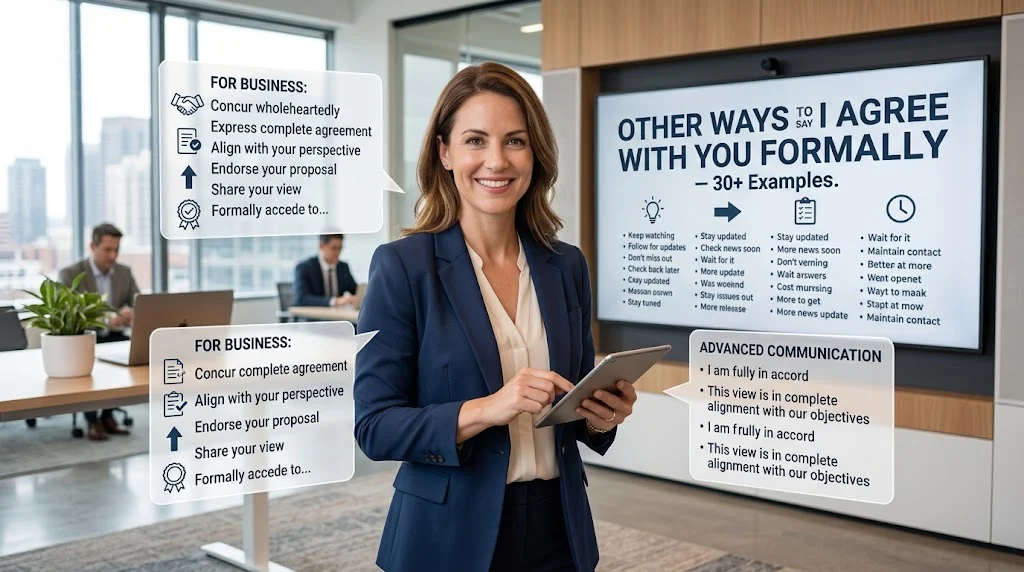
Prompt: A confident professional woman in a business suit standing in a modern office, nodding and smiling while holding a tablet. The bold white text overlay reads: “Other Ways to Say I Agree With You Formally — 30+ Examples.” Soft natural lighting, clean background, educational and Pinterest friendly style.
Alt Text: Other ways to say I agree with you formally – 30+ professional English phrases for business communication
Quick Answer Box 🔥
Quick Answer: Need formal alternatives to “I agree with you”? Try these professional phrases: I concur, I share your perspective, I am in full agreement, Your point is well taken, and I support this approach.
Introduction
“I agree with you” is a clear and useful phrase. It tells the other person that you share their opinion or support their idea. But when you use it repeatedly, your English can sound flat, repetitive, or even unprofessional.
Learning alternatives to “I agree with you” helps you sound more confident, articulate, and context aware. Native speakers rarely stick to one phrase—they adjust their language to match the setting, the relationship, and the tone of the conversation. Whether you are writing a business email, participating in a meeting, or having a formal discussion, having a range of professional reaction phrases at your disposal will elevate your communication.
“The right tone makes your English sound professional and confident.”
Quick Categories
Formal alternatives to “I agree with you”
- I concur
- I share your perspective
- I am in full agreement
- Your point is well taken
Casual alternatives
- Exactly
- You’re right
- That’s true
- I’m with you
Professional alternatives
- I support this approach
- That aligns with my thinking
- I endorse your view
- I am aligned with your position
Informal expressions
- Totally
- Couldn’t agree more
- Right on
- I feel the same way
Formal Alternatives to “I Agree With You”
1. Phrase: I concur.
Meaning: I formally agree with your opinion or conclusion.
Explanation: This is a classic, concise way to express agreement in professional and academic settings.
Example Sentence: “I concur with your assessment of the quarterly results.”
Best Use: Formal meetings
Worst Use: Casual chats
Tone: Formal, authoritative
2. Phrase: I share your perspective.
Meaning: I view the situation in the same way you do.
Explanation: This phrase shows thoughtful alignment and respect for the other person’s viewpoint.
Example Sentence: “I share your perspective on the need for better client communication.”
Best Use: Collaborative discussions
Worst Use: Quick text replies
Tone: Respectful, cooperative
3. Phrase: I am in full agreement.
Meaning: I agree completely without any reservations.
Explanation: This emphasizes total unity and is ideal for team communications.
Example Sentence: “I am in full agreement with your proposal to restructure the team.”
Best Use: Team alignment
Worst Use: Brief acknowledgments
Tone: Strong, committed
4. Phrase: Your point is well taken.
Meaning: I understand and accept your point.
Explanation: This is a courteous way to agree, especially after someone provides new insight.
Example Sentence: “Your point is well taken, and I support the recommended adjustment.”
Best Use: After new input
Worst Use: When you fully agree from the start
Tone: Polite, receptive
5. Phrase: I support this approach.
Meaning: I agree and endorse the suggested plan or method.
Explanation: This shows active backing, not just passive agreement.
Example Sentence: “I support this approach and believe it will improve our efficiency.”
Best Use: Strategic decisions
Worst Use: Personal opinions
Tone: Endorsing, confident
6. Phrase: That aligns with my thinking.
Meaning: Your idea matches my own thoughts on the matter.
Explanation: This phrase signals intellectual harmony in a professional way.
Example Sentence: “That aligns with my thinking on how to handle the budget.”
Best Use: Strategic planning
Worst Use: Everyday conversation
Tone: Analytical, professional
7. Phrase: I echo your sentiments.
Meaning: I share and express the same feelings or opinions.
Explanation: This is a polished phrase ideal for formal written communication.
Example Sentence: “I echo your sentiments regarding the importance of transparency.”
Best Use: Formal emails
Worst Use: Quick verbal agreement
Tone: Refined, articulate
8. Phrase: I am of the same opinion.
Meaning: My opinion is identical to yours.
Explanation: This is a slightly formal and clear way to express agreement.
Example Sentence: “I am of the same opinion when it comes to prioritizing customer satisfaction.”
Best Use: Professional discussions
Worst Use: Informal settings
Tone: Formal, clear
9. Phrase: I completely concur with your point.
Meaning: I fully agree with the specific point you have made.
Explanation: Adding “completely” strengthens the agreement.
Example Sentence: “I completely concur with your point about expanding our digital presence.”
Best Use: Formal emails or reports
Worst Use: Casual conversation
Tone: Emphatic, formal
10. Phrase: I fully support your view.
Meaning: I endorse your opinion or position entirely.
Explanation: This shows strong backing and is great for meetings.
Example Sentence: “I fully support your view on investing in employee training.”
Best Use: Strategy discussions
Worst Use: Minor agreements
Tone: Supportive, decisive
11. Phrase: Your perspective aligns with mine.
Meaning: Our viewpoints are in harmony.
Explanation: This is polished and professional phrasing.
Example Sentence: “Your perspective aligns with mine regarding the project timeline.”
Best Use: Professional conversations
Worst Use: Casual chats
Tone: Polished, professional
12. Phrase: I agree with your assessment.
Meaning: I accept your evaluation or analysis of the situation.
Explanation: This is a respectful way to validate someone’s analytical work.
Example Sentence: “I agree with your assessment of the market risks.”
Best Use: Analytical discussions
Worst Use: General agreement
Tone: Analytical, respectful
13. Phrase: I respectfully agree.
Meaning: I agree while showing deference and politeness.
Explanation: This phrase is ideal when responding to a senior colleague or manager.
Example Sentence: “I respectfully agree with your recommendation and will proceed accordingly.”
Best Use: Responding to superiors
Worst Use: Peer to peer casual talk
Tone: Deferential, polite
14. Phrase: I see eye to eye with you on this.
Meaning: We share the same opinion on this matter.
Explanation: This is a slightly more conversational but still professional idiom.
Example Sentence: “I see eye to eye with you on this approach to client retention.”
Best Use: Professional but friendly settings
Worst Use: Very formal legal documents
Tone: Collegial, agreeable
15. Phrase: I endorse your position.
Meaning: I formally support your stance.
Explanation: This shows strong, official backing.
Example Sentence: “I endorse your position on the new compliance policy.”
Best Use: Official statements
Worst Use: Casual conversation
Tone: Formal, authoritative
“Mastering formal agreement phrases helps you sound more articulate and credible in any professional setting.”
Professional Alternatives for the Workplace
16. Phrase: I am aligned with your position.
Meaning: My views match your stated position.
Explanation: This is a modern, business friendly way to express agreement.
Example Sentence: “I am aligned with your position on the merger strategy.”
Best Use: Corporate communication
Worst Use: Personal conversations
Tone: Business like, clear
17. Phrase: That matches my understanding.
Meaning: What you said is consistent with what I know.
Explanation: This phrase is useful when confirming shared knowledge.
Example Sentence: “That matches my understanding of the client’s requirements.”
Best Use: Clarifying discussions
Worst Use: Emotional agreement
Tone: Factual, confirming
18. Phrase: I am in accord with you.
Meaning: I am in harmony or agreement with you.
Explanation: This is a formal and somewhat literary way to agree.
Example Sentence: “I am in accord with you on the need for tighter security measures.”
Best Use: Formal reports
Worst Use: Everyday talk
Tone: Formal, harmonious
19. Phrase: I concur with your analysis.
Meaning: I agree with your detailed examination of the facts.
Explanation: This is specific and shows you have considered the evidence.
Example Sentence: “I concur with your analysis of the financial data.”
Best Use: Data driven discussions
Worst Use: Emotional topics
Tone: Analytical, formal
20. Phrase: I subscribe to that view.
Meaning: I hold the same opinion or belief.
Explanation: This suggests a long term or principled agreement.
Example Sentence: “I subscribe to that view on sustainable business practices.”
Best Use: Ideological or policy discussions
Worst Use: Quick decisions
Tone: Committed, principled
21. Phrase: I accept your proposition.
Meaning: I agree to your suggested plan or idea.
Explanation: This is a direct and formal way to agree to a proposal.
Example Sentence: “I accept your proposition to extend the deadline.”
Best Use: Formal proposals
Worst Use: Casual suggestions
Tone: Formal, accepting
22. Phrase: I have no objection to that.
Meaning: I do not oppose your idea; I agree with it.
Explanation: This is a polite way to agree, often used in formal settings.
Example Sentence: “I have no objection to that timeline.”
Best Use: Formal meetings
Worst Use: Enthusiastic agreement
Tone: Neutral, formal
23. Phrase: I am convinced by your argument.
Meaning: Your reasoning has persuaded me; I agree.
Explanation: This shows that you were thoughtfully persuaded.
Example Sentence: “I am convinced by your argument for a phased rollout.”
Best Use: Debates or persuasive discussions
Worst Use: Simple agreements
Tone: Persuaded, thoughtful
24. Phrase: I stand with you on this.
Meaning: I support you and your position on this issue.
Explanation: This shows solidarity and agreement.
Example Sentence: “I stand with you on this decision to cut costs.”
Best Use: Team support
Worst Use: Formal written contracts
Tone: Supportive, collegial
25. Phrase: I acknowledge and agree.
Meaning: I recognize your point and agree with it.
Explanation: This combines acknowledgment with agreement.
Example Sentence: “I acknowledge and agree with the need for more rigorous testing.”
Best Use: Formal responses
Worst Use: Quick replies
Tone: Formal, thorough
Polite and Tactful Agreement Phrases
26. Phrase: That is a valid point.
Meaning: Your point is reasonable and I agree with it.
Explanation: This validates the other person’s contribution before agreeing.
Example Sentence: “That is a valid point, and I support it.”
Best Use: Discussions with differing views
Worst Use: When you fully agree from the start
Tone: Validating, polite
27. Phrase: I see your point.
Meaning: I understand and agree with your perspective.
Explanation: This is a simple, polite way to show agreement.
Example Sentence: “I see your point about needing more resources.”
Best Use: Professional conversations
Worst Use: Formal legal writing
Tone: Understanding, polite
28. Phrase: You make a compelling argument.
Meaning: Your argument is strong and I agree with it.
Explanation: This shows respect for the other person’s reasoning.
Example Sentence: “You make a compelling argument for expanding into new markets.”
Best Use: Persuasive discussions
Worst Use: Casual chats
Tone: Respectful, convinced
29. Phrase: I am inclined to agree.
Meaning: I lean toward agreeing with you.
Explanation: This shows a slight hesitation, making it tactful.
Example Sentence: “I am inclined to agree with your assessment of the situation.”
Best Use: When you are mostly but not fully convinced
Worst Use: Strong, decisive agreement
Tone: Tentative, polite
30. Phrase: I have the same view.
Meaning: My view is identical to yours.
Explanation: This is a straightforward and formal way to agree.
Example Sentence: “I have the same view regarding the project’s direction.”
Best Use: Professional discussions
Worst Use: Emotional topics
Tone: Clear, formal
“Using varied agreement phrases shows emotional intelligence and builds stronger professional rapport.”
Common Mistakes to Avoid
- Overusing “I agree” in every sentence.
Example: “I agree with your point. I agree with your suggestion. I agree with your plan.”
Fix: Vary your language with phrases like “I concur” or “That aligns with my thinking.” - Using informal phrases in formal emails.
Example: “Yeah, totally agree with you.”
Fix: Use “I am in full agreement with your proposal.” - Forgetting to acknowledge the other person’s point.
Example: “I agree.” (without context)
Fix: “I agree with your assessment of the market trends.” - Using overly formal phrases in casual settings.
Example: “I concur with your perspective on the movie.”
Fix: Use “I agree” or “You’re right” in casual conversations. - Agreeing without showing understanding.
Example: “I agree.” (when you haven’t fully understood)
Fix: “I see your point and I agree with it.”
What Does “I Agree With You” Mean?
“I agree with you” means that you share the same opinion, viewpoint, or belief as the person you are speaking with. It is an expression of alignment, approval, or acknowledgment of their perspective.
Grammar note: It is a verb phrase: agree (verb) + with (preposition) + you (object pronoun).
Example sentence: “I agree with you about the importance of clear communication.”
When to Use “I Agree With You”
- Spoken English: Great for everyday conversations. Clear and friendly.
- Business English: Acceptable, but often replaced with more polished phrases.
- Emails / Messages: Fine in casual emails. In formal emails, alternatives sound better.
- Social Media: Works, but short phrases like “Exactly” or “Well said” feel more natural.
- Academic Writing: Usually avoided. Academic tone prefers phrases like “This view is valid.”
- Professional Meetings: Safe, but stronger agreement phrases show confidence.
Is It Professional or Polite to Say “I Agree With You”?
| Aspect | Verdict |
| Polite? | ✔️ Yes |
| Professional? | ❌ No (in most formal cases) |
The phrase is neutral and polite, but it is considered basic in professional settings. In corporate emails or presentations, choosing a more formal alternative will make you sound more confident and senior.
Business style example: “I concur with your analysis and support moving forward with the proposed strategy.”
Pros and Cons of Using “I Agree With You”
Pros:
- Simple and natural
- Friendly tone
- Common usage
- Easy to understand
Cons:
- Too informal for work
- Overused
- Limited emotional range
- Not suitable for formal writing
Comparison Table: Top 10 Alternatives
| Phrase | Tone | Best Use |
| I concur. | Formal, authoritative | Formal meetings, academic writing |
| I share your perspective. | Respectful, cooperative | Collaborative discussions |
| I am in full agreement. | Strong, committed | Team alignment |
| Your point is well taken. | Polite, receptive | After new input |
| I support this approach. | Endorsing, confident | Strategic decisions |
| That aligns with my thinking. | Analytical, professional | Strategic planning |
| I echo your sentiments. | Refined, articulate | Formal emails |
| I am of the same opinion. | Formal, clear | Professional discussions |
| I respectfully agree. | Deferential, polite | Responding to superiors |
| I see eye to eye with you. | Collegial, agreeable | Professional but friendly settings |
Mini Quiz / Self Check
1. Which phrase is best for a formal email to a client?
A) “Yeah, totally agree.”
B) “I concur with your assessment.”
C) “I’m with you.”
Answer: B
2. Which phrase is most appropriate for a casual conversation with a friend?
A) “I am in full agreement.”
B) “I concur.”
C) “You’re so right.”
Answer: C
3. You are in a meeting and want to show strong support for a colleague’s proposal. Which phrase works best?
A) “I have no objection.”
B) “I fully support your view.”
C) “That’s true.”
Answer: B
4. Which phrase is too formal for a quick text message?
A) “I concur.”
B) “Exactly.”
C) “Totally.”
Answer: A
FAQs
1. What is the most formal way to say “I agree with you”?
The most formal way is “I concur” or “I am in full agreement.” These phrases are widely used in professional and academic settings.
2. Can I say “I agree with you” in a professional email?
Yes, but it is better to use more polished phrases like “I support this approach” or “Your point is well taken” to sound more professional.
3. Is “I concur” too old fashioned?
No, “I concur” is still widely used in formal meetings, academic writing, and legal contexts.
4. What is a polite way to agree with a manager?
“I respectfully agree with your recommendation” is a polite and professional way to agree with a superior.
5. How can I agree without saying “I agree”?
You can use phrases like “That aligns with my thinking,” “I share your perspective,” or “Your point is well taken”.
Conclusion
Learning alternatives to “I agree with you” is one of the simplest ways to elevate your English. It helps you sound more fluent, confident, and professional in any situation. Whether you are writing an email, participating in a meeting, or having a casual conversation, the right phrase can make all the difference.
Start practicing these professional reaction phrases today. Pay attention to the tone and context, and soon you will naturally choose the best expression for every situation. Remember, great communication is not just about what you say it is about how you say.

John Green is an American writer who contributes to QuickResponsess.com, creating clear and practical content on English grammar, vocabulary and everyday language. His goal is to make learning English simple, engaging and easy to apply.