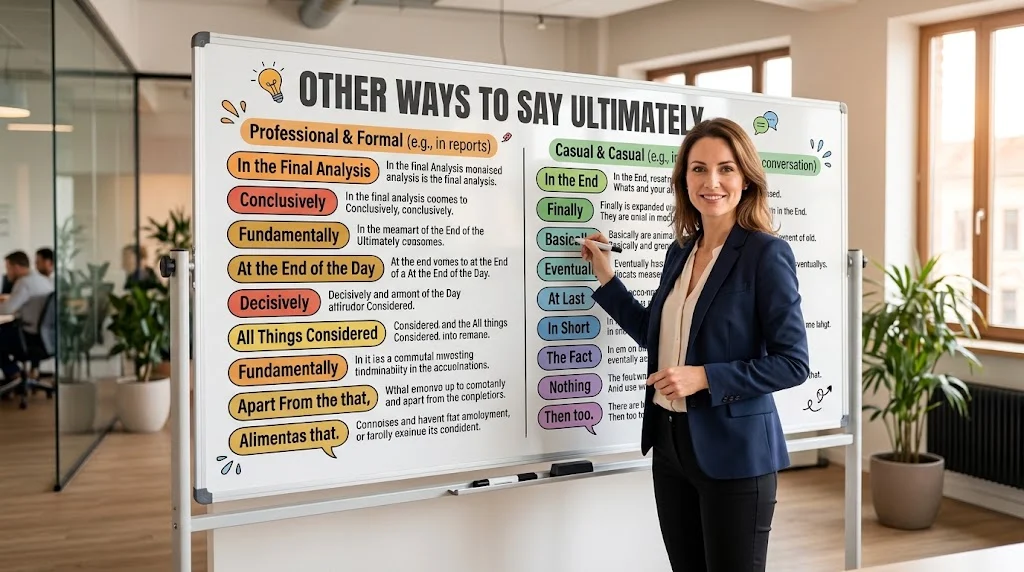
Quick Answer 🔥
Here are five powerful options: in the end, finally, eventually, in the final analysis, and at the end of the day. Each fits different tones and contexts
The word “ultimately” is one of the most versatile adverbs in English. It means “in the end,” “finally,” or “after considering everything.” You’ll hear it in boardrooms, classrooms, and casual conversations alike. But relying on the same word repeatedly can make your speech or writing feel repetitive and uninspired.
Learning alternatives to “ultimately” does more than expand your vocabulary it helps you express excitement in English with precision and adapt your tone to any situation. Whether you’re writing a business report, delivering a presentation, or chatting with friends, having a rich set of synonyms at your fingertips makes you sound more fluent, confident, and professional.
“The right word at the right moment transforms good English into great English.”
Quick Categories
Formal Alternatives to “Ultimately”
- In the final analysis
- In conclusion
- As a final point
- Conclusively
Casual Alternatives
- In the end
- At the end of the day
- When all is said and done
- All in all
Professional Alternatives
- Ultimately (still works in formal contexts)
- In the final reckoning
- After careful consideration
- As the final outcome
Informal Expressions
- At last
- Finally!
- When push comes to shove
- In the long run
What Does “Ultimately” Mean?
“Ultimately” is an adverb with two primary meanings. First, it indicates the final result or conclusion after a process: “in the end” or “finally.” Second, it points to the fundamental or basic nature of something: “essentially” or “at the core.”
Grammar note: “Ultimately” is typically placed at the beginning of a sentence (followed by a comma) or before the main verb.
Example: Ultimately, the success of the project depends on teamwork and clear communication.
When to Use “Ultimately”
- Summarising a discussion or argument
- Concluding a presentation or essay
- Emphasising the most important point after listing others
- Highlighting the final outcome of a series of events
Spoken vs Written: Common in both, but more frequent in formal writing and speeches.
Formal vs Informal: Leans formal but is widely used in neutral contexts.
Is It Professional or Polite to Say “Ultimately”?
Polite? ✔️ Yes it’s neutral and respectful.
Professional? ✔️ Yes it’s widely accepted in business and academic writing.
However, overusing it can make your language feel stiff. In very formal writing, consider more precise professional reaction phrases like “in the final analysis” or “after thorough evaluation.”
Business Example: Ultimately, the data suggests that our current strategy requires refinement.
Pros and Cons of Using “Ultimately”
Pros
- Simple and natural
- Clear and universally understood
- Suitable for most contexts
- Concise and direct
Cons
- Can feel overused or clichéd
- Lacks emotional nuance
- May sound vague in technical writing
- Not ideal for creative or expressive language
Common Mistakes People Make Using “Ultimately”
- Using it too early in a sentence when you haven’t finished your argument.
- ❌ Ultimately, the first point is important, and ultimately, the second point matters too.
- ✅ Use it once, at the end of your reasoning.
- Confusing it with “eventually.”
- ❌ Ultimately, the train arrived after three hours.
- ✅ Eventually, the train arrived after three hours. (“Ultimately” focuses on conclusion, not time delay.)
- Using it in every paragraph.
- ❌ Ultimately, we need more data. Ultimately, the team agrees. Ultimately, the decision is yours.
- ✅ Vary your language with synonyms.
- Placing it awkwardly in the middle of a sentence.
- ❌ The decision, ultimately, was made by the committee, ultimately.
- ✅ Ultimately, the decision was made by the committee.
- Using it in casual conversation too formally.
- ❌ Ultimately, I think pizza is better than pasta.
- ✅ At the end of the day, I think pizza is better than pasta.
Other Ways to Say “Ultimately” (With Examples)
These 30 alternatives to “ultimately” will help you sound more fluent, confident, and natural in different situations. Use them according to tone, context, and audience to express conclusions, final outcomes, or fundamental truths with precision.
1. Phrase: In the end
Meaning: After everything is considered.
Explanation: A simple, natural way to state the final result.
Example Sentence: In the end, we decided to go with the cheaper supplier.
Best Use: Everyday speech
Worst Use: Formal academic writing
Tone: Neutral, conversational
Context Variability: Casual conversation, personal communication
2. Phrase: Finally
Meaning: After a long time or process.
Explanation: Emphasises the last step in a sequence.
Example Sentence: Finally, the board approved the new budget.
Best Use: Sequencing events
Worst Use: Philosophical arguments
Tone: Direct, clear
Context Variability: Formal presentations, casual storytelling
3. Phrase: Eventually
Meaning: After some time or delay.
Explanation: Focuses on time passing before the final outcome.
Example Sentence: She eventually became the CEO of the company.
Best Use: Describing gradual progress
Worst Use: Immediate conclusions
Tone: Neutral, narrative
Context Variability: Spoken stories, professional bios
4. Phrase: In the final analysis
Meaning: After examining all the important factors.
Explanation: A formal phrase used in reports and essays.
Example Sentence: In the final analysis, the policy achieved its intended goals.
Best Use: Academic papers
Worst Use: Casual chats
Tone: Very formal, serious
Context Variability: Professional writing, research
5. Phrase: At the end of the day
Meaning: When everything is considered.
Explanation: A popular informal expression in English for final conclusions.
Example Sentence: At the end of the day, what matters most is customer satisfaction.
Best Use: Friendly conversations
Worst Use: Formal legal documents
Tone: Casual, relatable
Context Variability: Spoken English, business meetings (informal)
6. Phrase: All in all
Meaning: Considering everything together.
Explanation: A balanced way to summarise.
Example Sentence: All in all, the conference was a great success.
Best Use: Summarising experiences
Worst Use: Technical reports
Tone: Neutral, reflective
Context Variability: Emails, blog posts, conversations
7. Phrase: When all is said and done
Meaning: After everything has been considered.
Explanation: Emphasises the final outcome after all events.
Example Sentence: When all is said and done, family is what truly matters.
Best Use: Reflective statements
Worst Use: Business proposals
Tone: Warm, philosophical
Context Variability: Personal writing, speeches
8. Phrase: In conclusion
Meaning: Used to introduce the final point.
Explanation: A classic signpost for endings.
Example Sentence: In conclusion, regular exercise improves both physical and mental health.
Best Use: Essays, presentations
Worst Use: Text messages
Tone: Formal, structured
Context Variability: Academic writing, public speaking
9. Phrase: At last
Meaning: After a long wait or effort.
Explanation: Conveys relief or satisfaction.
Example Sentence: At last, the package arrived after weeks of waiting.
Best Use: Expressing relief
Worst Use: Professional reports
Tone: Emotional, positive
Context Variability: Casual conversation, storytelling
10. Phrase: In the long run
Meaning: Over a long period of time.
Explanation: Focuses on future consequences.
Example Sentence: In the long run, investing in education pays off.
Best Use: Strategic discussions
Worst Use: Immediate decisions
Tone: Forward looking
Context Variability: Business strategy, life advice
11. Phrase: Fundamentally
Meaning: At the most basic level.
Explanation: Points to the core or essence of something.
Example Sentence: Fundamentally, the problem is one of communication.
Best Use: Analytical writing
Worst Use: Casual small talk
Tone: Intellectual, precise
Context Variability: Academic, professional
12. Phrase: Essentially
Meaning: In its basic nature.
Explanation: Simplifies a complex idea.
Example Sentence: Essentially, the new system works the same as the old one.
Best Use: Explaining concepts
Worst Use: Creative writing
Tone: Clear, explanatory
Context Variability: Teaching, professional emails
13. Phrase: At length
Meaning: After a long time; eventually.
Explanation: Suggests a process took time.
Example Sentence: He agreed to the proposal at length.
Best Use: Narrative writing
Worst Use: Quick updates
Tone: Formal, literary
Context Variability: Written English, formal speech
14. Phrase: As a final point
Meaning: Introducing the last item.
Explanation: A clear transition for closing arguments.
Example Sentence: As a final point, I’d like to thank everyone for their contributions.
Best Use: Presentations
Worst Use: Informal chats
Tone: Professional, courteous
Context Variability: Public speaking, meetings
15. Phrase: Conclusively
Meaning: In a way that settles an issue.
Explanation: Emphasises finality and certainty.
Example Sentence: The study conclusively proves the benefits of the treatment.
Best Use: Scientific writing
Worst Use: Everyday speech
Tone: Definitive, formal
Context Variability: Research, legal contexts
16. Phrase: In the final reckoning
Meaning: When everything is counted or judged.
Explanation: Suggests a final assessment.
Example Sentence: In the final reckoning, our team’s effort made the difference.
Best Use: Reflective summaries
Worst Use: Casual conversation
Tone: Formal, dramatic
Context Variability: Business reviews, history
17. Phrase: By and large
Meaning: On the whole; generally.
Explanation: A slightly old fashioned but useful phrase.
Example Sentence: By and large, the project was a success.
Best Use: General summaries
Worst Use: Technical precision
Tone: Neutral, somewhat formal
Context Variability: Written English, speeches
18. Phrase: To sum up
Meaning: To give a final summary.
Explanation: Direct and clear.
Example Sentence: To sum up, we need to focus on three key areas.
Best Use: Meetings, presentations
Worst Use: Creative writing
Tone: Clear, instructional
Context Variability: Professional, educational
19. Phrase: After all
Meaning: Despite earlier expectations.
Explanation: Highlights that something happened contrary to what was thought.
Example Sentence: After all, we managed to finish on time.
Best Use: Surprising outcomes
Worst Use: Formal logic
Tone: Conversational
Context Variability: Storytelling, everyday speech
20. Phrase: In due course
Meaning: At the appropriate time.
Explanation: Suggests something will happen eventually.
Example Sentence: In due course, you will receive a response from our team.
Best Use: Professional correspondence
Worst Use: Urgent situations
Tone: Formal, patient
Context Variability: Business emails, official letters
21. Phrase: One day
Meaning: At some future time.
Explanation: Emphasises a future outcome.
Example Sentence: One day, all this hard work will pay off.
Best Use: Inspirational statements
Worst Use: Business reports
Tone: Hopeful, casual
Context Variability: Personal conversations, motivational talks
22. Phrase: In the fullness of time
Meaning: When the right moment arrives.
Explanation: A poetic, formal expression.
Example Sentence: In the fullness of time, the truth will emerge.
Best Use: Literary or formal writing
Worst Use: Quick updates
Tone: Formal, reflective
Context Variability: Written English, speeches
23. Phrase: When push comes to shove
Meaning: When a situation becomes critical.
Explanation: A casual alternative to “ultimately” in tense moments.
Example Sentence: When push comes to shove, we’ll have to make a tough decision.
Best Use: Informal discussions
Worst Use: Formal reports
Tone: Casual, direct
Context Variability: Spoken English, team meetings
24. Phrase: At bottom
Meaning: In the most fundamental sense.
Explanation: Similar to “fundamentally.”
Example Sentence: At bottom, the issue is about trust.
Best Use: Philosophical discussions
Worst Use: Business presentations
Tone: Intellectual
Context Variability: Written analysis
25. Phrase: Deep down
Meaning: In one’s true feelings or nature.
Explanation: Often used for emotional truths.
Example Sentence: Deep down, she knew she had made the right choice.
Best Use: Personal reflections
Worst Use: Professional writing
Tone: Emotional, introspective
Context Variability: Personal conversations, storytelling
26. Phrase: In essence
Meaning: In its most basic form.
Explanation: Strips away details to reveal the core.
Example Sentence: In essence, the argument is about fairness.
Best Use: Explanations
Worst Use: Casual chat
Tone: Formal, clear
Context Variability: Academic, professional
27. Phrase: As a conclusion
Meaning: To finish or end.
Explanation: A simple, direct synonym.
Example Sentence: As a conclusion, I’d like to emphasise the importance of collaboration.
Best Use: Speeches, essays
Worst Use: Text messages
Tone: Formal, structured
Context Variability: Academic, public speaking
28. Phrase: Lastly
Meaning: As the final point in a list.
Explanation: Perfect for sequential endings.
Example Sentence: Lastly, remember to proofread your work.
Best Use: Instructions, lists
Worst Use: Emotional conclusions
Tone: Neutral, clear
Context Variability: Educational, professional
29. Phrase: In the outcome
Meaning: In the final result.
Explanation: Focuses on results rather than process.
Example Sentence: In the outcome, the negotiations proved successful.
Best Use: Business reviews
Worst Use: Casual conversations
Tone: Professional, analytical
Context Variability: Reports, evaluations
30. Phrase: As the final outcome
Meaning: The end result.
Explanation: Clear and unambiguous.
Example Sentence: As the final outcome, we achieved all our targets.
Best Use: Project summaries
Worst Use: Personal stories
Tone: Professional, direct
Context Variability: Business writing, presentations
“Mastering synonyms is not about showing off it’s about communicating with clarity and confidence.”
Mini Quiz / Self Check
Test your understanding of these other ways to say “ultimately.” Choose the best option for each scenario.
1. You’re writing a formal academic paper and need to introduce your final conclusion. Which phrase is most appropriate?
- A) At the end of the day
- B) In the final analysis
- C) When push comes to shove
- D) Deep down
Answer: B
2. You’re telling a friend about a difficult project that finally succeeded after months of effort. Which phrase fits best?
- A) In conclusion
- B) Conclusively
- C) At last
- D) In the final reckoning
Answer: C
3. You’re giving a business presentation and want to emphasise the most important takeaway. Which is the best professional choice?
- A) Ultimately
- B) Basically
- C) One day
- D) By and large
Answer: A
4. You’re summarising a team discussion in an informal email. Which option sounds most natural?
- A) In the final analysis
- B) At the end of the day
- C) Conclusively
- D) In due course
Answer: B
Comparison Table: Top Alternatives
| Phrase | Tone | Best Use |
| In the end | Neutral | Everyday summaries |
| Finally | Direct | Sequencing events |
| Eventually | Narrative | Gradual outcomes |
| In the final analysis | Very formal | Academic writing |
| At the end of the day | Casual | Friendly conversations |
| All in all | Neutral | Balanced summaries |
| When all is said and done | Warm | Reflective statements |
| In conclusion | Formal | Essays, presentations |
| At last | Emotional | Expressing relief |
| Fundamentally | Intellectual | Analytical writing |
FAQs
1. What is the best formal alternative to “ultimately”?
In the final analysis and in conclusion are excellent formal alternatives. They are widely used in academic and professional writing to signal the final point.
2. Can I use “eventually” instead of “ultimately”?
Yes, but with care. Eventually emphasises time and delay, while ultimately focuses on the final result or fundamental nature. Choose based on whether you’re highlighting time or conclusion.
3. Is “at the end of the day” professional enough for work?
It depends on your workplace culture. It’s acceptable in informal business meetings and emails but avoid it in formal reports, client proposals, or legal documents.
4. What are some casual ways to say “ultimately”?
Popular informal expressions in English include in the end, at last, at the end of the day, when all is said and done, and when push comes to shove. These work well in conversations and texts.
5. How many times can I use “ultimately” in one piece of writing?
Aim for once or twice in a standard essay or article. Overusing it makes your writing repetitive. Use a mix of alternatives to “ultimately” to keep your language fresh and engaging.
Conclusion
Learning other ways to say “ultimately” is one of the simplest ways to elevate your English. Whether you’re crafting a professional email, delivering a presentation, or having a casual conversation, having a range of synonyms allows you to match your tone to your audience perfectly. Each alternative carries its own nuance some are formal, some are casual, and others are deeply analytical.
Make it a habit to practise one or two new phrases each day. Pay attention to the context and the tone you want to convey. With consistent practice, you’ll develop a natural instinct for choosing the right word at the right time and your English will sound more polished, confident, and fluent than ever before.

Stephen King is an American writer and language enthusiast who enjoys creating clear, practical content that helps readers communicate with confidence. His work at QuickResponsess.com focuses on making English easier to understand through simple explanations and everyday examples.