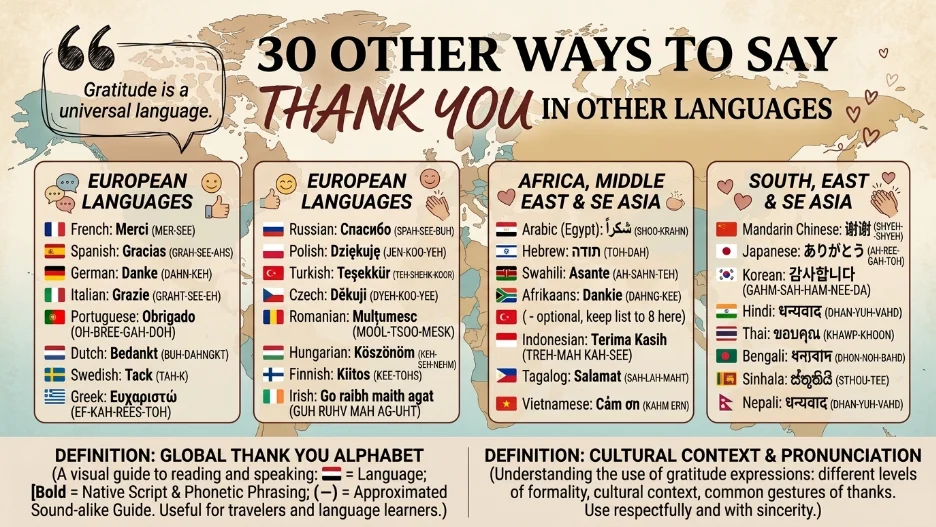
Quick Answer : Other ways to say thank you in other languages include: “Merci” (French), “Grazie” (Italian), “Danke” (German), “Arigatou” (Japanese), and “Gracias” (Spanish). These are the most universally recognized expressions of gratitude across different cultures.
Learning ways to say thank you in other languages is essential for anyone who travels, works internationally, or simply wants to connect more meaningfully with people from diverse backgrounds. Saying “thank you” is one of the most fundamental expressions of politeness in any language, and knowing multiple forms allows you to adapt to different levels of formality and cultural expectations.
Adding global expressions to your vocabulary helps you express gratitude in English settings more creatively and demonstrates cultural awareness. Whether you’re writing a professional email to an international colleague or thanking a local vendor while traveling, having a variety of phrases at your disposal makes your communication more authentic and respect.
Quick Categories
Formal Alternatives
- Merci beaucoup (French – thank you very much)
- Arigatou gozaimasu (Japanese – very formal thank you)
- Gamsahamnida (Korean – formal thank you)
- Muchas gracias (Spanish – thank you very much)
- Shukran jazeelan (Arabic – thank you very much)
Casual Alternatives
- Merci (French – thanks)
- Gracias (Spanish – thanks)
- Grazie (Italian – thanks)
- Danke (German – thanks)
- Tak (Danish/Norwegian/Swedish – thanks)
Professional Alternatives
- Vielen Dank (German – many thanks)
- Muito obrigado/a (Portuguese – thank you very much)
- Spasibo bol’shoye (Russian – thank you very much)
- Kiitos paljon (Finnish – thank you very much)
- Gamsahamnida (Korean – formal, respectful thanks)
Informal Expressions
- Gomawo (Korean – thanks to friends)
- Dík (Czech – casual thanks)
- Takk (Scandinavian – casual thanks)
- Xie xie (Mandarin – thanks)
- Cảm ơn (Vietnamese – thanks)
Pro Tip: When using these phrases, pay attention to cultural customs like bowing in Japan or placing your hand over your heart in Arabic-speaking countries. The words are only part of the expression .
Common Mistakes
1. Using the Wrong Level of Formality
Mistake: Using casual forms in formal situations.
Example: Saying “Gomawo” to a Korean boss instead of “Gamsahamnida” can seem disrespectful .
2. Not Adjusting for Gender in Gendered Languages
Mistake: Using the masculine form when you should use the feminine.
Example: A female speaker should say “Obrigada” (Portuguese) not “Obrigado” .
3. Using the Wrong “Thank You” for the Situation
Mistake: Using a gift-acknowledgment phrase for a service.
Example: In Cantonese, “Dòjeh” is for gifts, while “M̀hgòi” is for services .
4. Forgetting Cultural Gestures
Mistake: Not bowing in Japan or not placing your hand on your heart in Arabic cultures.
Example: A simple bow accompanies “Arigatou gozaimasu” in formal Japanese settings .
5. Mispronouncing Words
Mistake: Incorrect pronunciation can change meaning.
Example: “Xièxiè” in Mandarin (pronounced “shyeh-shyeh”) can be unrecognizable if mispronounced .
What Does “Thank You” Mean Around the World?
Definition: “Thank you” is an expression of gratitude used to acknowledge a kindness, gift, service, or favor received. Across cultures, it serves the same fundamental social function but with varying degrees of formality.
Cultural Note: Some cultures, like English-speaking ones, say thank you frequently. Others, like Chinese culture, may rarely say thank you to family and close friends .
Example: “Merci” in French is simple and versatile, used across social contexts, while “Arigatou gozaimasu” in Japanese signals deep respect .
When to Use Thank You in Other Languages
- Traveling abroad – Show respect to locals
- International business meetings – Build professional relationships
- Cultural events and gatherings – Acknowledge hospitality
- Social media interactions – Connect with global audiences
- Dining at ethnic restaurants – Appreciate service and cuisine
Spoken vs Written: Use formal versions in written correspondence; casual forms are fine for spoken interactions with friends.
Formal vs Informal: Consider your relationship and the setting. Use formal forms (like “Arigatou gozaimasu”) with strangers or elders .
Is It Professional to Say Thank You in Other Languages?
Polite? ✔️ Yes – Expressing gratitude is universally polite.
Professional? ✔️ Yes – In international contexts, it demonstrates cultural awareness and respect.
Business-Style Example: “Vielen Dank für Ihre Unterstützung” (German) – Thank you very much for your support.
“In global business, a simple ‘thank you’ in the local language can be the key to building trust and rapport.”
Pros and Cons of Using Thank You in Other Languages
✅ Pros
- Builds cultural connections
- Demonstrates respect and effort
- Enhances travel experiences
- Shows global awareness
❌ Cons
- Risk of mispronunciation
- Cultural faux pas if using wrong form
- Limited to specific contexts
- May need to learn multiple variations
Other Ways to Say Thank You in Other Languages (With Examples)
These alternatives will help you express gratitude in different languages with confidence. Use them according to tone, context, and audience to show appreciation appropriately.
Romance Languages (Expressions from Latin-Derived Languages)
1. Phrase: Merci (French)
Meaning: Thanks
Explanation: The standard way to say thank you in French, used across all social contexts .
Example: “Merci beaucoup pour votre aide.” (Thank you very much for your help.)
Best Use: Daily interactions
Worst Use: None – it’s universally appropriate
Tone: Warm, versatile
Context Variability: spoken / written / formal / casual
2. Phrase: Grazie (Italian)
Meaning: Thank you
Explanation: Italians use this regularly; variations include “Grazie mille” for “thanks a million” .
Example: “Grazie mille per il regalo!” (Thanks a million for the gift!)
Best Use: All situations
Worst Use: None
Tone: Warm, expressive
Context Variability: spoken / written / casual
3. Phrase: Gracias (Spanish)
Meaning: Thanks
Explanation: The most familiar foreign “thank you,” used across all Spanish-speaking countries .
Example: “¡Muchas gracias por todo!” (Thank you very much for everything!)
Best Use: All Spanish-speaking contexts
Worst Use: None
Tone: Warm, friendly
Context Variability: spoken / written / casual
4. Phrase: Obrigado/Obrigada (Portuguese)
Meaning: Thank you
Explanation: The word changes based on the speaker’s gender. Men say “obrigado,” women say “obrigada” .
Example: “Muito obrigado pela sua paciência.” (Thank you very much for your patience.)
Best Use: All Portuguese-speaking contexts
Worst Use: None
Tone: Formal, polite
Context Variability: spoken / written / formal
5. Phrase: Molte grazie (Italian)
Meaning: Many thanks
Explanation: A more formal way to express deeper gratitude in Italian .
Example: “Molte grazie per il suo tempo.” (Many thanks for your time.)
Best Use: Professional settings
Worst Use: Very casual conversations
Tone: Formal, respectful
Context Variability: spoken / written / formal
Germanic Languages (Expressions from Northern European Languages)
6. Phrase: Danke (German)
Meaning: Thanks
Explanation: The standard “thank you” in German, used in all contexts .
Example: “Danke schön für Ihre Hilfe.” (Thank you very much for your help.)
Best Use: All German-speaking contexts
Worst Use: None
Tone: Polite, straightforward
Context Variability: spoken / written / casual
7. Phrase: Vielen Dank (German)
Meaning: Many thanks
Explanation: A more formal, emphatic way to express gratitude in German .
Example: “Vielen Dank für Ihre Unterstützung.” (Many thanks for your support.)
Best Use: Professional and formal settings
Worst Use: Casual conversations
Tone: Formal, appreciative
Context Variability: spoken / written / formal
8. Phrase: Tack (Swedish/Danish/Norwegian)
Meaning: Thanks
Explanation: The standard “thank you” in Scandinavian languages .
Example: “Tack så mycket för maten.” (Thank you very much for the food.)
Best Use: Scandinavian countries
Worst Use: None
Tone: Warm, simple
Context Variability: spoken / written / casual
9. Phrase: Dankie (Afrikaans)
Meaning: Thank you
Explanation: The Afrikaans expression of gratitude .
Example: “Baie dankie vir jou hulp.” (Thank you very much for your help.)
Best Use: South Africa
Worst Use: None
Tone: Friendly, warm
Context Variability: spoken / written / casual
10. Phrase: Takk fyrir (Icelandic)
Meaning: Thank you
Explanation: The Icelandic way to express gratitude .
Example: “Takk fyrir hjálpina.” (Thanks for the help.)
Best Use: Iceland
Worst Use: None
Tone: Warm, sincere
Context Variability: spoken / casual
Asian Languages (Expressions from East and Southeast Asia)
11. Phrase: Xièxiè (Mandarin Chinese)
Meaning: Thank you
Explanation: The most common way to say thank you in Mandarin, with repetition creating a softer feeling .
Example: “Xièxiè nǐ de bāngzhù.” (Thank you for your help.)
Best Use: All Mandarin-speaking contexts
Worst Use: None
Tone: Warm, sincere
Context Variability: spoken / written / casual
12. Phrase: Arigatou (Japanese)
Meaning: Thanks
Explanation: The standard casual “thank you” in Japanese; “Arigatou gozaimasu” is the formal version .
Example: “Arigatou gozaimasu for your kindness.”
Best Use: Varies by formality
Worst Use: Very formal situations (use gozaimasu)
Tone: Sincere, respectful
Context Variability: spoken / formal / casual
13. Phrase: Gamsahamnida (Korean)
Meaning: Thank you
Explanation: The formal “thank you” in Korean; “Gomawo” is casual for friends .
Example: “Gamsahamnida for your support.”
Best Use: Formal settings
Worst Use: Close friends (use gomawo)
Tone: Formal, respectful
Context Variability: spoken / written / formal
14. Phrase: Terima kasih (Indonesian/Malay)
Meaning: Thank you
Explanation: The standard Indonesian and Malaysian expression of gratitude .
Example: “Terima kasih atas bantuan anda.” (Thank you for your help.)
Best Use: All contexts
Worst Use: None
Tone: Polite, warm
Context Variability: spoken / written / casual
15. Phrase: Dòjeh (Cantonese)
Meaning: Thank you (for gifts)
Explanation: Cantonese has different words for thanking based on the situation. “Dòjeh” is for gifts received; “M̀hgòi” is for services .
Example: “Dòjeh for the gift!” (For a gift) vs. “M̀hgòi for your help!” (For a service)
Best Use: Based on context
Worst Use: Mixing them up
Tone: Specific, precise
Context Variability: spoken / casual
Slavic and Eastern European Languages
16. Phrase: Spasibo (Russian)
Meaning: Thanks
Explanation: The standard “thank you” in Russian. “Spasibki” is a playful casual version .
Example: “Bol’shoye spasibo za pomoshch!” (Thank you very much for the help!)
Best Use: All Russian contexts
Worst Use: None
Tone: Warm, sincere
Context Variability: spoken / written / casual
17. Phrase: Dziękuję (Polish)
Meaning: Thank you
Explanation: The Polish “thank you,” with “Dziękuję bardzo” as the formal version .
Example: “Dziękuję bardzo za pomoc.” (Thank you very much for the help.)
Best Use: All Polish contexts
Worst Use: None
Tone: Formal, sincere
Context Variability: spoken / written / casual
18. Phrase: Děkuji (Czech)
Meaning: Thank you
Explanation: The formal Czech “thank you”; “Dík” is the casual version .
Example: “Moc děkuji za vaši pomoc.” (Thank you very much for your help.)
Best Use: Formal settings
Worst Use: Very casual conversations (use dík)
Tone: Formal, respectful
Context Variability: spoken / written / formal
19. Phrase: Dyakuyu (Ukrainian)
Meaning: Thank you
Explanation: The Ukrainian expression of gratitude .
Example: “Dyakuyu vam za dopomohu.” (Thank you for the help.)
Best Use: All Ukrainian contexts
Worst Use: None
Tone: Warm, sincere
Context Variability: spoken / written / casual
20. Phrase: Hvala (Croatian/Bosnian/Serbian)
Meaning: Thank you
Explanation: The common “thank you” in several Balkan languages .
Example: “Hvala vam na vašoj pomoći.” (Thank you for your help.)
Best Use: All Balkan contexts
Worst Use: None
Tone: Warm, simple
Context Variability: spoken / written / casual
Middle Eastern and South Asian Languages
21. Phrase: Shukran (Arabic)
Meaning: Thank you
Explanation: The standard Arabic “thank you,” widely understood across the Middle East .
Example: “Shukran jazeelan for your kindness.” (Thank you very much for your kindness.)
Best Use: All Arabic contexts
Worst Use: None
Tone: Formal, respectful
Context Variability: spoken / written / formal
22. Phrase: Dhanyavad (Hindi)
Meaning: Thank you
Explanation: The formal Hindi “thank you”; “Shukriya” is the informal version .
Example: “Bahut dhanyavad for your support.” (Thank you very much for your support.)
Best Use: Formal settings
Worst Use: Very casual conversations
Tone: Formal, respectful
Context Variability: spoken / written / formal
23. Phrase: Shukriya (Urdu)
Meaning: Thanks
Explanation: The Urdu “thank you,” commonly used in Pakistan .
Example: “Bahut shukriya for your assistance.” (Thank you very much for your assistance.)
Best Use: All Urdu contexts
Worst Use: None
Tone: Warm, polite
Context Variability: spoken / written / casual
24. Phrase: Toda (Hebrew)
Meaning: Thank you
Explanation: The Hebrew “thank you”; “Toda raba” is “thank you very much” .
Example: “Toda raba for your help.” (Thank you very much for your help.)
Best Use: All Hebrew contexts
Worst Use: None
Tone: Warm, sincere
Context Variability: spoken / written / casual
25. Phrase: Nandri (Tamil)
Meaning: Thank you
Explanation: The Tamil “thank you”; “Mikka nandri” is “thank you very much” .
Example: “Mikka nandri for your kindness.” (Thank you very much for your kindness.)
Best Use: All Tamil contexts
Worst Use: None
Tone: Formal, respectful
Context Variability: spoken / written / formal
Other Notable Languages
26. Phrase: Kiitos (Finnish)
Meaning: Thanks
Explanation: The Finnish “thank you”; “Kiitos paljon” is “thank you very much” .
Example: “Kiitos paljon avusta.” (Thank you very much for the help.)
Best Use: All Finnish contexts
Worst Use: None
Tone: Warm, simple
Context Variability: spoken / written / casual
27. Phrase: Asante (Swahili)
Meaning: Thanks
Explanation: The Swahili “thank you”; “Asante sana” is “thank you very much” .
Example: “Asante sana for your hospitality.”
Best Use: East African contexts
Worst Use: None
Tone: Warm, friendly
Context Variability: spoken / written / casual
28. Phrase: Salamat (Tagalog)
Meaning: Thank you
Explanation: The Filipino “thank you”; “Salamat po” is the formal version .
Example: “Salamat po for your help.”
Best Use: All Filipino contexts
Worst Use: None
Tone: Formal, respectful
Context Variability: spoken / written / formal
29. Phrase: Khàawp-khun (Thai)
Meaning: Thank you
Explanation: The Thai “thank you.” Add “kráp” for male speakers or “khâ” for female speakers .
Example: “Khàawp-khun kráp for your kindness.” (Male speaker)
Best Use: All Thai contexts
Worst Use: None
Tone: Formal, polite
Context Variability: spoken / written / formal
30. Phrase: Mahalo (Hawaiian)
Meaning: Thank you
Explanation: The Hawaiian expression of gratitude .
Example: “Mahalo nui loa for your help.” (Thank you very much for your help.)
Best Use: Hawaiian contexts
Worst Use: None
Tone: Warm, sincere
Context Variability: spoken / written / casual
“Pronunciation matters. A well-pronounced ‘thank you’ in any language shows effort and respect.”
Mini Quiz: Test Your Understanding
1. Which form of “thank you” in Korean is most appropriate for a boss?
- A) Gomawo
- B) Gamsahamnida
- C) Gomapseumnida
- D) Gomawoyo
2. In Japanese culture, what accompanies a formal “thank you” to show respect?
- A) A handshake
- B) A bow
- C) A smile
- D) A gift
3. A female Portuguese speaker should say:
- A) Obrigado
- B) Gracias
- C) Obrigada
- D) Merci
4. In Cantonese, which phrase is used to thank someone for a service?
- A) Dòjeh
- B) Xièxiè
- C) Arigatou
- D) M̀hgòi
👉 Check Your Answers:
- B – “Gamsahamnida” is the formal “thank you” in Korean .
- B – Bowing accompanies formal thanks in Japanese culture .
- C – Female speakers should use “obrigada” .
- D – “M̀hgòi” is for services; “Dòjeh” is for gifts .
Comparison Table: Top 10 Phrases
| Phrase | Language | Tone | Best Use |
|---|---|---|---|
| Merci | French | Warm, versatile | Daily conversations |
| Grazie | Italian | Expressive, warm | All situations |
| Gracias | Spanish | Warm, friendly | Spanish-speaking contexts |
| Danke | German | Polite, straightforward | All contexts |
| Arigatou gozaimasu | Japanese | Formal, respectful | Professional and formal |
| Gamsahamnida | Korean | Formal, respectful | Business and formal |
| Xièxiè | Mandarin | Warm, sincere | All Mandarin contexts |
| Spasibo | Russian | Warm, sincere | Russian-speaking contexts |
| Shukran | Arabic | Formal, respectful | Middle East |
| Kiitos | Finnish | Warm, simple | Finnish contexts |
FAQs
1. What is the most widely recognized way to say thank you in another language?
“Merci” (French) and “Gracias” (Spanish) are among the most recognized worldwide, but “Danke” (German) and “Arigatou” (Japanese) are also very well-known .
2. Which languages have gendered thank you phrases?
Portuguese (obrigado/obrigada) and Arabic (shukran lak for males, shukran laki for females) have gendered forms .
3. What cultural gesture should I use when saying thank you in Japan?
In Japan, bowing accompanies verbal thanks. The depth and duration of the bow correspond to the level of gratitude expressed .
4. Can I use the same “thank you” for gifts and services in Chinese?
In Cantonese, “Dòjeh” is used for gifts, while “M̀hgòi” is used for services. In Mandarin, “Xièxiè” works for both .
5. Why are there different levels of formality in some languages?
Languages like Japanese and Korean have hierarchical social structures where the relationship between speakers determines the level of formality. This shows respect for elders, bosses, and strangers .
Conclusion
Learning ways to say thank you in other languages opens doors to richer cultural connections and more authentic communication. Whether you’re traveling, working internationally, or simply expanding your linguistic skills, these expressions help you show respect and build relationships.
Practice using these phrases based on your context and audience. Pay attention to cultural nuances like appropriate gestures and formality levels. Remember that sincerity transcends language – a genuine “thank you” in any tongue goes a long way.

Sally Rooney is an American writer who contributes to QuickResponsess.com, creating clear and practical content for English learners. Her articles help readers build confidence in using words and expressions accurately in everyday and professional communication.