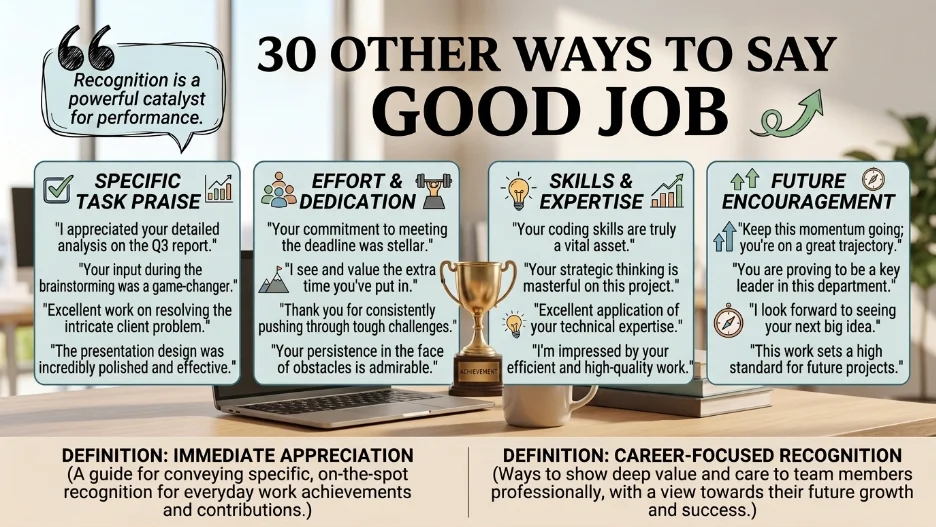
Quick Answer : Other ways to say “good job” include: “Excellent work,” “Well done,” “I’m impressed with your performance,” “You’ve done a fantastic job,” and “Outstanding effort.”
The phrase “good job” is one of the most common ways to offer praise and encouragement in English. While it’s simple and well intentioned, relying on it exclusively can make your feedback feel generic and less meaningful.
Learning alternatives to “good job” allows you to tailor your praise to the situation, the person, and the achievement. Whether you’re offering professional feedback, encouraging a student, or celebrating a friend’s success, having a rich vocabulary helps you express excitement in English with precision and authenticity. A varied praise vocabulary also demonstrates emotional intelligence and communication sophistication.
“Specific praise is powerful praise. General praise is quickly forgotten.”
Quick Categories
Formal Alternatives
- Excellent work
- Outstanding performance
- I commend your efforts
- Your work is exemplary
- You have my sincere admiration
Professional Alternatives
- Your contribution is greatly appreciated
- You’ve exceeded our expectations
- I’m impressed with your results
- Your dedication is commendable
- You consistently deliver quality work
Casual Alternatives
- Well done
- Great job
- Nice work
- Way to go
- You crushed it
Encouraging Alternatives
- Keep up the great work
- You’re on the right track
- I’m proud of your progress
- You should be proud of yourself
- Your hard work is paying off
Pro Tip: When offering praise, be specific about what the person did well. “Excellent work on the quarterly report” is far more meaningful than “good job” alone.
Common Mistakes
1. Being Too Vague
Mistake: “Good job” without any specifics.
Better Approach: Connect the praise to the specific action or result.
Example: “Good job on the presentation” is better than “Good job” alone.
2. Overusing the Same Phrase
Mistake: Saying “good job” repeatedly in one conversation.
Better Approach: Vary your praise language throughout the interaction.
Example: “Excellent work on the introduction. Your analysis was thorough.”
3. Praising Effort Instead of Results
Mistake: “Good job trying” when the outcome was poor.
Better Approach: Acknowledge effort while being honest about results.
Example: “I appreciate your effort. Let’s work on improving the outcome.”
4. Using Casual Language in Professional Settings
Mistake: “You crushed it!” in a boardroom meeting.
Better Approach: Match your language to the professional environment.
Example: “Excellent presentation” instead of “You killed it.”
5. Failing to Adjust Praise to the Achievement
Mistake: Using the same phrase for minor and major accomplishments.
Better Approach: Scale your praise to match the significance of the achievement.
Example: “Nice work” for small tasks, “Outstanding performance” for major achievements.
What Does “Good Job” Mean?
Definition: “Good job” is a simple expression of approval or praise used to acknowledge that someone has performed a task well or achieved a positive outcome.
Grammar Note: It functions as a noun phrase and is typically used as an interjection. Examples: “Good job!” or “You did a good job.”
Example: “Good job on completing the project ahead of schedule.”
When to Use “Good Job”
- In everyday conversations Simple, friendly acknowledgment
- With colleagues and teammates Quick praise for routine tasks
- With students and children Encouragement for learning and effort
- In casual emails Brief recognition of good work
- During team meetings General acknowledgment of performance
Spoken vs Written: Works well in both contexts, but written praise benefits from more specific language.
Formal vs Informal: More informal than professional. Use formal alternatives in official communications.
Is It Professional or Polite to Say “Good Job”?
Polite? ✔️ Yes The phrase is considered courteous and encouraging.
Professional? ❌ No While polite, it lacks the specificity and gravitas expected in professional performance feedback. It can feel dismissive of significant achievements.
Business Style Example: “Your work on the Johnson account was exceptional. You’ve consistently delivered high quality results this quarter.”
“Professionals don’t just praise; they provide specific, actionable recognition.”
Pros and Cons of Using “Good Job”
✅ Pros
- Simple and universally understood
- Friendly and approachable
- Common in everyday usage
- Easy to remember and use
❌ Cons
- Too vague for professional feedback
- Overused to the point of losing meaning
- Limited emotional range fails to capture significant achievements
- Not specific enough for formal performance reviews
Other Ways to Say “Good Job” (With Examples)
These alternatives will help you sound more fluent, confident, and natural in different situations. Use them according to tone, context, and audience to express excitement, admiration, or approval.
Professional and Formal Alternatives (Expressions for Workplace Settings)
1. Phrase: Excellent work
Meaning: A formal expression of high approval.
Explanation: This is a professional alternative suitable for formal feedback.
Example: “Excellent work on the quarterly presentation.”
Best Use: Professional settings
Worst Use: Casual conversations
Tone: Formal, appreciative
Context Variability: professional / written / formal
2. Phrase: Your performance was outstanding
Meaning: Your performance exceeded normal expectations.
Explanation: This highlights exceptional achievement in a professional context.
Example: “Your performance was outstanding this quarter.”
Best Use: Performance reviews
Worst Use: Informal chats
Tone: Professional, formal
Context Variability: professional / written / formal
3. Phrase: I commend your efforts
Meaning: I formally recognize and appreciate your work.
Explanation: This is a respectful way to acknowledge someone’s hard work.
Example: “I commend your efforts on this challenging project.”
Best Use: Official recognition
Worst Use: Text messages
Tone: Formal, respectful
Context Variability: professional / written / formal
4. Phrase: Your work is exemplary
Meaning: Your work serves as an excellent example.
Explanation: This suggests the work is worthy of being a model for others.
Example: “Your work on the research project is exemplary.”
Best Use: Formal evaluations
Worst Use: Everyday conversations
Tone: Formal, praising
Context Variability: professional / written / formal
5. Phrase: You have my sincere admiration
Meaning: I genuinely respect and appreciate your work.
Explanation: This conveys deep respect and recognition of effort.
Example: “You have my sincere admiration for completing such a complex project.”
Best Use: Formal appreciation
Worst Use: Quick casual praise
Tone: Formal, appreciative
Context Variability: professional / written / formal
Pro Tip: When giving professional praise, always connect it to the specific business outcome or value created. This makes feedback more meaningful and actionable.
Professional and Specific Alternatives (Expressions for Detailed Feedback)
6. Phrase: Your contribution is greatly appreciated
Meaning: We deeply value what you’ve contributed.
Explanation: This emphasizes the impact of the person’s work.
Example: “Your contribution to the team is greatly appreciated.”
Best Use: Team settings
Worst Use: Personal relationships
Tone: Professional, grateful
Context Variability: professional / written / formal
7. Phrase: You’ve exceeded our expectations
Meaning: Your performance surpassed what was anticipated.
Explanation: This indicates the person went above and beyond.
Example: “You’ve exceeded our expectations with your sales numbers.”
Best Use: Performance reviews
Worst Use: Casual settings
Tone: Professional, praising
Context Variability: professional / written / formal
8. Phrase: I’m impressed with your results
Meaning: Your outcomes have earned my respect.
Explanation: This acknowledges both effort and achievement.
Example: “I’m impressed with your results on the marketing campaign.”
Best Use: Professional feedback
Worst Use: Personal praise
Tone: Professional, sincere
Context Variability: professional / spoken / formal
9. Phrase: Your dedication is commendable
Meaning: Your commitment deserves recognition.
Explanation: This praises sustained effort and commitment.
Example: “Your dedication to this project is truly commendable.”
Best Use: Long term projects
Worst Use: Quick acknowledgments
Tone: Professional, respectful
Context Variability: professional / written / formal
10. Phrase: You consistently deliver quality work
Meaning: Your work is reliably excellent.
Explanation: This acknowledges consistent high performance over time.
Example: “You consistently deliver quality work, and we value that.”
Best Use: Performance reviews
Worst Use: Casual praise
Tone: Professional, appreciative
Context Variability: professional / written / formal
Casual and Encouraging Alternatives (Expressions for Friends and Colleagues)
11. Phrase: Well done
Meaning: A simple, classic expression of approval.
Explanation: This is a natural, widely acceptable alternative to “good job.”
Example: “Well done on the presentation today.”
Best Use: All contexts
Worst Use: None
Tone: Warm, encouraging
Context Variability: spoken / written / casual
12. Phrase: Great job
Meaning: A simple but enthusiastic expression of praise.
Explanation: This is a common upgrade from “good job.”
Example: “Great job on the event planning.”
Best Use: Team settings
Worst Use: Formal evaluations
Tone: Warm, encouraging
Context Variability: spoken / casual
13. Phrase: Nice work
Meaning: A casual, friendly acknowledgment of good performance.
Explanation: This is perfect for quick, informal praise.
Example: “Nice work on the report.”
Best Use: Casual feedback
Worst Use: Formal communications
Tone: Friendly, casual
Context Variability: spoken / casual
14. Phrase: Way to go
Meaning: An enthusiastic, informal expression of approval.
Explanation: This conveys excitement and encouragement.
Example: “Way to go on closing that deal!”
Best Use: Team celebrations
Worst Use: Professional settings
Tone: Enthusiastic, casual
Context Variability: spoken / casual
15. Phrase: You crushed it
Meaning: You did an exceptionally good job.
Explanation: This informal expression emphasizes outstanding performance.
Example: “You crushed it on the sales call.”
Best Use: Close colleagues
Worst Use: Formal business settings
Tone: Enthusiastic, informal
Context Variability: spoken / casual
Pro Tip: Match your level of enthusiasm to the achievement. A routine task might deserve “nice work,” while a major project warrants “outstanding performance.”
Encouraging and Supportive Alternatives (Expressions for Motivation)
16. Phrase: Keep up the great work
Meaning: Continue performing at this high level.
Explanation: This combines present praise with future encouragement.
Example: “Keep up the great work on the project.”
Best Use: Ongoing projects
Worst Use: Completed tasks
Tone: Encouraging, supportive
Context Variability: spoken / written / casual
17. Phrase: You’re on the right track
Meaning: Your approach is correct and effective.
Explanation: This is especially useful when someone is still learning or developing.
Example: “You’re on the right track with this approach.”
Best Use: Development settings
Worst Use: Final achievements
Tone: Encouraging, supportive
Context Variability: spoken / professional / casual
18. Phrase: I’m proud of your progress
Meaning: I recognize and appreciate your growth.
Explanation: This acknowledges improvement over time.
Example: “I’m proud of your progress on this project.”
Best Use: Personal development
Worst Use: Professional evaluations
Tone: Warm, supportive
Context Variability: spoken / casual
19. Phrase: You should be proud of yourself
Meaning: Your achievement deserves self recognition.
Explanation: This encourages the person to acknowledge their own success.
Example: “You should be proud of yourself for finishing such a difficult project.”
Best Use: Personal achievements
Worst Use: Professional settings
Tone: Warm, encouraging
Context Variability: spoken / casual
20. Phrase: Your hard work is paying off
Meaning: Your effort is producing visible results.
Explanation: This connects effort to outcomes, reinforcing positive behavior.
Example: “Your hard work is paying off in excellent results.”
Best Use: Long term efforts
Worst Use: Quick tasks
Tone: Encouraging, motivating
Context Variability: spoken / professional / casual
Specific and Detailed Alternatives (Expressions for Quality Recognition)
21. Phrase: The quality of your work is outstanding
Meaning: The caliber of your work is exceptional.
Explanation: This focuses specifically on quality rather than just achievement.
Example: “The quality of your work is outstanding.”
Best Use: Quality focused settings
Worst Use: Quick feedback
Tone: Professional, praising
Context Variability: professional / written / formal
22. Phrase: That was exceptional work
Meaning: Your work was notably excellent.
Explanation: This emphasizes how the work stood out from the ordinary.
Example: “That was exceptional work on the design project.”
Best Use: Exceptional achievements
Worst Use: Routine tasks
Tone: Formal, praising
Context Variability: professional / spoken / formal
23. Phrase: You’ve done a fantastic job
Meaning: Your performance has been excellent.
Explanation: This is a more enthusiastic version of “good job.”
Example: “You’ve done a fantastic job leading the team.”
Best Use: Team leadership
Worst Use: Minor tasks
Tone: Enthusiastic, warm
Context Variability: spoken / written / casual
24. Phrase: Your attention to detail is impressive
Meaning: Your thoroughness deserves recognition.
Explanation: This praises a specific quality rather than general performance.
Example: “Your attention to detail is impressive and has improved our accuracy.”
Best Use: Detail oriented work
Worst Use: Broad praise
Tone: Professional, specific
Context Variability: professional / spoken / formal
25. Phrase: That was first rate work
Meaning: Your work was of the highest quality.
Explanation: This emphasizes excellence and superiority.
Example: “That was first rate work on the market analysis.”
Best Use: High quality work
Worst Use: Routine tasks
Tone: Professional, praising
Context Variability: professional / written / formal
Creative and Enthusiastic Alternatives (Expressions for Celebrations)
26. Phrase: Brilliant work
Meaning: Your work was exceptionally clever and effective.
Explanation: This conveys admiration for both quality and creativity.
Example: “Brilliant work on solving that technical challenge.”
Best Use: Creative solutions
Worst Use: Routine tasks
Tone: Enthusiastic, praising
Context Variability: spoken / casual
27. Phrase: Outstanding job
Meaning: Your performance was noticeably excellent.
Explanation: This is a strong, formal expression of approval.
Example: “Outstanding job on the presentation to the client.”
Best Use: Client meetings
Worst Use: Everyday tasks
Tone: Formal, praising
Context Variability: professional / spoken / formal
28. Phrase: I’m thoroughly impressed
Meaning: Your work has completely earned my respect.
Explanation: This conveys genuine admiration and appreciation.
Example: “I’m thoroughly impressed with your proposal.”
Best Use: Important projects
Worst Use: Minor tasks
Tone: Warm, sincere
Context Variability: spoken / written / casual
29. Phrase: You’ve excelled
Meaning: You have performed at a very high level.
Explanation: This directly acknowledges exceptional performance.
Example: “You’ve excelled in handling this complex project.”
Best Use: Complex projects
Worst Use: Routine tasks
Tone: Professional, praising
Context Variability: professional / spoken / formal
30. Phrase: You’ve raised the bar
Meaning: You’ve set a new standard for excellence.
Explanation: This suggests the person has improved the expected level of performance.
Example: “You’ve raised the bar for the entire team with your work.”
Best Use: Outstanding achievements
Worst Use: Routine tasks
Tone: Professional, praising
Context Variability: professional / spoken / formal
“The most effective praise is specific, sincere, and tied to observable behavior or results.”
Mini Quiz: Test Your Understanding
1. Which phrase is most appropriate for a formal performance review?
- A) “You crushed it”
- B) “Way to go”
- C) “Your performance was outstanding”
- D) “Nice work”
2. What’s the most important element of effective praise?
- A) Enthusiasm
- B) Specificity
- C) Length
- D) Formality
3. The phrase “You should be proud of yourself” is best used with:
- A) A subordinate in a performance review
- B) A close friend celebrating a personal achievement
- C) A client in a business meeting
- D) A formal report
4. Which of the following is too casual for a professional email?
- A) “Excellent work”
- B) “Your contribution is appreciated”
- C) “You crushed it”
- D) “Outstanding performance”
5. What’s the most common mistake when praising someone?
- A) Being too enthusiastic
- B) Using formal language
- C) Being too vague
- D) Praising too often
👉 Check Your Answers:
- C “Your performance was outstanding” is formal and professional.
- B Specific praise is more meaningful and effective.
- B This warm, personal phrase works best with close relationships.
- C “You crushed it” is too informal for professional written communication.
- C Vague praise like “good job” is the most common mistake.
Comparison Table: Top 10 Alternatives
| Phrase | Tone | Best Use |
| Your performance was outstanding | Formal | Performance reviews |
| I commend your efforts | Formal | Official recognition |
| Excellent work | Professional | Professional settings |
| Your contribution is appreciated | Professional | Team communications |
| Well done | Warm | All contexts |
| Great job | Encouraging | Casual settings |
| Nice work | Casual | Quick feedback |
| You should be proud of yourself | Supportive | Personal achievements |
| Keep up the great work | Encouraging | Ongoing projects |
| You’ve raised the bar | Professional | Exceptional achievements |
FAQs
1. What is the best alternative to “good job”?
The best alternative depends on your context. “Excellent work” works for professional settings, while “Well done” is universally appropriate. For formal praise, use “Your performance was outstanding.”
2. Is “good job” unprofessional?
“Good job” isn’t necessarily unprofessional, but it’s too vague for formal feedback. For performance reviews and official communications, use more specific, formal alternatives.
3. How can I make my praise sound more professional?
Be specific about what the person did well, connect it to business outcomes, and use formal language like “Your contribution is greatly appreciated” or “Your work is exemplary.”
4. What should I say instead of “good job” to motivate a team?
Use encouraging phrases like “Keep up the great work,” “You’re on the right track,” or “Your hard work is paying off” to motivate continued effort.
5. How do you praise someone in a formal email?
Use phrases like “I would like to commend your exceptional work on…” or “Your outstanding performance on this project has been invaluable to our team.”
Conclusion
Learning alternatives to “good job” transforms your feedback from generic to memorable. Whether you’re offering professional performance feedback, encouraging a colleague, or celebrating a friend’s achievement, having a rich vocabulary of praise allows you to match your language to the moment.
Practice using different alternatives based on your audience and the significance of the achievement. Pay attention to the tone and specificity of your praise. The effort you invest in choosing the right words demonstrates emotional intelligence and strengthens your professional and personal relations.

Stephen King is an American writer and language enthusiast who enjoys creating clear, practical content that helps readers communicate with confidence. His work at QuickResponsess.com focuses on making English easier to understand through simple explanations and everyday examples.