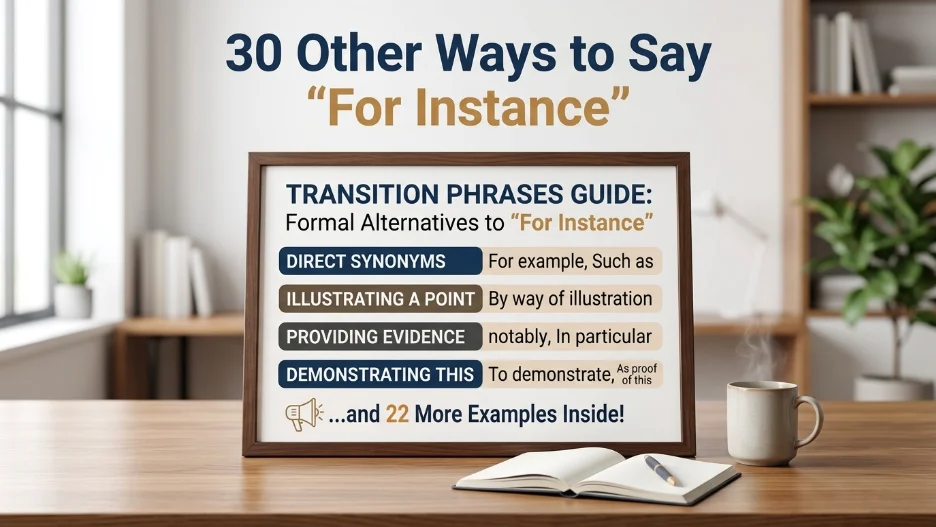
Quick Answer :Other ways to say “for instance” include: “for example,” “such as,” “like,” “as an illustration,” “to illustrate,” “namely,” “e.g.,” “as a case in point,” “by way of example,” and “to give you an idea.”
“For instance” is one of the most common phrases used to introduce examples and clarify points in both spoken and written English. It helps listeners and readers understand abstract ideas by providing concrete illustrations.
However, relying solely on “for instance” can make your communication feel repetitive and predictable. Learning alternatives to “for instance” allows you to vary your language, match your tone to different contexts, and sound more fluent and sophisticated. Whether you’re writing a business report, giving a presentation, or having a casual conversation, having a rich vocabulary of examples of transition phrases helps you express ideas in English with greater clarity and style.
“The examples you choose matter, but the words you use to introduce them matter just as much.”
Quick Categories
Formal Alternatives
- For example
- As an illustration
- To illustrate
- As a case in point
- By way of example
- Namely
Casual Alternatives
- Like
- Such as
- Say
- For one thing
- As an example
Professional Alternatives
- As demonstrated by
- Consider
- Take, for example
- In particular
- To cite an instance
Informal Expressions
- Just like
- Including
- Especially
- Particularly
- Specifically
Pro Tip: Match your introductory phrase to your audience. Formal writing demands precise, academic sounding transitions, while casual conversations allow for simpler, more conversational options.
Common Mistakes
1. Using “Like” in Formal Writing
Mistake: “Many companies, like Google, use this strategy.”
Better Approach: Use “such as” or “for example” in formal contexts.
Example: “Many companies, such as Google, use this strategy.”
2. Forgetting to Include an Example After the Phrase
Mistake: “There are several reasons, for instance.”
Better Approach: Always follow introductory phrases with a specific example.
Example: “There are several reasons, for instance, time constraints.”
3. Using “E.g.” Incorrectly in Spoken English
Mistake: Saying “e.g.” aloud in conversation.
Better Approach: Use “for example” or “like” in spoken English.
Example: “We need more data, for example, sales figures.”
4. Overusing “For Example” in Long Texts
Mistake: Starting every example with the same phrase.
Better Approach: Vary your language to maintain reader interest.
Example: Alternate between “for instance,” “as an illustration,” and “such as.”
5. Using Informal Phrases in Academic Writing
Mistake: “There are many options, like…”
Better Approach: Use formal alternatives in academic contexts.
Example: “There are many options, for example…”
What Does “For Instance” Mean?
Definition: “For instance” is a transitional phrase used to introduce an example that clarifies, supports, or illustrates a previous statement.
Grammar Note: It functions as an introductory adverbial phrase and is typically followed by a comma. It can appear at the beginning, middle, or end of a sentence.
Example: “Many factors contribute to success. For instance, consistent effort makes a significant difference.”
When to Use “For Instance”
- Academic writing To support arguments with evidence
- Business presentations To clarify points with concrete examples
- Everyday conversations To explain ideas clearly
- Professional emails To illustrate complex concepts
- Journalism and content writing To add depth to explanations
Spoken vs Written: Works effectively in both contexts, but written English offers more formal alternatives.
Formal vs Informal: Versatile and appropriate across all contexts.
Is It Professional or Polite to Say “For Instance”?
Polite? ✔️ Yes It’s universally considered clear and helpful.
Professional? ✔️ Yes It works well in most professional contexts, though more formal alternatives may be preferable in academic or legal writing.
Business Style Example: “We should prioritize key markets. For instance, the European market offers significant growth potential.”
“Using varied transition phrases signals sophistication and command of the language.”
Pros and Cons of Using “For Instance”
✅ Pros
- Clear and widely understood
- Appropriate for most contexts
- Easy to use correctly
- Helps organize ideas logically
❌ Cons
- Can sound repetitive
- May feel too basic in formal writing
- Less precise than some alternatives
- Limited emotional or persuasive impact
Other Ways to Say “For Instance” (With Examples)
These alternatives will help you sound more fluent, confident, and natural in different situations. Use them according to tone, context, and audience to introduce examples, illustrate ideas, and strengthen your arguments.
Formal Alternatives (Academic and Professional Writing)
1. Phrase: For example
Meaning: An introductory phrase for providing an illustration.
Explanation: This is the most common and widely accepted formal alternative to “for instance.”
Example: “Many factors influence consumer behavior. For example, brand loyalty often drives repeat purchases.”
Best Use: All formal contexts
Worst Use: None
Tone: Neutral, formal
Context Variability: professional / written / formal
2. Phrase: As an illustration
Meaning: Used to present a clarifying example.
Explanation: This phrase emphasizes that the example serves to illustrate or clarify the point.
Example: “The company experienced significant growth last quarter. As an illustration, revenue increased by 25%.”
Best Use: Business reports
Worst Use: Casual conversation
Tone: Formal, academic
Context Variability: professional / written / formal
3. Phrase: To illustrate
Meaning: A direct way to introduce an example.
Explanation: This active phrasing draws attention to the example’s purpose.
Example: “To illustrate this concept, consider the case of renewable energy adoption.”
Best Use: Presentations
Worst Use: Quick texts
Tone: Direct, formal
Context Variability: professional / spoken / formal
4. Phrase: As a case in point
Meaning: A specific example that proves or demonstrates the point.
Explanation: This phrase highlights that the example is particularly relevant or conclusive.
Example: “Effective communication is crucial in leadership. As a case in point, consider how Steve Jobs inspired his team.”
Best Use: Persuasive writing
Worst Use: Casual chats
Tone: Rhetorical, formal
Context Variability: professional / written / formal
5. Phrase: By way of example
Meaning: Used to provide an illustrative case.
Explanation: This formal phrase is common in academic and legal writing.
Example: “By way of example, let us examine the impact of policy changes on small businesses.”
Best Use: Legal documents
Worst Use: Text messages
Tone: Very formal
Context Variability: professional / written / formal
6. Phrase: Namely
Meaning: Used to specify or name something precisely.
Explanation: This phrase is ideal when providing a specific, named example.
Example: “The project requires additional resources, namely, funding and personnel.”
Best Use: Clarification
Worst Use: Broad examples
Tone: Precise, formal
Context Variability: professional / written / formal
7. Phrase: As demonstrated by
Meaning: Introduces evidence or proof.
Explanation: This phrase links the example directly to the evidence it provides.
Example: “The strategy was effective, as demonstrated by increased market share.”
Best Use: Evidence based writing
Worst Use: Casual conversation
Tone: Analytical, formal
Context Variability: professional / written / formal
8. Phrase: Consider
Meaning: An imperative encouraging the audience to think about an example.
Explanation: This direct approach engages the reader or listener.
Example: “Consider the case of Japan’s aging population when discussing economic challenges.”
Best Use: Speeches
Worst Use: Passive writing
Tone: Engaging, formal
Context Variability: professional / spoken / formal
9. Phrase: Take, for example
Meaning: A directive to examine a specific case.
Explanation: This phrase actively invites the audience to consider the example.
Example: “Take, for example, the rise of e commerce in developing nations.”
Best Use: Presentations
Worst Use: Academic papers
Tone: Engaging, formal
Context Variability: professional / spoken / formal
10. Phrase: To cite an instance
Meaning: To reference a specific occurrence as evidence.
Explanation: This phrase is common in formal research and legal contexts.
Example: “To cite an instance, the 2008 financial crisis illustrates systemic risk.”
Best Use: Research papers
Worst Use: Day to day conversation
Tone: Very formal
Context Variability: professional / written / formal
Pro Tip: In formal academic writing, choose more sophisticated alternatives like “as a case in point” or “to illustrate” to demonstrate advanced vocabulary.
Professional Alternatives (Business and Workplace Communication)
11. Phrase: In particular
Meaning: Highlights a specific example among others.
Explanation: This phrase narrows focus to a particularly relevant case.
Example: “Several departments reported growth, in particular, the marketing team.”
Best Use: Business meetings
Worst Use: General examples
Tone: Focused, professional
Context Variability: professional / spoken / formal
12. Phrase: Specifically
Meaning: Introduces a precise example or detail.
Explanation: This word signals that you’re about to provide exact information.
Example: “We need to improve our customer service, specifically, response times.”
Best Use: Clear communication
Worst Use: Broad introductions
Tone: Precise, professional
Context Variability: professional / spoken / formal
13. Phrase: Especially
Meaning: Highlights an example that is particularly significant.
Explanation: This phrase emphasizes the importance of the example.
Example: “Some skills are essential for success, especially adaptability.”
Best Use: Emphasis
Worst Use: Equal examples
Tone: Emphatic, professional
Context Variability: professional / spoken / formal
14. Phrase: Including
Meaning: Indicates that an example is part of a larger group.
Explanation: This is excellent for listing examples within a larger category.
Example: “Several factors contributed, including budget constraints and timeline issues.”
Best Use: Lists
Worst Use: Single examples
Tone: Inclusive, professional
Context Variability: professional / written / formal
15. Phrase: Particularly
Meaning: Highlights a specific, noteworthy example.
Explanation: Similar to “especially,” this emphasizes importance.
Example: “Consumer trends have shifted, particularly in the luxury sector.”
Best Use: Important examples
Worst Use: Casual contexts
Tone: Emphatic, professional
Context Variability: professional / spoken / formal
16. Phrase: Such as
Meaning: Introduces examples without making the list exhaustive.
Explanation: This is one of the most versatile professional alternatives.
Example: “We offer many services, such as consulting, training, and support.”
Best Use: Lists
Worst Use: Single examples
Tone: Neutral, professional
Context Variability: professional / spoken / formal
17. Phrase: Like
Meaning: A casual way to introduce examples.
Explanation: While widely used, it’s considered too informal for formal business writing.
Example: “We need to consider factors like cost and efficiency.”
Best Use: Internal communications
Worst Use: Formal reports
Tone: Casual, conversational
Context Variability: spoken / casual
18. Phrase: For one thing
Meaning: Used to introduce one of several reasons or examples.
Explanation: This phrase is useful when giving multiple examples sequentially.
Example: “We should reconsider the strategy. For one thing, costs are rising.”
Best Use: Arguments
Worst Use: Lists
Tone: Conversational, professional
Context Variability: spoken / casual
19. Phrase: As an example
Meaning: Directly introduces an example.
Explanation: This is a straightforward, accessible alternative.
Example: “As an example, consider our recent rebranding campaign.”
Best Use: Training materials
Worst Use: Formal documents
Tone: Clear, professional
Context Variability: professional / spoken / formal
20. Phrase: To give you an idea
Meaning: Provides an example to help the audience understand.
Explanation: This friendly phrase is common in presentations and explanations.
Example: “To give you an idea of the scale, we serve over 10,000 clients.”
Best Use: Presentations
Worst Use: Formal writing
Tone: Friendly, professional
Context Variability: professional / spoken / informal
Casual Alternatives (Conversations and Informal Writing)
21. Phrase: Say
Meaning: A hypothetical example introduced casually.
Explanation: This phrase is common in everyday conversation.
Example: “Let’s say you wanted to start a business…”
Best Use: Hypotheticals
Worst Use: Academic writing
Tone: Hypothetical, casual
Context Variability: spoken / casual
22. Phrase: Just like
Meaning: Draws a direct comparison or example.
Explanation: This is very casual and emphasizes similarity.
Example: “Some people learn visually, just like my brother.”
Best Use: Comparisons
Worst Use: Professional contexts
Tone: Comparative, casual
Context Variability: spoken / casual
23. Phrase: For one
Meaning: Used to introduce one example in a series.
Explanation: This is extremely casual and conversational.
Example: “I love this neighborhood. For one, it’s close to my office.”
Best Use: Casual conversation
Worst Use: Professional writing
Tone: Very casual
Context Variability: spoken / casual
24. Phrase: As seen in
Meaning: References a specific instance or observation.
Explanation: This phrase works well in informal writing and casual contexts.
Example: “We can understand this trend as seen in urban development.”
Best Use: Observations
Worst Use: Formal business
Tone: Observational, casual
Context Variability: spoken / casual
25. Phrase: One example is
Meaning: A very direct way to introduce an example.
Explanation: This is simple, clear, and works in almost any context.
Example: “One example is our successful product launch in Asia.”
Best Use: All contexts
Worst Use: None
Tone: Direct, versatile
Context Variability: spoken / written / casual
Additional Alternatives for Variety
26. Phrase: Think about
Meaning: Encourages the listener to consider an example.
Explanation: This engages the audience directly.
Example: “Think about how AI is changing customer service.”
Best Use: Speeches
Worst Use: Reports
Tone: Engaging, casual
Context Variability: spoken / casual
27. Phrase: In particular, consider
Meaning: Focuses attention on a specific example.
Explanation: This combines emphasis with engagement.
Example: “In particular, consider the impact of remote work.”
Best Use: Presentations
Worst Use: Casual chats
Tone: Focused, professional
Context Variability: professional / spoken / formal
28. Phrase: Among others
Meaning: Indicates the example is one of several.
Explanation: This phrase acknowledges that there are other relevant examples.
Example: “Key factors include market conditions, among others.”
Best Use: Lists
Worst Use: Explanations
Tone: Neutral, versatile
Context Variability: professional / written / formal
29. Phrase: By way of illustration
Meaning: A formal way to introduce a clarifying example.
Explanation: This is a more sophisticated version of “as an illustration.”
Example: “By way of illustration, the company’s profits doubled.”
Best Use: Formal writing
Worst Use: Conversation
Tone: Very formal
Context Variability: professional / written / formal
30. Phrase: E.g.
Meaning: The Latin abbreviation for “exempli gratia” (for example).
Explanation: This is common in academic and professional writing but should never be spoken aloud.
Example: “We need more research (e.g., clinical trials, surveys).”
Best Use: Academic writing
Worst Use: Spoken English
Tone: Very formal, academic
Context Variability: professional / written / formal
“Variety in language is like variety in color—it makes your communication more vibrant and engaging.”
Mini Quiz: Test Your Understanding
1. Which phrase is most appropriate for a formal academic paper?
- A) “Like”
- B) “Say”
- C) “As a case in point”
- D) “Just like”
2. Which of the following should you avoid in spoken English?
- A) “For example”
- B) “Such as”
- C) “E.g.”
- D) “Take, for example”
3. What does “for instance” mean?
- A) To emphasize importance
- B) To introduce a clarifying example
- C) To conclude an argument
- D) To introduce a contrast
4. Which phrase is too casual for a business report?
- A) “Specifically”
- B) “In particular”
- C) “Like”
- D) “For example”
5. What’s the best alternative for introducing a single, specific example?
- A) “Such as”
- B) “Namely”
- C) “Including”
- D) “Like”
👉 Check Your Answers:
- C “As a case in point” is appropriately formal for academic writing.
- C “E.g.” should never be spoken aloud; it’s for written English only.
- B “For instance” introduces a clarifying example.
- C “Like” is too casual for formal business writing.
- B “Namely” is ideal for introducing a specific, named example.
Comparison Table: Top 10 Alternatives
| Phrase | Tone | Best Use |
| For example | Formal, Neutral | All written contexts |
| As a case in point | Very formal | Persuasive writing |
| Such as | Neutral, Formal | Lists and examples |
| Namely | Precise, Formal | Specifying examples |
| To illustrate | Direct, Formal | Presentations |
| In particular | Focused, Professional | Emphasizing examples |
| Like | Casual, Conversational | Everyday speech |
| As an illustration | Formal, Academic | Research papers |
| Take, for example | Engaging, Formal | Speeches |
| E.g. | Very formal, Academic | Academic writing |
FAQs
1. What is the best alternative to “for instance”?
The best alternative depends on your context. “For example” is the most versatile and appropriate for most situations, while “as a case in point” is better for formal writing.
2. Is it okay to use “like” instead of “for instance”?
Yes, in casual conversation and informal writing, “like” is widely accepted. However, avoid it in formal and professional communication.
3. Can I use “e.g.” in place of “for instance”?
Yes, in academic and formal writing. Never use “e.g.” in spoken English—it sounds awkward and unnatural.
4. How do I avoid repeating “for instance” in a long article?
Vary your language by using different alternatives based on the context and tone of each example. Use the list above to mix formal, casual, and professional options.
5. Is “for instance” formal or informal?
“For instance” is versatile and works in both formal and informal contexts, though it tends to be slightly more formal than “for example” in academic writing.
Conclusion
Learning alternatives to “for instance” is essential for anyone looking to improve their English communication skills. By varying your language, you not only sound more fluent and sophisticated but also keep your audience engaged and interested.
Start incorporating these alternatives into your daily writing and speaking. Pay attention to the tone and context of each situation, and choose the phrase that best fits. With practice, these other ways to say “for instance” will become natural and automatic.

John Green is an American writer who contributes to QuickResponsess.com, creating clear and practical content on English grammar, vocabulary and everyday language. His goal is to make learning English simple, engaging and easy to apply.