Quick Answer 🔥
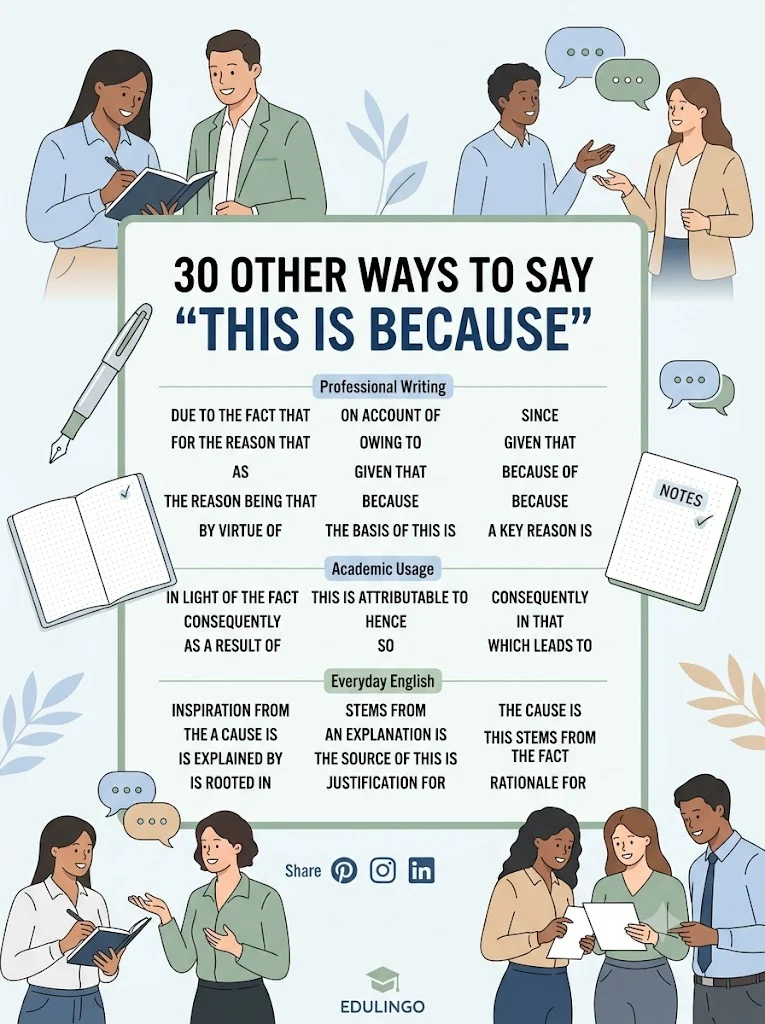
Replace “this is because” with this is due to, the reason for this is that, since, owing to, or as a result of. These alternatives add variety, clarity, and professionalism to your English, whether you are writing an essay, sending an email, or speaking in a meeting.
The phrase “this is because” is one of the most common ways English speakers explain reasons and causes. You use it constantly in conversations, emails, essays, and reports to connect an outcome to its cause. It is simple, direct, and easy to understand.
However, overusing “this is because” makes your English sound repetitive and uninspired. When you rely on the same phrase too often, your writing loses impact and your speaking feels less fluent. Learning alternatives to “this is because” will instantly elevate your communication skills, help you express excitement in English more naturally, and make you sound like a confident, advanced speaker.
Quick Categories
Formal Alternatives to “This Is Because”
- Due to the fact that
- Owing to
- On account of
- In light of the fact that
- For the reason that
- Inasmuch as
Casual Alternatives
- After all
- Since
- As
- Seeing that
- Now that
Professional Alternatives
- This is due to
- The reason for this is that
- As a result of
- This arises from
- This is attributable to
Informal Expressions
- Simply because
- Thanks to
- Cos / ’Cause
- The thing is
Common Mistakes People Make with “This Is Because”
1. Using “the reason is because”
❌ The reason I left early is because I was tired.
✅ The reason I left early is that I was tired.
Using “because” after “reason” is redundant. Use “that” instead.
2. Repeating “this is because” too many times in one paragraph
❌ Sales dropped. This is because the market changed. This is because customers lost trust.
✅ Sales dropped. This is because the market changed. As a result, customers lost trust.
3. Using “this is because” in very formal academic writing without variation
❌ The experiment failed. This is because the temperature was not controlled.
✅ The experiment failed owing to uncontrolled temperature variations.
4. Forgetting to punctuate correctly when starting a sentence with “since” or “as”
❌ Since it was raining we stayed inside.
✅ Since it was raining, we stayed inside.
5. Using “due to” incorrectly after a noun
❌ The cancellation was due to the storm was severe.
✅ The cancellation was due to the severe storm.
“Due to” should be followed by a noun, not a full clause.
What Does “This Is Because” Mean?
“This is because” is a phrase used to introduce the reason or cause for something that was just mentioned. It links a previous statement to its explanation, helping the listener or reader understand why something happened or is true.
Example Sentence:
The meeting was postponed, and this is because the CEO fell ill unexpectedly.
When to Use “This Is Because”
- Explaining a decision you made
- Providing a reason for an outcome
- Connecting two ideas in an essay
- Answering a “why” question
- Clarifying your reasoning in a conversation
| Context | Suitability |
|---|---|
| Spoken English | ✅ Very common |
| Written English | ✅ Acceptable |
| Formal Writing | ⚠️ Use sparingly |
| Informal Writing | ✅ Perfectly fine |
Is It Professional or Polite to Say “This Is Because”?
Polite? ✔️ Yes — it is neutral and courteous.
Professional? ❌ Not ideal — it is overused and can sound basic in business settings.
Business-style example:
We have decided to restructure the department. This is because we need to improve efficiency and reduce operational costs.
While this is clear, a more professional alternative would elevate the tone and demonstrate greater linguistic sophistication.
Pros and Cons of Using “This Is Because”
Pros
- Simple and natural for everyday speech
- Friendly and approachable tone
- Commonly used and easily understood by all
- Works well in casual writing and conversation
Cons
- Too informal for professional reports and academic papers
- Overused, making your writing feel repetitive and dull
- Limited emotional and expressive range
- Not suitable for formal business communication
Other Ways to Say “This Is Because” (With Examples)
These alternatives will help you sound more fluent, confident, and natural in different situations. Use them according to tone, context, and audience to express reasons and causes with precision.
1. Phrase: This is due to
Meaning: Indicates that the previous point is caused by what follows.
Explanation: The closest and most versatile synonym for “this is because,” widely used in essays and professional writing.
Example Sentence: People are shopping less in malls. This is due to the internet making it much easier to order things online.
Best Use: Essays, reports
Worst Use: Casual conversation
Tone: Formal, neutral
Context Variability: Professional / Written
2. Phrase: The reason for this is that
Meaning: Explicitly states the cause behind a previously mentioned situation.
Explanation: Allows you to elaborate on a point from the previous sentence.
Example Sentence: Television is one of the most powerful outlets in the world. The reason for this is that everyone has access to a TV.
Best Use: Academic writing
Worst Use: Quick spoken replies
Tone: Formal, explanatory
Context Variability: Professional / Academic
3. Phrase: Since
Meaning: For the reason that.
Explanation: A common and versatile one-word alternative that works in both speaking and writing.
Example Sentence: Since the report was late, the meeting was postponed.
Best Use: Emails, essays
Worst Use: When you need extreme formality
Tone: Neutral, versatile
Context Variability: Casual / Professional / Spoken
4. Phrase: Owing to
Meaning: Because of; as a result of.
Explanation: A formal alternative that sounds polished and professional.
Example Sentence: The event was canceled owing to bad weather.
Best Use: Professional emails
Worst Use: Everyday conversation
Tone: Formal, polished
Context Variability: Professional / Written
5. Phrase: As a result of
Meaning: Shows a consequence or effect caused by something.
Explanation: Emphasizes the cause-and-effect relationship clearly.
Example Sentence: The flight was delayed as a result of fog.
Best Use: Reports, business writing
Worst Use: Casual speech
Tone: Formal, clear
Context Variability: Professional / Written
6. Phrase: On account of
Meaning: Due to a specific reason.
Explanation: Often used in formal or legal contexts.
Example Sentence: The school closed on account of snow.
Best Use: Official notices
Worst Use: Informal chat
Tone: Formal, official
Context Variability: Professional / Legal
7. Phrase: Due to the fact that
Meaning: A very formal way to introduce a reason.
Explanation: Precise and explicit, though somewhat wordy.
Example Sentence: The event was canceled due to the fact that the weather forecast predicted storms.
Best Use: Academic papers
Worst Use: Everyday speech
Tone: Very formal
Context Variability: Academic / Official
8. Phrase: For the reason that
Meaning: Explains a specific cause explicitly.
Explanation: A formal and clear way to state why something happened.
Example Sentence: The contract was renewed for the reason that the partnership showed promising results.
Best Use: Legal, business documents
Worst Use: Casual conversation
Tone: Formal, explicit
Context Variability: Professional / Legal
9. Phrase: In light of the fact that
Meaning: Taking into consideration that.
Explanation: Used when new information or facts influence a situation.
Example Sentence: We adjusted the schedule in light of the fact that several team members were unavailable.
Best Use: Reports, memos
Worst Use: Spoken English
Tone: Formal, considerate
Context Variability: Professional / Written
10. Phrase: Considering that
Meaning: Taking a particular fact into account.
Explanation: A slightly formal alternative that shows nuanced reasoning.
Example Sentence: The proposal was approved considering that it benefits the community.
Best Use: Professional discussions
Worst Use: Very casual settings
Tone: Formal, nuanced
Context Variability: Professional / Spoken
11. Phrase: This arises from
Meaning: This originates or results from.
Explanation: A formal way to trace the origin of a situation.
Example Sentence: The current conflict arises from a misunderstanding of the original agreement.
Best Use: Analytical writing
Worst Use: Everyday talk
Tone: Formal, analytical
Context Variability: Professional / Academic
12. Phrase: This is attributable to
Meaning: This can be credited or assigned to.
Explanation: A sophisticated formal alternative.
Example Sentence: The company’s success is attributable to its innovative marketing strategy.
Best Use: Business reports
Worst Use: Casual speech
Tone: Formal, sophisticated
Context Variability: Professional / Written
13. Phrase: This results from
Meaning: This is the outcome of.
Explanation: Emphasizes that the current situation is a direct consequence.
Example Sentence: The delay results from supply chain disruptions.
Best Use: Reports, analysis
Worst Use: Informal settings
Tone: Formal, direct
Context Variability: Professional / Written
14. Phrase: The explanation for this is
Meaning: Here is the reason or clarification.
Explanation: A clear and formal way to provide reasoning.
Example Sentence: The explanation for this is that the data was not properly verified.
Best Use: Academic writing
Worst Use: Quick replies
Tone: Formal, explanatory
Context Variability: Academic / Professional
15. Phrase: As
Meaning: For the reason that (similar to “since”).
Explanation: A concise formal alternative, though it can sometimes cause ambiguity.
Example Sentence: As the project was underfunded, progress was slow.
Best Use: Formal writing
Worst Use: When clarity is critical
Tone: Formal, concise
Context Variability: Professional / Written
16. Phrase: After all
Meaning: When everything is considered; for the reason that.
Explanation: An informal alternative that works well in conversational English.
Example Sentence: I tried to find the most effective way. After all, that would give me the best results.
Best Use: Informal essays
Worst Use: Formal reports
Tone: Casual, reflective
Context Variability: Casual / Spoken
17. Phrase: Simply because
Meaning: For no more reason than.
Explanation: A casual way to give a straightforward reason.
Example Sentence: I chose this path simply because it felt right.
Best Use: Conversation, personal writing
Worst Use: Professional documents
Tone: Casual, honest
Context Variability: Casual / Spoken
18. Phrase: Thanks to
Meaning: Because of (often with a positive connotation).
Explanation: Can be used formally or casually, sometimes with irony.
Example Sentence: Thanks to her help, we finished early.
Best Use: Acknowledging positive causes
Worst Use: Negative contexts
Tone: Grateful, positive
Context Variability: Casual / Professional
19. Phrase: Seeing that
Meaning: Considering that; because.
Explanation: A conversational alternative that sounds natural in speech.
Example Sentence: Seeing that it’s late, let’s go home.
Best Use: Spoken English
Worst Use: Formal writing
Tone: Casual, natural
Context Variability: Casual / Spoken
20. Phrase: Now that
Meaning: Because something has happened or changed.
Explanation: Used when a new circumstance creates a reason.
Example Sentence: Now that everyone is here, we can start the meeting.
Best Use: Spoken, emails
Worst Use: Academic essays
Tone: Neutral, conditional
Context Variability: Casual / Professional
21. Phrase: In view of
Meaning: Considering; because of.
Explanation: A formal phrase often used in business and legal contexts.
Example Sentence: In view of recent events, the policy has been revised.
Best Use: Official communication
Worst Use: Everyday talk
Tone: Formal, official
Context Variability: Professional / Legal
22. Phrase: By reason of
Meaning: Because of; due to.
Explanation: A formal and slightly archaic alternative.
Example Sentence: The application was rejected by reason of incomplete documentation.
Best Use: Legal writing
Worst Use: Casual conversation
Tone: Very formal, legal
Context Variability: Legal / Official
23. Phrase: On the grounds that
Meaning: For the reason that (often used in legal or formal contexts).
Explanation: Emphasizes a justification or basis for a decision.
Example Sentence: The appeal was denied on the grounds that the evidence was insufficient.
Best Use: Legal, formal arguments
Worst Use: Casual speech
Tone: Formal, justificatory
Context Variability: Legal / Professional
24. Phrase: Inasmuch as
Meaning: In view of the fact that; because.
Explanation: A very formal alternative, often found in academic and legal writing.
Example Sentence: Inasmuch as resources are limited, we must plan carefully.
Best Use: Academic, legal
Worst Use: Everyday English
Tone: Extremely formal
Context Variability: Academic / Legal
25. Phrase: Given that
Meaning: Considering the fact that.
Explanation: A smooth transition phrase suitable for both formal and conversational contexts.
Example Sentence: Given that the deadline is approaching, we need to work faster.
Best Use: Professional, academic
Worst Use: Very casual settings
Tone: Formal, considerate
Context Variability: Professional / Spoken
26. Phrase: For
Meaning: Because (used as a conjunction).
Explanation: A somewhat old-fashioned but still correct formal alternative.
Example Sentence: He apologized profusely, for he knew he had made a mistake.
Best Use: Literary, formal writing
Worst Use: Modern spoken English
Tone: Formal, literary
Context Variability: Written / Formal
27. Phrase: In consequence of
Meaning: As a result of.
Explanation: A very formal phrase with a legal or official tone.
Example Sentence: The rules were changed in consequence of new regulations.
Best Use: Legal, official documents
Worst Use: Everyday communication
Tone: Very formal, legal
Context Variability: Legal / Official
28. Phrase: As long as
Meaning: Because; on the condition that.
Explanation: Used in conditional statements where a reason is implied.
Example Sentence: You can use my computer as long as you promise to be careful.
Best Use: Conditional contexts
Worst Use: Explaining straightforward causes
Tone: Conditional, neutral
Context Variability: Casual / Professional
29. Phrase: The thing is
Meaning: The reason or issue is.
Explanation: A very informal way to introduce an explanation in conversation.
Example Sentence: I couldn’t make it to the party. The thing is, my car broke down.
Best Use: Spoken English
Worst Use: Any formal writing
Tone: Casual, conversational
Context Variability: Casual / Spoken
30. Phrase: Cos / ’Cause
Meaning: Because (informal contraction).
Explanation: Common in everyday speech but rarely used in writing.
Example Sentence: I stayed home ’cause I wasn’t feeling well.
Best Use: Informal conversation
Worst Use: Writing of any kind
Tone: Very casual, slang
Context Variability: Casual / Spoken
“The right tone makes your English sound professional and confident. Choose your words based on who you are speaking to and where.”
Mini Quiz / Self-Check
1. Which alternative is most appropriate for an academic essay?
- A) ’Cause
- B) Due to the fact that
- C) The thing is
- D) Cos
Answer: B
2. You are writing a casual email to a colleague. Which phrase fits best?
- A) Inasmuch as
- B) By reason of
- C) Since
- D) In consequence of
Answer: C
3. Which sentence contains a common grammatical error?
- A) The reason I left is that I was tired.
- B) The reason I left is because I was tired.
- C) I left because I was tired.
- D) Since I was tired, I left.
Answer: B — “reason is because” is redundant.
4. You are writing a legal document. Which phrase is most suitable?
- A) On the grounds that
- B) Thanks to
- C) After all
- D) Simply because
Answer: A
“Variety is the spice of effective communication. Replacing overused phrases keeps your audience engaged.”
Comparison Table: Top 10 Alternatives
| Phrase | Tone | Best Use |
|---|---|---|
| This is due to | Formal | Essays, reports |
| The reason for this is that | Formal | Academic writing |
| Since | Neutral | Emails, essays, speech |
| Owing to | Formal | Professional emails |
| As a result of | Formal | Business reports |
| On account of | Formal | Official notices |
| Due to the fact that | Very formal | Academic papers |
| After all | Casual | Informal writing |
| Considering that | Formal | Professional discussions |
| Given that | Formal | Professional, academic |
“Using formal alternatives to ‘this is because’ signals intelligence, care, and professionalism in your writing.”
FAQs
1. What is a better way to say “this is because” in an essay?
This is due to and the reason for this is that are excellent formal alternatives that maintain an academic tone while adding variety to your writing.
2. Can I use “since” instead of “this is because”?
Yes, “since” is a common and versatile alternative. However, be careful not to confuse readers by using “since” to mean “from that time” rather than “because”.
3. Is “this is because” grammatically correct?
Yes, it is grammatically correct. However, it is overused and can make your writing feel repetitive and unsophisticated.
4. What is the most formal alternative to “this is because”?
Inasmuch as and by reason of are among the most formal alternatives, typically found in legal and academic writing.
5. How many times can I use “this is because” in a paragraph?
You should aim to use it no more than once per paragraph. Overusing it makes your writing dull and repetitive.
Conclusion
Learning alternatives to “this is because” is one of the fastest ways to elevate your English from basic to advanced. Whether you are writing a university essay, sending a professional email, or speaking in a meeting, choosing the right phrase for the right context demonstrates linguistic awareness and confidence.
Start by replacing just one or two instances of “this is because” in your daily communication. Pay attention to tone formal for work and academic settings, casual for friends and informal writing. With consistent practice, these alternatives will become second nature, and your English will improve.

John Green is an American writer who contributes to QuickResponsess.com, creating clear and practical content on English grammar, vocabulary and everyday language. His goal is to make learning English simple, engaging and easy to apply.