Quick Answer 🔥
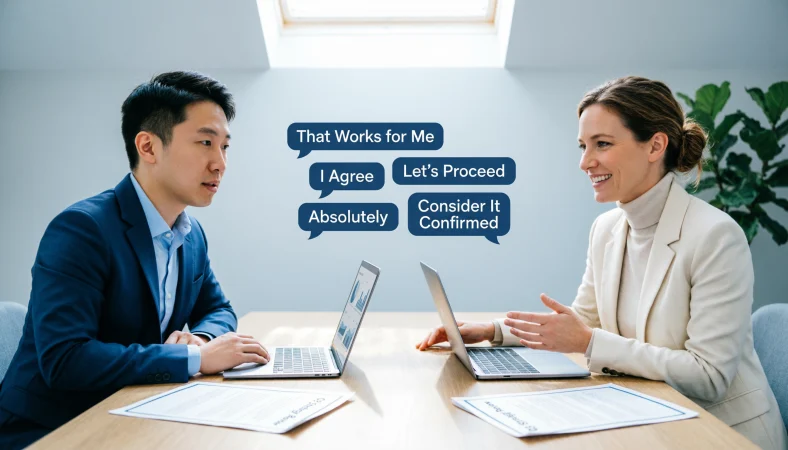
Instead of saying “sounds good” professionally, you can use phrases like That works for me, I agree, That sounds great, I’m happy with that, Absolutely, That’s acceptable, I’m on board, I approve, Consider it confirmed, or Let’s proceed.
“Sounds good” is one of the most commonly used phrases in everyday English. It’s a quick, friendly way to show agreement, approval, or acceptance. You hear it in casual conversations, team meetings, and even email replies.
But here’s the challenge: relying on this phrase too often can make you sound repetitive, vague, or overly informal especially in professional settings. Learning alternatives to “sounds good” helps you express excitement in English with more precision and confidence. It also shows you understand the nuances of professional communication.
Quick Categories
Formal Alternatives
- That is acceptable to me
- I approve this
- This aligns with our goals
- I agree with this approach
- Consider it confirmed
Casual Alternatives
- Works for me
- I’m good with that
- Let’s go with that
- Count me in
- Sure thing
Professional Alternatives
- I’m on board with that
- That sounds like a solid plan
- Let’s proceed with that
- I’m comfortable with this
- That’s a reasonable suggestion
Informal Expressions
- Love this
- That sounds great
- Let’s do it
- I’m happy with that
- That’s perfect
💡 Pro Tip: When in doubt, slightly more formal is safer than slightly too casual, especially in client communication.
Common Mistakes
- Using “sounds good” for everything
- ❌ “Sounds good” → every email reply
- ✅ Vary your responses based on context
- Being too vague
- ❌ “Sounds good” after a detailed proposal
- ✅ “This aligns with our goals for Q2”
- Using it with clients or superiors
- ❌ “Sounds good” → client email
- ✅ “That works for me. I’ll send a calendar invite.”
- Not acknowledging receipt of information
- ❌ “Sounds good” without showing you’ve read the details
- ✅ “I’ve reviewed this and everything looks clear”
- Overusing “noted” alone
- ❌ “Noted.” → sounds curt
- ✅ “Noted, let me review and get back to you by Friday”
What Does “Sounds Good” Mean?
Sounds good is an informal expression used to indicate agreement, approval, or acceptance of a suggestion, plan, or idea.
Grammar note: It’s a shortened form of “That sounds good,” where “sound” means “to convey an impression” or “seem.”
Example: “The 3 PM meeting sounds good to me.”
When to Use “Sounds Good”
- ✅ Responding to peers in Slack or Teams
- ✅ Confirming low stakes plans (meeting times, lunch)
- ✅ Verbal conversations with colleagues
- ⚠️ Use sparingly in emails to managers
- ❌ Avoid with new clients or first contacts
Is It Professional or Polite to Say “Sounds Good”?
Polite? ✅ Yes
Professional? ❌ No (in most formal cases)
It’s polite but often too casual for professional written communication. Use it with peers but swap it for more specific phrases in client facing or high stakes contexts.
Business style example: “I’ve blocked Friday morning. Looking forward to it.”
Pros and Cons of Using “Sounds Good”
Pros
- Simple and natural
- Friendly tone
- Common usage—everyone understands it
- Easy to understand
Cons
- Too informal for work
- Overused and repetitive
- Limited emotional range
- Not suitable for formal writing
Other Ways to Say “Sounds Good” (With Examples)
These alternatives will help you sound more fluent, confident, and natural in different situations. Use them according to tone, context, and audience.
1. Phrase: That works for me.
Meaning: I agree with the plan or suggestion.
Explanation: A neutral, widely accepted confirmation.
Example Sentence: “Friday at 2 PM works for me. I’ll send a calendar invite.”
Best Use: Scheduling
Worst Use: Strategic decisions
Tone: Neutral, direct
2. Phrase: I’m on board with that.
Meaning: I fully support the idea.
Explanation: Shows you’ve read and support the direction.
Example Sentence: “I’m on board with this approach. Happy to take the lead on the first phase.”
Best Use: Team buy in
Worst Use: Formal contracts
Tone: Collaborative, confident
3. Phrase: That aligns with our goals.
Meaning: The idea matches team objectives.
Explanation: Sounds thoughtful and organizational.
Example Sentence: “This aligns with our goals for Q2.”
Best Use: Strategy meetings
Worst Use: Casual chats
Tone: Strategic, leadership
4. Phrase: Let’s proceed with that.
Meaning: You’re ready to move forward.
Explanation: Action focused and motivating.
Example Sentence: “Good analysis. Let’s proceed with Option B.”
Best Use: Project decisions
Worst Use: Non actionable topics
Tone: Action oriented, decisive
5. Phrase: That sounds like a solid plan.
Meaning: The proposal is well structured and reliable.
Explanation: Slightly more encouraging and positive.
Example Sentence: “That sounds like a solid plan—let’s move forward.”
Best Use: Project planning
Worst Use: Minor decisions
Tone: Encouraging, positive
6. Phrase: I agree with this approach.
Meaning: You support or approve the idea.
Explanation: Sounds professional and analytical.
Example Sentence: “After reviewing your plan, I agree with this approach.”
Best Use: Decision making
Worst Use: Trivial matters
Tone: Professional, analytical
7. Phrase: That is acceptable to me.
Meaning: The terms or plan meet your expectations.
Explanation: More formal and neutral.
Example Sentence: “The revised schedule is acceptable to me.”
Best Use: Negotiations
Worst Use: Enthusiastic agreement
Tone: Formal, reserved
8. Phrase: I can work with that.
Meaning: You can manage or adapt to the plan.
Explanation: Shows cooperation without over enthusiasm.
Example Sentence: “I can work with that timeline as long as the team agrees.”
Best Use: Flexible scenarios
Worst Use: Formal documents
Tone: Cooperative, adaptable
9. Phrase: Consider it confirmed.
Meaning: The arrangement is officially agreed upon.
Explanation: Formal and action oriented.
Example Sentence: “Consider the March 15 slot confirmed. Please let me know if anything changes.”
Best Use: External scheduling
Worst Use: Internal chats
Tone: Formal, decisive
10. Phrase: This looks right to me.
Meaning: You’ve reviewed and approved.
Explanation: Signals review without overstating authority.
Example Sentence: “This looks right to me. I’d flag it with legal before we finalize.”
Best Use: Document review
Worst Use: Major decisions
Tone: Analytical, careful
11. Phrase: I’m comfortable with this.
Meaning: You accept and have no concerns.
Explanation: Good for sensitive discussions.
Example Sentence: “After reviewing the details, I’m comfortable with this.”
Best Use: Sensitive topics
Worst Use: Enthusiastic approval
Tone: Reassuring, measured
12. Phrase: That’s a reasonable suggestion.
Meaning: The idea is logical and fair.
Explanation: Sounds thoughtful and diplomatic.
Example Sentence: “I think that’s a reasonable suggestion, given the situation.”
Best Use: Problem solving
Worst Use: Obvious choices
Tone: Diplomatic, thoughtful
13. Phrase: I’ve blocked that time.
Meaning: The time is secured on your calendar.
Explanation: Slightly more formal than “works for me.”
Example Sentence: “I’ve blocked Friday morning. Looking forward to it.”
Best Use: Scheduling
Worst Use: Non calendar topics
Tone: Professional, proactive
14. Phrase: Let’s go with that.
Meaning: You agree to proceed.
Explanation: Casual but action oriented.
Example Sentence: “Good analysis. Let’s go with Option B.”
Best Use: Team discussions
Worst Use: Formal emails
Tone: Casual, decisive
15. Phrase: That’s perfect.
Meaning: Strong approval.
Explanation: Use sparingly—it’s very positive.
Example Sentence: “The revised timeline is perfect. Thank you.”
Best Use: Great news
Worst Use: Neutral topics
Tone: Enthusiastic, positive
16. Phrase: I support this.
Meaning: Strong endorsement.
Explanation: Good for final decisions.
Example Sentence: “I support this direction for Q4.”
Best Use: Leadership contexts
Worst Use: Minor decisions
Tone: Endorsing, confident
17. Phrase: That’s manageable.
Meaning: You can handle the requirement.
Explanation: Shows realistic acceptance.
Example Sentence: “The additional tasks are manageable with the current timeline.”
Best Use: Workload discussions
Worst Use: Enthusiastic agreement
Tone: Realistic, capable
18. Phrase: I appreciate this update.
Meaning: You acknowledge and accept new information.
Explanation: Shows you’ve received and valued the update.
Example Sentence: “I appreciate this update. I’ll follow up by Tuesday.”
Best Use: Information sharing
Worst Use: Agreements
Tone: Grateful, professional
19. Phrase: That makes sense.
Meaning: The idea is logical and acceptable.
Explanation: Shows understanding.
Example Sentence: “That makes sense given the timeline.”
Best Use: Explanations
Worst Use: Enthusiastic approval
Tone: Understanding, logical
20. Phrase: I’m happy with that.
Meaning: You’re satisfied with the decision.
Explanation: Positive and respectful.
Example Sentence: “I’m happy with that solution if you are.”
Best Use: Polite confirmations
Worst Use: Formal contracts
Tone: Positive, respectful
21. Phrase: Agreed.
Meaning: You and the other person agree.
Explanation: Short, sweet, yet professional.
Example Sentence: “Agreed. Let’s meet tomorrow to go over the timeline.”
Best Use: Meetings
Worst Use: Enthusiastic contexts
Tone: Direct, professional
22. Phrase: I’m looking forward to it.
Meaning: You’re excited about the plan.
Explanation: Shows enthusiasm while staying professional.
Example Sentence: “I’m looking forward to working with you on this!”
Best Use: New projects
Worst Use: Routine tasks
Tone: Enthusiastic, professional
23. Phrase: We can make that happen.
Meaning: You can turn the idea into reality.
Explanation: Action oriented and confident.
Example Sentence: “Great idea! We can make that happen with a little reorganizing.”
Best Use: Team projects
Worst Use: Unrealistic requests
Tone: Capable, proactive
24. Phrase: I’m pleased with…
Meaning: You approve of something specific.
Explanation: More formal than “sounds good.”
Example Sentence: “I’m pleased with this project so far.”
Best Use: Progress updates
Worst Use: Brief responses
Tone: Formal, appreciative
25. Phrase: Works for me.
Meaning: Short confirmation of agreement.
Explanation: Casual and brief.
Example Sentence: “Monday morning works for me.”
Best Use: Quick replies
Worst Use: Formal communication
Tone: Casual, brief
26. Phrase: That’s fine with me.
Meaning: You have no objections.
Explanation: Calm and non committal.
Example Sentence: “Tomorrow morning? That’s fine with me.”
Best Use: Flexible situations
Worst Use: Important decisions
Tone: Neutral, easygoing
27. Phrase: I approve this.
Meaning: Official authorization.
Explanation: Direct and authoritative—use only when appropriate.
Example Sentence: “I approve this and support moving forward.”
Best Use: Leadership decisions
Worst Use: Casual contexts
Tone: Authoritative, formal
28. Phrase: Received, thank you.
Meaning: You’ve received and acknowledged.
Explanation: Simple confirmation.
Example Sentence: “Received, thank you. I’ll review and get back to you.”
Best Use: Email receipts
Worst Use: Approval contexts
Tone: Professional, neutral
29. Phrase: I’m fully on board.
Meaning: You completely support the idea.
Explanation: More emphatic than “I’m on board.”
Example Sentence: “I’m fully on board. This aligns with everything we discussed.”
Best Use: Major decisions
Worst Use: Minor choices
Tone: Enthusiastic, committed
30. Phrase: This is exactly what we need.
Meaning: The proposal is perfectly suited to requirements.
Explanation: Shows strong approval.
Example Sentence: “This is exactly what we need. Can we share it with the wider team?”
Best Use: Great ideas
Worst Use: Neutral topics
Tone: Enthusiastic, affirming
💡 Pro Tip: “The right tone makes your English sound professional and confident. Choose phrases that match the stakes of your conversation.”
Mini Quiz: Which Phrase Should You Use?
1. You’re responding to a client’s proposal. Which is best?
- A) Sounds good
- B) That aligns with our goals
- C) Works for me
- Answer: B — Shows you’ve read and understood the proposal.
2. Your colleague suggests a team lunch. What’s appropriate?
- A) That works for me
- B) I approve this
- C) That aligns with our goals
- Answer: A — Casual situations call for neutral confirmations.
3. You’re reviewing a document and need to show you’ve read it.
- A) Sounds good
- B) This looks right to me
- C) Let’s do it
- Answer: B — Signals review and careful consideration.
4. You’re confirming a meeting time with a new contact.
- A) Works for me
- B) Sounds good
- C) Consider it confirmed
- Answer: C — Most formal and professional option.
Comparison Table: Top 10 Alternatives
| Phrase | Tone | Best Use |
| That works for me | Neutral | Scheduling |
| I’m on board with that | Collaborative | Team buy in |
| That aligns with our goals | Strategic | Strategy meetings |
| Let’s proceed with that | Action oriented | Project decisions |
| That sounds like a solid plan | Encouraging | Project planning |
| I agree with this approach | Analytical | Decision making |
| That is acceptable to me | Formal | Negotiations |
| Consider it confirmed | Formal | External scheduling |
| This looks right to me | Analytical | Document review |
| I can work with that | Cooperative | Flexible scenarios |
FAQs
1. Is “sounds good” professional enough for work email?
It depends on your audience and context. Use it with peers on Slack, but swap it for more specific phrases in client emails or high stakes confirmations. The stakes matter more than the channel.
2. What is the best alternative to “sounds good” in a business meeting?
“That aligns with our goals” or “I agree with this approach” work best in business meetings. They show you’ve heard the proposal and understand its strategic value.
3. How can I express excitement without saying “sounds good”?
Try “This is exactly what we need,” “That’s perfect,” or “I’m looking forward to it.” These phrases express enthusiasm while remaining professional.
4. What should I say instead of “sounds good” to a client?
Use formal alternatives like “That is acceptable to me,” “Consider it confirmed,” or “I’ve blocked that time” for scheduling. These show professionalism and attention to detail.
5. Is “I’m on board” formal enough for a manager?
Yes, “I’m on board” is professional and works well with managers. It shows support without being overly casual. Use “I’m fully on board” for extra emphasis.
Conclusion
Learning alternatives to “sounds good” helps you sound more fluent, confident, and context aware in professional settings. The key is matching the right phrase to the right situation whether you need formal language for clients, professional teamwork phrases, or casual expressions for peers.
Practice using these alternatives daily. Pay attention to tone, audience, and stakes. With time, choosing the right professional reaction phrase will become second nature and you’ll notice how much more polished your English communication becomes.

Stephen King is an American writer and language enthusiast who enjoys creating clear, practical content that helps readers communicate with confidence. His work at QuickResponsess.com focuses on making English easier to understand through simple explanations and everyday examples.