Quick Answer
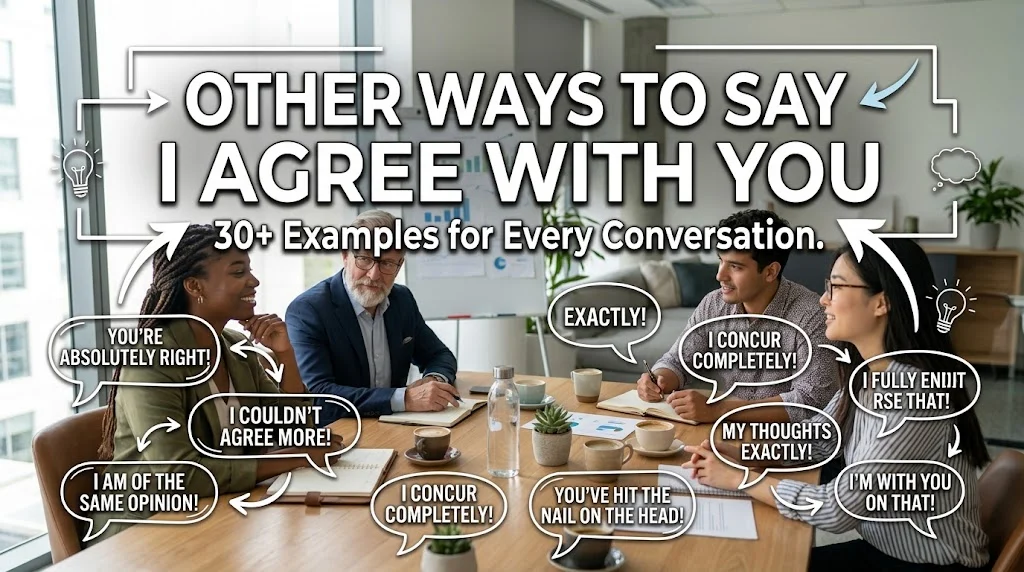
“I agree with you” is a direct way to show that you share someone’s opinion. For more variety and precision, try alternatives like “I couldn’t agree more,” “You’re absolutely right,” “That’s a fair point,” “I see it the same way,” or “I’m with you on that.”
“I agree with you” is one of the most useful phrases in English conversation. It appears in meetings, debates, casual chats, and formal negotiations. It signals alignment, builds rapport, and moves discussions forward. Because it is so essential, many learners use it for every situation, from agreeing with a friend about a film to agreeing with a client about contract terms.
This guide provides 30 practical options with meanings, examples, and notes on tone. You will learn to express excitement in English when you fully support an idea and use professional reaction phrases that fit workplace communication.
Pull Quote: “Agreement is not one sound. It is a scale, from quiet assent to enthusiastic endorsement.”
Quick Categories
Formal alternatives to “I agree with you”
- I concur with your assessment.
- I am in full agreement.
- I share your perspective.
- Your point is well founded.
Pro Tip: Formal alternatives suit reports, official emails, and academic discussion.
Casual alternatives
- Same here.
- You bet.
- For sure.
- Tell me about it.
Pro Tip: Casual options work best with friends and familiar colleagues, not with clients.
Professional alternatives
- I fully support that position.
- That aligns with my view.
- I am of the same opinion.
- I endorse that approach.
Pro Tip: Professional alternatives should sound confident but not overly emotional.
Informal expressions
- Couldn’t have said it better.
- You took the words right out of my mouth.
- Right on.
- Amen to that.
Pro Tip: Informal expressions belong in spoken English, texts, and private conversations.
Pull Quote: “The right tone makes your English sound professional and confident.”
Common Mistakes
- Using “I agree with you” in formal writing without qualification.
Example: “I agree with you” in a legal memo instead of “I concur with your assessment.” - Agreeing too quickly without showing understanding.
Example: “I agree with you” before the other person has finished explaining. - Overusing the same phrase in one conversation.
Example: “I agree with you. I agree with you. I agree with you.” Repetition weakens impact. - Mixing register awkwardly in one message.
Example: “Dear Sir, I agree with you, cheers.” The tone clashes badly. - Agreeing with something you do not actually support.
Example: “I agree with you” when you have serious doubts. This damages credibility later.
What Does “I Agree With You” Mean?
Definition
It is a statement that expresses shared opinion, belief, or position on a specific topic or proposal.
Grammar Explanation
“Agree” is an intransitive verb in this structure, followed by the preposition “with” and the object. You agree with a person, but you agree to a proposal or on a plan.
Example Sentence
“I agree with you that the deadline should be extended.”
When to Use “I Agree With You”
Common Contexts
- Meetings: Supporting a colleague’s proposal.
- Negotiations: Confirming shared terms.
- Debates: Aligning with a speaker’s argument.
- Casual conversations: Sharing an opinion about films, food, or plans.
- Written communication: Confirming alignment in emails and reports.
Spoken vs Written
- Spoken: Extremely common in everyday conversation.
- Written: Common in emails and reports but often replaced by more formal phrases.
Formal vs Informal
- Formal: Acceptable but often replaced by “I concur” or “I am in full agreement.”
- Informal: The default choice in casual speech.
Is It Professional or Polite to Say “I Agree With You”?
Politeness vs Professionalism
The phrase is polite and neutral. In professional settings, it can sound slightly basic compared to “I fully support that position” or “That aligns with my view.” Using more precise alternatives signals confidence and seniority.
Business-Style Example
“That aligns with my view, and I fully support the proposed timeline.”
Polite? Yes
Professional? Acceptable, but stronger alternatives exist
Pull Quote: “In professional English, precision is a form of respect.”
Pros and Cons of Using “I Agree With You”
Pros
- Simple and natural: Easy to say and understand.
- Friendly tone: Cooperative and approachable.
- Common usage: Recognised in every English-speaking country.
- Easy to understand: Requires no advanced vocabulary.
Cons
- Too informal for work: Can sound basic in professional writing.
- Overused: Loses impact through repetition.
- Limited emotional range: Cannot express enthusiasm or partial agreement.
- Not suitable for formal writing: Avoid in legal and academic texts without qualification.
Other Ways to Say “I Agree With You” (With Examples)
These alternatives will help you sound more fluent, confident, and natural in different situations. Use them according to tone, context, and audience to express excitement, admiration, or approval.
1. I couldn’t agree more
Meaning: I agree completely and strongly.
Explanation: Emphatic and warm.
Example Sentence: “I couldn’t agree more with your assessment of the situation.”
Best Use: Strong agreement
Worst Use: Partial agreement
Tone: Enthusiastic, warm, emphatic
Context Variability: Casual and professional
2. You’re absolutely right
Meaning: Your statement is completely correct.
Explanation: Direct and confident.
Example Sentence: “You’re absolutely right, we need to act now.”
Best Use: Confirming opinions
Worst Use: Formal reports
Tone: Confident, direct, warm
Context Variability: Casual and spoken
3. That’s a fair point
Meaning: Your argument is reasonable and valid.
Explanation: Slightly measured and thoughtful.
Example Sentence: “That’s a fair point, and I think we should consider it.”
Best Use: Discussions, debates
Worst Use: Enthusiastic praise
Tone: Measured, thoughtful, neutral
Context Variability: Professional and spoken
4. I see it the same way
Meaning: My perspective matches yours.
Explanation: Neutral and calm.
Example Sentence: “I see it the same way, especially after reviewing the data.”
Best Use: Meetings, discussions
Worst Use: Emotional moments
Tone: Neutral, calm, professional
Context Variability: Professional and spoken
5. I’m with you on that
Meaning: I support your position.
Explanation: Friendly and informal.
Example Sentence: “I’m with you on that, let’s push for the change.”
Best Use: Team alignment
Worst Use: Formal letters
Tone: Friendly, casual, supportive
Context Variability: Casual and spoken
6. I concur
Meaning: I formally agree.
Explanation: Very formal and often used in professional writing.
Example Sentence: “I concur with your recommendation to delay the launch.”
Best Use: Formal reports
Worst Use: Casual chats
Tone: Formal, precise, authoritative
Context Variability: Professional and written
7. I am in full agreement
Meaning: I agree completely.
Explanation: Formal and clear.
Example Sentence: “I am in full agreement with the proposed strategy.”
Best Use: Business writing
Worst Use: Friendly texts
Tone: Formal, confident, professional
Context Variability: Professional and written
8. That aligns with my view
Meaning: Your position matches mine.
Explanation: Professional and neutral.
Example Sentence: “That aligns with my view on the budget priorities.”
Best Use: Meetings, emails
Worst Use: Casual speech
Tone: Professional, neutral, precise
Context Variability: Professional and written
9. I share your perspective
Meaning: We see the situation in the same way.
Explanation: Formal and respectful.
Example Sentence: “I share your perspective on the risks involved.”
Best Use: Formal discussions
Worst Use: Quick replies
Tone: Formal, respectful, thoughtful
Context Variability: Professional and written
10. Your point is well founded
Meaning: Your argument is based on solid reasoning.
Explanation: Formal and analytical.
Example Sentence: “Your point is well founded, and the evidence supports it.”
Best Use: Academic, debates
Worst Use: Casual chats
Tone: Analytical, formal, respectful
Context Variability: Professional and written
11. Same here
Meaning: I feel the same way.
Explanation: Very casual and short.
Example Sentence: “Same here, I think the plan needs more work.”
Best Use: Friends, peers
Worst Use: Formal writing
Tone: Casual, brief, friendly
Context Variability: Casual and spoken
12. You bet
Meaning: Definitely, I agree.
Explanation: Very informal.
Example Sentence: “You bet, I’m on board with that idea.”
Best Use: Informal settings
Worst Use: Professional emails
Tone: Enthusiastic, casual, brief
Context Variability: Casual and spoken
13. For sure
Meaning: Certainly, I agree.
Explanation: Relaxed and modern.
Example Sentence: “For sure, that is the best approach.”
Best Use: Casual conversations
Worst Use: Formal reports
Tone: Casual, positive, relaxed
Context Variability: Casual and spoken
14. Tell me about it
Meaning: I completely understand and agree from experience.
Explanation: Idiomatic and empathetic.
Example Sentence: “Tell me about it, the traffic was terrible.”
Best Use: Shared frustrations
Worst Use: Professional contexts
Tone: Empathetic, casual, idiomatic
Context Variability: Casual and spoken
15. Couldn’t have said it better
Meaning: Your words perfectly express my view.
Explanation: Warm and complimentary.
Example Sentence: “Couldn’t have said it better myself.”
Best Use: Praise, agreement
Worst Use: Formal writing
Tone: Warm, appreciative, informal
Context Variability: Casual and spoken
16. You took the words right out of my mouth
Meaning: You said exactly what I was thinking.
Explanation: Idiomatic and friendly.
Example Sentence: “You took the words right out of my mouth.”
Best Use: Friendly agreement
Worst Use: Business memos
Tone: Friendly, idiomatic, warm
Context Variability: Casual and spoken
17. Right on
Meaning: I strongly agree.
Explanation: Short and energetic.
Example Sentence: “Right on, that’s exactly the point.”
Best Use: Informal support
Worst Use: Formal writing
Tone: Energetic, casual, positive
Context Variability: Casual and spoken
18. Amen to that
Meaning: I strongly agree, often with feeling.
Explanation: Slightly religious in origin but widely used.
Example Sentence: “Amen to that, we all need a break.”
Best Use: Informal agreement
Worst Use: Formal documents
Tone: Emphatic, informal, warm
Context Variability: Casual and spoken
19. I endorse that approach
Meaning: I formally support the method or plan.
Explanation: Professional and confident.
Example Sentence: “I endorse that approach and will communicate it to the team.”
Best Use: Business decisions
Worst Use: Casual chats
Tone: Professional, confident, formal
Context Variability: Professional and written
20. I fully support that position
Meaning: I am completely behind your stance.
Explanation: Strong and professional.
Example Sentence: “I fully support that position and will back it in the meeting.”
Best Use: Workplace alignment
Worst Use: Personal opinions
Tone: Strong, professional, confident
Context Variability: Professional and spoken
21. I am of the same opinion
Meaning: I hold the same view.
Explanation: Formal and slightly old-fashioned.
Example Sentence: “I am of the same opinion regarding the merger.”
Best Use: Formal discussion
Worst Use: Casual conversations
Tone: Formal, neutral, respectful
Context Variability: Professional and written
22. We are on the same page
Meaning: We share the same understanding.
Explanation: Collaborative and professional.
Example Sentence: “It sounds like we are on the same page about the priorities.”
Best Use: Team meetings
Worst Use: Personal arguments
Tone: Collaborative, neutral, professional
Context Variability: Professional and spoken
23. I see your point
Meaning: I understand and accept your argument.
Explanation: Slightly cautious, often used in partial agreement.
Example Sentence: “I see your point, though I still have some concerns.”
Best Use: Debates, discussions
Worst Use: Full endorsement
Tone: Thoughtful, measured, neutral
Context Variability: Professional and spoken
24. That makes sense to me
Meaning: Your reasoning is logical and I accept it.
Explanation: Neutral and thoughtful.
Example Sentence: “That makes sense to me, let’s move forward.”
Best Use: Problem solving
Worst Use: Emotional support
Tone: Logical, calm, neutral
Context Variability: Professional and spoken
25. I think so too
Meaning: I hold the same belief.
Explanation: Simple and direct.
Example Sentence: “I think so too, the timing feels right.”
Best Use: Casual agreement
Worst Use: Formal writing
Tone: Simple, friendly, neutral
Context Variability: Casual and spoken
26. That is exactly how I feel
Meaning: Your view matches my emotions or opinion.
Explanation: Emotional and personal.
Example Sentence: “That is exactly how I feel about the situation.”
Best Use: Personal agreement
Worst Use: Technical writing
Tone: Emotional, personal, warm
Context Variability: Casual and spoken
27. You have a point there
Meaning: Your argument has merit.
Explanation: Slightly informal but thoughtful.
Example Sentence: “You have a point there, I had not considered that angle.”
Best Use: Discussions
Worst Use: Strong endorsement
Tone: Thoughtful, casual, fair
Context Variability: Casual and spoken
28. I am inclined to agree
Meaning: I am leaning toward agreement.
Explanation: Cautious and measured.
Example Sentence: “I am inclined to agree, but I would like more data first.”
Best Use: Cautious agreement
Worst Use: Enthusiastic contexts
Tone: Cautious, formal, measured
Context Variability: Professional and written
29. I back that idea
Meaning: I support the idea.
Explanation: Direct and confident.
Example Sentence: “I back that idea and I think it will work.”
Best Use: Team support
Worst Use: Formal reports
Tone: Confident, direct, supportive
Context Variability: Professional and spoken
30. Consider it settled
Meaning: I agree, and we can move on.
Explanation: Decisive and slightly formal.
Example Sentence: “Consider it settled, we will proceed with your plan.”
Best Use: Decision making
Worst Use: Open debates
Tone: Decisive, formal, confident
Context Variability: Professional and spoken
Pull Quote: “Professional reaction phrases and clear agreement words both show the same thing: you are engaged, not passive.”
Mini Quiz / Self-Check
- Scenario: You are in a board meeting and want to formally support a colleague’s proposal. Which fits best?
- A) Same here.
- B) I fully support that position.
- C) You bet.
- Scenario: A friend shares an opinion you share exactly. Which is most natural?
- A) I concur with your assessment.
- B) Couldn’t have said it better.
- C) I endorse that approach.
- Scenario: You partially agree but still have doubts. Which phrase fits best?
- A) I see your point, though I still have concerns.
- B) I couldn’t agree more.
- C) Amen to that.
- Scenario: Which phrase is the most formal?
- A) For sure.
- B) I am of the same opinion.
- C) Right on.
Comparison Table: Top Alternatives
| Phrase | Tone | Best Use |
| I couldn’t agree more | Enthusiastic, warm | Strong agreement |
| You’re absolutely right | Confident, direct | Confirming opinions |
| That’s a fair point | Measured, thoughtful | Discussions, debates |
| I concur | Formal, precise | Formal reports |
| I am in full agreement | Formal, confident | Business writing |
| That aligns with my view | Professional, neutral | Meetings, emails |
| I’m with you on that | Friendly, casual | Team alignment |
| We are on the same page | Collaborative, professional | Team meetings |
| I see your point | Thoughtful, measured | Partial agreement |
| I endorse that approach | Professional, confident | Business decisions |
FAQs
1. What is a formal alternative to “I agree with you”?
“I concur with your assessment” or “I am in full agreement” are strong formal alternatives suitable for reports, official emails, and academic writing.
2. How do I agree professionally in a business meeting?
Use phrases such as “I fully support that position,” “That aligns with my view,” or “I endorse that approach” to sound confident and credible.
3. What is the difference between “I agree with you” and “I agree to your proposal”?
You agree with a person or opinion, but you agree to a proposal, plan, or request.
4. What can I say instead of “I agree” in casual conversation?
“Same here,” “For sure,” “You bet,” and “Couldn’t have said it better” are natural and informal alternatives.
5. How do I show partial agreement in English?
Use phrases such as “I see your point, though I still have concerns” or “I am inclined to agree, but I would like more data first” to express measured agreement.
Conclusion
Learning other ways to say I agree with you gives you the ability to express alignment with precision, warmth, and confidence. Whether you are endorsing a proposal, supporting a friend, or engaging in a debate, the right phrase makes your English sound fluent and intentional. These alternatives to I agree with you help you move beyond one overused expression and into richer, more natural communication.
Practise by listening for moments of agreement in conversations, meetings, and media. Pay close attention to tone and context, because the right phrase depends on the situation and the audience. With steady practice, these informal expressions in English and their formal counterparts will become part of your everyday fluency.

John Green is an American writer who contributes to QuickResponsess.com, creating clear and practical content on English grammar, vocabulary and everyday language. His goal is to make learning English simple, engaging and easy to apply.