Quick Answer
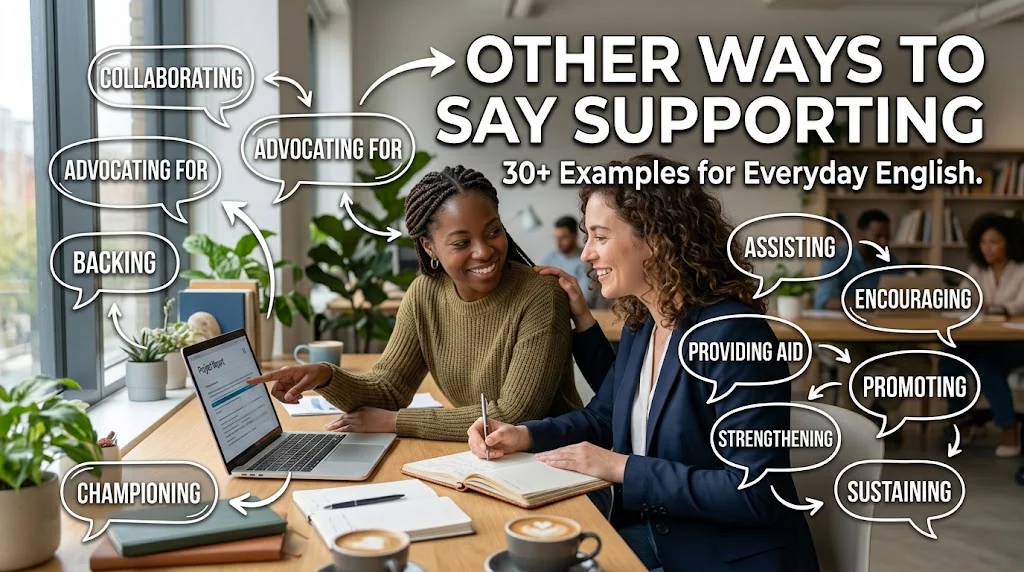
“Supporting” means giving help, encouragement, or backing to a person, idea, or cause. For more variety and precision, try alternatives like “backing,” “assisting,” “endorsing,” “advocating for,” “standing by,” or “championing.”
“Supporting” is one of the most versatile words in English. It appears in job descriptions, personal conversations, corporate emails, and academic writing. It can describe emotional encouragement, financial assistance, professional backing, or technical reinforcement. Because it covers so many meanings, learners often rely on it for every situation, which flattens meaning and weakens impact.
This guide presents 30 practical alternatives with clear notes on tone, context, and audience. Whether you are writing a performance review, encouraging a friend, or drafting a proposal, these options will help you sound fluent, confident, and precise.
Pull Quote: “Support is not one action. It is a spectrum, and each point on that spectrum deserves its own word.”
Quick Categories
Formal alternatives to “Supporting”
- Endorsing
- Advocating for
- Championing
- Upholding
Pro Tip: Formal alternatives suit proposals, official statements, and academic writing.
Casual alternatives
- Backing
- Rooting for
- Sticking with
- Having someone’s back
Pro Tip: Casual options work well in spoken English and friendly messages.
Professional alternatives
- Assisting
- Facilitating
- Reinforcing
- Contributing to
Pro Tip: Professional alternatives suit CVs, reports, and business communication.
Informal expressions
- Cheering on
- Lifting up
- Standing behind
- Going to bat for
Pro Tip: Informal expressions belong in conversations, texts, and motivational messages.
Pull Quote: “The right tone makes your English sound professional and confident.”
Common Mistakes
- Using “supporting” for every kind of help.
Example: “She is supporting the project” when “leading” or “managing” is more accurate. - Confusing emotional and financial support.
Example: “He supported his brother” without clarifying whether it was emotional or financial. - Overusing the word in business writing.
Example: “We are supporting the team, supporting the plan, and supporting the launch.” Repetition weakens clarity. - Using it as a noun when a verb is needed.
Example: “She is supporting of the idea” instead of “She supports the idea.” - Applying it vaguely without context.
Example: “Thank you for supporting” without specifying what or how.
What Does “Supporting” Mean?
Definition
It is the act of providing assistance, encouragement, backing, or reinforcement to a person, group, idea, or structure.
Grammar Explanation
“Supporting” is the present participle of the verb “support.” It can function as an adjective (“a supporting role”), a gerund (“supporting others is rewarding”), or part of a continuous verb form (“she is supporting the campaign”).
Example Sentence
“His supporting role in the project was essential to its success.”
When to Use “Supporting”
Common Contexts
- Workplace: Describing assistance to colleagues or teams.
- Personal life: Encouraging friends and family.
- Business: Backing proposals, initiatives, or clients.
- Academia: Reinforcing arguments with evidence.
- Construction: Describing structural reinforcement.
Spoken vs Written
- Spoken: Common in everyday conversation and meetings.
- Written: Very common in reports, proposals, and academic writing.
Formal vs Informal
- Formal: Standard in professional and academic contexts.
- Informal: Acceptable but often replaced by “backing” or “rooting for” in casual speech.
Is It Professional or Polite to Say “Supporting”?
Politeness vs Professionalism
“Supporting” is both polite and professional. It is widely accepted in all registers. However, it can sound generic when used repeatedly, so pairing it with specific alternatives often strengthens your message.
Business-Style Example
“Our team is fully committed to facilitating the transition and reinforcing the new processes.”
Polite? Yes
Professional? Yes, in most contexts
Pull Quote: “Specific words build credibility. Vague words build distance.”
Pros and Cons of Using “Supporting”
Pros
- Simple and natural: Widely understood across all English registers.
- Friendly tone: Positive and cooperative.
- Common usage: Recognised in every professional field.
- Easy to understand: Requires no specialist vocabulary.
Cons
- Too informal for work: Rarely an issue, but can sound vague in corporate writing.
- Overused: Loses impact through repetition.
- Limited emotional range: Cannot express specific types of assistance.
- Not suitable for formal writing: Acceptable, but precise alternatives often read better.
Other Ways to Say “Supporting” (With Examples)
These alternatives will help you sound more fluent, confident, and natural in different situations. Use them according to tone, context, and audience to express excitement, admiration, or approval.
1. Backing
Meaning: Giving approval or financial support to a person or plan.
Explanation: Direct and confident in tone.
Example Sentence: “The investors are backing the new venture with significant funding.”
Best Use: Business, finance
Worst Use: Emotional comfort
Tone: Confident, direct, practical
Context Variability: Professional and spoken
2. Assisting
Meaning: Helping someone complete a task.
Explanation: Focuses on practical help rather than emotional backing.
Example Sentence: “She is assisting the team with the data analysis.”
Best Use: Workplace, tasks
Worst Use: Emotional support
Tone: Professional, practical, neutral
Context Variability: Professional and written
3. Endorsing
Meaning: Publicly declaring approval or support.
Explanation: Formal and often public in nature.
Example Sentence: “The committee is endorsing the new policy.”
Best Use: Official statements
Worst Use: Personal comfort
Tone: Formal, public, authoritative
Context Variability: Professional and written
4. Advocating for
Meaning: Speaking in favour of a person or cause.
Explanation: Active and vocal support.
Example Sentence: “She is advocating for better mental health services.”
Best Use: Social causes
Worst Use: Casual chat
Tone: Active, principled, formal
Context Variability: Professional and spoken
5. Championing
Meaning: Actively fighting for a cause or person.
Explanation: Energetic and leadership oriented.
Example Sentence: “He is championing the diversity initiative across all departments.”
Best Use: Leadership, causes
Worst Use: Routine tasks
Tone: Energetic, passionate, leadership
Context Variability: Professional and written
6. Upholding
Meaning: Maintaining or defending a principle or decision.
Explanation: Formal and moral in tone.
Example Sentence: “The court is upholding the original ruling.”
Best Use: Legal, ethical
Worst Use: Casual encouragement
Tone: Formal, principled, serious
Context Variability: Professional and written
7. Rooting for
Meaning: Hoping someone succeeds.
Explanation: Emotional and encouraging.
Example Sentence: “We are all rooting for you in the final round.”
Best Use: Sports, motivation
Worst Use: Formal reports
Tone: Warm, encouraging, informal
Context Variability: Casual and spoken
8. Standing by
Meaning: Remaining loyal during difficulty.
Explanation: Emphasises loyalty over action.
Example Sentence: “Her family is standing by her through the trial.”
Best Use: Personal loyalty
Worst Use: Business proposals
Tone: Loyal, steady, emotional
Context Variability: Casual and spoken
9. Having someone’s back
Meaning: Protecting or defending someone.
Explanation: Informal and loyal in tone.
Example Sentence: “Do not worry, I am having your back in the meeting.”
Best Use: Close colleagues
Worst Use: Formal writing
Tone: Loyal, informal, protective
Context Variability: Casual and spoken
10. Cheering on
Meaning: Encouraging someone enthusiastically.
Explanation: Energetic and celebratory.
Example Sentence: “The whole office is cheering on the sales team.”
Best Use: Motivation, events
Worst Use: Technical writing
Tone: Enthusiastic, warm, informal
Context Variability: Casual and spoken
11. Facilitating
Meaning: Making a process easier for others.
Explanation: Professional and process oriented.
Example Sentence: “She is facilitating the onboarding process for new hires.”
Best Use: Workplace, projects
Worst Use: Emotional comfort
Tone: Professional, neutral, efficient
Context Variability: Professional and written
12. Reinforcing
Meaning: Strengthening an idea, structure, or behaviour.
Explanation: Often used in academic and technical contexts.
Example Sentence: “The new data is reinforcing our original findings.”
Best Use: Academic, technical
Worst Use: Personal encouragement
Tone: Technical, formal, analytical
Context Variability: Professional and written
13. Contributing to
Meaning: Adding to a collective effort or result.
Explanation: Collaborative and neutral.
Example Sentence: “Each department is contributing to the overall strategy.”
Best Use: Teamwork, projects
Worst Use: Personal loyalty
Tone: Collaborative, neutral, professional
Context Variability: Professional and written
14. Lifting up
Meaning: Encouraging and elevating someone emotionally.
Explanation: Warm and uplifting.
Example Sentence: “She has a gift for lifting up everyone around her.”
Best Use: Personal encouragement
Worst Use: Technical reports
Tone: Warm, emotional, supportive
Context Variability: Casual and spoken
15. Standing behind
Meaning: Giving full backing to a person or decision.
Explanation: Strong and loyal.
Example Sentence: “The board is standing behind the CEO during the transition.”
Best Use: Leadership, loyalty
Worst Use: Casual chats
Tone: Loyal, firm, formal
Context Variability: Professional and spoken
16. Going to bat for
Meaning: Defending or fighting for someone.
Explanation: Informal and active.
Example Sentence: “My manager went to bat for me during the promotion review.”
Best Use: Workplace loyalty
Worst Use: Formal letters
Tone: Loyal, active, informal
Context Variability: Casual and spoken
17. Nurturing
Meaning: Caring for and helping something grow.
Explanation: Gentle and long term.
Example Sentence: “The programme is nurturing young talent in the community.”
Best Use: Education, development
Worst Use: Financial backing
Tone: Gentle, caring, developmental
Context Variability: Professional and written
18. Fostering
Meaning: Encouraging the development of something.
Explanation: Formal and developmental.
Example Sentence: “The company is fostering innovation across all teams.”
Best Use: Business, education
Worst Use: Personal loyalty
Tone: Formal, developmental, positive
Context Variability: Professional and written
19. Aiding
Meaning: Providing practical help or relief.
Explanation: Slightly formal and often humanitarian.
Example Sentence: “The charity is aiding families affected by the flood.”
Best Use: Humanitarian, medical
Worst Use: Casual chats
Tone: Formal, compassionate, practical
Context Variability: Professional and written
20. Bolstering
Meaning: Strengthening or reinforcing something.
Explanation: Formal and strategic.
Example Sentence: “The new evidence is bolstering the case for reform.”
Best Use: Academic, legal
Worst Use: Personal comfort
Tone: Formal, strategic, strong
Context Variability: Professional and written
21. Underpinning
Meaning: Providing a foundation for something.
Explanation: Technical and structural.
Example Sentence: “These principles are underpinning the entire framework.”
Best Use: Academic, technical
Worst Use: Emotional support
Tone: Technical, formal, foundational
Context Variability: Professional and written
22. Propping up
Meaning: Giving temporary or necessary help.
Explanation: Can imply weakness or dependency.
Example Sentence: “The subsidies are propping up the failing industry.”
Best Use: Economics, analysis
Worst Use: Praise
Tone: Critical, practical, informal
Context Variability: Professional and spoken
23. Seconding
Meaning: Formally agreeing with and supporting a motion.
Explanation: Specific to meetings and procedures.
Example Sentence: “I am seconding the proposal put forward by the finance team.”
Best Use: Meetings, formal votes
Worst Use: General conversation
Tone: Formal, procedural, precise
Context Variability: Professional and spoken
24. Allying with
Meaning: Joining forces with someone for a common goal.
Explanation: Strategic and political in tone.
Example Sentence: “The union is allying with community groups to push for change.”
Best Use: Politics, strategy
Worst Use: Casual encouragement
Tone: Strategic, formal, political
Context Variability: Professional and written
25. Cooperating with
Meaning: Working together toward a shared aim.
Explanation: Neutral and collaborative.
Example Sentence: “The two departments are cooperating with each other on the launch.”
Best Use: Teamwork
Worst Use: Personal loyalty
Tone: Neutral, collaborative, professional
Context Variability: Professional and written
26. Holding up
Meaning: Giving physical or moral support.
Explanation: Literal or metaphorical.
Example Sentence: “The pillars are holding up the entire structure.”
Best Use: Physical, structural
Worst Use: Emotional comfort
Tone: Practical, physical, neutral
Context Variability: Professional and descriptive
27. Carrying
Meaning: Taking on a burden for someone else.
Explanation: Implies significant effort.
Example Sentence: “She has been carrying the team through a difficult quarter.”
Best Use: Workplace, hardship
Worst Use: Routine tasks
Tone: Strong, responsible, committed
Context Variability: Professional and spoken
28. Shouldering
Meaning: Accepting a difficult responsibility.
Explanation: Formal and weighty in tone.
Example Sentence: “He is shouldering the responsibility for the entire restructuring.”
Best Use: Leadership, crisis
Worst Use: Casual help
Tone: Formal, responsible, serious
Context Variability: Professional and written
29. Sustaining
Meaning: Keeping something going over time.
Explanation: Long term and resource oriented.
Example Sentence: “The donations are sustaining the shelter through the winter.”
Best Use: Long term projects
Worst Use: Quick favours
Tone: Steady, long term, practical
Context Variability: Professional and written
30. Aligning with
Meaning: Positioning oneself in agreement with a person or idea.
Explanation: Strategic and neutral.
Example Sentence: “The marketing team is aligning with the new brand strategy.”
Best Use: Business, strategy
Worst Use: Personal loyalty
Tone: Strategic, neutral, professional
Context Variability: Professional and written
Pull Quote: “Professional reaction phrases and precise support words both show the same thing: you understand the situation, not just the sentiment.”
Mini Quiz / Self-Check
- Scenario: You are writing a performance review praising an employee who helped a struggling colleague. Which fits best?
- A) She was going to bat for him.
- B) She was assisting him with his workload.
- C) She was championing him.
- Scenario: You are writing a formal proposal recommending a new policy. Which is most appropriate?
- A) We are rooting for this policy.
- B) We are endorsing this policy.
- C) We are having its back.
- Scenario: You want to encourage a friend before a job interview. Which is most natural?
- A) I am facilitating your interview.
- B) I am rooting for you.
- C) I am seconding your application.
- Scenario: Which phrase is the most informal?
- A) Advocating for.
- B) Cheering on.
- C) Reinforcing.
Comparison Table: Top Alternatives
| Phrase | Tone | Best Use |
| Backing | Confident, direct | Business, finance |
| Assisting | Professional, practical | Workplace, tasks |
| Endorsing | Formal, public | Official statements |
| Advocating for | Active, principled | Social causes |
| Championing | Energetic, passionate | Leadership, causes |
| Rooting for | Warm, encouraging | Sports, motivation |
| Facilitating | Professional, efficient | Workplace, projects |
| Standing behind | Loyal, firm | Leadership, loyalty |
| Going to bat for | Loyal, informal | Workplace loyalty |
| Fostering | Formal, developmental | Business, education |
FAQs
1. What is a formal alternative to “supporting”?
“Endorsing,” “advocating for,” and “championing” are strong formal alternatives suitable for proposals, official statements, and academic writing.
2. How do I say “supporting” professionally at work?
Use specific phrases such as “assisting with,” “facilitating,” or “contributing to” to make your support clear and credible in professional communication.
3. What is the difference between “supporting” and “backing”?
“Backing” often implies financial or public approval, while “supporting” is broader and can include emotional, practical, or structural help.
4. What can I say instead of “supporting” in casual conversation?
“Rooting for,” “cheering on,” and “having someone’s back” are natural and informal alternatives for everyday speech.
5. Is “supporting” a verb or an adjective?
“Supporting” can function as a verb form, an adjective (“a supporting role”), or a gerund (“supporting others is rewarding”), depending on how it is used in a sentence.
Conclusion
Learning other ways to say supporting gives you the ability to express help with precision, warmth, and professionalism. Whether you are backing a colleague, endorsing a proposal, or cheering on a friend, the right word makes your English sound fluent and intentional. These alternatives to supporting help you move beyond one overused term and into richer, more specific expression.
Practise by describing the ways people help each other every day, from small favours to major commitments. Pay close attention to tone and context, because the right word depends on the situation and the audience. With steady practice, these informal expressions in English and their formal counterparts will become part of your everyday fluency.

Stephen King is an American writer and language enthusiast who enjoys creating clear, practical content that helps readers communicate with confidence. His work at QuickResponsess.com focuses on making English easier to understand through simple explanations and everyday examples.