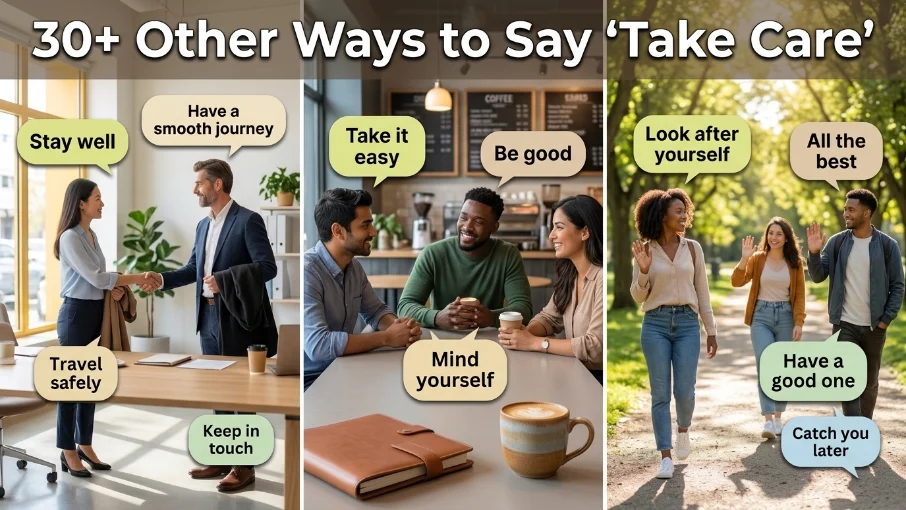
Quick Answer: Here are 5 top options: Stay safe, Look after yourself, All the best, Take it easy, and Be well. Use them based on your relationship with the person and the situation.
“Take care” is one of the most common ways to end a conversation or express concern for someone’s well-being. While it’s friendly and versatile, using the same phrase repeatedly can sound predictable. Choosing different expressions allows you to match the tone, whether you’re speaking to a friend, family member, colleague, or client.
In this guide, you’ll discover 30 other ways to say “Take Care”, including formal, casual, warm, and thoughtful alternatives. Each expression comes with examples to help you use it naturally and confidently in everyday conversations, professional communication, and messages.
Quick Categories
Formal Alternatives to “Take Care”
- All the best
- Farewell for now
- Wishing you well
- Keep well
Casual Alternatives
- Take it easy
- Catch you later
- See you soon
- Have a good one
Professional Alternatives
- Be well
- Stay healthy
- Until next time
- Safe travels
Informal Expressions
- Later
- Peace
- Cheers
- Bye for now
Pro Tip Box
Match your phrase to your audience. Use formal alternatives with colleagues and clients; save casual and informal expressions for friends and family. When in doubt, “Be well” works in almost any context.
Common Mistakes People Make with “Take Care”
- Using it in formal business emails
- Mistake: “Please review the attached proposal. Take care.”
- “Take care” feels too personal for professional correspondence .
- Using it when someone is grieving
- Mistake: “I heard about your loss. Take care.”
- It sounds dismissive; offer specific support instead.
- Overusing it in every farewell
- Mistake: Ending every conversation the same way.
- Variety makes your language more engaging.
- Using it sarcastically
- Mistake: “Take care” said with a sarcastic tone.
- It can come across as rude and insincere.
- Using it in written notes without context
- Mistake: Signing off with only “Take care.”
- It feels abrupt; add a warm closing line first.
What Does “Take Care” Mean?
Meaning: A farewell phrase expressing concern for someone’s safety, health, or well being.
Grammar: It functions as an imperative verb phrase, though it’s used idiomatically rather than as a literal command.
Example Sentence: “I’ll see you next week. Take care!”
When to Use “Take Care”
- Ending a conversation with friends or family
- Saying goodbye to colleagues in informal settings
- Checking in on someone who’s been unwell
- Closing emails to people you know well
Spoken vs Written: Used in both, but in writing it’s best for informal emails and messages .
Formal vs Informal: Mostly informal. Avoid it in formal business communication .
Is It Professional or Polite to Say “Take Care”?
Polite? ✔️ Yes—it shows warmth and concern.
Professional? ❌ No—it’s too casual for most workplace settings .
Business Style Example: Instead of “Take care,” use “Please let me know if you need anything further.”
Pros and Cons of Using “Take Care”
Pros:
- Simple and natural
- Friendly tone
- Common usage
- Easy to understand
Cons:
- Too informal for work
- Overused
- Limited emotional range
- Not suitable for formal writing
Other Ways to Say “Take Care” (With Examples)
These 30 alternatives will help you sound more fluent, confident, and natural in different situations. Use them according to tone, context, and audience to express care and good wishes appropriately.
Formal & Professional Alternatives
1. Phrase: All the best
- Meaning: A general well wishing phrase.
- Explanation: Often used in emails or when saying goodbye to colleagues.
- Example Sentence: “It was a pleasure working with you. All the best in your new role.”
- Best Use: Professional farewells
- Worst Use: Close personal relationships
- Tone: Warm, professional
- Context Variability: Professional; can be used in emails and spoken goodbyes
2. Phrase: Wishing you well
- Meaning: Hoping good things happen for you.
- Explanation: A sincere, formal way to express concern for someone’s future.
- Example Sentence: “Thank you for the meeting. Wishing you well with the project.”
- Best Use: Formal correspondence
- Worst Use: Casual texts
- Tone: Polite, formal
- Context Variability: Best for written communication
3. Phrase: Farewell for now
- Meaning: Goodbye until we meet again.
- Explanation: A slightly formal and gracious parting phrase.
- Example Sentence: “Farewell for now, and good luck with the conference.”
- Best Use: Formal goodbyes
- Worst Use: Everyday casual farewells
- Tone: Formal, gracious
- Context Variability: Formal, written or spoken
4. Phrase: Keep well
- Meaning: Maintain good health.
- Explanation: A concise and polite professional sign off.
- Example Sentence: “I hope the rest of your week goes smoothly. Keep well.”
- Best Use: Business emails
- Worst Use: Friends or family
- Tone: Professional, polite
- Context Variability: Professional written communication
5. Phrase: Safe travels
- Meaning: Wishing you a safe journey.
- Explanation: Specifically for someone who is traveling.
- Example Sentence: “I hope you have a wonderful trip. Safe travels.”
- Best Use: Travel situations
- Worst Use: Non travel contexts
- Tone: Caring, thoughtful
- Context Variability: Travel specific, formal or informal
6. Phrase: Until next time
- Meaning: Goodbye until we meet again.
- Explanation: Neutral and professional, suitable for regular contacts.
- Example Sentence: “We’ll continue this discussion next month. Until next time.”
- Best Use: Ongoing professional relationships
- Worst Use: Final farewells
- Tone: Neutral, forward looking
- Context Variability: Written or spoken professional contexts
Casual & Friendly Alternatives
7. Phrase: Take it easy
- Meaning: Relax and don’t stress.
- Explanation: A laid back alternative among friends.
- Example Sentence: “I’ll call you tomorrow. Take it easy.”
- Best Use: Close friends
- Worst Use: Professional situations
- Tone: Relaxed, casual
- Context Variability: Best for informal spoken English
8. Phrase: Catch you later
- Meaning: See you soon.
- Explanation: A common slang for friends and acquaintances.
- Example Sentence: “I’ve got to run. Catch you later.”
- Best Use: Friends
- Worst Use: Formal meetings
- Tone: Very casual
- Context Variability: Spoken, informal settings
9. Phrase: Have a good one
- Meaning: Have a good day or evening.
- Explanation: Generic, friendly farewell.
- Example Sentence: “It was great catching up. Have a good one.”
- Best Use: Casual encounters
- Worst Use: Formal business
- Tone: Friendly, casual
- Context Variability: Spoken; informal
10. Phrase: Cheers
- Meaning: Goodbye and good wishes.
- Explanation: Widely used in British English as a casual farewell.
- Example Sentence: “Cheers, mate. See you on Monday.”
- Best Use: UK casual settings
- Worst Use: US professional contexts
- Tone: Casual, warm
- Context Variability: Regional (UK/Australia), spoken
11. Phrase: Bye for now
- Meaning: Goodbye until later.
- Explanation: A friendly, temporary farewell.
- Example Sentence: “I’ll talk to you soon. Bye for now.”
- Best Use: Phone calls, short partings
- Worst Use: Final goodbyes
- Tone: Friendly, temporary
- Context Variability: Spoken or written, informal
12. Phrase: See you soon
- Meaning: I look forward to seeing you again soon.
- Explanation: Expresses anticipation and warmth.
- Example Sentence: “Enjoy the rest of your day. See you soon.”
- Best Use: Friends and colleagues you see regularly
- Worst Use: When you won’t see the person again
- Tone: Warm, friendly
- Context Variability: Casual; spoken or written
Heartfelt & Caring Alternatives
13. Phrase: Look after yourself
- Meaning: Take personal responsibility for your well being.
- Explanation: A warm and sincere alternative .
- Example Sentence: “Please look after yourself while you’re recovering.”
- Best Use: Caring for someone’s health
- Worst Use: Professional emails
- Tone: Personal, sincere
- Context Variability: Spoken; close relationships
14. Phrase: Be good to yourself
- Meaning: Treat yourself with kindness.
- Explanation: Encourages self care and compassion.
- Example Sentence: “You work too hard. Be good to yourself.”
- Best Use: Emotional support
- Worst Use: Professional contexts
- Tone: Gentle, kind
- Context Variability: Emotional, spoken
15. Phrase: Keep safe
- Meaning: Protect yourself from harm.
- Explanation: A caring reminder to stay cautious.
- Example Sentence: “I know the weather is rough. Keep safe.”
- Best Use: Safety concerns
- Worst Use: Everyday casual farewells
- Tone: Cautious, caring
- Context Variability: Safety related
16. Phrase: Stay healthy
- Meaning: Maintain your physical well being.
- Explanation: Specifically focuses on health.
- Example Sentence: “Get enough rest and stay healthy.”
- Best Use: Health related concerns
- Worst Use: General farewells
- Tone: Concerned, positive
- Context Variability: Health related
17. Phrase: Be well
- Meaning: Remain in good health and spirits.
- Explanation: Simple, warm, and broadly applicable.
- Example Sentence: “It was wonderful seeing you. Be well.”
- Best Use: Almost any context
- Worst Use: None—very versatile
- Tone: Warm, simple
- Context Variability: Versatile, formal or informal
Situational Alternatives
18. Phrase: Safe travels
- Meaning: Wishing a safe trip.
- Explanation: Perfect for departures and journeys.
- Example Sentence: “Enjoy your holiday! Safe travels.”
- Best Use: Travel
- Worst Use: Non travel
- Tone: Thoughtful, specific
- Context Variability: Travel contexts
19. Phrase: Drive safe
- Meaning: Be careful while driving.
- Explanation: Specifically for someone on the road.
- Example Sentence: “The roads are icy. Drive safe.”
- Best Use: When someone is driving
- Worst Use: Non driving situations
- Tone: Cautious, caring
- Context Variability: Driving related
20. Phrase: Get some rest
- Meaning: Relax and recharge.
- Explanation: For someone tired or unwell.
- Example Sentence: “You’ve been working non stop. Get some rest.”
- Best Use: Exhaustion or illness
- Worst Use: Energetic contexts
- Tone: Caring, practical
- Context Variability: Rest/sleep contexts
21. Phrase: Stay out of trouble
- Meaning: Avoid risky situations.
- Explanation: Often playful, sometimes serious.
- Example Sentence: “Have fun at the party, but stay out of trouble.”
- Best Use: Friendly warning
- Worst Use: Professional contexts
- Tone: Playful, concerned
- Context Variability: Informal relationships
Warm & Sweet Alternatives
22. Phrase: Be kind to yourself
- Meaning: Don’t be too hard on yourself.
- Explanation: A gentle, emotionally supportive phrase.
- Example Sentence: “You’re doing your best. Be kind to yourself.”
- Best Use: Emotional support
- Worst Use: Professional situations
- Tone: Gentle, supportive
- Context Variability: Emotional
23. Phrase: Keep your chin up
- Meaning: Stay hopeful and positive.
- Explanation: Encouraging someone through difficulty.
- Example Sentence: “I know things are tough. Keep your chin up.”
- Best Use: Encouragement
- Worst Use: Professional contexts
- Tone: Encouraging, friendly
- Context Variability: Emotional support
24. Phrase: I’m here if you need me
- Meaning: I’m available for support.
- Explanation: Reassuring someone they’re not alone.
- Example Sentence: “Don’t hesitate to reach out. I’m here if you need me.”
- Best Use: Offering support
- Worst Use: Professional sign off
- Tone: Reassuring, kind
- Context Variability: Supportive relationships
25. Phrase: Stay strong
- Meaning: Be resilient through challenges.
- Explanation: Encourages endurance.
- Example Sentence: “I’m thinking of you. Stay strong.”
- Best Use: Difficult times
- Worst Use: Casual farewells
- Tone: Encouraging, serious
- Context Variability: Difficult situations
26. Phrase: Mind yourself
- Meaning: Look after yourself.
- Explanation: Common in Irish and British English.
- Example Sentence: “It was lovely meeting you. Mind yourself.”
- Best Use: Regional casual contexts
- Worst Use: International professional contexts
- Tone: Warm, regional
- Context Variability: Ireland/UK, spoken
Playful & Creative Alternatives
27. Phrase: Don’t be a stranger
- Meaning: Stay in touch.
- Explanation: A friendly way to ask someone not to lose contact.
- Example Sentence: “It was great seeing you. Don’t be a stranger.”
- Best Use: After a long time apart
- Worst Use: Formal farewells
- Tone: Friendly, inviting
- Context Variability: Casual
28. Phrase: Stay golden
- Meaning: Remain wonderful and true to yourself.
- Explanation: An upbeat and affectionate slang phrase.
- Example Sentence: “Keep shining, my friend. Stay golden.”
- Best Use: Close friends
- Worst Use: Professional contexts
- Tone: Affectionate, playful
- Context Variability: Very casual
29. Phrase: Catch ya later, alligator
- Meaning: See you later.
- Explanation: A playful rhyming farewell.
- Example Sentence: “I’ll text you when I’m home. Catch ya later, alligator.”
- Best Use: Close friends, playful
- Worst Use: Any serious or professional setting
- Tone: Playful, silly
- Context Variability: Casual, usually with children or close friends
30. Phrase: Keep on truckin’
- Meaning: Keep moving forward.
- Explanation: Encourages persistence and positivity.
- Example Sentence: “You’ve got this! Keep on truckin’.”
- Best Use: Encouragement
- Worst Use: Professional contexts
- Tone: Motivating, playful
- Context Variability: Casual
Pro Tip Box
When in doubt, use “Be well.” It’s warm, professional, and fits almost any context.
Pull Quotes
“Learning alternatives to ‘take care’ shows emotional intelligence and linguistic depth.”
“The right tone makes your English sound professional and confident.”
“In professional emails, ‘All the best’ is almost always a safer choice than ‘Take care.'”
“Using varied farewells makes your speech more engaging and less robotic.”
Mini Quiz: Choose the Right Phrase
1. Which phrase is best for ending a formal business email?
- a) Catch you later
- b) All the best
- c) Stay golden
Answer: b) All the best
2. Which expression is most appropriate for a close friend who is going through a hard time?
- a) Farewell for now
- b) I’m here if you need me
- c) Drive safe
Answer: b) I’m here if you need me
3. True or False: “Take care” is always appropriate in workplace emails.
- Answer: False. It’s often too informal for professional communication .
4. Which phrase works best for someone traveling?
- a) Stay out of trouble
- b) Safe travels
- c) Cheers
Answer: b) Safe travels
Comparison Table: Top 10 Alternatives
| Phrase | Tone | Best Use |
| All the best | Professional | Email sign offs |
| Wishing you well | Formal | Business farewells |
| Be well | Warm, versatile | Almost any context |
| Look after yourself | Caring | Health and personal support |
| Take it easy | Casual | Friends |
| Stay safe | Cautious | Safety concerns |
| Safe travels | Thoughtful | Travel |
| Catch you later | Very casual | Close friends |
| Cheers | Casual, regional | UK/Australia farewells |
| Keep safe | Concerned | Protective well wishing |
FAQs
1. What is a professional way to say “Take Care”?
Professional alternatives include “All the best,” “Wishing you well,” and “Best wishes.” They sound polite and appropriate in workplace communication.
2. Is it okay to say “Take Care” in a business email?
It can be used in friendly business emails, but “Best regards,” “All the best,” or “Kind regards” are better for formal correspondence.
3. What should I say instead of “Take Care” to a sick friend?
Try “Get well soon,” “Be well,” or “Wishing you a speedy recovery” to show care and support.
4. What is the difference between “Take Care” and “Take Care of Yourself”?
“Take Care” is a general farewell, while “Take Care of Yourself” is more personal and emphasizes someone’s health or well-being.
5. Can “Take Care” be used as a sign-off in emails?
Yes. It’s suitable for informal emails to friends, family, or close colleagues, but more formal sign-offs are preferred in professional settings.
Conclusion
Expanding your range of farewell phrases is a simple yet powerful way to improve your English fluency. By learning alternatives to “take care,” you can tailor your language to any context—whether professional, casual, or deeply personal.
Start practicing today: Choose one alternative from each category and use it in your next conversation or email. Pay attention to tone and context. Small changes like these make your English sound more natural, confident, and emotionally intelligent.

John Green is an American writer who contributes to QuickResponsess.com, creating clear and practical content on English grammar, vocabulary and everyday language. His goal is to make learning English simple, engaging and easy to apply.