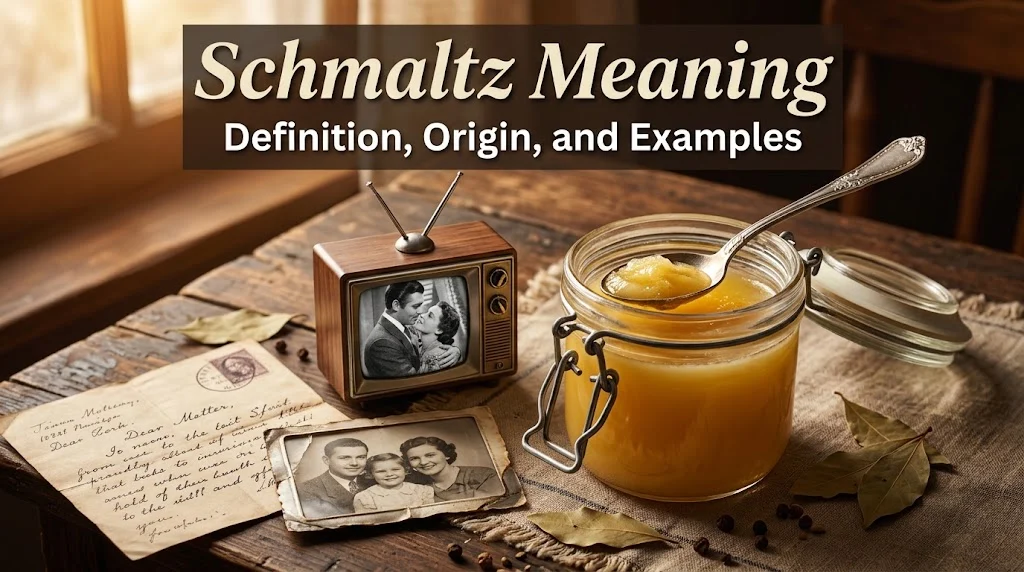
Schmaltz means excessive sentimentality, especially when emotions feel overly sweet, dramatic, or emotionally manipulative. The word also has a literal meaning: rendered animal fat, traditionally chicken or goose fat used in cooking. Understanding the context is essential because schmaltz can describe both a type of cooking ingredient and an exaggerated emotional style in music, movies, writing, and everyday conversation.
Schmaltz is a word with two main meanings. In cooking, it refers to rendered animal fat, traditionally chicken or goose fat, used to prepare food. In everyday English, it describes excessive sentimentality, especially when something seems overly emotional, sentimental, or cheesy. The emotional meaning is often used when discussing movies, music, speeches, and stories.
| Detail | Explanation |
|---|---|
| Main figurative meaning | Excessive sentimentality |
| Literal meaning | Rendered animal fat, traditionally chicken or goose fat |
| Origin | Yiddish, with German linguistic roots |
| Tone | Often critical, humorous, or dismissive |
| Common contexts | Movies, music, writing, cooking, and conversation |
| Formal or informal | More common in informal conversation and cultural criticism |
What Is the Main Meaning of Schmaltz?
In everyday English, schmaltz describes emotion that feels exaggerated, overly sweet, or excessively sentimental. It is often used when a song, movie, speech, or story tries so hard to make people feel emotional that the result seems artificial or cheesy.
For example:
“The movie’s ending was full of schmaltz, with dramatic music and an emotional reunion.”
This means the ending relied heavily on sentimental moments to make the audience feel moved. The speaker may believe the scene was touching, but they also suggest that it was too emotionally exaggerated.
Schmaltz does not always mean something is bad. Some people enjoy sentimental entertainment, nostalgic songs, and emotional storytelling. In those situations, the word can describe a style that is deliberately warm, dramatic, or old-fashioned.
However, when someone says a movie is “too schmaltzy,” they are usually criticizing its excessive emotional appeal rather than praising its subtlety.
What Does Schmaltz Mean in Different Contexts?
The intended meaning depends mainly on whether the conversation concerns food or emotional expression.
| Meaning | Context | Example |
|---|---|---|
| Excessive sentimentality | Movies and television | “The finale was entertaining but full of schmaltz.” |
| Overly emotional style | Music and performances | “The singer added too much schmaltz to the ballad.” |
| Sentimental writing | Books and speeches | “The speech crossed the line from heartfelt to schmaltz.” |
| Rendered animal fat | Cooking | “She used schmaltz to add flavor to the onions.” |
The figurative meaning is common in discussions of entertainment and artistic style. The literal meaning appears in recipes, traditional cooking, and conversations about ingredients.
Schmaltz in Movies and Television
A film may be described as schmaltzy when it uses dramatic music, tearful reunions, inspirational speeches, or predictable emotional moments to influence the audience.
Example: “I liked the characters, but the final scene was a little too schmaltzy.”
The speaker is not necessarily saying the movie is terrible. They are suggesting that the emotional presentation felt excessive.
Schmaltz in Music
In music, schmaltz can describe a performance that sounds overly sentimental, melodramatic, or emotionally exaggerated.
Example: “The orchestra played the love theme with so much schmaltz that it felt like a soap opera.”
This suggests the performance emphasized emotion so strongly that it lost some subtlety.
Schmaltz in Writing
Writers sometimes use the term to criticize stories, speeches, or passages that rely too heavily on sentimental language.
Example: “The letter was heartfelt, but a few lines were pure schmaltz.”
Here, the writer recognizes the genuine emotion but feels that some expressions are overly sweet or dramatic.
Schmaltz in Cooking
In its literal sense, schmaltz is rendered poultry fat, especially chicken or goose fat, traditionally used in Jewish cooking.
It can add rich flavor to dishes such as chopped liver, fried onions, potatoes, and other traditional recipes. Unlike the figurative meaning, this use is neutral and describes an actual cooking ingredient.
How Context Changes the Meaning of Schmaltz
You can usually determine the meaning of schmaltz by looking at the surrounding words and the topic of conversation.
Consider these examples:
- “That movie was pure schmaltz.” The speaker is criticizing the movie’s excessive sentimentality.
- “Add a spoonful of schmaltz to the pan.” The word refers to rendered animal fat used in cooking.
- “The singer’s performance was warm without becoming schmaltzy.” The speaker is praising an emotional performance that avoids excessive sentimentality.
- “I love old-fashioned schmaltz in holiday movies.” The speaker enjoys sentimental entertainment, so the word is being used affectionately.
Notice that the word itself does not always communicate disapproval. The surrounding language reveals whether the speaker considers something excessively emotional, pleasantly nostalgic, or simply useful in a recipe.
Is Schmaltz a Negative Word?
Schmaltz often carries a negative or teasing tone when it describes emotional expression. Calling a scene schmaltzy may suggest that the feelings are exaggerated, predictable, or designed to make the audience cry.
However, the word can also be affectionate or playful.
For example, someone might say, “I know this holiday movie is full of schmaltz, but I watch it every year.”
The speaker recognizes the movie’s sentimental style but enjoys it anyway.
The tone depends on the speaker’s attitude, the subject being discussed, and whether the word is used as a criticism or an expression of affection.
Is Schmaltz the Same as Cheesy?
Not exactly. The words overlap, but they emphasize slightly different qualities.
Schmaltz focuses on excessive sentimentality, while cheesy can describe anything that seems corny, outdated, exaggerated, or lacking sophistication.
For example, a romantic movie with dramatic music and tearful declarations might be called schmaltzy. A joke with an obvious punchline might be called cheesy.
Something can be both schmaltzy and cheesy, but the words are not interchangeable in every situation.
How Do You Use Schmaltz in a Sentence?
Schmaltz is a noun. When describing something as excessively sentimental, people often use the adjective schmaltzy.
Here are several natural examples:
- “The romantic comedy was enjoyable, despite its occasional schmaltz.”
- “I prefer emotional music that avoids unnecessary schmaltz.”
- “His farewell speech was touching without becoming too schmaltzy.”
- “The holiday special was packed with nostalgia and schmaltz.”
- “The recipe calls for schmaltz to give the dish a richer flavor.”
These examples demonstrate the distinction between the emotional and culinary meanings.
When discussing entertainment, you can use schmaltz as a critical or playful description. In a recipe, it refers to a specific ingredient, so the surrounding food-related vocabulary makes the meaning clear.
Real Conversation Examples
Example 1: Talking About a Movie
Person A: “Did you like the ending of that romance movie?”
Person B: “It was sweet, but there was a little too much schmaltz for me.”
Meaning: Person B thought the ending was overly sentimental.
Example 2: Discussing Music
Person A: “Why didn’t you enjoy the singer’s performance?”
Person B: “The song was beautiful, but the delivery felt too schmaltzy.”
Meaning: Person B felt the singer emphasized emotion too heavily.
Example 3: Sharing a Recipe
Person A: “What makes these potatoes taste so rich?”
Person B: “I cooked them with schmaltz instead of using ordinary cooking oil.”
Meaning: Person B used rendered poultry fat to add flavor to the dish.
What Is the Difference Between Schmaltz and Schmaltzy?
Although the words are closely related, they serve different grammatical purposes.
Schmaltz is a noun that refers to excessive sentimentality or rendered animal fat.
Example: “The film contains too much schmaltz.”
Schmaltzy is an adjective describing something that is excessively sentimental.
Example: “The film has a schmaltzy ending.”
You can remember the distinction by thinking of schmaltz as the quality or substance and schmaltzy as the word that describes something possessing that quality.
Schmaltz vs. Sentimental, Cheesy, and Sappy
These words are related, but each carries a slightly different emphasis.
| Term | Meaning | Main Difference |
|---|---|---|
| Schmaltz | Excessive sentimentality | Often suggests exaggerated emotional appeal |
| Sentimental | Showing or expressing emotion, affection, or nostalgia | Can be positive, neutral, or negative |
| Cheesy | Corny, clichéd, or lacking sophistication | Can describe jokes, dialogue, design, or behavior |
| Sappy | Excessively emotional or sentimental | Often implies that something is overly sweet or tearful |
For example, a heartfelt letter may be sentimental without being schmaltzy. A predictable romantic line may be cheesy, while a movie filled with dramatic reunions and emotional music might be described as full of schmaltz.
Choosing the right word helps you explain exactly what you find excessive or appealing.
Where Does the Word Schmaltz Come From?
Schmaltz entered English through Yiddish and is related to German Schmalz, a word referring to rendered animal fat. The culinary meaning reflects the word’s history as a term for fat used in traditional cooking.
The figurative meaning developed around the idea of richness or excess, eventually becoming associated with overly sentimental entertainment and emotional expression.
Today, English speakers may use schmaltz when discussing films, music, literature, speeches, and nostalgic entertainment. The word’s two meanings remain in use, so context is especially helpful when interpreting it.
Its connection to Yiddish and Jewish culinary traditions is also worth recognizing. The word is not simply an internet abbreviation or newly invented slang; it has a longer linguistic and cultural history.
Common Mistakes When Using Schmaltz
Three common misunderstandings can make the word confusing.
| Common Mistake | Correct Understanding |
|---|---|
| Assuming schmaltz only refers to food | It also commonly describes excessive sentimentality. |
| Treating schmaltz as always negative | It can be used affectionately to describe entertainment someone enjoys. |
| Confusing schmaltz with schmaltzy | Schmaltz is a noun, while schmaltzy is an adjective. |
Remembering these distinctions makes it easier to understand the word in conversation, reviews, and recipes.
Quick Recap
- Schmaltz usually means excessive sentimentality when discussing movies, music, and writing.
- In cooking, it refers to rendered animal fat, traditionally chicken or goose fat.
- Schmaltzy is the adjective used to describe something overly sentimental.
- The word can sound critical, humorous, or affectionate depending on context.
- Surrounding words help you identify whether the speaker means emotional exaggeration or a cooking ingredient.
Frequently Asked Questions
What does schmaltz mean in simple terms?
Schmaltz means excessive sentimentality in entertainment or rendered animal fat used as a cooking ingredient.
Is schmaltz a negative word?
Schmaltz often criticizes exaggerated emotion, but it can also affectionately describe sentimental movies, music, or nostalgic entertainment.
What does schmaltzy mean?
Schmaltzy describes something overly sentimental, emotionally exaggerated, or excessively sweet, especially in movies, music, writing, and performances.
Is schmaltz a Yiddish word?
Yes, schmaltz entered English through Yiddish and is related to the German word Schmalz, meaning rendered animal fat.
What is the difference between schmaltz and cheesy?
Schmaltz specifically emphasizes excessive sentimentality, while cheesy describes something corny, clichéd, or lacking sophistication more broadly.
Final Thoughts
The schmaltz meaning depends on whether you are discussing emotional expression or food. In everyday English, the word usually describes excessive sentimentality in movies, music, speeches, or stories. In cooking, it refers to rendered animal fat that adds richness and flavor to traditional dishes.
Although schmaltz can sound critical, it may also describe sentimental entertainment that someone genuinely enjoys. Remember that schmaltz is a noun and schmaltzy is an adjective. With these distinctions in mind, you can recognize the word in conversations, reviews, and recipes and understand what the speaker intends.
Discover Also

John Green is an American writer who contributes to QuickResponsess.com, creating clear and practical content on English grammar, vocabulary and everyday language. His goal is to make learning English simple, engaging and easy to apply.