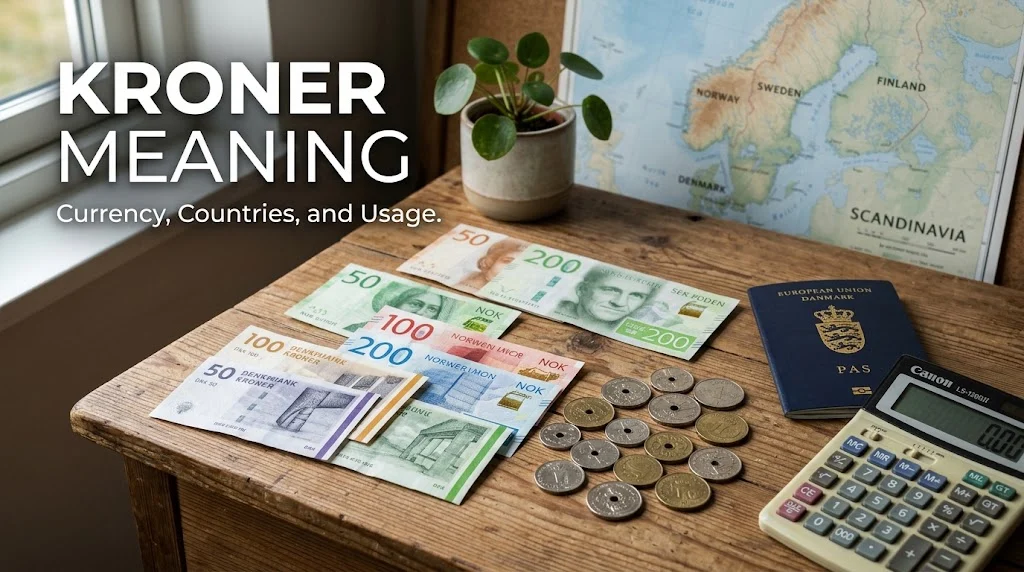
Kroner is the plural form of krone, a currency unit used in Denmark and Norway. The word is also associated with the Scandinavian currency family, although Sweden uses the related term kronor and Iceland uses krónur.
Kroner means more than one krone, a currency unit used in Denmark and Norway. The word comes from a term meaning “crown.” Although Danish and Norwegian kroner share the same currency name, they are separate currencies with different exchange rates. You may encounter the term on price tags, travel websites, financial reports, and international shopping platforms.
| Detail | Explanation |
|---|---|
| Meaning | Plural of krone |
| Word origin | Danish and Norwegian word for “crown” |
| Currency use | Denmark and Norway |
| Currency codes | DKK for Danish krone; NOK for Norwegian krone |
| Common contexts | Shopping, travel, banking, and exchange rates |
| Formal or informal | Standard currency terminology |
What Is the Meaning of Kroner in Currency?
The word kroner is used when referring to amounts of money in certain Scandinavian currencies. It is not a separate currency from the krone; rather, it is the plural form used in Danish and Norwegian.
For example, if a product costs 250 kroner in Norway, the price is expressed in Norwegian currency. If a similar price appears on a Danish website, it may refer to Danish kroner instead.
The currency code helps you identify which one is being used:
- DKK: Danish krone, the official currency of Denmark.
- NOK: Norwegian krone, the official currency of Norway.
These currencies have their own exchange rates. Therefore, 250 DKK and 250 NOK do not necessarily have the same value when converted into US dollars, euros, or another currency.
What Does the Word Krone Mean?
Krone is the singular form of kroner in Danish and Norwegian. It translates to “crown” in English, connecting the currency’s name to the historical use of crowns as symbols of royal authority.
The word is used when referring to a single currency unit. For example, you might say “one Norwegian krone” when discussing an individual unit of Norwegian money.
Which Countries Use Kroner?
Danish kroner ( DKK ), coins and banknotes
Forventningsbarometeret: Flere har svakere tro på landets økonomi
Several Nordic countries use currencies with names derived from the word crown. However, the spelling and currency codes differ between countries.
| Country | Currency Name | Currency Code |
|---|---|---|
| Denmark | Danish krone; plural kroner | DKK |
| Norway | Norwegian krone; plural kroner | NOK |
| Sweden | Swedish krona; plural kronor | SEK |
| Iceland | Icelandic króna; plural krónur | ISK |
Although these names share a historical connection, the currencies are distinct. Their values, monetary policies, banknotes, and coins are not interchangeable.
Denmark, Norway, Sweden, and Iceland also have different monetary arrangements. For instance, Denmark maintains a fixed-exchange-rate policy against the euro, while Norway, Sweden, and Iceland have their own floating exchange-rate arrangements.
This distinction matters when comparing prices or converting money for travel. Always check the country and currency code instead of assuming that every currency with a similar name has the same value.
Kroner vs. Krone: What Is the Difference?
The main difference between kroner and krone is grammatical number.
- Krone: The singular form, used for one unit.
- Kroner: The plural form, used for multiple units in Danish and Norwegian.
For example, “one krone” refers to a single unit, while “100 kroner” refers to a larger amount expressed in multiple units.
The spelling can also help you identify the language. Danish and Norwegian use krone and kroner, while Swedish uses krona and kronor. Icelandic uses króna and krónur.
These differences are useful when reading international product listings, travel guides, or financial documents. The words may look similar, but they follow the spelling conventions of their respective languages.
How Is Kroner Used in Everyday Situations?
You are most likely to encounter kroner when discussing prices, planning a trip, shopping internationally, or reading financial information.
Shopping and Price Tags
Online stores based in Denmark or Norway may display product prices in kroner.
Example: “The jacket costs 800 kroner.”
This means the jacket costs 800 units of the relevant Danish or Norwegian currency. Checking the currency code helps you identify the correct amount.
Travel and Tourism
Travelers may encounter kroner when booking hotels, buying meals, or paying for transportation in Denmark or Norway.
Example: “The train ticket costs 120 kroner.”
The statement tells you the ticket price in the local currency. You would need the applicable exchange rate to determine its equivalent in your home currency.
Banking and Money Transfers
Banks and money-transfer services use currency codes to distinguish between currencies with similar names.
Example: “The payment was sent in NOK.”
This indicates Norwegian kroner rather than Danish kroner. The code reduces confusion when transferring money internationally.
News and Financial Reports
Kroner may appear in business reports, economic news, and discussions of exchange rates.
Example: “The company reported revenue of 10 million kroner.”
The currency’s country and code provide the necessary context for interpreting the financial figure.
Real-Life Examples of Kroner in Sentences
Here are four natural examples showing how the word appears in everyday English.
Example 1: Shopping
“The shoes were on sale for 600 kroner.”
Meaning: The shoes cost 600 units of the relevant Scandinavian currency.
Example 2: Travel
“I exchanged some money before my trip to Norway so I could pay in kroner.”
Meaning: The traveler obtained Norwegian currency for local purchases.
Example 3: International business
“The supplier quoted the price in Danish kroner rather than euros.”
Meaning: The supplier specified DKK as the currency for the transaction.
Example 4: Currency conversion
“The hotel bill was 1,500 NOK, so I checked the exchange rate before paying.”
Meaning: The traveler checked how much the Norwegian amount was worth in another currency.
These examples demonstrate that kroner is a standard currency term rather than internet slang or a text abbreviation.
How Do You Convert Kroner Into Other Currencies?
To convert kroner into another currency, you need the correct currency code and the current exchange rate.
For example, suppose you want to convert 1,000 Norwegian kroner into US dollars. You would multiply 1,000 by the current NOK-to-USD exchange rate.
If the hypothetical exchange rate were 0.10 USD per NOK, the calculation would be:
1,000 NOK × 0.10 = $100
This is only an illustrative calculation, not a current exchange-rate quotation. Actual rates fluctuate, and banks or exchange services may charge additional fees.
Remember these three points when converting kroner:
- Check whether the amount is in DKK or NOK.
- Use an up-to-date exchange rate.
- Consider any transaction fees or conversion charges.
The same process applies when converting Danish kroner into euros, pounds, or other currencies, but you must use the appropriate DKK exchange rate.
Is Kroner the Same as Swedish Kronor?
No. Kroner and kronor are related currency terms, but they are not the same spelling or currency.
Denmark and Norway use kroner as the plural of krone. Sweden uses kronor as the plural of krona.
The Swedish krona has the currency code SEK, while the Danish krone uses DKK and the Norwegian krone uses NOK.
Although all three currencies share a linguistic connection to the word “crown,” they are separate monetary units. Their exchange rates differ, so you should not treat the amounts as equivalent.
Common Mistakes When Understanding Kroner
Readers sometimes confuse kroner with other currency terms because the spellings are similar. These are the most common misunderstandings to avoid.
| Common Mistake | Correct Understanding |
|---|---|
| Assuming kroner is an abbreviation | Kroner is a plural currency word, not an acronym. |
| Treating Danish and Norwegian kroner as identical | DKK and NOK represent separate currencies with different exchange rates. |
| Confusing kroner with Swedish kronor | Sweden uses the related term kronor and the currency code SEK. |
Recognizing these distinctions makes it easier to understand international prices and avoid mistakes when making purchases or comparing exchange rates.
Similar Currency Terms You Should Know
Several currency names have similar spellings or historical meanings. Understanding their differences helps when reading international financial information.
| Term | Meaning | Main Difference |
|---|---|---|
| Krone | Singular form in Danish and Norwegian | Refers to one currency unit |
| Kroner | Plural form in Danish and Norwegian | Refers to multiple units |
| Kronor | Swedish plural of krona | Used for Swedish currency |
| Krónur | Icelandic plural of króna | Used for Icelandic currency |
| Crown | English meaning associated with the name | A general word, not the modern currency name used in these countries |
These words are related, but their correct use depends on the language and country involved.
Origin and Historical Background of Kroner
The word krone comes from the word for “crown.” The name reflects a broader European tradition of naming currencies after crowns, royal symbols, or historical monetary units.
The Danish krone and Norwegian krone belong to this wider family of crown-related currency names. Sweden’s krona and Iceland’s króna share the same linguistic connection.
Despite their related names, each country’s currency developed within its own monetary system. Similar terminology does not mean that the currencies have identical histories, values, or exchange arrangements.
Today, the term kroner is most useful in practical contexts such as shopping, tourism, banking, and international business. Understanding the country and currency code is more important for financial accuracy than relying on the name alone.
Quick Recap: What Does Kroner Mean?
- Kroner is the plural of krone in Danish and Norwegian.
- Denmark uses DKK, while Norway uses NOK.
- The word is related to “crown” and has historical and linguistic roots.
- Sweden uses kronor, while Iceland uses krónur.
- Always check the currency code and current exchange rate when comparing prices.
Frequently Asked Questions
What does kroner mean in English?
Kroner is the plural of the Danish and Norwegian word krone, which translates into English as “crown.”
What country uses kroner?
Denmark and Norway use currencies called kroner, identified by the currency codes DKK and NOK, respectively.
Is kroner the same as krone?
Kroner is the plural form of krone, so the words differ mainly in grammatical number.
What is the difference between kroner and kronor?
Kroner is used in Danish and Norwegian, while kronor is the Swedish plural form of krona.
How much is one kroner worth in US dollars?
One krone’s value in US dollars depends on whether it is Danish or Norwegian and the current exchange rate.
Final Thoughts
The kroner meaning is straightforward once you understand its connection to Scandinavian currencies. Kroner is the plural form of krone in Danish and Norwegian, and the word is historically connected to the meaning “crown.” Although Denmark and Norway share this currency name, their money is different and has separate exchange rates.
Sweden and Iceland use related terms with different spellings. Whenever you encounter kroner on a price tag, travel website, or financial statement, check the country and currency code to understand exactly which money is being discussed.
Discover More Articles:
- Namaste Meaning: What It Means and How to Use It
- Ennui Meaning: Definition, Examples & How To Use It
- Pookie Meaning: In Text, Slang & Social Media

Sally Rooney is an American writer who contributes to QuickResponsess.com, creating clear and practical content for English learners. Her articles help readers build confidence in using words and expressions accurately in everyday and professional communication.