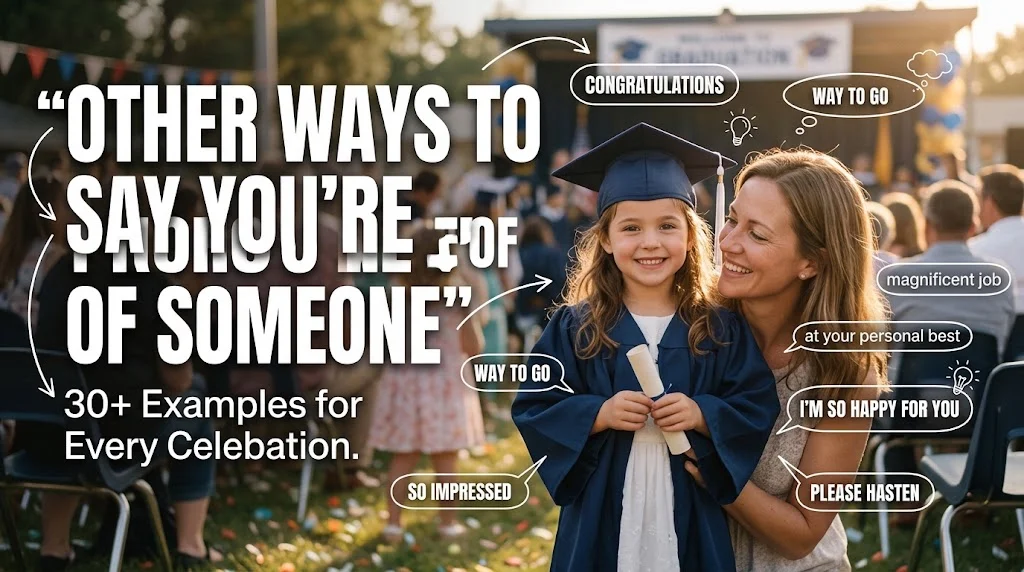
Quick Answer
“I’m proud of you” is a warm expression of approval and admiration for someone’s achievement or character. For more variety and precision, try alternatives like “You make me proud,” “I’m bursting with pride,” “I commend you,” “You’ve done me proud,” or “I hold you in high esteem.”
“I’m proud of you” is one of the most meaningful things you can say to another person. It acknowledges effort, growth, and character. People say it to children, partners, colleagues, students, and friends. It appears in graduation speeches, performance reviews, family dinners, and quiet moments of encouragement.
This guide provides 30 practical alternatives with clear notes on tone, context, and audience. You will also learn to express excitement in English when someone achieves something remarkable. Whether you are writing a card, giving a toast, or sending a quick message, these phrases will help you sound fluent and heartfelt.
Pull Quote: “Praise becomes powerful when it is specific, sincere, and suited to the person receiving it.”
Quick Categories
Formal alternatives to “I’m proud of you”
- I commend you on your achievement.
- I hold you in high esteem.
- I applaud your success.
- I am filled with pride.
Pro Tip: Formal alternatives suit letters, speeches, and official acknowledgements where dignity matters more than intimacy.
Casual alternatives
- You make me proud.
- Way to go.
- That’s my boy.
- You did it.
Pro Tip: Casual options work best with family, close friends, and familiar colleagues in relaxed settings.
Professional alternatives
- I want to acknowledge your accomplishment.
- You have my admiration.
- I recognize your hard work.
- I am impressed by your dedication.
Pro Tip: Professional alternatives should be specific so the recipient knows exactly what you are praising.
Informal expressions
- You rock.
- You’re a star.
- You’re amazing.
- I’m so thrilled for you.
Pro Tip: Informal expressions belong in texts, chats, and spoken English with people you know well.
Pull Quote: “The right tone makes your English sound professional and confident.”
Common Mistakes
- Using “I’m proud of you” in a formal business email.
Example: “Dear Sir, I’m proud of you for submitting the report.” This sounds too personal for formal correspondence. - Forgetting to say what you are proud of.
Example: “I’m proud of you.” without context can feel vague and incomplete. - Overusing the phrase in the same message.
Example: “I’m proud of you. I’m so proud. I’m really proud.” Repetition weakens impact. - Mixing register awkwardly.
Example: “Dear Professor, you rock.” The tone clashes badly. - Using it sarcastically.
Example: “I’m so proud of you for finally showing up.” Sarcasm can confuse learners and offend readers.
What Does “I’m Proud of You” Mean?
Definition
It is a statement of approval, admiration, and satisfaction regarding someone’s actions, achievements, or character.
Grammar Explanation
The phrase uses the adjective “proud” followed by the preposition “of.” It can be intensified with adverbs such as “so,” “very,” or “immensely.” The subject can change to “we” or “they” depending on who is speaking.
Example Sentence
“I’m proud of you for finishing the marathon despite the injury.”
When to Use “I’m Proud of You”
Common Contexts
- Family: Celebrating a child’s graduation or first job.
- Workplace: Acknowledging a colleague’s promotion or project success.
- Education: Praising a student’s improvement or effort.
- Sports: Congratulating an athlete after a personal best.
- Personal life: Supporting a friend through a difficult challenge.
Spoken vs Written
- Spoken: Extremely common in daily conversation and emotional moments.
- Written: Common in cards, messages, and social media posts.
Formal vs Informal
- Formal: Acceptable in speeches and letters but often replaced by more formal phrases.
- Informal: The default choice in everyday speech and personal messages.
Is It Professional or Polite to Say “I’m Proud of You”?
Politeness vs Professionalism
The phrase is polite and warm, but it is personal in nature. In a professional setting, it can feel overly familiar or paternalistic. A more specific and neutral phrase usually works better in business communication.
Business-Style Example
“I want to acknowledge your excellent work on the client proposal. Your dedication was clear throughout.”
Polite? Yes
Professional? Not usually, unless the relationship is close and the context is informal
Pull Quote: “Professional reaction phrases show respect without crossing personal boundaries.”
Pros and Cons of Using “I’m Proud of You”
Pros
- Simple and natural: Easy to say and understand.
- Friendly tone: Warm and emotionally supportive.
- Common usage: Recognised in every English speaking country.
- Easy to understand: Requires no advanced vocabulary.
Cons
- Too informal for work: Can sound paternalistic in professional settings.
- Overused: Loses impact through repetition.
- Limited emotional range: Cannot express specific types of admiration.
- Not suitable for formal writing: Avoid in reports, official letters, and academic texts.
Other Ways to Say “You’re Proud of Someone” (With Examples)
These alternatives will help you sound more fluent, confident, and natural in different situations. Use them according to tone, context, and audience to express excitement, admiration, or approval.
1. You make me proud
Meaning: Your actions bring me a feeling of pride.
Explanation: Shifts focus to the effect on the speaker.
Example Sentence: “You make me proud every single day, and today is no exception.”
Best Use: Family, personal
Worst Use: Formal reports
Tone: Warm, personal, sincere
Context Variability: Casual and spoken
2. I’m bursting with pride
Meaning: I am overflowing with pride.
Explanation: Emphatic and emotional.
Example Sentence: “I’m bursting with pride after watching your performance.”
Best Use: Emotional moments
Worst Use: Business emails
Tone: Emotional, enthusiastic, warm
Context Variability: Casual and spoken
3. I commend you
Meaning: I formally praise you.
Explanation: Professional and respectful.
Example Sentence: “I commend you on your excellent handling of the negotiation.”
Best Use: Workplace, formal
Worst Use: Close friends
Tone: Formal, respectful, professional
Context Variability: Professional and written
4. You’ve done me proud
Meaning: Your achievement reflects well on me.
Explanation: Common in British English and family contexts.
Example Sentence: “You’ve done me proud with that exam result.”
Best Use: Family, mentors
Worst Use: Corporate writing
Tone: Warm, proud, informal
Context Variability: Casual and spoken
5. I hold you in high esteem
Meaning: I have great respect and admiration for you.
Explanation: Very formal and dignified.
Example Sentence: “I hold you in high esteem for your integrity during the crisis.”
Best Use: Formal tributes
Worst Use: Casual chats
Tone: Formal, respectful, dignified
Context Variability: Professional and written
6. Way to go
Meaning: Well done, good job.
Explanation: Short and energetic.
Example Sentence: “You passed the test. Way to go.”
Best Use: Children, friends
Worst Use: Formal letters
Tone: Energetic, casual, encouraging
Context Variability: Casual and spoken
7. That’s my boy
Meaning: An affectionate expression of pride.
Explanation: Often used by parents or mentors.
Example Sentence: “You scored the winning goal. That’s my boy.”
Best Use: Family, sports
Worst Use: Professional settings
Tone: Affectionate, proud, informal
Context Variability: Casual and spoken
8. That’s my girl
Meaning: An affectionate expression of pride.
Explanation: Often used by parents or mentors.
Example Sentence: “You delivered the speech perfectly. That’s my girl.”
Best Use: Family, mentors
Worst Use: Business emails
Tone: Affectionate, proud, informal
Context Variability: Casual and spoken
9. You did it
Meaning: You achieved what you set out to do.
Explanation: Simple and celebratory.
Example Sentence: “You finished the project on time. You did it.”
Best Use: Milestones, goals
Worst Use: Formal reports
Tone: Celebratory, simple, warm
Context Variability: Casual and spoken
10. I’m so thrilled for you
Meaning: I am very happy about your success.
Explanation: Focuses on shared joy rather than pride.
Example Sentence: “I’m so thrilled for you after your promotion.”
Best Use: Friends, colleagues
Worst Use: Formal writing
Tone: Joyful, warm, supportive
Context Variability: Casual and spoken
11. You rock
Meaning: You are excellent.
Explanation: Very informal and modern.
Example Sentence: “You handled that difficult client. You rock.”
Best Use: Close friends
Worst Use: Formal letters
Tone: Informal, energetic, modern
Context Variability: Casual and spoken
12. You’re a star
Meaning: You are outstanding.
Explanation: Warm and encouraging.
Example Sentence: “You stayed late to help. You’re a star.”
Best Use: Workplace praise
Worst Use: Formal documents
Tone: Warm, encouraging, friendly
Context Variability: Casual and professional
13. You’re amazing
Meaning: You are wonderful and impressive.
Explanation: General and heartfelt.
Example Sentence: “You’re amazing for completing the course while working full time.”
Best Use: Personal encouragement
Worst Use: Business reports
Tone: Warm, sincere, supportive
Context Variability: Casual and spoken
14. I want to acknowledge your accomplishment
Meaning: I formally recognize your success.
Explanation: Professional and specific.
Example Sentence: “I want to acknowledge your accomplishment in leading the merger.”
Best Use: Workplace, formal
Worst Use: Close family
Tone: Formal, respectful, professional
Context Variability: Professional and written
15. You have my admiration
Meaning: I respect and admire you.
Explanation: Formal and sincere.
Example Sentence: “You have my admiration for your courage during the transition.”
Best Use: Formal tributes
Worst Use: Casual chats
Tone: Formal, sincere, respectful
Context Variability: Professional and written
16. I recognize your hard work
Meaning: I see and value your effort.
Explanation: Focuses on effort rather than outcome.
Example Sentence: “I recognize your hard work on this project, and it shows.”
Best Use: Workplace
Worst Use: Personal messages
Tone: Professional, appreciative, specific
Context Variability: Professional and written
17. I am impressed by your dedication
Meaning: Your commitment has made an impact on me.
Explanation: Specific and professional.
Example Sentence: “I am impressed by your dedication to quality.”
Best Use: Performance reviews
Worst Use: Casual chats
Tone: Professional, respectful, sincere
Context Variability: Professional and written
18. I applaud your success
Meaning: I publicly praise your achievement.
Explanation: Formal and celebratory.
Example Sentence: “I applaud your success in launching the new product.”
Best Use: Speeches, letters
Worst Use: Text messages
Tone: Formal, celebratory, respectful
Context Variability: Professional and written
19. I am filled with pride
Meaning: I am completely full of pride.
Explanation: Poetic and emotional.
Example Sentence: “I am filled with pride watching you accept your award.”
Best Use: Emotional moments
Worst Use: Business emails
Tone: Emotional, poetic, warm
Context Variability: Casual and written
20. You’ve exceeded my expectations
Meaning: You did better than I thought possible.
Explanation: Specific and encouraging.
Example Sentence: “You’ve exceeded my expectations with this report.”
Best Use: Workplace, education
Worst Use: Personal praise
Tone: Professional, appreciative, specific
Context Variability: Professional and spoken
21. I couldn’t be prouder
Meaning: My pride is at its maximum.
Explanation: Emphatic and emotional.
Example Sentence: “I couldn’t be prouder of you today.”
Best Use: Family, milestones
Worst Use: Business writing
Tone: Emotional, warm, sincere
Context Variability: Casual and spoken
22. You’ve come so far
Meaning: You have made great progress.
Explanation: Focuses on growth over time.
Example Sentence: “You’ve come so far since you started this journey.”
Best Use: Mentoring, education
Worst Use: Formal reports
Tone: Reflective, warm, encouraging
Context Variability: Casual and spoken
23. I’m so happy for you
Meaning: I feel joy because of your success.
Explanation: Focuses on shared happiness.
Example Sentence: “I’m so happy for you after all your hard work.”
Best Use: Friends, colleagues
Worst Use: Formal letters
Tone: Warm, joyful, supportive
Context Variability: Casual and spoken
24. You should be proud of yourself
Meaning: Your achievement deserves self-recognition.
Explanation: Encourages self-esteem.
Example Sentence: “You should be proud of yourself for finishing the marathon.”
Best Use: Personal encouragement
Worst Use: Business emails
Tone: Supportive, empowering, warm
Context Variability: Casual and spoken
25. I admire your courage
Meaning: I respect your bravery.
Explanation: Specific and sincere.
Example Sentence: “I admire your courage in speaking up.”
Best Use: Personal, professional
Worst Use: Casual chats
Tone: Respectful, sincere, formal
Context Variability: Professional and written
26. You’ve made us all proud
Meaning: Your achievement brings pride to a group.
Explanation: Communal and inclusive.
Example Sentence: “You’ve made us all proud with your performance.”
Best Use: Teams, families
Worst Use: Individual praise
Tone: Communal, warm, proud
Context Variability: Casual and spoken
27. I salute you
Meaning: I express respect and admiration.
Explanation: Formal and slightly military in origin.
Example Sentence: “I salute you for your years of service.”
Best Use: Formal tributes
Worst Use: Casual chats
Tone: Formal, respectful, dignified
Context Variability: Professional and written
28. You’ve done yourself proud
Meaning: You have brought honour to yourself.
Explanation: British and reflective.
Example Sentence: “You’ve done yourself proud with that presentation.”
Best Use: Workplace, education
Worst Use: Formal reports
Tone: Warm, proud, encouraging
Context Variability: Casual and spoken
29. I’m in awe of what you’ve achieved
Meaning: I am deeply impressed by your success.
Explanation: Strong and emotional.
Example Sentence: “I’m in awe of what you’ve achieved in one year.”
Best Use: Personal admiration
Worst Use: Business emails
Tone: Emotional, admiring, sincere
Context Variability: Casual and spoken
30. You are an inspiration
Meaning: Your actions motivate others.
Explanation: Broad and uplifting.
Example Sentence: “You are an inspiration to everyone on the team.”
Best Use: Speeches, tributes
Worst Use: Quick texts
Tone: Inspirational, warm, formal
Context Variability: Professional and written
Pull Quote: “The right praise lifts the person and strengthens the relationship.”
Mini Quiz / Self-Check
- Scenario: You are writing a formal email to a colleague who led a successful project. Which fits best?
- A) You rock.
- B) I commend you on your excellent leadership.
- C) That’s my boy.
- Scenario: Your child has just won a school award. Which is most natural?
- A) I hold you in high esteem.
- B) I’m bursting with pride.
- C) I want to acknowledge your accomplishment.
- Scenario: You want to encourage a friend who finished a difficult course. Which is most appropriate?
- A) You’ve come so far.
- B) I salute you.
- C) I applaud your success.
- Scenario: Which phrase is too informal for a business email?
- A) I recognize your hard work.
- B) You’re a star.
- C) I am impressed by your dedication.
Comparison Table: Top Alternatives
| Phrase | Tone | Best Use |
| You make me proud | Warm, personal | Family, personal |
| I’m bursting with pride | Emotional, enthusiastic | Emotional moments |
| I commend you | Formal, respectful | Workplace, formal |
| You’ve done me proud | Warm, proud | Family, mentors |
| Way to go | Energetic, casual | Children, friends |
| I want to acknowledge your accomplishment | Formal, professional | Workplace, formal |
| You’re a star | Warm, encouraging | Workplace praise |
| I couldn’t be prouder | Emotional, warm | Family, milestones |
| You’ve come so far | Reflective, encouraging | Mentoring, education |
| You are an inspiration | Inspirational, formal | Speeches, tributes |
FAQs
1. What is a formal alternative to “I’m proud of you”?
“I commend you,” “I hold you in high esteem,” and “I applaud your success” are strong formal alternatives suitable for business and official settings.
2. How do I say “I’m proud of you” professionally at work?
Use specific phrases such as “I recognize your hard work,” “I am impressed by your dedication,” or “I want to acknowledge your accomplishment.”
3. What can I say instead of “I’m proud of you” to a friend?
“You make me proud,” “I’m so thrilled for you,” “You did it,” and “You’re amazing” are natural and friendly alternatives.
4. Is it okay to say “I’m proud of you” to a colleague?
It is acceptable if you have a close relationship, but in most professional settings a more neutral phrase like “I appreciate your effort” is safer.
5. What is the difference between “I’m proud of you” and “I’m happy for you”?
“I’m proud of you” focuses on achievement and character, while “I’m happy for you” focuses on joy at someone’s good fortune.
See also: Other Ways to Say Break a Leg
See also: Professional English Guide
CTA: Which phrase will you use to praise someone this week? Share your favourite in the comments below.
Conclusion
Learning other ways to say you’re proud of someone gives you the ability to express admiration with precision and warmth. Whether you are celebrating a child’s achievement, acknowledging a colleague’s success, or encouraging a friend, the right words make your praise genuine and memorable. These alternatives to you’re proud of someone help you move beyond one familiar phrase and into richer, more sincere expression.
Practise by noticing the achievements of people around you each day and choosing a phrase that fits the moment. Pay close attention to tone and context, because the right words depend on the relationship and the setting. With steady practice, these informal expressions in English and their formal counterparts will become part of your everyday fluency.

Stephen King is an American writer and language enthusiast who enjoys creating clear, practical content that helps readers communicate with confidence. His work at QuickResponsess.com focuses on making English easier to understand through simple explanations and everyday examples.