Quick Answer
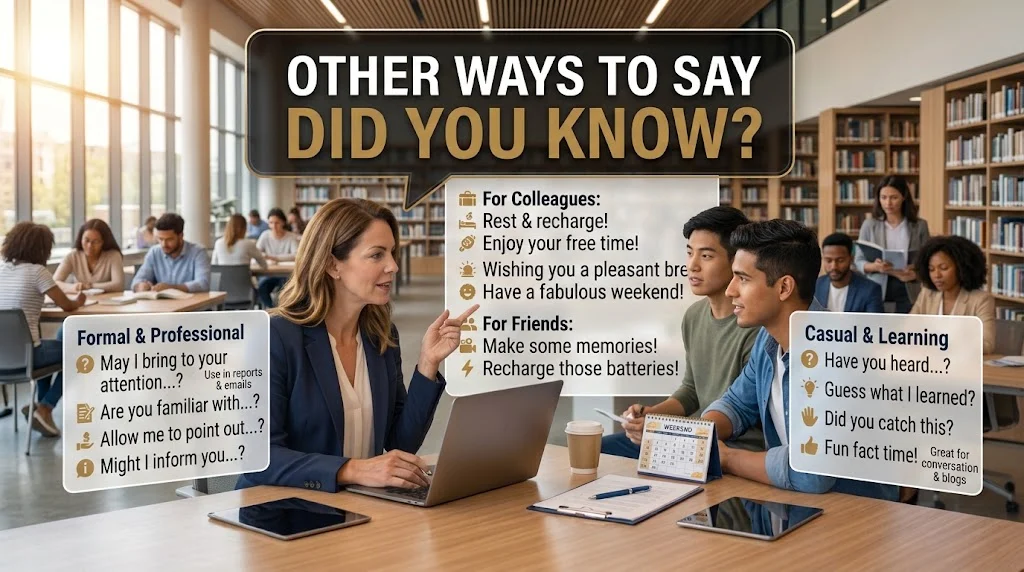
Other ways to say “did you know” include: “Have you heard,” “Are you aware,” “Were you aware,” “Did you realize,” and “You might be surprised to learn.
“Did you know” is a common conversational opener used to introduce surprising facts, interesting information, or little known details. You often hear it in casual chats, presentations, and even marketing content. It sparks curiosity and engages the listener immediately.
However, using the same phrase repeatedly can make your English sound repetitive and less sophisticated. Learning alternatives to “did you know” helps you express curiosity and share information with greater variety and precision. Whether you want to express excitement in English professionally or keep things casual with friends, having a rich vocabulary at your disposal enhances your communication skills significantly.
Quick Categories
Formal Alternatives
- Are you aware
- Have you been informed
- It may interest you to know
- For your information
Casual Alternatives
- Have you heard
- Guess what
- You know what
- Check this out
Professional Alternatives
- I would like to bring to your attention
- Please be advised
- You may find it interesting
- It is worth noting
Informal Expressions
- Bet you didn’t know
- You’ll never guess
- Get this
- Surprise, surprise
Common Mistakes
Using “did you know” incorrectly can make you sound unnatural or even rude in certain contexts.
1: Using it when the information is obvious
- Incorrect: “Did you know the sky is blue?”
- Correct: Use the phrase only for genuinely surprising or non obvious facts.
2: Overusing it in a single conversation
- Incorrect: “Did you know… Did you know… Did you know…”
- Correct: Vary your language to keep the conversation engaging.
3: Using it in formal written reports
- Incorrect: “Did you know our sales increased by 15%?”
- Correct: Use “You may find it interesting that sales increased by 15%.”
4: Assuming the listener has no knowledge of the topic
- Incorrect: “Did you know about the new policy?” (when the listener already knows)
- Correct: “Have you had a chance to review the new policy?”
5: Using it in a condescending tone
- Incorrect: “Did you know you’re doing that wrong?”
- Correct: “Have you considered an alternative approach?”
“The difference between the right word and the almost right word is the difference between lightning and a lightning bug.” Mark Twain
What Does “Did You Know” Mean?
Definition: “Did you know” is a question phrase used to introduce an interesting fact or piece of information that the listener may not be aware of.
Grammar Explanation: It is a past tense interrogative sentence. While it uses the past tense verb “did,” it refers to present knowledge. Essentially, it asks, “Were you aware of this fact before this moment?”
Example Sentence: “Did you know that octopuses have three hearts?”
When to Use “Did You Know”
Common Contexts
- Starting conversations
- Sharing interesting trivia
- Introducing new information
- Engaging an audience
- Breaking the ice
Spoken vs. Written
- Spoken: Very common in casual conversations, presentations, and storytelling
- Written: Appears in blog posts, articles, and marketing materials, but use sparingly in formal documents
Formal vs. Informal
- Formal: Not appropriate for business reports, academic papers, or official correspondence
- Informal: Perfect for everyday conversations, social media, and friendly exchanges
Is It Professional or Polite to Say “Did You Know”?
Politeness: ✔️ Yes — It shows curiosity and engagement.
Professionalism: ❌ No — It lacks formality and sophistication.
Business Example Instead: “I would like to bring to your attention that we have achieved our quarterly targets.”
The phrase works well in casual professional settings but falls short in formal business communication. Use it with colleagues you know well, but opt for more polished alternatives in meetings with senior leadership or clients.
Pros and Cons of Using “Did You Know”
Pros
- Simple and immediately understandable
- Creates a natural conversational flow
- Widely recognized by all English speakers
- Easy to use for non native speakers
Cons
- Too informal for professional documents
- Easily overused in conversations
- Lacks depth for expressing significant discoveries
- Can sound like a classroom trivia question
“Mastering alternatives transforms your English from functional to impressive.”
Other Ways to Say “Did You Know” (With Examples)
These alternatives to “did you know” will help you sound more fluent, confident, and natural in different situations.
Use them according to tone, context, and audience to express excitement in English, share information, or engage your listeners effectively.
Formal Alternatives
1. Phrase: Are you aware
Meaning: Asks if someone knows about a specific fact or situation.
Explanation: This is a polite and professional way to introduce information.
Example Sentence: “Are you aware that the conference has been rescheduled to next month?”
Best Use: Professional settings
Worst Use: Casual conversations with friends
Tone: Polite, formal
Context Variability: Business meetings, formal emails
2. Phrase: Have you been informed
Meaning: Questions whether someone has received previous communication about a topic.
Explanation: Suggests the information should have been shared earlier.
Example Sentence: “Have you been informed about the changes to our benefits package?”
Best Use: Workplace communication
Worst Use: Sharing fun trivia
Tone: Professional, serious
Context Variability: Formal written communication
3. Phrase: It may interest you to know
Meaning: Politely introduces information that might be relevant to the listener.
Explanation: Shows consideration for the listener’s interests or concerns.
Example Sentence: “It may interest you to know that we’ve received funding for the new project.”
Best Use: Important announcements
Worst Use: Casual texting
Tone: Formal, considerate
Context Variability: Professional presentations, formal letters
4. Phrase: For your information
Meaning: Provides information that the listener should know.
Explanation: Often abbreviated as FYI in written communication.
Example Sentence: “For your information, the deadline has been extended to Friday.”
Best Use: Sharing updates
Worst Use: Surprising or exciting news
Tone: Direct, formal
Context Variability: Memos, emails, briefings
5. Phrase: I would like to bring to your attention
Meaning: Politely directs someone’s focus to important information.
Explanation: A formal expression used to highlight significant matters.
Example Sentence: “I would like to bring to your attention the discrepancies in the financial report.”
Best Use: Issues or concerns
Worst Use: Lighthearted topics
Tone: Serious, formal
Context Variability: Business correspondence, meetings
6. Phrase: Please be advised
Meaning: A formal warning or notification about something important.
Explanation: Commonly used in official communications and legal contexts.
Example Sentence: “Please be advised that the office will be closed for renovations next week.”
Best Use: Official notices
Worst Use: Friendly conversations
Tone: Official, authoritative
Context Variability: Legal documents, official announcements
7. Phrase: It is worth noting
Meaning: Highlights something important or interesting.
Explanation: A professional phrase for drawing attention to notable information.
Example Sentence: “It is worth noting that our competitors have just launched a similar product.”
Best Use: Analytical writing
Worst Use: Casual chat
Tone: Analytical, professional
Context Variability: Reports, presentations, articles
8. Phrase: You may find it interesting
Meaning: Suggests the listener might appreciate the following information.
Explanation: A polite and engaging professional phrase.
Example Sentence: “You may find it interesting that our customer satisfaction score has increased by 20%.”
Best Use: Sharing positive news
Worst Use: Warning about problems
Tone: Friendly, professional
Context Variability: Professional conversations, newsletters
9. Phrase: Allow me to inform you
Meaning: A formal way to give information to someone.
Explanation: Shows respect and professionalism in communication.
Example Sentence: “Allow me to inform you that your application has been successful.”
Best Use: Formal announcements
Worst Use: Trivia sharing
Tone: Formal, courteous
Context Variability: Formal letters, official communications
10. Phrase: Have you had the opportunity to learn
Meaning: Politely asks if someone has discovered something yet.
Explanation: Shows you respect the listener’s time and information sources.
Example Sentence: “Have you had the opportunity to learn about our new sustainability initiatives?”
Best Use: Introducing topics
Worst Use: Quick questions
Tone: Professional, thoughtful
Context Variability: Business conversations
“Professional alternatives make you sound competent and credible.”
Casual Alternatives
11. Phrase: Have you heard
Meaning: Asks if someone is aware of recent news or information.
Explanation: A natural and common conversational opener.
Example Sentence: “Have you heard that they’re opening a new coffee shop downtown?”
Best Use: Sharing news
Worst Use: Serious announcements
Tone: Casual, friendly
Context Variability: Social conversations, gossip
12. Phrase: Guess what
Meaning: A playful way to introduce surprising or exciting information.
Explanation: Creates anticipation and excitement in the listener.
Example Sentence: “Guess what! I got the job I applied for!”
Best Use: Personal news
Worst Use: Professional updates
Tone: Excited, playful
Context Variability: Social media, friendly chats
13. Phrase: You know what
Meaning: A conversational lead in to share an idea or fact.
Explanation: Often used to introduce spontaneous thoughts or discoveries.
Example Sentence: “You know what? I think we should visit that museum this weekend.”
Best Use: Casual suggestions
Worst Use: Formal presentations
Tone: Spontaneous, friendly
Context Variability: Personal conversations
14. Phrase: Check this out
Meaning: Directs someone’s attention to something interesting.
Explanation: A common phrase for sharing cool discoveries or information.
Example Sentence: “Check this out! They have a sale on all electronics.”
Best Use: Sharing interesting finds
Worst Use: Sensitive information
Tone: Enthusiastic, casual
Context Variability: Social media, casual conversations
15. Phrase: Did you catch
Meaning: Asks if someone noticed or became aware of something.
Explanation: Conversational way to refer to shared information or experiences.
Example Sentence: “Did you catch the announcement about the new product launch?”
Best Use: Referencing events
Worst Use: Formal contexts
Tone: Casual, conversational
Context Variability: Workplace conversations
16. Phrase: I just found out
Meaning: Shares new information the speaker has recently discovered.
Explanation: Emphasizes the freshness and relevance of the information.
Example Sentence: “I just found out that tickets for the concert are already sold out.”
Best Use: Breaking news
Worst Use: Official communications
Tone: Surprised, conversational
Context Variability: Social sharing
17. Phrase: Word is that
Meaning: Shares information based on what people are saying or rumors.
Explanation: Indicates the information is from informal sources.
Example Sentence: “Word is that they’re planning a company wide party next month.”
Best Use: Gossip or rumors
Worst Use: Confirmed facts
Tone: Informal, secretive
Context Variability: Informal conversations
18. Phrase: It turns out
Meaning: Reveals a discovery or surprising truth.
Explanation: Often follows unexpected information or reveals a misunderstanding.
Example Sentence: “It turns out that the restaurant we wanted to go to has closed.”
Best Use: Revealing discoveries
Worst Use: Formal announcements
Tone: Surprised, casual
Context Variability: Personal stories
19. Phrase: Have you heard about
Meaning: A casual way to introduce a topic someone might not know.
Explanation: Very common in everyday English conversations.
Example Sentence: “Have you heard about the new policy on flexible working hours?”
Best Use: Topic introductions
Worst Use: Academic contexts
Tone: Casual, engaged
Context Variability: All spoken contexts
20. Phrase: Did you realize
Meaning: Asks if someone understood or noticed something.
Explanation: Often used to point out overlooked information.
Example Sentence: “Did you realize that we’ve been working together for five years?”
Best Use: Reflection and insight
Worst Use: Business reports
Tone: Thoughtful, casual
Context Variability: Personal revelations
“Variety in expression keeps your English fresh and engaging.”
Professional Alternatives
21. Phrase: I would like to highlight
Meaning: Directs attention to important information in a professional manner.
Explanation: A standard phrase in presentations and reports.
Example Sentence: “I would like to highlight the outstanding performance of our sales team.”
Best Use: Presentations
Worst Use: Texting friends
Tone: Professional, authoritative
Context Variability: Business meetings, reports
22. Phrase: You may be interested to learn
Meaning: Introduces information that might benefit or interest the listener.
Explanation: Shows consideration for the listener’s professional interests.
Example Sentence: “You may be interested to learn that we’re expanding into three new markets.”
Best Use: Sharing positive developments
Worst Use: Sensitive information
Tone: Professional, considerate
Context Variability: Professional emails
23. Phrase: An important point to consider
Meaning: Highlights a crucial piece of information for decision making.
Explanation: Used in analytical contexts to emphasize key facts.
Example Sentence: “An important point to consider is the impact of inflation on our budget.”
Best Use: Strategic discussions
Worst Use: Casual chat
Tone: Analytical, serious
Context Variability: Reports, planning sessions
24. Phrase: As you may already know
Meaning: Acknowledges that the listener might already have some knowledge.
Explanation: A polite way to introduce information without assuming ignorance.
Example Sentence: “As you may already know, we’re restructuring our department.”
Best Use: Introducing familiar topics
Worst Use: Revealing surprises
Tone: Professional, respectful
Context Variability: Corporate communication
25. Phrase: I should mention
Meaning: Introduces an important point the listener should consider.
Explanation: A polite way to add important context to a discussion.
Example Sentence: “I should mention that the client has requested an earlier delivery date.”
Best Use: Adding context
Worst Use: Trivia sharing
Tone: Professional, responsible
Context Variability: Work conversations
26. Phrase: Let me bring to your notice
Meaning: Formal way to draw attention to something important.
Explanation: Used in official and administrative contexts.
Example Sentence: “Let me bring to your notice the discrepancies in the inventory report.”
Best Use: Formal offices
Worst Use: Friendly conversations
Tone: Official, formal
Context Variability: Administrative communication
27. Phrase: You’ll be pleased to know
Meaning: Shares good news in a professional manner.
Explanation: Combines positive information with professional courtesy.
Example Sentence: “You’ll be pleased to know that your proposal has been approved.”
Best Use: Good news delivery
Worst Use: Neutral information
Tone: Professional, positive
Context Variability: Professional communications
28. Phrase: It should be noted
Meaning: Indicates information that deserves attention or action.
Explanation: Common in written reports and formal documents.
Example Sentence: “It should be noted that all expenses must be submitted by the deadline.”
Best Use: Important instructions
Worst Use: Casual conversations
Tone: Formal, directive
Context Variability: Written documents
29. Phrase: I draw your attention to
Meaning: A formal phrase to direct someone to important information.
Explanation: Used when emphasizing critical points.
Example Sentence: “I draw your attention to the budget constraints outlined in section 4.”
Best Use: Formal presentations
Worst Use: Friendly conversations
Tone: Serious, formal
Context Variability: Legal, business documents
30. Phrase: Kindly note that
Meaning: A polite and formal way to provide important information.
Explanation: Shows courtesy while conveying necessary details.
Example Sentence: “Kindly note that the office will be closed for the holiday weekend.”
Best Use: Official notices
Worst Use: Sharing fun facts
Tone: Polite, formal
Context Variability: Professional emails, notifications
Informal Expressions
31. Phrase: Bet you didn’t know
Meaning: Playfully challenges the listener’s knowledge.
Explanation: Creates a fun, competitive atmosphere around sharing facts.
Example Sentence: “Bet you didn’t know that penguins mate for life.”
Best Use: Trivia sharing
Worst Use: Serious discussions
Tone: Playful, confident
Context Variability: Social media, friendly conversations
32. Phrase: You’ll never guess
Meaning: Builds anticipation for surprising information.
Explanation: A dramatic way to introduce unexpected news.
Example Sentence: “You’ll never guess what I found at the flea market yesterday.”
Best Use: Personal stories
Worst Use: Professional announcements
Tone: Excited, mysterious
Context Variability: Social conversations
33. Phrase: Get this
Meaning: A casual way to introduce something surprising or shocking.
Explanation: Adds drama and emphasis to the following information.
Example Sentence: “Get this: they’re paying for employees to take yoga classes.”
Best Use: Sharing surprising benefits
Worst Use: Formal contexts
Tone: Surprised, engaged
Context Variability: Casual conversations
34. Phrase: Surprise, surprise
Meaning: Introduces information with an ironic or playful tone.
Explanation: Often used when the information is predictable or expected.
Example Sentence: “Surprise, surprise, our manager forgot to send the meeting notes again.”
Best Use: Ironic observations
Worst Use: Genuinely surprising news
Tone: Sarcastic, playful
Context Variability: Casual complaints
35. Phrase: Here’s something you might not know
Meaning: A gentle way to introduce new information.
Explanation: Emphasizes the newness or obscurity of the fact.
Example Sentence: “Here’s something you might not know: I used to be a professional dancer.”
Best Use: Personal revelations
Worst Use: Work announcements
Tone: Casual, intimate
Context Variability: Personal conversations
36. Phrase: Fun fact
Meaning: Introduces an entertaining or interesting piece of trivia.
Explanation: Common in social media, presentations, and casual conversations.
Example Sentence: “Fun fact: honey never spoils. Archaeologists found 3,000 year old honey in Egyptian tombs.”
Best Use: Trivia and facts
Worst Use: Serious topics
Tone: Lively, educational
Context Variability: Presentations, social media
“The best communicators choose their words based on audience and context.”
Mini Quiz: Test Your Knowledge
Question 1: Which phrase is most appropriate for a formal business email?
- A) “Guess what”
- B) “Are you aware”
- C) “Bet you didn’t know”
- D) “You’ll never guess”
Answer: B) “Are you aware” – This is professional and polite.
Question 2: You want to share an interesting fact at a dinner party. Which phrase would work best?
- A) “I draw your attention to”
- B) “Kindly note that”
- C) “Have you heard”
- D) “Please be advised”
Answer: C) “Have you heard” – It’s casual and engaging for social settings.
Question 3: Which of the following is NOT a professional alternative to “did you know”?
- A) “It is worth noting”
- B) “You may be interested to learn”
- C) “Get this”
- D) “I would like to highlight”
Answer: C) “Get this” – This is an informal expression, not professional.
Question 4: You’re giving a presentation and want to introduce a surprising statistic. Which phrase should you use?
- A) “Fun fact”
- B) “Surprise, surprise”
- C) “I would like to bring to your attention”
- D) “You know what”
Answer: C) “I would like to bring to your attention” – It’s professional for presentations.
Comparison Table: Top 10 Alternatives
| Phrase | Tone | Best Use |
| Are you aware | Formal | Professional settings |
| Have you heard | Casual | Sharing news |
| I would like to bring to your attention | Formal | Business issues |
| It may interest you to know | Formal | Important updates |
| Guess what | Casual | Personal news |
| For your information | Neutral | Quick updates |
| It is worth noting | Professional | Analytical writing |
| Have you had the opportunity to learn | Professional | Introducing topics |
| Fun fact | Casual | Trivia sharing |
| I should mention | Professional | Adding context |
FAQs
1. Is “did you know” grammatically correct?
Yes, it is grammatically correct. It’s a past tense question that asks about present knowledge. It follows proper English question structure.
2. What are the best professional alternatives to “did you know”?
Professional alternatives include “are you aware,” “it may interest you to know,” “I would like to bring to your attention,” and “it is worth noting.” These phrases sound polished and appropriate for workplace communication.
3. Can I use “did you know” in formal writing?
No, “did you know” is too informal for formal writing like academic papers, business reports, or official correspondence. Use professional alternatives to maintain a formal tone.
4. Why should I learn other ways to say “did you know”?
Learning alternatives helps you sound more fluent and sophisticated. It prevents repetition, allows you to match your language to different contexts, and demonstrates a richer vocabulary in English.
5. Is “did you know” considered polite?
Yes, it’s generally polite in casual contexts. It shows curiosity and engagement. However, be mindful of your tone and the context, as it can sound patronizing if used inappropriately.
Conclusion
Learning different ways to express the same idea is a hallmark of advanced English fluency. By mastering these alternatives to “did you know,” you can tailor your language to any situation—from casual conversations with friends to professional presentations. You’ll sound more natural, more sophisticated, and more confident.
Start practicing these phrases today. Choose two or three new ones each week and incorporate them into your conversations and writing. Pay attention to the professional reaction phrases you hear native speakers use, and soon you’ll be choosing the perfect phrase for every occasion without even thinking about it.

Sally Rooney is an American writer who contributes to QuickResponsess.com, creating clear and practical content for English learners. Her articles help readers build confidence in using words and expressions accurately in everyday and professional communication.