Quick Answer 🔥
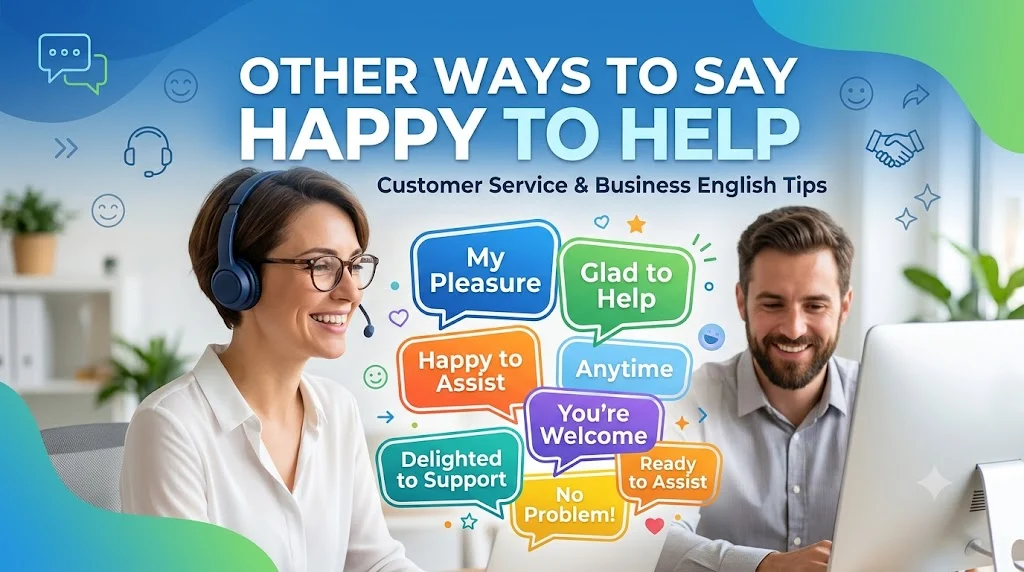
Other ways to say “happy to help” include my pleasure, you’re welcome, glad to help, no problem, anytime, it was my pleasure, don’t mention it, I’m always happy to assist, happy to assist, and it’s the least I could do. These alternatives let you sound more professional, friendly, or polite depending on the situation.
“Happy to help” is one of the most common phrases in English. You hear it in customer service, workplace emails, and casual conversations. But if you say it too often, it starts to sound like a script not genuine.
Learning alternatives to “happy to help” makes your English sound more natural and professional. The right phrase shows you actually care, not just that you’re doing your job. Whether you want to express excitement in English or simply sound more polished, these alternatives give you choices .
Quick Categories
Formal Alternatives to “Happy to Help”
- Glad to assist
- Pleased to help
- Delighted to be of service
- It would be my pleasure
- I am at your disposal
Casual Alternatives
- No sweat
- Anytime
- Happy to lend a hand
- You got it
- Sure thing
Professional Alternatives
- I’m available to support
- Glad to be of assistance
- Always here to help
- Ready to assist
- Happy to support
Informal Expressions
- No worries
- Happy to pitch in
- Count on me
- I’m here for you
- Happy to help out
💡 Pro Tip: Match your phrase to the situation. Formal for clients and bosses. Casual for coworkers and friends. Getting this right makes a huge difference.
Common Mistakes Using “Happy to Help”
- Using it in formal documents
❌ “We are happy to help with your legal matter.”
✅ “We are pleased to assist with your legal matter.” - Saying it too often in one conversation
❌ Repeating “happy to help” three times in one email.
✅ Use one alternative per interaction. - Using it after a big favor
❌ “Happy to help” after working overtime for a client.
✅ “It was my pleasure to assist.” - Using it with someone senior
❌ “Happy to help, boss.”
✅ “I’m glad to be of assistance.” - Using it in writing without context
❌ Just “happy to help” with no explanation.
✅ Add a sentence showing how you helped .
What Does “Happy to Help” Mean?
Meaning: A friendly way to say you’re willing to assist someone.
Grammar: It’s a shortened form of “I am happy to help.” The adjective “happy” describes how you feel about helping.
Example: “Happy to help. Let me know if you need anything else.”
When to Use “Happy to Help”
- Responding to “thank you”
- Offering assistance in casual settings
- Customer service interactions
- Quick email replies
- Informal workplace chats
Spoken vs Written: Common in both, but more natural in spoken English.
Formal vs Informal: Generally informal. Avoid in formal correspondence .
Is It Professional or Polite to Say “Happy to Help”?
Polite? ✔️ Yes – It shows willingness and good manners.
Professional? ❌ Not usually – It’s too casual for formal business settings.
Example: Instead of “Happy to help with your account,” say “I’m pleased to assist with your account.”
Pros and Cons of Using “Happy to Help”
Pros
- Simple and natural
- Friendly tone
- Common usage – everyone understands it
- Easy to understand
Cons
- Too informal for professional writing
- Overused and cliché
- Limited emotional range
- Not suitable for formal documents
Other Ways to Say “Happy to Help” (With Examples)
These alternatives help you sound more fluent, confident, and natural in different situations. Use them based on tone, context, and audience.
1. Phrase: Glad to Assist
Meaning: You are pleased to offer support.
Explanation: A polite and professional alternative that sounds more formal.
Example: “I’m glad to assist with your proposal. Let me know what you need.”
Best Use: Formal emails
Worst Use: Texting friends
Tone: Professional, polite
Context Variability: Professional – Use with clients or senior colleagues.
2. Phrase: It’s My Pleasure
Meaning: Helping you made me happy.
Explanation: This phrase suggests you genuinely enjoyed helping, not just doing your job .
Example: “It’s my pleasure to help you with this project.”
Best Use: Customer service
Worst Use: Responding to a small favor
Tone: Warm, polite
Context Variability: Formal and informal – Works in most situations.
3. Phrase: Happy to Lend a Hand
Meaning: Willing to help someone with a task.
Explanation: A friendly, slightly casual phrase that shows teamwork.
Example: “I’m happy to lend a hand with the presentation.”
Best Use: Workplace collaboration
Worst Use: Formal legal correspondence
Tone: Friendly, collaborative
Context Variability: Casual to semi professional.
4. Phrase: I’m At Your Service
Meaning: Ready to help you whenever needed.
Explanation: A traditional and polite way to offer assistance .
Example: “I’m at your service. How can I help?”
Best Use: Client meetings
Worst Use: Daily workplace chats
Tone: Formal, respectful
Context Variability: Professional settings.
5. Phrase: Delighted to Help
Meaning: Very happy and excited to assist.
Explanation: Shows higher enthusiasm than “happy to help” .
Example: “I’m delighted to help you prepare for the interview.”
Best Use: Enthusiastic responses
Worst Use: When you’re actually annoyed
Tone: Enthusiastic, warm
Context Variability: Formal and informal, but always positive.
6. Phrase: Glad to Be of Service
Meaning: Pleased to provide help.
Explanation: A formal way to acknowledge a thank you .
Example: “I’m glad to be of service. Please reach out anytime.”
Best Use: After resolving a complaint
Worst Use: Casual text messages
Tone: Formal, professional
Context Variability: Professional service settings.
7. Phrase: More Than Happy to Help
Meaning: Very enthusiastic about helping.
Explanation: Adds emphasis and shows extra willingness .
Example: “I’m more than happy to help you with that report.”
Best Use: When you want to show excitement
Worst Use: Overly formal documents
Tone: Enthusiastic, friendly
Context Variability: Semi formal to casual.
8. Phrase: No Sweat
Meaning: It wasn’t difficult for me.
Explanation: A very casual, informal phrase that dismisses any trouble .
Example: “No sweat! I was happy to help.”
Best Use: With friends or close colleagues
Worst Use: Professional emails
Tone: Casual, relaxed
Context Variability: Informal only.
9. Phrase: Anytime
Meaning: Always available to help.
Explanation: A short, friendly way to say you’re always willing .
Example: “Thanks for your help!” “Anytime.”
Best Use: Quick replies
Worst Use: Formal business letters
Tone: Friendly, casual
Context Variability: Casual settings.
10. Phrase: I’m Here to Help
Meaning: This is what I do.
Explanation: Shows reliability and readiness to support .
Example: “I’m here to help. Feel free to ask questions.”
Best Use: Customer service
Worst Use: When the favor was big
Tone: Reliable, professional
Context Variability: Both formal and informal.
11. Phrase: Pleased to Assist
Meaning: Happy to provide help.
Explanation: A shorter, slightly formal alternative .
Example: “Pleased to assist with your enquiry.”
Best Use: Business emails
Worst Use: Texting friends
Tone: Formal, polite
Context Variability: Professional contexts.
12. Phrase: Happy to Support
Meaning: Willing to give assistance or backing.
Explanation: Shows enthusiasm for helping with a project or cause .
Example: “I’m happy to support your team with this initiative.”
Best Use: Collaborative work
Worst Use: Personal favors
Tone: Professional, positive
Context Variability: Semi formal to professional.
13. Phrase: Glad I Could Help
Meaning: I’m happy my help was useful.
Explanation: Focuses on the positive outcome for the other person .
Example: “Glad I could help you solve that issue.”
Best Use: After solving a problem
Worst Use: Before offering help
Tone: Satisfied, warm
Context Variability: Both formal and informal.
14. Phrase: It’s the Least I Can Do
Meaning: The favor was small compared to what you deserve.
Explanation: A humble way to accept thanks .
Example: “It’s the least I can do after all your support.”
Best Use: Responding to gratitude
Worst Use: For simple favors
Tone: Humble, gracious
Context Variability: Semi formal and casual.
15. Phrase: No Trouble at All
Meaning: Helping you wasn’t a problem.
Explanation: Reassures the person they didn’t bother you .
Example: “It was no trouble at all. I enjoyed helping.”
Best Use: When someone apologizes for asking
Worst Use: Formal business writing
Tone: Friendly, reassuring
Context Variability: Informal to semi formal.
16. Phrase: Happy to Pitch In
Meaning: Willing to contribute help.
Explanation: A team oriented phrase for collaborative situations .
Example: “I’m happy to pitch in whenever you need extra hands.”
Best Use: Team projects
Worst Use: Formal client communication
Tone: Collaborative, casual
Context Variability: Casual workplace settings.
17. Phrase: I’m Open to Assist
Meaning: Available and willing to help.
Explanation: Straightforward and professional .
Example: “I’m open to assist with whatever you need.”
Best Use: Offering help proactively
Worst Use: Responding to thanks
Tone: Professional, open
Context Variability: Professional settings.
18. Phrase: Glad to Be of Assistance
Meaning: Happy to have provided help.
Explanation: A formal phrase that shows satisfaction .
Example: “I’m glad to be of assistance. Is there anything else?”
Best Use: Formal thank you replies
Worst Use: Casual conversations
Tone: Formal, polite
Context Variability: Formal or professional settings.
19. Phrase: Count on Me to Help
Meaning: You can rely on me.
Explanation: Builds trust and shows dependability .
Example: “Count on me to help you get this done.”
Best Use: Showing reliability
Worst Use: Formal letters
Tone: Confident, friendly
Context Variability: Informal to semi formal.
20. Phrase: Always Here to Help
Meaning: I’m always available for support.
Explanation: Shows ongoing willingness .
Example: “I’m always here to help if you have questions.”
Best Use: Customer support
Worst Use: After a one time favor
Tone: Warm, reliable
Context Variability: Both formal and informal.
“The right tone makes your English sound professional and confident.”
21. Phrase: Don’t Hesitate to Ask
Meaning: Feel free to request help.
Explanation: An open invitation for future assistance .
Example: “Don’t hesitate to ask if you need anything else.”
Best Use: Ending conversations
Worst Use: After already helping
Tone: Welcoming, friendly
Context Variability: Professional and informal.
22. Phrase: Consider It Done
Meaning: I’ll handle it immediately.
Explanation: Shows you’re taking action, not just offering words .
Example: “Consider it done. I’ll send it over today.”
Best Use: When taking on a task
Worst Use: After a thank you
Tone: Confident, efficient
Context Variability: Both formal and informal.
23. Phrase: My Door Is Always Open
Meaning: I’m always available to help.
Explanation: A leadership phrase that invites people to ask for support .
Example: “My door is always open if you need guidance.”
Best Use: Managers and leaders
Worst Use: Peer to peer casual chats
Tone: Open, welcoming
Context Variability: Professional settings.
24. Phrase: I’m Available to Support
Meaning: Ready to provide assistance.
Explanation: Formal and direct .
Example: “I’m available to support you however you need.”
Best Use: Offering help in an email
Worst Use: Casual replies
Tone: Professional, reliable
Context Variability: Professional contexts.
25. Phrase: We’ve Got Your Back
Meaning: We support you completely.
Explanation: A strong team phrase emphasizing loyalty .
Example: “We’ve got your back on this project.”
Best Use: Team encouragement
Worst Use: Formal client communication
Tone: Supportive, casual
Context Variability: Casual workplace.
26. Phrase: Happy to Help Out
Meaning: Willing to assist.
Explanation: A more casual version with a relaxed tone .
Example: “Happy to help out with the event setup.”
Best Use: Offering help casually
Worst Use: Formal business letters
Tone: Friendly, casual
Context Variability: Informal settings.
“Using varied phrases makes you sound more sincere, not like a robot.”
27. Phrase: I’m Glad We Could Solve This
Meaning: Happy about the outcome.
Explanation: Focuses on results, not just the act of helping .
Example: “I’m glad we could solve this issue together.”
Best Use: After resolving a problem
Worst Use: Before helping
Tone: Satisfied, warm
Context Variability: Professional.
28. Phrase: Your Satisfaction Is Important
Meaning: I care about your experience.
Explanation: Centers the customer rather than yourself .
Example: “Your satisfaction is important to us. We’ll fix this.”
Best Use: Customer service
Worst Use: Personal favors
Tone: Professional, caring
Context Variability: Customer focused settings.
29. Phrase: It Would Be a Pleasure
Meaning: I’d be happy to do this.
Explanation: Used when agreeing to a request, not after it .
Example: “It would be a pleasure to work on this with you.”
Best Use: Accepting invitations or tasks
Worst Use: Responding to thanks
Tone: Polite, gracious
Context Variability: Both formal and informal.
30. Phrase: I’m Ready to Assist
Meaning: Prepared to help right now.
Explanation: Proactive and direct .
Example: “I’m ready to assist whenever you need me.”
Best Use: Showing readiness
Worst Use: After a thank you
Tone: Professional, eager
Context Variability: Professional settings.
“Stop saying the same thing. Choose the phrase that fits the moment.”
Mini Quiz / Self Check
1. You’re writing to a client after fixing their problem. Which phrase is best?
A) No sweat
B) I’m glad we could solve this
C) Happy to help
D) Anytime
Answer: B
2. A friend thanks you for a small favor. What should you say?
A) I’m at your service
B) It’s my pleasure
C) No sweat
D) Your satisfaction is important
Answer: C
3. Your boss thanks you for finishing a project. Which is most professional?
A) Happy to help
B) No trouble
C) I’m glad to be of assistance
D) You got it
Answer: C
4. You’re offering help on a team project. What works best?
A) I’m delighted to be of service
B) I’m happy to pitch in
C) Consider it done
D) No worries
Answer: B
Comparison Table: Top 10 Alternatives
| Phrase | Tone | Best Use |
| Glad to assist | Formal | Business emails |
| It’s my pleasure | Warm | Customer service |
| Happy to lend a hand | Friendly | Team collaboration |
| I’m at your service | Formal | Client interactions |
| Delighted to help | Enthusiastic | Showing excitement |
| No sweat | Casual | Friends and colleagues |
| Anytime | Friendly | Quick replies |
| I’m here to help | Reliable | Professional settings |
| Glad to be of service | Formal | Thank you responses |
| Happy to support | Professional | Collaborative work |
FAQs
1. What is the best formal alternative to “happy to help”?
“Glad to assist” or “Pleased to help” are professional and polite alternatives for formal settings .
2. Is “happy to help” professional?
Not usually. It’s polite but considered informal for professional correspondence .
3. What can I say instead of “I’m happy to help”?
You can say “It’s my pleasure,” “Glad to assist,” or “I’m delighted to help” depending on the context .
4. How do you say “happy to help” in a business email?
Use “I’m pleased to assist,” “Glad to be of service,” or “I’m available to support” .
5. Is “no sweat” a good alternative to “happy to help”?
Yes, but only in casual situations with friends or close colleagues. It’s not for professional use .
Conclusion
Using different ways to say “happy to help” makes your English more natural and professional. The goal is to match your phrase to the person and situation. A client needs a formal “glad to assist,” while a friend needs a casual “no sweat.”
Practice these phrases daily. Soon you’ll stop saying “happy to help” automatically and start choosing words that fit each moment.

Sally Rooney is an American writer who contributes to QuickResponsess.com, creating clear and practical content for English learners. Her articles help readers build confidence in using words and expressions accurately in everyday and professional communication.