Quick Answer 🔥
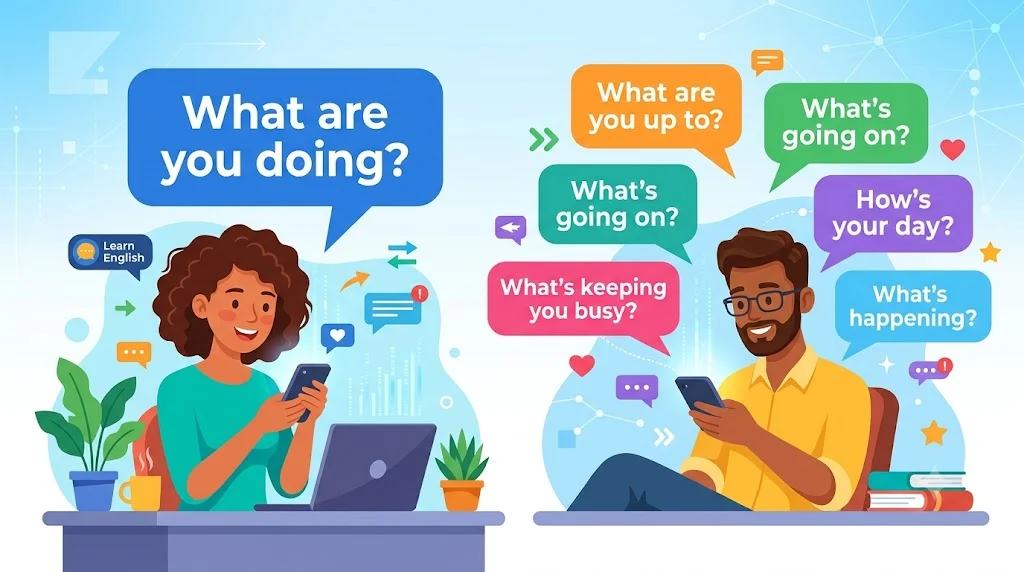
Other ways to say “What are you doing?” include What are you up to?, What’s going on?, How’s it going?, What’s happening?, What have you been up to?, What are you working on?, What’s keeping you busy?, What are you up to today?, What’s new?, and What’s keeping you occupied? These alternatives can sound more casual, friendly, or polite depending on the situation.
The simple question “What are you doing?” is one of the most frequently used phrases in everyday English. It serves as a conversation starter, a check in, and a way to show genuine interest in someone’s current activities. However, relying on the same phrase repeatedly can make your conversations feel repetitive and robotic.
Whether you’re networking at a professional event, catching up with a friend, or starting a meeting, having a variety of alternatives to “What are you doing?” helps you sound more fluent, confident, and context aware. This guide presents 30+ polished alternatives, categorized by formality and usage, so you can choose the perfect phrase every time.
Common Mistakes When Using “What Are You Doing?”
- Using informal grammar in formal settings
❌ “What you doing?” — This is grammatically incorrect for professional contexts. ✅ Use “What are you doing?” instead. - Repeating the same phrase in a single conversation
❌ “What are you doing? … So, what are you doing now?” — Sounds repetitive. ✅ Vary your language. - Using it as a greeting in formal emails
❌ “Hi John, what are you doing?” — Too direct. ✅ Use “I hope this message finds you well.” - Using it when you mean “How are you?”
❌ “What are you doing?” when you really mean to ask about well being. ✅ Use “How are you doing?” or “How have you been?” - Overusing it with close friends
❌ Asking the same question every time you meet. ✅ Use casual alternatives like “What’s up?” or “What’s new?”
What Does “What Are You Doing?” Mean?
The question “What are you doing?” is used to ask about someone’s current action, task, or activity. It can refer to what they are engaged in at this very moment or what they are occupied with more generally.
Grammar Explanation
- Present Continuous Tense — “Are” (auxiliary verb) + “doing” (present participle)
- Used for actions happening now or around the present time
Example Sentence
“What are you doing this weekend?” — Asking about future plans, not just the present moment.
When to Use “What Are You Doing?”
Use this phrase when:
- You want to check in on someone’s current activity
- Starting a casual conversation
- Asking about someone’s immediate tasks
- You’re in a neutral, informal setting
Spoken vs Written:
- Spoken: Very common in everyday speech
- Written: Acceptable in informal messages; avoid in formal correspondence
Formal vs Informal:
- Informal: The default choice for friends and family
- Formal: Acceptable but may sound too casual; better alternatives exist
Is It Professional or Polite to Say “What Are You Doing?”
Polite? ✔️ Yes — It’s a neutral, courteous question.
Professional? ❌ In most cases, no — It can sound too casual in business contexts.
Business Style Example
Instead of:
“What are you doing?”
Use:
“Could you update me on your current work priorities?”
Pros and Cons of Using “What Are You Doing?”
Pros
- Simple and natural
- Friendly tone
- Common usage
- Easy to understand
Cons
- Too informal for work
- Overused
- Limited emotional range
- Not suitable for formal writing
30+ Other Ways to Say “What Are You Doing?” (With Examples)
These alternatives will help you sound more fluent, confident, and natural in different situations. Use them according to tone, context, and audience.
Formal Alternatives
1. Phrase: What is occupying your time at the moment?
Meaning: Asking what tasks or activities currently demand someone’s attention.
Explanation: This is a polite, indirect way to inquire about someone’s work or commitments.
Example: “What is occupying your time at the moment? I’d love to hear about your current projects.”
Best Use: Formal settings
Worst Use: Casual chats
Tone: Polite, respectful
Context Variability: Formal
2. Phrase: What are your current projects or responsibilities?
Meaning: Asking about ongoing work or duties.
Explanation: Directly inquires about professional obligations with a structured tone.
Example: “What are your current projects or responsibilities? We may be able to collaborate.”
Best Use: Business meetings
Worst Use: Social gatherings
Tone: Professional, direct
Context Variability: Professional
3. Phrase: What tasks are you currently handling?
Meaning: Asking about specific duties being managed.
Explanation: Focuses on actionable tasks and workload.
Example: “What tasks are you currently handling? I don’t want to overlap efforts.”
Best Use: Team coordination
Worst Use: Friendly conversations
Tone: Efficient, task oriented
Context Variability: Work
4. Phrase: Could you update me on your current activities?
Meaning: A polite request for information about recent or ongoing work.
Explanation: This is diplomatic and shows interest in someone’s contributions.
Example: “Could you update me on your current activities before our team meeting?”
Best Use: Professional check ins
Worst Use: Casual texting
Tone: Diplomatic, polished
Context Variability: Formal
5. Phrase: What are you currently engaged in?
Meaning: Asking about what someone is actively involved with.
Explanation: Slightly formal but still conversational — ideal for professional environments.
Example: “What are you currently engaged in? I’d like to understand your priorities.”
Best Use: Manager employee conversations
Worst Use: Social media DMs
Tone: Professional, inquisitive
Context Variability: Professional
6. Phrase: May I ask what you’re working on at present?
Meaning: A courteous way to ask about current work.
Explanation: Adds politeness and formality through the use of “may.”
Example: “May I ask what you’re working on at present? I’m curious about your team’s progress.”
Best Use: Emails and meetings
Worst Use: Quick check ins
Tone: Very polite
Context Variability: Formal
Professional Alternatives
7. Phrase: What are you working on?
Meaning: A direct question about someone’s current project or task.
Explanation: Widely used in workplace settings; it’s professional yet approachable.
Example: “What are you working on this week? I’d love to see how I can support.”
Best Use: Office conversations
Worst Use: Social events
Tone: Professional, friendly
Context Variability: Work
8. Phrase: What’s on your plate?
Meaning: A metaphorical question about current responsibilities.
Explanation: Common in business English — asks about workload and priorities.
Example: “What’s on your plate right now? We’ve got a new client coming in.”
Best Use: Informal professional settings
Worst Use: Formal correspondence
Tone: Casual productive
Context Variability: Semi formal
9. Phrase: What’s keeping you busy?
Meaning: Asking what occupies someone’s time and energy.
Explanation: A friendly, career focused alternative showing interest in someone’s productivity.
Example: “What’s keeping you busy these days? I haven’t seen you at the office much.”
Best Use: Catch ups with colleagues
Worst Use: Very formal communications
Tone: Warm, professional
Context Variability: Professional
10. Phrase: How are things coming along?
Meaning: Asking about progress or developments.
Explanation: Shows interest in outcomes and forward momentum.
Example: “How are things coming along with the project? Need any help?”
Best Use: Project check ins
Worst Use: Casual greetings
Tone: Supportive, encouraging
Context Variability: Professional
11. Phrase: What are you busy with?
Meaning: Asking about current tasks and priorities.
Explanation: Common in workplace contexts; polite and task focused.
Example: “What are you busy with today? I’ll make sure my request doesn’t disrupt you.”
Best Use: Work environments
Worst Use: Social chats
Tone: Task oriented
Context Variability: Professional
12. Phrase: What’s the status of your current work?
Meaning: A structured question about progress and completion.
Explanation: Ideal for managers, project leads, and structured reporting.
Example: “What’s the status of your current work? We’re planning the next sprint.”
Best Use: Project management
Worst Use: Casual interactions
Tone: Structured, analytical
Context Variability: Formal work
Casual Alternatives
13. Phrase: What are you up to?
Meaning: Asking what someone is doing in a relaxed, friendly way.
Explanation: One of the most common alternatives — works in almost any casual setting.
Example: “Hey! What are you up to this weekend?”
Best Use: Social conversations
Worst Use: Professional meetings
Tone: Casual, friendly
Context Variability: Spoken
14. Phrase: What’s going on with you?
Meaning: Asking about someone’s life or current activities.
Explanation: Great for casual check ins; broad enough for varied responses.
Example: “What’s going on with you? Haven’t talked in a while.”
Best Use: Catching up
Worst Use: Workplace settings
Tone: Warm, informal
Context Variability: Spoken
15. Phrase: What have you been up to?
Meaning: Asking about someone’s recent activities (not just current).
Explanation: Perfect when you haven’t seen someone in a while.
Example: “Long time no see! What have you been up to?”
Best Use: Reconnecting
Worst Use: Formal emails
Tone: Friendly, curious
Context Variability: Casual
16. Phrase: What’s new with you?
Meaning: Asking for updates or changes in someone’s life.
Explanation: A light, conversational opener.
Example: “What’s new with you? Any exciting news?”
Best Use: Social interactions
Worst Use: Professional correspondence
Tone: Conversational
Context Variability: Informal
17. Phrase: What’s happening?
Meaning: A general inquiry about events or activities.
Explanation: Popular in casual American English; functions as a greeting.
Example: “What’s happening? Are you free later?”
Best Use: Group settings
Worst Use: Formal meetings
Tone: Easy going
Context Variability: Spoken
Informal / Slang Alternatives
18. Phrase: Whatcha doin’?
Meaning: A casual, contracted form of “What are you doing?”
Explanation: Used in text messages and quick spoken interactions.
Example: “Whatcha doin’ later? Wanna grab coffee?”
Best Use: Messaging friends
Worst Use: Professional contexts
Tone: Playful, intimate
Context Variability: Very informal
19. Phrase: Sup?
Meaning: Extremely casual shorthand for “What’s up?”
Explanation: Common in text messages and among close friends.
Example: “Sup? You coming to the party tonight?”
Best Use: Texting friends
Worst Use: Any professional setting
Tone: Relaxed, colloquial
Context Variability: Very informal
20. Phrase: What’s shakin’?
Meaning: A slangy, friendly way of asking “What’s happening?”
Explanation: Playful and energetic, best used among friends.
Example: “What’s shakin’? How was your trip?”
Best Use: Very casual chats
Worst Use: Professional contexts
Tone: Playful, energetic
Context Variability: Slang
21. Phrase: What’s sizzling?
Meaning: A creative slang alternative for “What’s happening?”
Explanation: Adds fun energy to casual greetings.
Example: “What’s sizzling? It’s been ages!”
Best Use: Informal, social settings
Worst Use: Workplace
Tone: Creative, colloquial
Context Variability: Slang
22. Phrase: What’s good in the hood?
Meaning: A slangy, playful way to ask “What’s new?”
Explanation: Often used in urban or pop culture contexts.
Example: “Yo, what’s good in the hood?”
Best Use: Very casual conversations
Worst Use: Professional contexts
Tone: Slangy, playful
Context Variability: Street/colloquial
Checking In Alternatives
23. Phrase: How are things?
Meaning: A broad check in on life, work, or general state.
Explanation: Works in casual and semi formal situations.
Example: “How are things? I wanted to check in.”
Best Use: Versatile
Worst Use: Very formal writing
Tone: Neutral, warm
Context Variability: Spoken/written
24. Phrase: How’s everything?
Meaning: Asking about overall well being and life circumstances.
Explanation: A safe, friendly opener for many contexts.
Example: “How’s everything at home?”
Best Use: General check ins
Worst Use: Business emails
Tone: Caring, conversational
Context Variability: Casual
25. Phrase: How’s it going?
Meaning: A classic way to ask about someone’s general state.
Explanation: Very common in American and British English.
Example: “Hey, how’s it going? Can I grab you for a minute?”
Best Use: Everyday conversations
Worst Use: Formal documents
Tone: Friendly
Context Variability: Versatile
26. Phrase: How have you been?
Meaning: Asking about someone’s well being over a period of time.
Explanation: Ideal when you haven’t spoken recently.
Example: “It’s been a while — how have you been?”
Best Use: Reconnecting with people
Worst Use: Quick check ins
Tone: Caring
Context Variability: Casual/semi formal
27. Phrase: How’s your day going?
Meaning: Asking specifically about the current day.
Explanation: Shows immediate interest and politeness.
Example: “How’s your day going? Hope it’s a good one.”
Best Use: Daily conversations
Worst Use: Formal emails
Tone: Friendly
Context Variability: Spoken
28. Phrase: How are you holding up?
Meaning: Asking about someone’s well being during difficult times.
Explanation: Shows empathy and care not a casual greeting.
Example: “I know it’s been out of control how are you holding up?”
Best Use: Supporting others
Worst Use: Casual contexts
Tone: Empathetic
Context Variability: Supportive
Creative Alternatives
29. Phrase: What’s the latest buzz in your world?
Meaning: Asking for recent updates or gossip.
Explanation: Playful and engaging, ideal for informal chats.
Example: “What’s the latest buzz in your world? Tell me everything.”
Best Use: Social contexts
Worst Use: Professional settings
Tone: Playful
Context Variability: Casual
30. Phrase: What was the highlight of your day, so far?
Meaning: Asking about the best part of someone’s day.
Explanation: Encourages positive conversation and deeper sharing.
Example: “What was the highlight of your day so far?”
Best Use: Personal conversations
Worst Use: Work environments
Tone: Warm, positive
Context Variability: Personal
31. Phrase: How is life sailing?
Meaning: A metaphorical, poetic way of asking about life.
Explanation: Quirky and memorable — works with close friends.
Example: “How is life sailing lately? I hope things are smooth.”
Best Use: Creative settings
Worst Use: Professional contexts
Tone: Imagery rich
Context Variability: Informal
32. Phrase: Anything interesting happening in your life lately?
Meaning: Asking for updates in a curious, open ended way.
Explanation: Encourages the other person to share what matters.
Example: “Anything interesting happening in your life lately?”
Best Use: Catching up
Worst Use: Business contexts
Tone: Curious
Context Variability: Casual
Mini Quiz: Choose the Right Phrase
1. Your manager asks for an update on your current projects. Which phrase should you use?
A) “What’s up?”
B) “What are your current projects or responsibilities?”
C) “Whatcha doin’?”
Answer: B — Formal and professional.
2. A friend texts you asking what you’re doing. Which is most natural?
A) “What tasks are you handling?”
B) “Whatcha doin’?”
C) “What is occupying your time?”
Answer: B — Casual and fits text messaging.
3. You haven’t seen a colleague in a week and want to check in. Which phrase works best?
A) “Sup?”
B) “How have you been?”
C) “What’s shakin’?”
Answer: B — Warm, natural, and appropriate for colleagues.
4. You want to show empathy to a friend going through a tough time. Which phrase is best?
A) “How are you holding up?”
B) “What are you up to?”
C) “What’s new?”
Answer: A — Shows care and emotional support.
Comparison Table: Top Alternatives
| Phrase | Tone | Best Use |
| What are you working on? | Professional | Workplace check ins |
| What’s on your plate? | Semi formal | Professional, casual |
| What’s keeping you busy? | Warm professional | Career conversations |
| What are you up to? | Casual | Social contexts |
| What have you been up to? | Friendly | Reconnecting |
| What is occupying your time? | Formal | Professional emails |
| How are things? | Neutral | General check ins |
| What’s new with you? | Informal | Catching up |
| Whatcha doin’? | Slang | Texting friends |
| How are you holding up? | Empathetic | Supportive conversations |
Frequently Asked Questions
1. What are other ways to say what are you doing?
There are many alternatives, including “What are you up to?”, “What’s keeping you busy?”, and “What are you working on?” depending on formality and context.
2. Is “What are you doing?” professional or polite?
While polite, it is often too casual for professional settings. Use “What are you currently engaged in?” or “What is occupying your time?” for a more formal tone.
3. How do you ask what someone is doing in a business email?
In a business email, avoid direct questions. Instead, say “I hope this message finds you well” and focus on your purpose. If you need to ask about activities, try “Could you update me on your current work?”
4. What is a casual way to ask what someone is doing?
“What are you up to?” is the most common casual alternative. Others include “What’s going on?” and “What’s happening?”
5. What does “What are you up to?” mean?
It’s a casual way of asking “What are you doing?” especially useful for checking in on someone’s activities in a friendly way.
Conclusion
Learning alternatives to “What are you doing?” is one of the simplest ways to sound more fluent, confident, and context aware in English. Whether you’re in a professional meeting, texting a friend, or checking in on a colleague, the right phrase can make all the difference it shows you understand tone, audience, and emotional nuance.
Start incorporating five new alternatives this week. Pay attention to tone and context, and soon these variations will become a natural part of your English vocabulary. Your conversations will feel more engaging and you’ll sound like a native speaker who knows exactly what to say, when to say it, and why.

Stephen King is an American writer and language enthusiast who enjoys creating clear, practical content that helps readers communicate with confidence. His work at QuickResponsess.com focuses on making English easier to understand through simple explanations and everyday examples.