Quick Answer 🔥
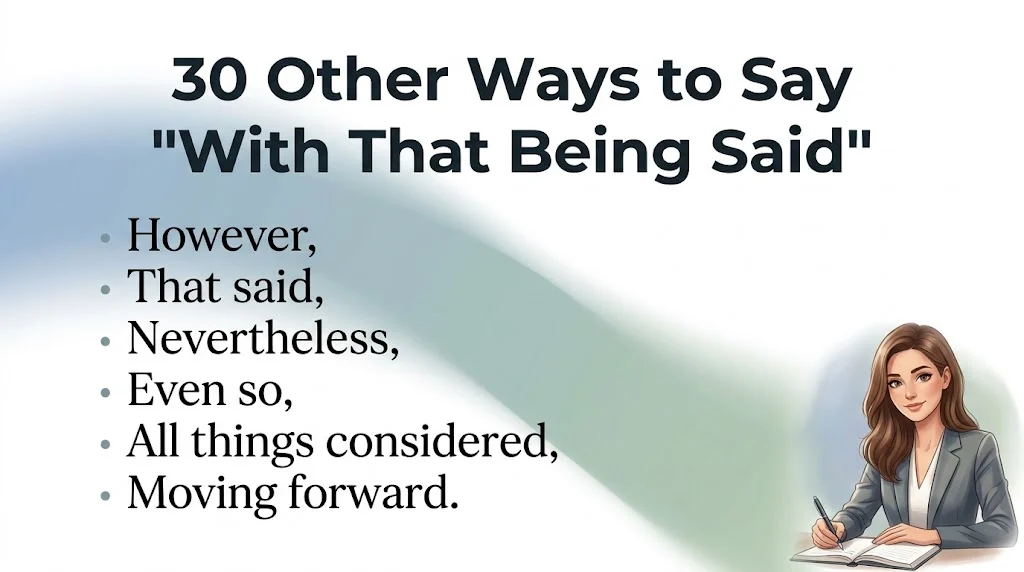
However, That said, Nevertheless, Even so, or On the other hand. These transitions help you contrast ideas, shift direction, and sound more fluent in both spoken and written English.
The phrase “with that being said” is one of the most common transitional expressions in English. It signals a shift in thought often introducing a contrast, a conclusion, or a new perspective after acknowledging what came before.
But here’s the challenge: using the same phrase repeatedly makes your speech and writing sound repetitive, robotic, and less confident. Learning alternatives to “with that being said” expands your vocabulary, improves your fluency, and helps you match the right tone for every situation whether you’re writing a business email, participating in a meeting, or having a casual conversation.
“The right transition phrase can turn a clumsy sentence into a confident statement.”
Quick Categories
Formal Alternatives
- Nevertheless
- Nonetheless
- However
- That being the case
- In light of this
- Consequently
- Therefore
- Accordingly
- As such
- Thus
Professional Alternatives
- That said
- Having said that
- All things considered
- With this in mind
- Moving forward
- Taking that into consideration
- On that note
- From that perspective
Casual Alternatives
- Even so
- Still
- Yet
- Anyway
- All the same
- Then again
- At the same time
Informal Expressions
- Be that as it may
- In any case
- Regardless
- Despite that
- At any rate
- Even though that’s true
💡 Pro Tip: Match your transition to your audience. Use formal alternatives for academic writing and reports, professional alternatives for workplace emails, and casual alternatives for conversations with friends.
Common Mistakes
❌ Mistake 1: Using it too frequently
“The budget is tight. With that being said, we need to cut costs. With that being said, we should also invest in marketing.”
✅ Fix: Vary your transitions. Use “however” or “that said” instead.
❌ Mistake 2: Using it when there’s no contrast
“I love coffee. With that being said, I drink it every morning.”
✅ Fix: Use “and” or “in fact” when continuing the same idea.
❌ Mistake 3: Using it in very formal academic writing
“The data supports the hypothesis. With that being said, further research is needed.”
✅ Fix: Use “nevertheless” or “however” for academic precision.
❌ Mistake 4: Overusing it in short emails
“Thanks for your email. With that being said, I’ll review the document.”
✅ Fix: Keep it simple with “I’ll review the document” or use “that said.”
❌ Mistake 5: Using it to introduce a completely unrelated point
“The meeting is at 3 PM. With that being said, I’m hungry.”
✅ Fix: Only use transitions when ideas are logically connected.
What Does “With That Being Said” Mean?
“With that being said” is a transitional phrase used to introduce a new idea that often contrasts with, limits, or builds upon what was just mentioned.
Grammar Note: It functions as a discourse marker not a verb or idiom linking two statements together.
Example Sentence:
“I understand your concerns. With that being said, I believe we should move forward with the plan.”
When to Use “With That Being Said”
- Spoken English: To shift direction or soften disagreement in conversations
- Business English: In meetings and presentations to introduce new points politely
- Emails and Messages: After providing background information
- Professional Meetings: To present ideas without sounding aggressive
- Academic Writing: Acceptable but better replaced with more precise connectors
- Social Media: Less common; shorter phrases work better
Is It Professional or Polite to Say “With That Being Said”?
Polite? ✔️ Yes — it softens disagreement and sounds respectful
Professional? ❌ No (in most cases) — it’s considered somewhat wordy and can feel weak in formal writing
Business Example:
“I appreciate your perspective. However, we need to prioritize the deadline.”
💡 “Professional communication values clarity and brevity. Short, direct transitions often sound more confident than lengthy phrases.”
Pros and Cons of Using “With That Being Said”
Pros
- Simple and natural to use
- Friendly and non confrontational tone
- Common and widely understood
- Easy for learners to remember
Cons
- Too informal for many work settings
- Overused and repetitive
- Limited emotional range
- Not suitable for formal academic or legal writing
Other Ways to Say “With That Being Said” (With Examples)
These 30 alternatives will help you sound more fluent, confident, and natural in different situations. Use them according to tone, context, and audience to express contrast, shift direction, or introduce new ideas with precision.
Formal Alternatives
1. Phrase: Nevertheless
- Meaning: In spite of what was just mentioned.
- Explanation: A strong, formal transition that signals contrast while maintaining a polished tone.
- Example Sentence: “The deadline is tight. Nevertheless, we will deliver on time.”
- Best Use: Academic writing, reports
- Worst Use: Casual conversation
- Tone: Confident, formal
- Context Variability: Professional / formal writing
2. Phrase: Nonetheless
- Meaning: Despite what was just said.
- Explanation: Similar to “nevertheless,” but slightly more formal and emphatic.
- Example Sentence: “The project faced many challenges. Nonetheless, the team succeeded.”
- Best Use: Formal arguments, essays
- Worst Use: Everyday speech
- Tone: Formal, persistent
- Context Variability: Professional / academic
3. Phrase: However
- Meaning: Introduces a contrasting point.
- Explanation: The most direct and widely used formal transition.
- Example Sentence: “We tried the new approach. However, the results were disappointing.”
- Best Use: Emails, reports, academic writing
- Worst Use: Casual chats
- Tone: Formal, neutral
- Context Variability: Professional / formal
4. Phrase: Therefore
- Meaning: As a logical consequence.
- Explanation: Used to show that the next point directly follows from the previous idea.
- Example Sentence: “The deadline has shifted. Therefore, we must adjust the schedule.”
- Best Use: Business reports, formal presentations
- Worst Use: Casual chats
- Tone: Formal, logical
- Context Variability: Professional / analytical
5. Phrase: Consequently
- Meaning: As a result of the previous point.
- Explanation: Demonstrates cause and effect with professional clarity.
- Example Sentence: “The budget has been approved. Consequently, we can proceed with procurement.”
- Best Use: Corporate documents, strategy updates
- Worst Use: Emotional emails
- Tone: Highly formal
- Context Variability: Professional / formal documents
6. Phrase: Thus
- Meaning: As a result or conclusion.
- Explanation: Ideal for academic or logical argumentation.
- Example Sentence: “The findings were inconsistent. Thus, further research is needed.”
- Best Use: Academia, analytical reports
- Worst Use: Spoken language
- Tone: Academic formal
- Context Variability: Academic / formal
7. Phrase: Accordingly
- Meaning: In a manner consistent with what was stated.
- Explanation: Shows alignment between cause and action.
- Example Sentence: “The team will accordingly adjust the deliverables for Q4.”
- Best Use: Project management communication
- Worst Use: Casual speech
- Tone: Very formal
- Context Variability: Professional / formal
8. Phrase: That being the case
- Meaning: Given the situation.
- Explanation: An elegant shift to a conclusion derived from facts.
- Example Sentence: “That being the case, we must prioritize security enhancements.”
- Best Use: Corporate reasoning
- Worst Use: Informal conversation
- Tone: Sophisticated, formal
- Context Variability: Professional / analytical
9. Phrase: As such
- Meaning: For this reason.
- Explanation: Adds refinement to the transition.
- Example Sentence: “As such, we will implement the new compliance standards immediately.”
- Best Use: HR, legal, policy documents
- Worst Use: Everyday conversation
- Tone: Corporate formal
- Context Variability: Professional / legal
10. Phrase: In light of this
- Meaning: Considering the previous information.
- Explanation: Signals that the next point is based on new insight or context.
- Example Sentence: “In light of this, we will revise the training schedule.”
- Best Use: Policy announcements
- Worst Use: Quick chats
- Tone: Formal, reflective
- Context Variability: Professional / formal
Professional Alternatives
11. Phrase: That said
- Meaning: After what was mentioned, here is a contrast.
- Explanation: The shortest, cleanest version of the original phrase.
- Example Sentence: “I like your idea. That said, we need more data.”
- Best Use: Workplace conversations, emails
- Worst Use: Very formal academic papers
- Tone: Professional, neutral
- Context Variability: Professional / spoken / written
12. Phrase: Having said that
- Meaning: Acknowledging what was just stated before adding a new point.
- Explanation: A natural, slightly more formal alternative to “that said.”
- Example Sentence: “The hotel was noisy. Having said that, the staff was wonderful.”
- Best Use: Professional discussions, presentations
- Worst Use: Very casual texts
- Tone: Professional, reflective
- Context Variability: Professional / spoken
13. Phrase: All things considered
- Meaning: Taking everything into account.
- Explanation: Used to introduce a conclusion based on previous points.
- Example Sentence: “All things considered, the results were better than expected.”
- Best Use: Professional and academic writing
- Worst Use: Quick, casual remarks
- Tone: Measured, thoughtful
- Context Variability: Professional / academic
14. Phrase: With this in mind
- Meaning: Keeping the previous information in focus.
- Explanation: Shows that what follows is influenced by previous information.
- Example Sentence: “With this in mind, we adjusted the plan accordingly.”
- Best Use: Decision making contexts, strategy discussions
- Worst Use: Informal chats
- Tone: Professional, logical
- Context Variability: Professional / written
15. Phrase: Moving forward
- Meaning: Transitioning toward future actions or ideas.
- Explanation: Ideal for workplace communication and presentations.
- Example Sentence: “Moving forward, we need better project planning.”
- Best Use: Business meetings, emails
- Worst Use: Personal conversations
- Tone: Forward looking, professional
- Context Variability: Professional / business
16. Phrase: Taking that into consideration
- Meaning: Considering what was just mentioned.
- Explanation: An articulate, somewhat formal alternative.
- Example Sentence: “Taking that into consideration, we might hire someone with more experience.”
- Best Use: Academic or professional correspondence
- Worst Use: Casual conversation
- Tone: Formal, articulate
- Context Variability: Professional / formal
17. Phrase: On that note
- Meaning: Transitioning to a related point.
- Explanation: A smooth, professional way to pivot while maintaining connection.
- Example Sentence: “On that note, let’s discuss the next agenda item.”
- Best Use: Meetings, presentations
- Worst Use: Formal essays
- Tone: Professional, conversational
- Context Variability: Professional / spoken
18. Phrase: From that perspective
- Meaning: Viewing the next point through the previous lens.
- Explanation: Helps maintain logical flow while shifting focus.
- Example Sentence: “From that perspective, the proposal makes more sense.”
- Best Use: Strategic discussions, analysis
- Worst Use: Casual chats
- Tone: Analytical, professional
- Context Variability: Professional / analytical
Casual Alternatives
19. Phrase: Even so
- Meaning: Accepts a fact but opposes it.
- Explanation: Shows something surprising or unexpected follows.
- Example Sentence: “Traffic was bad. Even so, we arrived on time.”
- Best Use: Emails, discussions
- Worst Use: Highly formal writing
- Tone: Warm, encouraging
- Context Variability: Casual / spoken
20. Phrase: Still
- Meaning: Indicates continuation despite prior points.
- Explanation: Simple and conversational.
- Example Sentence: “I see your point. Still, I disagree.”
- Best Use: Spoken language
- Worst Use: Highly formal writing
- Tone: Casual, honest
- Context Variability: Casual / spoken
21. Phrase: Yet
- Meaning: Despite that; nevertheless.
- Explanation: A short, effective contrast marker.
- Example Sentence: “It’s expensive. Yet, it’s worth every penny.”
- Best Use: Conversational English, blogs
- Worst Use: Formal reports
- Tone: Neutral, slightly formal
- Context Variability: Casual / written
22. Phrase: Anyway
- Meaning: Regardless of what was just said.
- Explanation: A very casual way to change the subject or return to the main point.
- Example Sentence: “Anyway, let’s get back to the main issue.”
- Best Use: Casual conversations
- Worst Use: Professional writing
- Tone: Informal, conversational
- Context Variability: Casual / spoken
23. Phrase: All the same
- Meaning: Despite what was said.
- Explanation: A friendly, slightly old fashioned alternative.
- Example Sentence: “I understand your concerns. All the same, I think we should try.”
- Best Use: Friendly discussions
- Worst Use: Business reports
- Tone: Warm, informal
- Context Variability: Casual / spoken
24. Phrase: Then again
- Meaning: Introducing an alternative or contrasting thought.
- Explanation: Often used to reconsider a previous statement.
- Example Sentence: “It’s a good plan. Then again, we’ve been wrong before.”
- Best Use: Conversations, informal writing
- Worst Use: Formal documents
- Tone: Reflective, casual
- Context Variability: Casual / spoken
Informal Expressions
25. Phrase: Be that as it may
- Meaning: Even if that is true.
- Explanation: Acknowledge a point before introducing a contrasting one.
- Example Sentence: “Be that as it may, we still need to address the issue.”
- Best Use: Debates, informal arguments
- Worst Use: Very formal writing
- Tone: Dismissive but polite
- Context Variability: Casual / spoken
26. Phrase: In any case
- Meaning: Regardless of what has been said.
- Explanation: A casual way to move on to the main point.
- Example Sentence: “In any case, we should finalize the decision today.”
- Best Use: Conversations, informal emails
- Worst Use: Academic writing
- Tone: Casual, decisive
- Context Variability: Casual / spoken
27. Phrase: Regardless
- Meaning: Without considering the previous point.
- Explanation: A short, blunt way to move forward.
- Example Sentence: “Regardless, we need to act now.”
- Best Use: Casual and professional settings (neutral)
- Worst Use: Sensitive conversations
- Tone: Direct, neutral
- Context Variability: Casual / professional
28. Phrase: Despite that
- Meaning: In spite of what was just said.
- Explanation: A clear, informal contrast marker.
- Example Sentence: “Despite that, I think we should proceed.”
- Best Use: Everyday conversation
- Worst Use: Formal essays
- Tone: Casual, straightforward
- Context Variability: Casual / spoken
29. Phrase: At any rate
- Meaning: In any case; regardless.
- Explanation: A casual way to return to the main point.
- Example Sentence: “At any rate, the meeting is still on for tomorrow.”
- Best Use: Conversations, informal writing
- Worst Use: Formal documents
- Tone: Casual, dismissive
- Context Variability: Casual / spoken
30. Phrase: Even though that’s true
- Meaning: Acknowledging a fact before introducing a contrast.
- Explanation: A conversational way to show you’ve heard the other person.
- Example Sentence: “Even though that’s true, I still believe we can find a solution.”
- Best Use: Friendly debates, discussions
- Worst Use: Professional reports
- Tone: Friendly, empathetic
- Context Variability: Casual / spoken
💡 Pro Tip: The best transition is the one your audience doesn’t notice. Match your phrase to the formality of the situation, and your English will sound effortlessly professional.
Mini Quiz / Self Check
1. Which alternative is best for a formal academic paper?
- A) Anyway
- B) Nevertheless
- C) Then again
- D) All the same
Answer: B) Nevertheless
2. You’re in a casual conversation with a friend. Which transition sounds most natural?
- A) Accordingly
- B) Thus
- C) Anyway
- D) Consequently
Answer: C) Anyway
3. Which phrase is too informal for a business email?
- A) That said
- B) However
- C) Be that as it may
- D) With this in mind
Answer: C) Be that as it may
4. You want to introduce a contrasting idea in a team meeting. Which option sounds most professional?
- A) Even so
- B) That said
- C) Anyway
- D) All the same
Answer: B) That said
Comparison Table: Top 10 Alternatives
| Phrase | Tone | Best Use |
| Nevertheless | Formal | Academic writing, reports |
| However | Formal | Emails, professional documents |
| That said | Professional | Workplace conversations, emails |
| Having said that | Professional | Presentations, discussions |
| All things considered | Professional | Conclusions, summaries |
| With this in mind | Professional | Decision making contexts |
| Even so | Casual | Friendly discussions |
| Still | Casual | Spoken English, informal writing |
| Anyway | Informal | Casual conversations |
| Be that as it may | Informal | Debates, informal arguments |
FAQs
1. Is “with that being said” grammatically correct?
Yes, it is grammatically correct and widely used in English. However, it can sound wordy if overused.
2. What is the best formal alternative to “with that being said”?
“Nevertheless” and “however” are the most precise and professional alternatives. They clearly signal contrast without extra words.
3. Can I use “that said” in professional emails?
Yes, “that said” is a professional and concise alternative that works well in workplace communication.
4. What’s the difference between “with that being said” and “therefore”?
“With that being said” introduces a contrast or new perspective, while “therefore” introduces a logical conclusion or result.
5. Is “with that being said” too informal for academic writing?
It’s not incorrect, but academic writing typically prefers more precise transitions like “however,” “nevertheless,” or “on the other hand”.
Conclusion
Learning alternatives to “with that being said” is one of the fastest ways to elevate your English fluency. Each alternative carries a unique tone from the formal precision of “nevertheless” to the casual ease of “anyway.” The key is knowing which one fits your context, audience, and purpose.
Start by choosing two or three new alternatives and practice using them this week. Pay attention to how native speakers transition between ideas in podcasts, meetings, and articles. See also: Other Ways to Say “I Think” and our Professional English Communication Guide for more tone building strategies

John Green is an American writer who contributes to QuickResponsess.com, creating clear and practical content on English grammar, vocabulary and everyday language. His goal is to make learning English simple, engaging and easy to apply.