Quick Answer
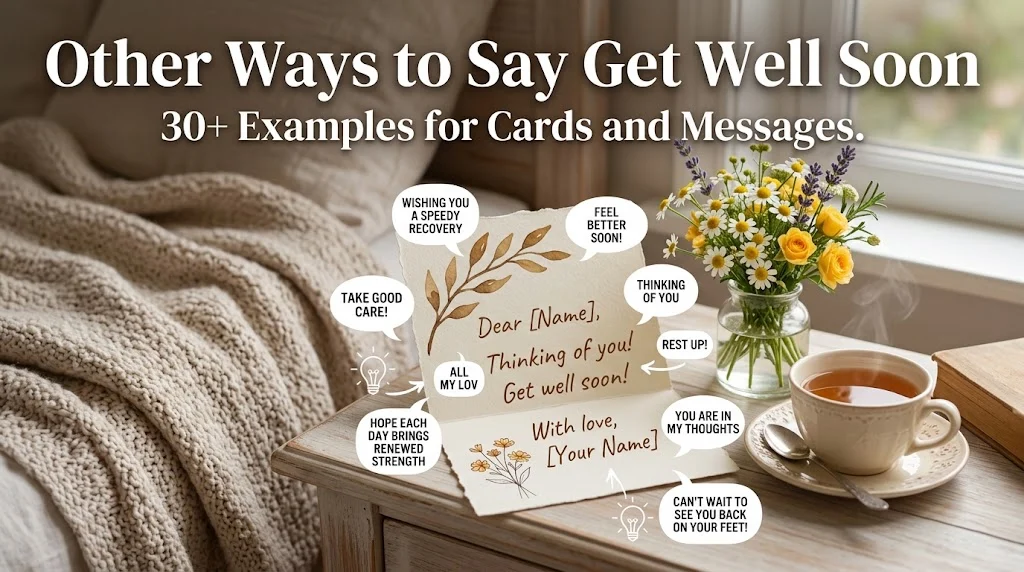
“Get well soon” is a warm wish for someone who is ill or recovering. For more variety and sincerity, try alternatives like “Wishing you a speedy recovery,” “Hope you feel better soon,” “Take care of yourself,” “Sending you healing thoughts,” or “Rest up and recover well.”
“Get well soon” is one of the kindest phrases in English. People write it on cards, type it in messages, and say it at hospital bedsides. It is short, warm, and universally understood. Because it is so easy to use, many learners rely on it for every situation, from a friend with a cold to a colleague recovering from surgery.
This guide provides 30 practical alternatives with meanings, examples, and clear notes on tone. You will also learn to express excitement in English when celebrating someone’s recovery and use professional reaction phrases that fit workplace communication.
Pull Quote: “The right words at a difficult time can mean more than medicine.”
Quick Categories
Formal alternatives to “Get well soon”
- Wishing you a speedy recovery.
- I hope you make a full and quick recovery.
- Please accept my warmest wishes for your health.
- May you return to full strength soon.
Pro Tip: Formal alternatives suit cards to acquaintances, colleagues, and respected elders.
Casual alternatives
- Feel better soon.
- Hope you are back on your feet soon.
- Take it easy.
- Rest up.
Pro Tip: Casual options work well with close friends and family members.
Professional alternatives
- Wishing you a smooth recovery.
- I hope you are feeling better each day.
- Take all the time you need to recover.
- We are thinking of you during your recovery.
Pro Tip: Professional alternatives should be brief and respectful, focusing on wellbeing rather than details.
Informal expressions
- Get better quickly.
- Hurry back to health.
- Sending healing vibes.
- You will be back in no time.
Pro Tip: Informal expressions belong in texts, voice notes, and messages to close friends.
Pull Quote: “The right tone makes your English sound professional and confident.”
Common Mistakes
- Using “get well soon” for serious illness.
Example: Saying “Get well soon” to someone diagnosed with a long term condition can feel dismissive. - Using it for mental health struggles.
Example: “Get well soon” can sound inappropriate when someone is dealing with anxiety or depression. - Making the message entirely about yourself.
Example: “Get well soon, I really need you back at work.” - Sounding too casual in a professional context.
Example: “Get well soon, mate” in an email to a senior colleague. - Adding pressure to recover quickly.
Example: “Get well soon, we cannot manage without you.” This can feel like a burden.
What Does “Get Well Soon” Mean?
Definition
It is a sympathetic expression used to wish someone a quick recovery from illness, injury, or medical treatment.
Grammar Explanation
“Get” is an imperative verb, “well” functions as an adjective describing the desired state, and “soon” is an adverb of time. Together, the phrase forms a short, direct wish.
Example Sentence
“I heard you are unwell. Get well soon, and let me know if you need anything.”
When to Use “Get Well Soon”
Common Contexts
- Cards: A standard message for someone in hospital.
- Messages: Texts and voice notes to friends and family.
- Workplace: A brief email to a colleague on sick leave.
- Social media: Public posts wishing someone a quick recovery.
- Get well gifts: Notes attached to flowers or hampers.
Spoken vs Written
- Spoken: Common in phone calls and personal visits.
- Written: Extremely common on cards, messages, and social posts.
Formal vs Informal
- Formal: Acceptable in cards and polite messages but often expanded with additional wishes.
- Informal: The default option in everyday speech and family communication.
Is It Professional or Polite to Say “Get Well Soon”?
Politeness vs Professionalism
The phrase is polite and kind, but it can sound casual in a professional context. In business writing, a more measured phrase such as “Wishing you a smooth recovery” usually leaves a stronger impression.
Business-Style Example
“We are thinking of you during your recovery and wish you a smooth return to full health.”
Polite? Yes
Professional? Sometimes, depending on the relationship and context
Pull Quote: “In difficult moments, tone matters as much as vocabulary.”
Pros and Cons of Using “Get Well Soon”
Pros
- Simple and natural: Easy to say, write, and remember.
- Friendly tone: Warm and immediately understood.
- Common usage: Recognised in every English speaking country.
- Easy to understand: Requires no advanced vocabulary.
Cons
- Too informal for work: Can sound casual in professional emails.
- Overused: Loses impact through repetition.
- Limited emotional range: Cannot express deep concern or long term support.
- Not suitable for formal writing: Avoid in official correspondence.
Other Ways to Say “Get Well Soon” (With Examples)
These alternatives will help you sound more fluent, confident, and natural in different situations. Use them according to tone, context, and audience to express excitement, admiration, or approval.
1. Wishing you a speedy recovery
Meaning: A warm wish for a quick return to health.
Explanation: Slightly more formal and sincere than the standard phrase.
Example Sentence: “Wishing you a speedy recovery and a restful time at home.”
Best Use: Cards, emails
Worst Use: Casual texts
Tone: Warm, sincere, standard
Context Variability: Professional and written
2. Hope you feel better soon
Meaning: A gentle wish for improved health.
Explanation: Soft and caring in tone.
Example Sentence: “Hope you feel better soon, take all the rest you need.”
Best Use: Friends, family
Worst Use: Formal letters
Tone: Gentle, warm, caring
Context Variability: Casual and spoken
3. Take care of yourself
Meaning: A reminder to prioritise personal wellbeing.
Explanation: Focuses on self care rather than speed of recovery.
Example Sentence: “Take care of yourself and do not rush back too soon.”
Best Use: Personal messages
Worst Use: Official notes
Tone: Caring, gentle, supportive
Context Variability: Casual and spoken
4. Sending you healing thoughts
Meaning: A wish for recovery through positive energy.
Explanation: Slightly spiritual and very warm.
Example Sentence: “Sending you healing thoughts during this difficult time.”
Best Use: Emotional support
Worst Use: Business emails
Tone: Warm, spiritual, sincere
Context Variability: Casual and written
5. Rest up and recover well
Meaning: Encouragement to rest and heal properly.
Explanation: Practical and caring.
Example Sentence: “Rest up and recover well, we will manage everything here.”
Best Use: Colleagues, friends
Worst Use: Formal letters
Tone: Practical, caring, calm
Context Variability: Casual and professional
6. I hope you make a full recovery
Meaning: A wish for complete restoration of health.
Explanation: More formal and comprehensive.
Example Sentence: “I hope you make a full recovery and return to everything you love.”
Best Use: Formal cards
Worst Use: Quick texts
Tone: Formal, sincere, respectful
Context Variability: Professional and written
7. Thinking of you during your recovery
Meaning: A message of emotional presence.
Explanation: Gentle and supportive.
Example Sentence: “Thinking of you during your recovery and sending strength.”
Best Use: Difficult moments
Worst Use: Casual chats
Tone: Gentle, supportive, sincere
Context Variability: Professional and written
8. Wishing you strength and comfort
Meaning: A wish for physical and emotional ease.
Explanation: Balanced and empathetic.
Example Sentence: “Wishing you strength and comfort as you recover.”
Best Use: Serious illness
Worst Use: Minor colds
Tone: Empathetic, warm, formal
Context Variability: Professional and written
9. May you be back on your feet soon
Meaning: A wish for a quick return to normal activity.
Explanation: Slightly idiomatic but widely understood.
Example Sentence: “May you be back on your feet soon and doing what you love.”
Best Use: Recovery wishes
Worst Use: Formal documents
Tone: Warm, encouraging, traditional
Context Variability: Casual and written
10. Take all the time you need
Meaning: A message that removes pressure to return quickly.
Explanation: Compassionate and patient.
Example Sentence: “Take all the time you need, your health comes first.”
Best Use: Workplace, family
Worst Use: Casual chats
Tone: Compassionate, patient, supportive
Context Variability: Professional and spoken
11. I hope each day brings you more strength
Meaning: A gradual wish for improvement.
Explanation: Gentle and encouraging over time.
Example Sentence: “I hope each day brings you more strength and less pain.”
Best Use: Long recovery
Worst Use: Quick messages
Tone: Gentle, hopeful, sincere
Context Variability: Casual and written
12. Sending you warm wishes for a quick recovery
Meaning: A polite and caring message.
Explanation: Slightly formal and very safe.
Example Sentence: “Sending you warm wishes for a quick recovery.”
Best Use: Acquaintances
Worst Use: Close friends
Tone: Polite, warm, neutral
Context Variability: Professional and written
13. You are in my thoughts and prayers
Meaning: A message of spiritual and emotional support.
Explanation: Common in religious communities.
Example Sentence: “You are in my thoughts and prayers during this time.”
Best Use: Religious contexts
Worst Use: Secular workplaces
Tone: Spiritual, sincere, respectful
Context Variability: Casual and written
14. Hope you are back to your old self soon
Meaning: A wish for a full return to normal personality and energy.
Explanation: Personal and affectionate.
Example Sentence: “Hope you are back to your old self soon, we miss your energy.”
Best Use: Close friends
Worst Use: Formal letters
Tone: Affectionate, warm, informal
Context Variability: Casual and spoken
15. Wishing you a smooth and full recovery
Meaning: A wish for an easy recovery process.
Explanation: Professional and reassuring.
Example Sentence: “Wishing you a smooth and full recovery after the procedure.”
Best Use: Workplace, medical
Worst Use: Casual chats
Tone: Professional, calm, sincere
Context Variability: Professional and written
16. Please focus on getting better
Meaning: A gentle instruction to prioritise health.
Explanation: Practical and caring.
Example Sentence: “Please focus on getting better and leave the rest to us.”
Best Use: Colleagues
Worst Use: Formal letters
Tone: Caring, practical, direct
Context Variability: Professional and spoken
17. I hope you are feeling a little better today
Meaning: A gentle check in message.
Explanation: Shows ongoing concern.
Example Sentence: “I hope you are feeling a little better today.”
Best Use: Daily check ins
Worst Use: Initial messages
Tone: Gentle, caring, personal
Context Variability: Casual and spoken
18. Sending you comfort and healing
Meaning: A wish for physical and emotional ease.
Explanation: Soft and empathetic.
Example Sentence: “Sending you comfort and healing during this difficult time.”
Best Use: Serious illness
Worst Use: Quick texts
Tone: Empathetic, warm, gentle
Context Variability: Casual and written
19. Do not rush your recovery
Meaning: A message encouraging patience.
Explanation: Prevents pressure to return too soon.
Example Sentence: “Do not rush your recovery, your health is the priority.”
Best Use: Workplace, family
Worst Use: Casual chats
Tone: Caring, patient, supportive
Context Variability: Professional and spoken
20. Wishing you a restful and healing time
Meaning: A wish for rest and recovery together.
Explanation: Balanced and gentle.
Example Sentence: “Wishing you a restful and healing time at home.”
Best Use: Cards, messages
Worst Use: Formal reports
Tone: Gentle, calm, warm
Context Variability: Casual and written
21. Hope you are on the mend
Meaning: A wish that recovery has begun.
Explanation: Informal and optimistic.
Example Sentence: “Hope you are on the mend and feeling stronger each day.”
Best Use: Friends, colleagues
Worst Use: Formal letters
Tone: Optimistic, informal, warm
Context Variability: Casual and spoken
22. Sending positive energy your way
Meaning: A modern wish for recovery.
Explanation: Slightly spiritual and very supportive.
Example Sentence: “Sending positive energy your way as you recover.”
Best Use: Social media
Worst Use: Corporate emails
Tone: Modern, warm, supportive
Context Variability: Casual and written
23. I hope you are taking it easy
Meaning: A gentle check that someone is resting.
Explanation: Caring and practical.
Example Sentence: “I hope you are taking it easy and not overdoing things.”
Best Use: Personal messages
Worst Use: Formal letters
Tone: Caring, gentle, personal
Context Variability: Casual and spoken
24. Wishing you a quick return to health
Meaning: A formal wish for recovery.
Explanation: Slightly old fashioned but respectful.
Example Sentence: “Wishing you a quick return to health and happiness.”
Best Use: Formal cards
Worst Use: Quick texts
Tone: Formal, respectful, warm
Context Variability: Professional and written
25. Hope you are back to full strength soon
Meaning: A wish for complete physical recovery.
Explanation: Focuses on energy and ability.
Example Sentence: “Hope you are back to full strength soon and feeling like yourself.”
Best Use: Athletes, active people
Worst Use: Formal writing
Tone: Encouraging, warm, energetic
Context Variability: Casual and spoken
26. You are not alone in this
Meaning: A message of solidarity during illness.
Explanation: Emotional and deeply supportive.
Example Sentence: “You are not alone in this, we are all here for you.”
Best Use: Serious illness
Worst Use: Minor colds
Tone: Emotional, supportive, sincere
Context Variability: Casual and written
27. Wishing you peace and rest during your recovery
Meaning: A wish for calm and rest.
Explanation: Gentle and reflective.
Example Sentence: “Wishing you peace and rest during your recovery.”
Best Use: Long recovery
Worst Use: Casual chats
Tone: Gentle, calm, reflective
Context Variability: Professional and written
28. Hope the worst is behind you
Meaning: A wish that the hardest part has passed.
Explanation: Empathetic and realistic.
Example Sentence: “Hope the worst is behind you and better days are ahead.”
Best Use: After surgery
Worst Use: Early diagnosis
Tone: Empathetic, hopeful, sincere
Context Variability: Casual and spoken
29. Take it one day at a time
Meaning: A message encouraging patience.
Explanation: Practical and comforting.
Example Sentence: “Take it one day at a time and be kind to yourself.”
Best Use: Long recovery
Worst Use: Quick messages
Tone: Patient, calm, supportive
Context Variability: Casual and spoken
30. Looking forward to seeing you well again
Meaning: A message of hope and anticipation.
Explanation: Warm and forward looking.
Example Sentence: “Looking forward to seeing you well again and back with us.”
Best Use: Colleagues, friends
Worst Use: Formal letters
Tone: Hopeful, warm, encouraging
Context Variability: Professional and spoken
Pull Quote: “Professional reaction phrases and sincere recovery wishes both show the same thing: you care enough to choose the right words.”
Mini Quiz / Self-Check
- Scenario: You are writing a card to a colleague recovering from surgery. Which fits best?
- A) Get well soon, mate.
- B) Wishing you a smooth and full recovery.
- C) Hope you are on the mend.
- Scenario: Your close friend has a bad cold. Which is the most natural message?
- A) Please accept my warmest wishes for your health.
- B) Hope you feel better soon, rest up.
- C) Wishing you a formal return to health.
- Scenario: You want to message a friend with a serious illness. Which is most appropriate?
- A) Hurry back to health.
- B) Sending you comfort and healing.
- C) Get better quickly.
- Scenario: Which phrase is the most informal?
- A) Wishing you a speedy recovery.
- B) You will be back in no time.
- C) I hope you make a full recovery.
Comparison Table: Top Alternatives
| Phrase | Tone | Best Use |
| Wishing you a speedy recovery | Warm, sincere | Cards, emails |
| Hope you feel better soon | Gentle, caring | Friends, family |
| Take care of yourself | Caring, supportive | Personal messages |
| Sending you healing thoughts | Warm, spiritual | Emotional support |
| Rest up and recover well | Practical, calm | Colleagues, friends |
| I hope you make a full recovery | Formal, respectful | Formal cards |
| Thinking of you during your recovery | Gentle, supportive | Difficult moments |
| Take all the time you need | Compassionate, patient | Workplace, family |
| Wishing you strength and comfort | Empathetic, warm | Serious illness |
| Hope you are on the mend | Optimistic, informal | Friends, colleagues |
FAQs
1. What is a formal alternative to “get well soon”?
“Wishing you a speedy recovery” or “I hope you make a full and quick recovery” are strong formal alternatives suitable for cards, emails, and official messages.
2. How do I wish a colleague a quick recovery professionally?
Use a brief, respectful phrase such as “Wishing you a smooth recovery” or “Take all the time you need, your health comes first.”
3. What can I say instead of “get well soon” for a serious illness?
“Sending you strength and comfort,” “Thinking of you during your recovery,” and “You are not alone in this” are more appropriate for serious situations.
4. Is “get well soon” appropriate for mental health struggles?
It can sound dismissive. A gentler option such as “Thinking of you” or “Take care of yourself” is usually more appropriate.
5. What are good short get well messages in English?
Short options include “Feel better soon,” “Take it easy,” “Rest up,” “Hope you are on the mend,” and “Sending healing thoughts.”
Conclusion
Learning other ways to say get well soon gives you the ability to offer comfort with sincerity and precision. A quick phrase suits a mild cold, while a fuller message shows real empathy during serious illness. These alternatives to get well soon help you sound natural, warm, and thoughtful in every situation.
Practise by rewriting one message of care each week, whether it is a text, a card, or an email. Pay close attention to tone and audience, because the right words depend on who is reading them and what they are going through. With steady practice, these informal expressions in English and their formal counterparts will become part of your everyday fluency.

Sally Rooney is an American writer who contributes to QuickResponsess.com, creating clear and practical content for English learners. Her articles help readers build confidence in using words and expressions accurately in everyday and professional communication.