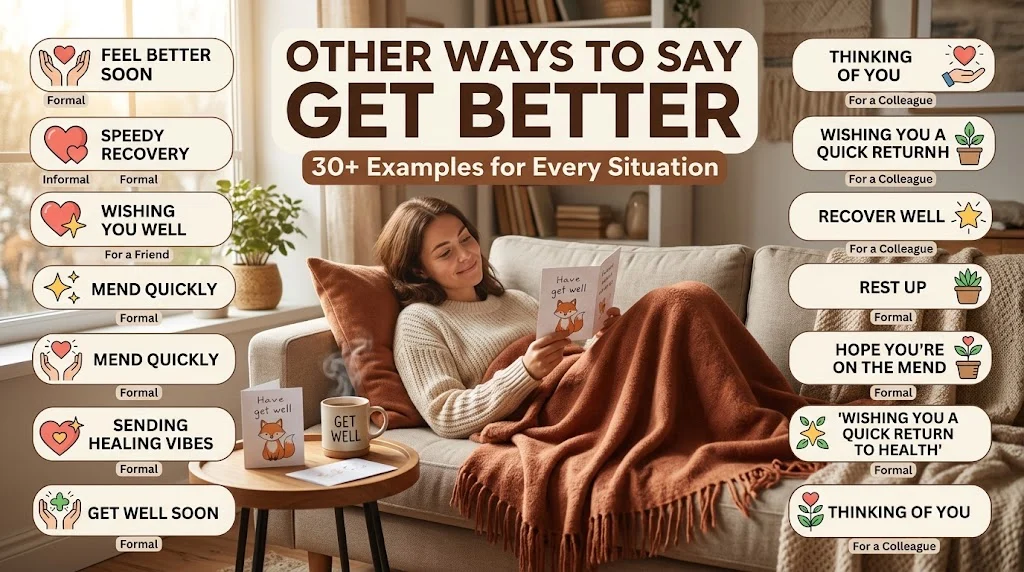
Quick Answer
“Get better” is a common phrase used to describe recovery, improvement, or progress. For more variety and precision, try alternatives like “recover,” “improve,” “heal,” “make progress,” “bounce back,” or “turn the corner.”
“Get better” is one of the most flexible phrases in everyday English. It can describe recovering from illness, improving at a skill, finding a better job, or feeling happier after a difficult time. It appears in conversations, messages, emails, and casual advice. Because it covers so many meanings, learners often use it for every situation, which makes their English sound repetitive and vague.
Learning the alternatives to get better gives you the ability to be specific. You can distinguish between physical recovery, professional growth, emotional healing, and skill improvement. You can also express excitement in English when someone makes real progress.
This guide presents 30 practical alternatives with meanings, examples, and clear notes on tone. Whether you are wishing a friend a speedy recovery, encouraging a colleague, or describing your own progress, these options will help you sound fluent, confident, and natural.
Pull Quote: “One phrase cannot cover recovery, growth, and improvement. Precision is what makes your English sound fluent.”
Quick Categories
Formal alternatives to “Get better”
- Recover
- Convalesce
- Improve
- Ameliorate
Pro Tip: Formal alternatives suit medical contexts, official correspondence, and academic writing.
Casual alternatives
- Feel better
- Bounce back
- Pick up
- Come around
Pro Tip: Casual options work with friends, family, and close colleagues.
Professional alternatives
- Make progress
- Enhance
- Advance
- Develop
Pro Tip: Professional alternatives should match the type of improvement you are describing.
Informal expressions
- Turn the corner
- Get back on your feet
- Be on the mend
- Get your groove back
Pro Tip: Informal expressions belong in spoken English and friendly messages.
Pull Quote: “The right tone makes your English sound professional and confident.”
Common Mistakes
- Using “get better” for a serious illness.
Example: “Get better soon” to someone with a life threatening condition. It can sound trivial. - Using it for skills without context.
Example: “I want to get better” without saying better at what. The statement is too vague. - Confusing recovery with improvement.
Example: “She got better at her job after the flu.” These are two different meanings. - Using it in formal writing.
Example: “The patient will get better in two weeks” in a medical report. Formal alternatives are preferred. - Using it as a command in the wrong context.
Example: “Get better!” when someone is grieving. This can feel dismissive.
What Does “Get Better” Mean?
Definition
It is a phrasal verb meaning to improve, recover, or become healthier, more skilled, or more successful over time.
Grammar Explanation
“Get” is a verb meaning to become, and “better” is a comparative adjective. Together they form a phrasal verb that describes a change of state. The phrase is intransitive and can apply to health, skills, situations, or emotions.
Example Sentence
“I hope you get better soon after your surgery.”
When to Use “Get Better”
Common Contexts
- Health: Wishing someone a speedy recovery.
- Skills: Describing improvement in a sport, language, or hobby.
- Work: Discussing professional growth.
- Emotions: Describing feeling happier after a difficult period.
- Situations: Referring to improving circumstances.
Spoken vs Written
- Spoken: Extremely common in daily conversation.
- Written: Common in informal messages but less so in formal writing.
Formal vs Informal
- Formal: Rarely used. Formal alternatives are preferred in official contexts.
- Informal: The default choice in everyday speech.
Is It Professional or Polite to Say “Get Better”?
Politeness vs Professionalism
The phrase is polite in casual settings, but it is not professional in formal writing. In medical, academic, or official contexts, precise alternatives such as “recover” or “improve” are expected.
Business-Style Example
“We hope you make a full recovery and look forward to your return.”
Polite? Yes
Professional? Not usually in formal writing
Pull Quote: “Casual words suit casual moments. Formal moments demand formal words.”
Pros and Cons of Using “Get Better”
Pros
- Simple and natural: Easy to say and understand.
- Friendly tone: Warm and approachable.
- Common usage: Recognised in every English speaking country.
- Easy to understand: Requires no advanced vocabulary.
Cons
- Too informal for work: Rarely appropriate in professional writing.
- Overused: Loses impact through repetition.
- Limited emotional range: Cannot express the type or depth of improvement.
- Not suitable for formal writing: Avoid in medical, academic, and official documents.
Other Ways to Say “Get Better” (With Examples)
These alternatives will help you sound more fluent, confident, and natural in different situations. Use them according to tone, context, and audience to express excitement, admiration, or approval.
1. Recover
Meaning: To return to a normal state of health or strength.
Explanation: The standard formal alternative for health contexts.
Example Sentence: “We hope you recover quickly after the procedure.”
Best Use: Medical, formal
Worst Use: Skill improvement
Tone: Formal, medical, neutral
Context Variability: Professional and written
2. Improve
Meaning: To make or become better in quality or condition.
Explanation: Broad and neutral.
**Example Sentence: “Your pronunciation will improve with daily practice.”
Best Use: Skills, performance
Worst Use: Illness
Tone: Neutral, professional, standard
Context Variability: Professional and written
3. Heal
Meaning: To become healthy again after injury or illness.
Explanation: Often physical or emotional.
**Example Sentence: “The wound will heal within a few weeks.”
Best Use: Medical, emotional
Worst Use: Skill improvement
Tone: Gentle, medical, restorative
Context Variability: Professional and personal
4. Make progress
Meaning: To move forward toward a goal.
Explanation: Focuses on steady advancement.
**Example Sentence: “She is making real progress in her recovery.”
Best Use: Health, learning
Worst Use: Sudden changes
Tone: Positive, steady, professional
Context Variability: Professional and written
5. Bounce back
Meaning: To recover quickly after a setback.
Explanation: Informal and energetic.
**Example Sentence: “He bounced back quickly after the surgery.”
Best Use: Recovery, sports
Worst Use: Formal writing
Tone: Energetic, informal, positive
Context Variability: Casual and spoken
6. Turn the corner
Meaning: To pass the worst part of an illness or difficulty.
Explanation: Idiomatic and hopeful.
**Example Sentence: “The doctor says she has finally turned the corner.”
Best Use: Health, crisis
Worst Use: Skill improvement
Tone: Hopeful, idiomatic, warm
Context Variability: Casual and spoken
7. Be on the mend
Meaning: To be recovering from illness.
Explanation: Common in British English.
**Example Sentence: “He is on the mend after a rough week.”
Best Use: Health
Worst Use: Skill improvement
Tone: Warm, informal, hopeful
Context Variability: Casual and spoken
8. Get back on your feet
Meaning: To recover after illness or difficulty.
Explanation: Practical and encouraging.
**Example Sentence: “It will take time, but you will get back on your feet.”
Best Use: Recovery, hardship
Worst Use: Skill improvement
Tone: Supportive, practical, warm
Context Variability: Casual and spoken
9. Convalesce
Meaning: To recover gradually after illness or surgery.
Explanation: Formal and medical.
**Example Sentence: “She is convalescing at home after the operation.”
Best Use: Medical, formal
Worst Use: Casual chats
Tone: Formal, medical, precise
Context Variability: Professional and written
10. Enhance
Meaning: To improve the quality or value of something.
Explanation: Professional and specific.
**Example Sentence: “The training will enhance your communication skills.”
Best Use: Business, skills
Worst Use: Illness
Tone: Professional, formal, positive
Context Variability: Professional and written
11. Advance
Meaning: To move forward in skill or position.
Explanation: Professional and career oriented.
**Example Sentence: “He advanced quickly in his career.”
Best Use: Career, skills
Worst Use: Health recovery
Tone: Professional, ambitious, formal
Context Variability: Professional and written
12. Develop
Meaning: To grow or improve over time.
Explanation: Broad and developmental.
**Example Sentence: “Her leadership skills developed steadily over the year.”
Best Use: Skills, growth
Worst Use: Illness
Tone: Professional, developmental, neutral
Context Variability: Professional and written
13. Pick up
Meaning: To improve or increase.
Explanation: Informal and conversational.
**Example Sentence: “Sales are starting to pick up again.”
Best Use: Business, trends
Worst Use: Formal reports
Tone: Informal, practical, positive
Context Variability: Casual and spoken
14. Come around
Meaning: To recover or improve after a setback.
Explanation: Informal and hopeful.
**Example Sentence: “He was very ill, but he is slowly coming around.”
Best Use: Health
Worst Use: Formal writing
Tone: Informal, hopeful, warm
Context Variability: Casual and spoken
15. Feel better
Meaning: To experience improved health or mood.
Explanation: Common and gentle.
**Example Sentence: “I hope you feel better soon.”
Best Use: Health, emotions
Worst Use: Formal reports
Tone: Warm, gentle, caring
Context Variability: Casual and spoken
16. Get your strength back
Meaning: To regain physical energy.
Explanation: Specific to physical recovery.
**Example Sentence: “It took weeks to get her strength back after the flu.”
Best Use: Health
Worst Use: Skill improvement
Tone: Practical, warm, physical
Context Variability: Casual and spoken
17. Pull through
Meaning: To survive or recover from a serious situation.
Explanation: Often used for critical illness.
**Example Sentence: “Everyone was relieved when he pulled through.”
Best Use: Critical illness
Worst Use: Minor tasks
Tone: Serious, hopeful, emotional
Context Variability: Professional and spoken
18. Make a full recovery
Meaning: To return completely to health.
Explanation: Formal and medical.
**Example Sentence: “We wish you a full recovery and a swift return.”
Best Use: Medical, formal
Worst Use: Casual chats
Tone: Formal, medical, respectful
Context Variability: Professional and written
19. Regain your health
Meaning: To return to good health.
Explanation: Formal and respectful.
**Example Sentence: “She slowly regained her health after months of treatment.”
Best Use: Medical, formal
Worst Use: Casual texts
Tone: Formal, medical, positive
Context Variability: Professional and written
20. Sharpen your skills
Meaning: To improve existing abilities.
Explanation: Professional and specific.
**Example Sentence: “Take this course to sharpen your writing skills.”
Best Use: Training, skills
Worst Use: Health recovery
Tone: Professional, focused, practical
Context Variability: Professional and written
21. Level up
Meaning: To improve significantly.
Explanation: Modern and gaming inspired.
**Example Sentence: “She levelled up her design skills in just three months.”
Best Use: Skills, gaming
Worst Use: Formal writing
Tone: Modern, energetic, informal
Context Variability: Casual and spoken
22. Step up your game
Meaning: To improve your performance.
Explanation: Informal and motivational.
**Example Sentence: “If you want the promotion, you need to step up your game.”
Best Use: Sports, career
Worst Use: Formal reports
Tone: Motivational, informal, direct
Context Variability: Casual and spoken
23. Turn things around
Meaning: To reverse a negative situation.
Explanation: Broad and strategic.
**Example Sentence: “The new manager turned things around within six months.”
Best Use: Business, recovery
Worst Use: Minor tasks
Tone: Strategic, positive, professional
Context Variability: Professional and spoken
24. Get back in shape
Meaning: To return to good physical condition.
Explanation: Fitness related.
**Example Sentence: “He is working out daily to get back in shape.”
Best Use: Fitness
Worst Use: Formal writing
Tone: Practical, physical, informal
Context Variability: Casual and spoken
25. Be on the up
Meaning: To be improving or rising.
Explanation: British and informal.
**Example Sentence: “Her career has been on the up since the promotion.”
Best Use: Career, trends
Worst Use: Health recovery
Tone: Informal, positive, British
Context Variability: Casual and spoken
26. Come along
Meaning: To improve gradually.
Explanation: Often used for progress.
**Example Sentence: “His recovery is coming along nicely.”
Best Use: Health, projects
Worst Use: Formal reports
Tone: Warm, gradual, informal
Context Variability: Casual and spoken
27. Get well
Meaning: To recover from illness.
Explanation: Common in get well soon messages.
**Example Sentence: “Get well soon, we miss you at the office.”
Best Use: Health, cards
Worst Use: Skill improvement
Tone: Warm, caring, standard
Context Variability: Casual and written
28. Strengthen
Meaning: To make or become stronger.
Explanation: Formal and physical or strategic.
**Example Sentence: “The exercises will strengthen your core muscles.”
Best Use: Fitness, strategy
Worst Use: Casual chats
Tone: Formal, physical, professional
Context Variability: Professional and written
29. Refine
Meaning: To improve through small changes.
Explanation: Professional and precise.
**Example Sentence: “She refined her presentation skills over several months.”
Best Use: Skills, craft
Worst Use: Health recovery
Tone: Professional, precise, polished
Context Variability: Professional and written
30. Rebound
Meaning: To recover after a setback.
Explanation: Often economic or physical.
**Example Sentence: “The market rebounded strongly after the downturn.”
Best Use: Business, sports
Worst Use: Emotional recovery
Tone: Formal, strategic, energetic
Context Variability: Professional and written
Pull Quote: “Professional reaction phrases and precise recovery words both show the same thing: you understand the situation, not just the sentiment.”
Mini Quiz / Self-Check
- Scenario: You are writing a get well card to a colleague. Which fits best?
- A) Level up.
- B) Wishing you a full recovery.
- C) Turn things around.
- Scenario: You are encouraging a friend learning a new language. Which is most natural?
- A) Your skills will improve with daily practice.
- B) You will convalesce soon.
- C) You will pull through.
- Scenario: You are writing a medical note about a patient. Which is most appropriate?
- A) The patient is on the mend.
- B) The patient is convalescing at home.
- C) The patient bounced back.
- Scenario: Which phrase is generally too informal for a medical report?
- A) Recover.
- B) Bounce back.
- C) Make a full recovery.
Comparison Table: Top Alternatives
| Phrase | Tone | Best Use |
| Recover | Formal, medical | Health, formal |
| Improve | Neutral, professional | Skills, performance |
| Heal | Gentle, restorative | Medical, emotional |
| Make progress | Positive, steady | Health, learning |
| Bounce back | Energetic, informal | Recovery, sports |
| Turn the corner | Hopeful, idiomatic | Health, crisis |
| Be on the mend | Warm, informal | Health |
| Make a full recovery | Formal, medical | Medical, formal |
| Sharpen your skills | Professional, focused | Training, skills |
| Turn things around | Strategic, positive | Business, recovery |
FAQs
1. What is a formal alternative to “get better”?
“Recover,” “convalesce,” and “make a full recovery” are strong formal alternatives suitable for medical and official contexts.
2. How do I say “get better” professionally at work?
Use phrases such as “improve,” “enhance,” or “make progress” to describe professional growth and skill development.
3. What can I say instead of “get better soon” for an illness?
“Wishing you a speedy recovery,” “Hope you are on the mend,” or “Get well soon” are warm and appropriate alternatives.
4. What is the difference between “recover” and “improve”?
“Recover” refers to returning to a normal state after illness or difficulty, while “improve” refers to becoming better in quality or performance.
5. What can I say instead of “get better” in casual conversation?
“Bounce back,” “turn the corner,” “pick up,” and “be on the mend” are natural and informal alternatives for everyday speech.
See also: Other Ways to Say Information
See also: Professional English Guide
CTA: Which alternative will you use in your next message of encouragement? Share your favourite in the comments below.
Conclusion
Learning other ways to say get better gives you the precision to describe recovery, improvement, and progress with clarity and warmth. Whether you are wishing someone good health, encouraging a colleague, or describing your own growth, the right word makes your English sound fluent and intentional. These alternatives to get better help you move beyond one overused phrase and into richer, more specific expression.
Practise by choosing one new alternative each day and using it in a real message or conversation. Pay close attention to tone and context, because the right word depends on the situation and the audience. With steady practice, these informal expressions in English and their formal counterparts will become part of your everyday fluency.

Stephen King is an American writer and language enthusiast who enjoys creating clear, practical content that helps readers communicate with confidence. His work at QuickResponsess.com focuses on making English easier to understand through simple explanations and everyday examples.