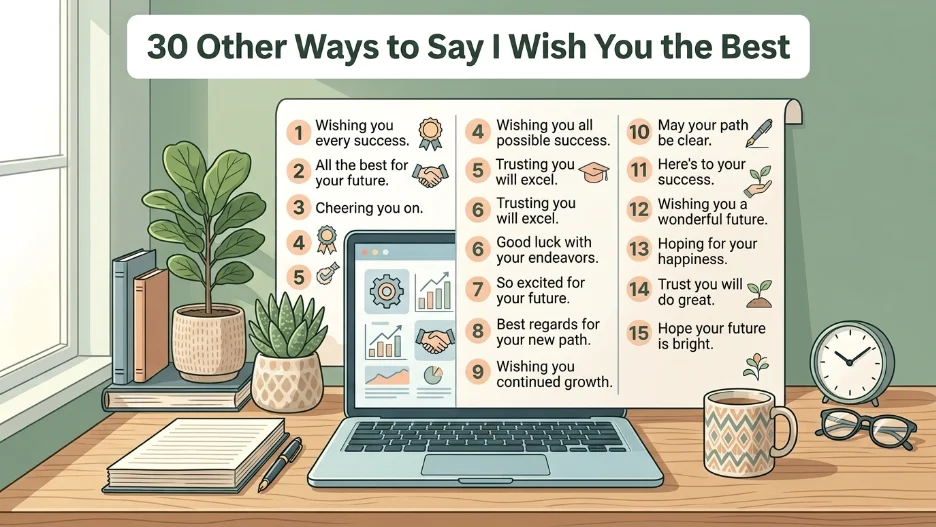
Quick Answer :Other ways to say “I wish you the best” include: “Wishing you all the best,” “I wish you every success,” “Best of luck in your future endeavors,” “May all your dreams come true,” and “I hope everything works out for you.”
“I wish you the best” is a warm, versatile phrase used to express goodwill toward someone embarking on a new chapter—whether it’s a new job, a move, a graduation, or any life transition. While it’s perfectly acceptable, relying on it too often can feel generic or uninspired.
Learning alternatives to “I wish you the best” allows you to tailor your message to the specific situation and relationship. Whether you’re writing a formal farewell email, sending a casual text to a friend, or giving a professional recommendation, having a range of expressions helps you express goodwill in English with greater precision and personality.
Quick Categories
Formal Alternatives
- I wish you every success in your future endeavors
- May you achieve great things
- Wishing you continued success
- All the best in your future pursuits
- I trust you will excel in all you do
Casual Alternatives
- Wishing you all the best
- Hope everything goes well
- Best of luck
- Fingers crossed for you
- Wishing you nothing but the best
Professional Alternatives
- I wish you success in your new role
- Best wishes for your future career
- Wishing you continued professional growth
- May your new position bring you fulfillment
- I look forward to seeing your future achievements
Informal Expressions
- Knock ’em dead
- Break a leg
- You’ve got this
- Go get ’em
- Sending good vibes your way
Pro Tip: Match your tone to the occasion. A job change calls for professional warmth, while a friend’s new adventure allows for casual encouragement.
Common Mistakes
1. Being Too Vague
Mistake: “Good luck with everything.”
Better Approach: Be specific about what you’re wishing them well for.
Example: “I wish you the best in your new teaching position” is more meaningful than a generic send off.
2. Using Overly Casual Language in Professional Settings
Mistake: “Knock ’em dead!” in a farewell email to a colleague.
Better Approach: Use professional phrases like “I wish you continued success.”
Example: “I wish you the best in your new role” is safer for workplace communications.
3. Sounding Dismissive
Mistake: “Well, good luck with that.” (can sound sarcastic)
Better Approach: Ensure your tone conveys genuine warmth.
Example: “I truly wish you the best” sounds sincere and supportive.
4. Forgetting to Personalize
Mistake: Using the same generic phrase for everyone.
Better Approach: Add a personal touch or specific reference.
Example: “I wish you the best in your new city—you’re going to love it there.”
5. Overusing the Phrase
Mistake: Saying “I wish you the best” in every farewell.
Better Approach: Vary your language based on context and relationship.
Example: Use “Wishing you all the best” for one person and “Best of luck with your new venture” for another.
What Does “I Wish You the Best” Mean?
Definition: “I wish you the best” is an expression of goodwill used to convey hopes for someone’s success, happiness, or positive outcomes in their future endeavors.
Grammar Note: The phrase is typically followed by a specific reference to what you’re wishing them well for, though it can stand alone. Example: “I wish you the best in your new job.”
Example: “I wish you the best as you start your own business.”
When to Use “I Wish You the Best”
- Farewells When someone is leaving a job, school, or community
- New beginnings Starting a new job, moving to a new city, or beginning a new project
- Life transitions Graduation, retirement, marriage, or having a baby
- End of interactions Closing emails, meetings, or conversations on a positive note
- Professional recommendations Ending a reference letter or recommendation
Spoken vs Written: The phrase works well in both contexts, though written messages allow for more elaboration.
Formal vs Informal: It’s versatile, making it suitable for almost any situation.
Is It Professional or Polite to Say “I Wish You the Best”?
Polite? ✔️ Yes The phrase is universally considered courteous and warm.
Professional? ❌ No While polite, it can feel too casual for formal business communications. It lacks the specific, professional language often expected in corporate settings.
Business Style Example: “I wish you continued success in your future endeavors and trust you will excel in your new role.”
“In professional contexts, specificity adds weight to your well wishes.”
Pros and Cons of Using “I Wish You the Best”
✅ Pros
- Simple and universally understood
- Friendly and approachable tone
- Commonly used in everyday language
- Easy to adapt to different situations
❌ Cons
- Too informal for formal professional correspondence
- Overused to the point of feeling generic
- Limited emotional depth doesn’t convey strong enthusiasm
- Not suitable for highly formal or ceremonial contexts
Other Ways to Say “I Wish You the Best” (With Examples)
These alternatives will help you sound more fluent, confident, and natural in different situations. Use them according to tone, context, and audience to express goodwill, support, and genuine encouragement.
Formal Alternatives (Expressions for Formal Situations)
1. Phrase: I wish you every success in your future endeavors
Meaning: A formal expression of hope for continued achievement.
Explanation: This is one of the most professional ways to offer well wishes.
Example: “I wish you every success in your future endeavors as you transition to your new role.”
Best Use: Formal letters
Worst Use: Casual conversations
Tone: Formal, respectful
Context Variability: professional / written / formal
2. Phrase: May you achieve great things
Meaning: A hopeful wish for significant accomplishments.
Explanation: This phrase conveys ambition and confidence in the person’s abilities.
Example: “May you achieve great things in your new position.”
Best Use: Commencement speeches
Worst Use: Quick texts
Tone: Formal, aspirational
Context Variability: professional / spoken / formal
3. Phrase: Wishing you continued success
Meaning: A hope that their current success continues.
Explanation: This acknowledges past achievements while hoping for future ones.
Example: “Wishing you continued success in all your future projects.”
Best Use: Professional emails
Worst Use: Casual chats
Tone: Professional, encouraging
Context Variability: professional / written / formal
4. Phrase: All the best in your future pursuits
Meaning: A formal wish for success in everything they do.
Explanation: This is a classic, widely accepted formal farewell.
Example: “All the best in your future pursuits, and please stay in touch.”
Best Use: Farewell messages
Worst Use: Personal conversations
Tone: Formal, warm
Context Variability: professional / written / formal
5. Phrase: I trust you will excel in all you do
Meaning: You have confidence in their future success.
Explanation: This expresses faith in their abilities while offering encouragement.
Example: “I trust you will excel in all you do and look forward to hearing about your achievements.”
Best Use: Mentorship messages
Worst Use: Casual settings
Tone: Confident, respectful
Context Variability: professional / written / formal
Pro Tip: In formal settings, always pair your well wishes with a specific acknowledgment of the person’s achievements or the opportunity ahead of them.
Professional Alternatives (Expressions for Workplaces)
6. Phrase: I wish you success in your new role
Meaning: A direct, professional hope for success.
Explanation: This is specifically tailored for job or role changes.
Example: “I wish you success in your new role as Marketing Director.”
Best Use: Workplace transitions
Worst Use: Personal milestones
Tone: Professional, encouraging
Context Variability: professional / written / formal
7. Phrase: Best wishes for your future career
Meaning: A professional expression of goodwill.
Explanation: This is appropriate for colleagues moving to new opportunities.
Example: “Best wishes for your future career—you will be greatly missed.”
Best Use: Colleague farewells
Worst Use: Friend conversations
Tone: Professional, warm
Context Variability: professional / written / formal
8. Phrase: Wishing you continued professional growth
Meaning: A hope for ongoing development and success.
Explanation: This emphasizes long term career development.
Example: “Wishing you continued professional growth in your new position.”
Best Use: Performance reviews
Worst Use: Personal notes
Tone: Professional, developmental
Context Variability: professional / written / formal
9. Phrase: May your new position bring you fulfillment
Meaning: A hope for personal and professional satisfaction.
Explanation: This focuses on the emotional rewards of the new role.
Example: “May your new position bring you fulfillment and professional satisfaction.”
Best Use: Career transitions
Worst Use: Short messages
Tone: Professional, caring
Context Variability: professional / written / formal
10. Phrase: I look forward to seeing your future achievements
Meaning: You anticipate their continued success.
Explanation: This expresses ongoing interest in their career journey.
Example: “I look forward to seeing your future achievements and staying connected.”
Best Use: Networking messages
Worst Use: Immediate farewells
Tone: Professional, engaged
Context Variability: professional / written / formal
Pro Tip: In professional contexts, always express genuine appreciation for their contributions before offering your well wishes.
Warm and Personal Alternatives (Expressions for Close Relationships)
11. Phrase: Wishing you all the best
Meaning: A warm expression of general goodwill.
Explanation: This is friendly, sincere, and widely appropriate.
Example: “Wishing you all the best as you start this exciting new chapter.”
Best Use: Personal relationships
Worst Use: Formal letters
Tone: Warm, supportive
Context Variability: spoken / written / casual
12. Phrase: I hope everything works out for you
Meaning: A sincere hope for positive outcomes.
Explanation: This shows genuine investment in their success.
Example: “I hope everything works out for you in your new city.”
Best Use: Friendly conversations
Worst Use: Formal settings
Tone: Warm, caring
Context Variability: spoken / written / casual
13. Phrase: Best of luck with everything
Meaning: A casual, supportive expression.
Explanation: This is friendly and supportive without being too formal.
Example: “Best of luck with everything in the coming year.”
Best Use: Casual farewells
Worst Use: Professional letters
Tone: Friendly, encouraging
Context Variability: spoken / casual
14. Phrase: I’m rooting for you
Meaning: You’re offering enthusiastic support.
Explanation: This shows active encouragement and emotional investment.
Example: “I’m rooting for you as you pursue your dream of opening a café.”
Best Use: Close relationships
Worst Use: Formal situations
Tone: Encouraging, warm
Context Variability: spoken / casual
15. Phrase: I’ll be cheering you on
Meaning: You’re offering enthusiastic support from afar.
Explanation: This expresses ongoing emotional support.
Example: “I’ll be cheering you on from here. You’ve got this!”
Best Use: Friendly support
Worst Use: Professional emails
Tone: Enthusiastic, warm
Context Variability: spoken / casual
Encouraging and Supportive Alternatives (Expressions for Offering Hope)
16. Phrase: You’ve got this
Meaning: You have confidence in their ability.
Explanation: This is a modern, friendly way to express encouragement.
Example: “You’ve got this—your hard work is about to pay off.”
Best Use: Friendly encouragement
Worst Use: Formal contexts
Tone: Confident, modern
Context Variability: spoken / casual
17. Phrase: The best is yet to come
Meaning: A hopeful expression for their future.
Explanation: This is optimistic and encourages a positive outlook.
Example: “The best is yet to come for you, I’m sure of it.”
Best Use: Graduation messages
Worst Use: Professional emails
Tone: Optimistic, warm
Context Variability: spoken / written / casual
18. Phrase: Go get ’em
Meaning: Enthusiastic encouragement to succeed.
Explanation: This is an energetic, casual expression of support.
Example: “Go get ’em at your new job—you’re going to be amazing.”
Best Use: Close friends
Worst Use: Professional contexts
Tone: Energetic, modern
Context Variability: spoken / casual
19. Phrase: Sending you good vibes
Meaning: You’re offering positive energy and support.
Explanation: This is a modern, informal expression of goodwill.
Example: “Sending you good vibes as you prepare for your big interview.”
Best Use: Casual messages
Worst Use: Formal situations
Tone: Modern, warm
Context Variability: spoken / casual
20. Phrase: Wishing you nothing but the best
Meaning: A wish for purely positive outcomes.
Explanation: This emphasizes your genuine desire for their happiness.
Example: “Wishing you nothing but the best in your next adventure.”
Best Use: Personal relationships
Worst Use: Formal business
Tone: Warm, sincere
Context Variability: spoken / written / casual
Short and Simple Alternatives (Expressions for Quick Messages)
21. Phrase: All the best
Meaning: A brief, positive send off.
Explanation: This is quick, friendly, and appropriate for many situations.
Example: “All the best in your new job!”
Best Use: Quick emails
Worst Use: Formal letters
Tone: Friendly, simple
Context Variability: spoken / written / casual
22. Phrase: Best of luck
Meaning: A simple expression of hope.
Explanation: This is friendly and supportive without being overly formal.
Example: “Best of luck with your upcoming presentation.”
Best Use: Casual farewells
Worst Use: Formal contexts
Tone: Friendly, encouraging
Context Variability: spoken / written / casual
23. Phrase: Good luck
Meaning: A direct expression of hope for success.
Explanation: This is the most straightforward and commonly used expression.
Example: “Good luck with your interview tomorrow.”
Best Use: All contexts
Worst Use: None
Tone: Simple, warm
Context Variability: spoken / written / casual
24. Phrase: Fingers crossed for you
Meaning: You’re hopeful for their success.
Explanation: This is a casual, modern way to express hope.
Example: “Fingers crossed for you on your first day!”
Best Use: Casual messages
Worst Use: Professional letters
Tone: Modern, casual
Context Variability: spoken / casual
25. Phrase: Hope it goes well
Meaning: A simple wish for a positive outcome.
Explanation: This is friendly and appropriate for everyday situations.
Example: “Hope it goes well with your new business venture.”
Best Use: Everyday conversations
Worst Use: Formal settings
Tone: Friendly, supportive
Context Variability: spoken / written / casual
Idiomatic and Creative Alternatives (Expressions for Variety)
26. Phrase: Break a leg
Meaning: A theatrical expression meaning “good luck.”
Explanation: This is a traditional expression used in performing arts contexts.
Example: “Break a leg at your performance tonight!”
Best Use: Performances
Worst Use: Business settings
Tone: Traditional, playful
Context Variability: spoken / casual
27. Phrase: Knock ’em dead
Meaning: An expression meaning “impress everyone.”
Explanation: This is an energetic way to encourage success in a performance or presentation.
Example: “Knock ’em dead at your presentation tomorrow!”
Best Use: Presentations
Worst Use: Formal settings
Tone: Energetic, casual
Context Variability: spoken / casual
28. Phrase: May the force be with you
Meaning: A playful way to wish someone luck.
Explanation: This is a pop culture reference that adds humor to your message.
Example: “May the force be with you on your first day!”
Best Use: Close friends
Worst Use: Professional contexts
Tone: Playful, creative
Context Variability: spoken / casual
29. Phrase: Here’s to your success
Meaning: A toast like expression of hope.
Explanation: This is celebratory and emphasizes the achievement aspect.
Example: “Here’s to your success in this new chapter of your life.”
Best Use: Celebrations
Worst Use: Brief messages
Tone: Celebratory, warm
Context Variability: spoken / written / casual
30. Phrase: I hope all your dreams come true
Meaning: A heartfelt wish for complete fulfillment.
Explanation: This is deeply personal and emotionally resonant.
Example: “I hope all your dreams come true as you begin this exciting journey.”
Best Use: Close relationships
Worst Use: Professional settings
Tone: Heartfelt, emotional
Context Variability: spoken / written / casual
“Variety in expression shows thoughtfulness and emotional intelligence.”
Mini Quiz: Test Your Understanding
1. Which phrase is most appropriate for a formal farewell email?
- A) “Knock ’em dead”
- B) “Fingers crossed for you”
- C) “I wish you every success in your future endeavors”
- D) “You’ve got this”
2. What should you avoid when expressing well wishes?
- A) Being specific about what you’re wishing them well for
- B) Using the same generic phrase for everyone
- C) Personalizing the message
- D) Matching the tone to the situation
3. “Break a leg” is best used when:
- A) A colleague is starting a new job
- B) A friend is performing in a play
- C) A boss is retiring
- D) A student is graduating
4. Which of the following is too casual for a professional recommendation letter?
- A) “I wish you continued success”
- B) “Best of luck with everything”
- C) “Wishing you professional growth”
- D) “I trust you will excel”
5. What’s the most common mistake when using “I wish you the best”?
- A) Being too specific
- B) Using it in professional settings
- C) Overusing it without varying the language
- D) Being too warm and friendly
👉 Check Your Answers:
- C “I wish you every success in your future endeavors” is the most formal option.
- B Using the same generic phrase for everyone lacks thoughtfulness.
- B “Break a leg” is traditionally used for theatrical performances.
- B “Best of luck with everything” is too casual for a formal recommendation letter.
- C Overusing “I wish you the best” without varying your language can sound generic and insincere.
Comparison Table: Top 10 Alternatives
| Phrase | Tone | Best Use |
| I wish you every success | Very Formal | Written formal communications |
| May you achieve great things | Formal, Aspirational | Speeches and ceremonies |
| Wishing you continued success | Professional | Workplace farewells |
| Wishing you all the best | Warm, Friendly | Personal relationships |
| I’m rooting for you | Encouraging, Warm | Close relationships |
| You’ve got this | Confident, Modern | Friendly encouragement |
| All the best | Simple, Friendly | Quick messages |
| Best of luck | Friendly, Casual | Everyday situations |
| Break a leg | Traditional, Playful | Performance contexts |
| Here’s to your success | Celebratory, Warm | Celebrations and milestones |
FAQs
1. What is the best alternative to “I wish you the best”?
The best alternative depends on the context. “I wish you every success in your future endeavors” works well for formal situations, while “Wishing you all the best” is perfect for casual settings.
2. Is “I wish you the best” professional?
No, it’s considered too casual for formal professional communications. Use “I wish you continued success” or “I wish you success in your new role” instead.
3. How do professionals express well wishes?
Professionals should use phrases like “Best wishes for your future career,” “Wishing you continued professional growth,” or “I look forward to seeing your future achievements.”
4. What should I say instead of “good luck”?
Use “Best of luck,” “Wishing you all the best,” or “I hope everything works out for you” for a more thoughtful alternative.
5. How do you end a farewell message?
End with a warm closing like “All the best,” “Wishing you success,” or “Stay in touch,” followed by your name.
Conclusion
Learning alternatives to “I wish you the best” enriches your vocabulary and helps you express goodwill with greater nuance and sincerity. Whether you need a formal send off for a departing colleague, a warm message for a friend’s new adventure, or a quick note of encouragement for someone facing a challenge, having a variety of expressions ensures you can match your tone to the moment.
Practice using different expressions based on your relationship with the recipient and the specific context. Pay attention to tone, and always aim for sincerity over perfection. Your genuine support matters more than any particular phrase.

Sally Rooney is an American writer who contributes to QuickResponsess.com, creating clear and practical content for English learners. Her articles help readers build confidence in using words and expressions accurately in everyday and professional communication.