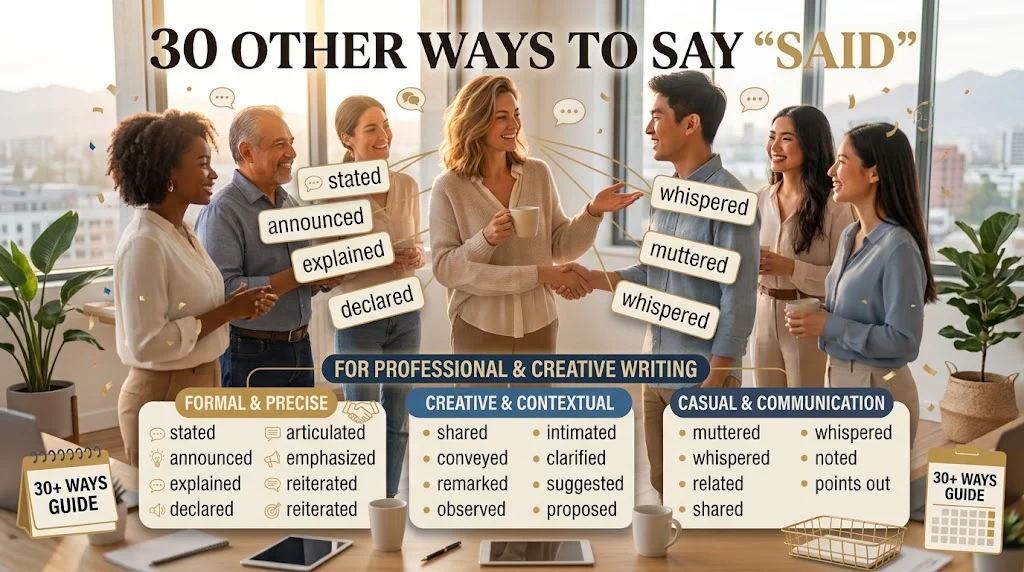
Quick Answer 🔥
The best alternatives to “said” include stated, mentioned, announced, explained, replied, whispered, exclaimed, declared, suggested, and remarked. Choose based on tone formal for professional writing, expressive for storytelling, and neutral for everyday conversation.
The word “said” is one of the most common verbs in English. It’s simple, clear, and gets the job done. But when you rely on it too often, your writing can feel flat, repetitive, and unpolished. Whether you’re writing an email, a business report, a school essay, or a story, knowing other ways to say said transforms how you communicate.
For English learners and professionals alike, expanding your vocabulary isn’t just about sounding smarter it’s about expressing excitement in English with precision, showing emotion, and matching the right tone to the right situation. Imagine delivering a presentation where every quote sounds the same, or writing a story where every character “said” the same way. Your audience will lose interest fast.
Quick Categories
Formal Alternatives to “Said”
- Stated official, definitive
- Announced public, declarative
- Declared firm, assertive
- Asserted confident, emphatic
- Proclaimed grand, authoritative
Casual Alternatives to “Said”
- Mentioned brief, offhand
- Added extra information
- Noted observed, pointed out
- Commented opinion, observation
- Remarked casual observation
Professional Alternatives to “Said”
- Reported factual, formal
- Confirmed verified, assured
- Responded formal reply
- Clarified made clear
- Advised gave guidance
Informal Expressions
- Blurted sudden, impulsive
- Chatted friendly, casual
- Gushed enthusiastic, emotional
- Mumbled unclear, quiet
- Babbled excessive, confused
💡 Pro Tip: Match your alternative to your audience. Use stated or reported for professional documents, mentioned or commented for casual emails, and whispered or exclaimed for creative writing.
What Does “Said” Mean?
“Said” is the past tense of “say.” It means to speak words aloud or express something in words. It is neutral—it reports speech without adding emotion, tone, or attitude. In grammar, it functions as a transitive verb (it takes an object) and is used in both direct and indirect speech.
Example Sentence: She said she would join us later.
When to Use “Said”
Use “said” when you need a neutral, invisible dialogue tag that doesn’t draw attention to itself.
Common Contexts:
- Everyday conversation simple storytelling
- Business writing meeting minutes, reports, neutral documentation
- Academic writing reporting sources without bias
- News articles factual reporting
- Emails neutral, professional statements
Spoken vs Written: “Said” works well in both. In speech, it’s natural and unobtrusive. In writing, it’s best used sparingly overusing it makes dialogue feel mechanical.
Formal vs Informal: “Said” fits both, but alternatives often sound more polished and professional.
Is It Professional or Polite to Say “Said”?
Polite? ✔️ Yes it’s neutral and inoffensive.
Professional? ❌ No (in most cases) it lacks the precision and authority that professional communication often requires.
Business Example:
❌ The manager said the project was behind schedule.
✔️ The manager reported that the project was behind schedule.
Pros and Cons of Using “Said”
Pros
- Simple and clear everyone understands it
- Friendly tone doesn’t sound stiff or overly formal
- Common usage native speakers use it daily
- Easy to understand ideal for beginners
Cons
- Too informal for work lacks professional weight
- Overused becomes repetitive and boring
- Limited emotional range doesn’t convey how something was said
- Not suitable for formal writing essays, reports, and proposals need stronger verbs
Other Ways to Say “Said” (30 Alternatives with Examples)
These alternatives will help you sound more fluent, confident, and natural in different situations. Use them according to tone, context, and audience to express excitement, admiration, or approval.
1. Phrase: Stated
Meaning: Expressed something clearly and formally.
Explanation: Often used in professional reports, academic writing, or official statements; carries authority.
Example Sentence: The manager stated that all deadlines must be met by Friday.
Best Use: Formal writing
Worst Use: Casual chat
Tone: Formal, authoritative
Context Variability: Professional: The CEO stated the company’s vision. | Casual: She stated her opinion firmly.
2. Phrase: Mentioned
Meaning: Brought something up briefly without emphasis.
Explanation: Casual or semi-formal; used to reference something in passing.
Example Sentence: She mentioned the meeting during lunch.
Best Use: Emails, conversations
Worst Use: Formal academic writing
Tone: Neutral, casual
Context Variability: Professional: He mentioned the budget concerns. | Casual: I mentioned your idea to Sarah.
3. Phrase: Announced
Meaning: Declared something openly or officially.
Explanation: Used for public statements, news, or important updates.
Example Sentence: The CEO announced the merger during the conference call.
Best Use: Public statements
Worst Use: Private conversation
Tone: Formal, confident
Context Variability: Professional: They announced the new policy. | Spoken: She announced her engagement.
4. Phrase: Explained
Meaning: Made something clear by giving details.
Explanation: Used when someone is teaching, clarifying, or providing instructions.
Example Sentence: The teacher explained the rule again for the new students.
Best Use: Teaching, clarifying
Worst Use: Brief responses
Tone: Neutral, instructive
Context Variability: Professional: He explained the process step by step. | Casual: She explained why she was late.
5. Phrase: Replied
Meaning: Answered a question or statement.
Explanation: Direct and neutral; used when someone is responding.
Example Sentence: “Yes, I can help,” she replied.
Best Use: Conversations, interviews
Worst Use: Monologues
Tone: Neutral
Context Variability: Professional: He replied to the email within an hour. | Casual: “I’m not sure,” she replied.
6. Phrase: Responded
Meaning: Gave an answer or reaction.
Explanation: Slightly more formal than “replied”; often used in professional contexts.
Example Sentence: The manager responded quickly to the client’s concerns.
Best Use: Professional communication
Worst Use: Creative dialogue
Tone: Professional, neutral
Context Variability: Professional: The committee responded to the proposal. | Casual: He responded with a laugh.
7. Phrase: Whispered
Meaning: Spoke very softly or quietly.
Explanation: Used for secrets, intimate moments, or tense situations.
Example Sentence: She whispered the secret in his ear.
Best Use: Creative writing, secrets
Worst Use: Formal reports
Tone: Intimate, secretive
Context Variability: Creative: “Stay quiet,” he whispered. | Spoken: She whispered to her friend.
8. Phrase: Exclaimed
Meaning: Spoke suddenly and with strong emotion.
Explanation: Used for surprise, excitement, or strong reactions.
Example Sentence: “What a beautiful view!” she exclaimed.
Best Use: Expressing excitement
Worst Use: Formal writing
Tone: Emotional, enthusiastic
Context Variability: Creative: He exclaimed in disbelief. | Spoken: “That’s amazing!” she exclaimed.
9. Phrase: Declared
Meaning: Announced something strongly, clearly, and often publicly.
Explanation: Carries weight and finality; used for firm statements.
Example Sentence: He declared his decision without hesitation.
Best Use: Formal statements, decisions
Worst Use: Casual conversation
Tone: Formal, emphatic
Context Variability: Professional: The judge declared the verdict. | Creative: He declared his love.
10. Phrase: Suggested
Meaning: Proposed an idea or possibility.
Explanation: Used when offering a recommendation or hinting at something.
Example Sentence: She suggested a new strategy for the campaign.
Best Use: Brainstorming, recommendations
Worst Use: Reporting facts
Tone: Neutral, diplomatic
Context Variability: Professional: He suggested we reconsider the timeline. | Casual: I suggested going to the park.
11. Phrase: Claimed
Meaning: Said something was true, often without proof.
Explanation: Implies doubt or that the statement may be disputed.
Example Sentence: The company claimed the product was 100% organic.
Best Use: Reporting allegations
Worst Use: Confirmed facts
Tone: Formal, skeptical
Context Variability: Academic: The study claimed a breakthrough. | Casual: He claimed he saw a ghost.
12. Phrase: Admitted
Meaning: Accepted something, often reluctantly.
Explanation: Used when someone confesses or acknowledges a mistake.
Example Sentence: She admitted her mistake during the meeting.
Best Use: Confessions, apologies
Worst Use: Neutral reporting
Tone: Emotional, honest
Context Variability: Professional: He admitted the error in the report. | Casual: I admitted I was wrong.
13. Phrase: Confirmed
Meaning: Verified or approved information as true.
Explanation: Used in professional settings to validate facts.
Example Sentence: The office confirmed the appointment for next week.
Best Use: Professional verification
Worst Use: Creative dialogue
Tone: Professional, reliable
Context Variability: Professional: The bank confirmed the transaction. | Casual: She confirmed she was coming.
14. Phrase: Noted
Meaning: Pointed out something important or observed.
Explanation: Used to highlight key information in a neutral way.
Example Sentence: The report noted several risks in the project plan.
Best Use: Reports, observations
Worst Use: Emotional dialogue
Tone: Neutral, academic
Context Variability: Professional: The analyst noted the trend. | Casual: I noted your comment.
15. Phrase: Commented
Meaning: Gave an opinion or observation.
Explanation: Used when someone is offering a thought rather than stating a fact.
Example Sentence: She commented on the design during the review.
Best Use: Opinions, feedback
Worst Use: Official statements
Tone: Neutral, professional
Context Variability: Professional: He commented on the proposal. | Casual: She commented on the weather.
16. Phrase: Added
Meaning: Gave extra information.
Explanation: Used when someone supplements a previous statement.
Example Sentence: He added that the plan might change depending on the budget.
Best Use: Supplementary information
Worst Use: Main statements
Tone: Neutral
Context Variability: Professional: She added a key point to the discussion. | Casual: I added that I was tired.
17. Phrase: Argued
Meaning: Presented reasons strongly, often in a debate.
Explanation: Used in academic, legal, or persuasive contexts.
Example Sentence: The lawyer argued the case before the judge.
Best Use: Debates, legal writing
Worst Use: Casual conversation
Tone: Strong, persuasive
Context Variability: Academic: The researcher argued for a new approach. | Casual: They argued about the movie.
18. Phrase: Insisted
Meaning: Said something firmly and repeatedly.
Explanation: Shows determination or refusal to change position.
Example Sentence: He insisted he was right, despite the evidence.
Best Use: Strong opinions
Worst Use: Neutral statements
Tone: Strong, determined
Context Variability: Professional: She insisted on following the protocol. | Casual: He insisted we try the restaurant.
19. Phrase: Shouted
Meaning: Spoke very loudly.
Explanation: Used for anger, excitement, or getting attention.
Example Sentence: She shouted across the room to get his attention.
Best Use: Creative writing, emergencies
Worst Use: Formal writing
Tone: Loud, emotional
Context Variability: Creative: He shouted for help. | Spoken: She shouted his name.
20. Phrase: Asked
Meaning: Requested information.
Explanation: Used for questions and inquiries.
Example Sentence: He asked a simple question about the deadline.
Best Use: Questions
Worst Use: Statements
Tone: Neutral, inquisitive
Context Variability: Professional: She asked about the budget. | Casual: He asked where I was going.
21. Phrase: Answered
Meaning: Gave a response.
Explanation: Similar to “replied” but slightly more formal.
Example Sentence: She answered politely despite the difficult question.
Best Use: Responses
Worst Use: Initiating conversation
Tone: Neutral, polite
Context Variability: Professional: He answered all the questions. | Casual: She answered with a smile.
22. Phrase: Reported
Meaning: Gave a formal account or statement.
Explanation: Used in journalism, business, and official contexts.
Example Sentence: The journalist reported the events as they unfolded.
Best Use: News, official updates
Worst Use: Creative dialogue
Tone: Formal, factual
Context Variability: Professional: The committee reported its findings. | Casual: She reported what she saw.
23. Phrase: Clarified
Meaning: Made something clearer or less confusing.
Explanation: Used when resolving misunderstandings or providing details.
Example Sentence: He clarified the instructions so everyone understood.
Best Use: Explaining, resolving confusion
Worst Use: Simple statements
Tone: Helpful, instructive
Context Variability: Professional: She clarified the policy changes. | Casual: I clarified what I meant.
24. Phrase: Advised
Meaning: Offered guidance or a recommendation.
Explanation: Used in professional and formal contexts.
Example Sentence: The consultant advised the company on its strategy.
Best Use: Giving recommendations
Worst Use: Reporting facts
Tone: Professional, helpful
Context Variability: Professional: The doctor advised rest. | Casual: I advised him to wait.
25. Phrase: Observed
Meaning: Mentioned something noticed or seen.
Explanation: Used when making a casual or thoughtful comment.
Example Sentence: She observed that the team worked well together.
Best Use: Observations, insights
Worst Use: Strong statements
Tone: Neutral, thoughtful
Context Variability: Professional: The analyst observed a pattern. | Casual: He observed the changes.
26. Phrase: Remarked
Meaning: Made a brief, casual comment.
Explanation: Used for light, informal observations.
Example Sentence: He remarked on the beautiful weather.
Best Use: Casual comments
Worst Use: Formal reports
Tone: Casual, light
Context Variability: Professional: She remarked on the progress. | Casual: I remarked that it was late.
27. Phrase: Blurted
Meaning: Said something suddenly and impulsively.
Explanation: Used when someone speaks without thinking.
Example Sentence: He blurted out the answer before the teacher finished the question.
Best Use: Creative writing, surprises
Worst Use: Professional settings
Tone: Impulsive, uncontrolled
Context Variability: Creative: She blurted the secret. | Spoken: He blurted out the truth.
28. Phrase: Mumbled
Meaning: Spoke unclearly or quietly.
Explanation: Used when someone is hesitant, shy, or unclear.
Example Sentence: He mumbled an apology and looked away.
Best Use: Creative writing, low volume
Worst Use: Clear communication
Tone: Quiet, unclear
Context Variability: Creative: She mumbled under her breath. | Spoken: He mumbled his order.
29. Phrase: Gushed
Meaning: Spoke with excessive enthusiasm or emotion.
Explanation: Used for expressing excitement in English with great energy.
Example Sentence: She gushed about the new restaurant she had visited.
Best Use: Expressing excitement
Worst Use: Formal writing
Tone: Enthusiastic, emotional
Context Variability: Casual: He gushed about his new job. | Creative: She gushed over the puppy.
30. Phrase: Acknowledged
Meaning: Recognized or accepted something as true.
Explanation: Used when someone confirms or accepts a fact.
Example Sentence: She acknowledged receipt of the documents.
Best Use: Formal acknowledgment
Worst Use: Creative dialogue
Tone: Formal, gracious
Context Variability: Professional: He acknowledged the team’s effort. | Casual: I acknowledged her point.
“The right tone makes your English sound professional and confident.”
Common Mistakes When Using Alternatives to “Said”
- Overusing fancy alternatives Not every sentence needs a dramatic verb.
❌ “I’m going to the store,” he proclaimed.
✔️ “I’m going to the store,” he said. (Keep it simple when the emotion doesn’t matter) - Choosing the wrong tone Using informal verbs in professional writing.
❌ The CEO gushed about the quarterly results.
✔️ The CEO reported the quarterly results. - Ignoring meaning Using a word that doesn’t match what’s being said.
❌ “I’m so sad,” she exclaimed. (Exclaimed implies excitement, not sadness)
✔️ “I’m so sad,” she whispered. - Using physical actions as dialogue tags incorrectly Actions are not speech verbs.
❌ “I disagree,” he smiled. (You can’t “smile” words)
✔️ “I disagree,” he said with a smile. - Forgetting context Using a word that doesn’t fit the situation.
❌ “The meeting is at 3 PM,” she whispered in the boardroom.
✔️ “The meeting is at 3 PM,” she stated in the boardroom.
Mini Quiz: Test Your Knowledge
1. Which alternative is best for a formal business email?
a) Gushed
b) Stated
c) Blurted
d) Mumbled
2. Which verb would you use to express excitement in English?
a) Whispered
b) Exclaimed
c) Stated
d) Reported
3. What’s wrong with this sentence: “I disagree,” he smiled.
a) Smiled is not a speech verb
b) The grammar is wrong
c) The punctuation is wrong
d) Nothing is wrong
4. Which alternative suggests doubt about the truth of a statement?
a) Confirmed
b) Stated
c) Claimed
d) Announced
Answers: 1-b, 2-b, 3-a, 4-c
Comparison Table: Top 10 Alternatives to “Said”
| Phrase | Tone | Best Use |
| Stated | Formal, authoritative | Official statements, reports |
| Mentioned | Neutral, casual | Brief references in conversation |
| Announced | Formal, confident | Public declarations, news |
| Explained | Neutral, instructive | Teaching, clarifying |
| Replied | Neutral | Direct answers |
| Whispered | Intimate, quiet | Secrets, quiet moments |
| Exclaimed | Emotional, enthusiastic | Surprise, excitement |
| Declared | Formal, emphatic | Firm decisions, announcements |
| Suggested | Neutral, diplomatic | Proposals, recommendations |
| Claimed | Formal, skeptical | Unverified statements |
“Variety in word choice shows sophistication, but precision shows mastery.”
Frequently Asked Questions
1. What are other ways to say said in professional writing?
Use stated, reported, confirmed, clarified, or advised for professional contexts. These verbs add authority and precision to business communication.
2. Is “said” a formal or informal word?
“Said” is neutral it works in both formal and informal settings. However, alternatives to said like “stated” or “declared” sound more formal and polished.
3. Why should I avoid using “said” too often?
Overusing “said” makes writing feel repetitive, flat, and unengaging. Using varied verbs adds emotion, tone, and clarity to your communication.
4. Can I use “said” in academic essays?
Yes, “said” is acceptable in academic writing, but alternatives to said like “argued,” “claimed,” “stated,” and “asserted” are often more precise and appropriate for academic contexts.
5. What’s the best way to express excitement in English without using “said”?
Use exclaimed, gushed, shouted, or announced to convey excitement and enthusiasm naturally.
Conclusion
Learning other ways to say said transforms your English from basic to brilliant. It gives you the tools to match your tone to your audience whether you’re writing a formal report, sending a professional email, or telling a story. Each alternative adds a layer of meaning that “said” simply cannot convey.
Start by practicing one new alternative each day. Use it in an email, a conversation, or a journal entry. Pay attention to tone, context, and audience. With consistent practice, you’ll develop an instinct for choosing the perfect word every time. Your English will sound more polished, confident, and professional and that’s a goal worth saying (or stating, declaring, or announcing) with pride.

Stephen King is an American writer and language enthusiast who enjoys creating clear, practical content that helps readers communicate with confidence. His work at QuickResponsess.com focuses on making English easier to understand through simple explanations and everyday examples.