Quick Answer
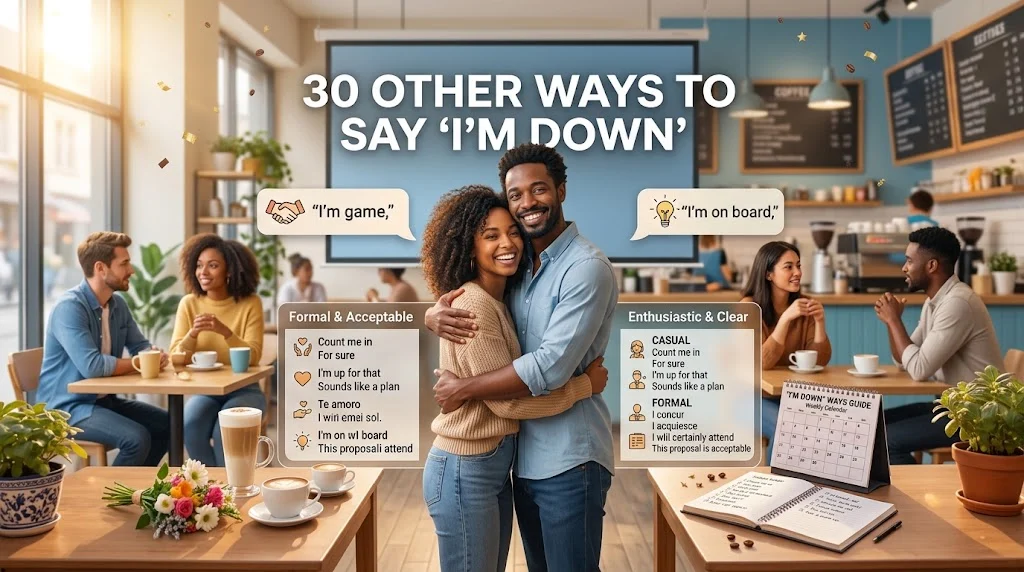
I’m game, I’m in, I’m up for it, count me in, and I’m on board are the most versatile alternatives to “I’m down” for everyday conversations.
“I’m down” is one of the most common informal expressions in modern English. When someone says “I’m down,” they are typically expressing agreement, willingness, or enthusiasm to participate in an activity. It is a casual, slang-driven way of saying “yes” to an invitation or proposal. Alternatives to “I’m down” allow you to sound more fluent, nuanced, and contextually appropriate in different settings.
Learning different ways to express excitement in English is essential for sounding natural and confident. While “I’m down” works perfectly among friends, it may not be the best choice in professional environments or formal writing. By expanding your vocabulary, you gain the ability to match your tone to your audience, whether you are responding to a colleague, a client, or a close friend. This guide provides 30 powerful alternatives categorized by formality, tone, and context so you can always choose the right phrase.
Quick Categories
Formal Alternatives to “I’m Down”
- I am amenable to that
- I would be delighted to
- That is acceptable to me
- I consent to that
Casual Alternatives
- I’m game
- I’m in
- I’m up for it
- Count me in
Professional Alternatives
- I am on board with that
- I support that idea
- I am aligned with that
- I am in full agreement
Informal Expressions
- Let’s do it
- Sounds good to me
- I’m totally down
- Absolutely
What Does “I’m Down” Mean?
“I’m down” is an informal slang expression that primarily means you agree to participate in an activity or accept a proposal. It signals willingness, enthusiasm, and a relaxed “yes” to whatever is being suggested.
Example Sentence:
“Do you want to grab dinner tonight?” “Yeah, I’m down.”
Grammar Note: The phrase is typically followed by “for” + noun (“I’m down for pizza”) or “to” + verb (“I’m down to go”).
When to Use “I’m Down”
- Responding to social invitations from friends
- Agreeing to casual plans or activities
- Expressing enthusiasm in relaxed, informal settings
- Texting or messaging with people you know well
- Spoken conversations among peers
Spoken vs Written: Primarily spoken or used in informal written communication like texts and chats. Not suitable for formal writing.
Formal vs Informal: Highly informal. Avoid professional emails, business meetings, or academic writing.
Is It Professional or Polite to Say “I’m Down”?
Polite? ✔️ Yes among friends and peers, it is perfectly polite and friendly.
Professional? ❌ No in most professional contexts, it is too informal and may come across as unprofessional or immature.
Business-Style Example (What to avoid):
“I’m down for that project deadline.” ❌
Better: “I am available to meet that project deadline.” ✔️
Pros and Cons of Using “I’m Down”
Pros
- Simple and natural easy to use in everyday speech
- Friendly tone conveys approachability and warmth
- Common usage widely understood by native speakers
- Easy to understand requires no complex vocabulary
Cons
- Too informal for work can undermine professionalism
- Overused lacks originality and variety
- Limited emotional range doesn’t convey strong enthusiasm or deep commitment
- Not suitable for formal writing inappropriate for emails, reports, or official correspondence
“The right tone makes your English sound professional and confident.”
Common Mistakes When Using “I’m Down”
- Using it in a job interview
“I’m down to start immediately.” ❌
“I am available to start immediately.” ✔️ - Confusing it with feeling sad
“I’m down about the news” can mean you are sad, not agreeing. Always consider context. - Using it with “with” incorrectly
“I’m down with that” is acceptable informally, but “I’m down for that” is more common for activities. - Overusing it in professional emails
Repeatedly saying “I’m down” in a work setting sounds unprofessional and repetitive. - Using it with superiors or clients
“I’m down with your proposal” too casual for client communication.
Other Ways to Say “I’m Down” (With Examples)
These alternatives will help you sound more fluent, confident, and natural in different situations. Use them according to tone, context, and audience to express excitement, agreement, or approval.
1. Phrase: I’m game
Meaning: You are willing and ready to participate.
Explanation: This phrase suggests enthusiasm and a playful readiness to try something.
Example Sentence: “I’ve never tried rock climbing, but I’m game!”
Best Use: Casual plans
Worst Use: Formal meetings
Tone: Playful, willing
Context Variability: Casual “I’m game if you are.”
2. Phrase: I’m in
Meaning: You have decided to join or participate.
Explanation: Conveys commitment and agreement to be part of something.
Example Sentence: “You’re organizing a weekend trip? I’m in.”
Best Use: Group activities
Worst Use: Professional proposals
Tone: Committed, decisive
Context Variability: Casual/Spoken “Count me in, I’m in!”
3. Phrase: I’m up for it
Meaning: You are interested and willing to try something.
Explanation: Suggests openness and a positive attitude toward the suggestion.
Example Sentence: “I’m up for it if everyone else is.”
Best Use: Social invitations
Worst Use: Formal writing
Tone: Open, willing
Context Variability: Casual/Spoken “I’m up for anything.”
4. Phrase: Count me in
Meaning: Include me in the plan or activity.
Explanation: A clear and enthusiastic way to confirm participation.
Example Sentence: “If you’re going to the beach this weekend, count me in.”
Best Use: Group plans
Worst Use: Professional emails
Tone: Enthusiastic, clear
Context Variability: Casual/Spoken “Count me in for sure!”
5. Phrase: I’m on board
Meaning: I agree with and support the idea.
Explanation: Commonly used in both casual and professional settings to show alignment.
Example Sentence: “I’m on board with your suggestion to revise the timeline.”
Best Use: Team discussions
Worst Use: Very formal contracts
Tone: Supportive, professional
Context Variability: Professional/Spoken “I’m on board with that plan.”
6. Phrase: I support that
Meaning: I agree with and back that idea.
Explanation: A straightforward professional way to express agreement.
Example Sentence: “I support that approach to the marketing strategy.”
Best Use: Workplace meetings
Worst Use: Casual hangouts
Tone: Professional, clear
Context Variability: Professional “I fully support that.”
7. Phrase: I am amenable to that
Meaning: I am open and agreeable to that suggestion.
Explanation: A formal and polished way to express willingness.
Example Sentence: “I am amenable to that timeline if the team agrees.”
Best Use: Formal negotiations
Worst Use: Texting friends
Tone: Formal, polite
Context Variability: Formal/Written “I am amenable to your proposal.”
8. Phrase: That works for me
Meaning: That is acceptable and convenient for me.
Explanation: A neutral, practical way to agree to a plan or schedule.
Example Sentence: “Meeting at 3 PM? That works for me.”
Best Use: Scheduling
Worst Use: Emotional agreement
Tone: Practical, neutral
Context Variability: Professional/Casual “That works for me too.”
9. Phrase: Sounds good to me
Meaning: I think that is a good idea.
Explanation: A friendly and widely used way to show agreement.
Example Sentence: “Pizza for dinner? Sounds good to me.”
Best Use: Everyday decisions
Worst Use: Formal documents
Tone: Friendly, agreeable
Context Variability: Casual/Spoken “Sounds good to me, let’s do it.”
10. Phrase: I’d be delighted to
Meaning: I would be very happy to participate.
Explanation: A warm, formal expression of enthusiasm and willingness.
Example Sentence: “I’d be delighted to join the panel discussion.”
Best Use: Formal invitations
Worst Use: Casual texts
Tone: Warm, formal
Context Variability: Formal/Written “I’d be delighted to attend.”
11. Phrase: I’m keen
Meaning: I am very interested and eager.
Explanation: Commonly used in British and Australian English to express strong interest.
Example Sentence: “I’m keen to get started on this project.”
Best Use: Enthusiastic agreement
Worst Use: North American casual slang
Tone: Eager, interested
Context Variability: Casual/Professional “I’m keen if you are.”
12. Phrase: Let’s do it
Meaning: I agree, let’s proceed with the plan.
Explanation: An energetic and action-oriented way to confirm participation.
Example Sentence: “You want to go skydiving? Let’s do it!”
Best Use: Exciting plans
Worst Use: Formal settings
Tone: Energetic, action-oriented
Context Variability: Casual/Spoken “Let’s do it this weekend!”
“Variety in your vocabulary shows confidence and fluency.”
13. Phrase: I’m all for it
Meaning: I completely support and agree with that.
Explanation: Emphasizes strong approval and enthusiasm.
Example Sentence: “If you want to extend the deadline, I’m all for it.”
Best Use: Supporting ideas
Worst Use: Neutral situations
Tone: Enthusiastic, supportive
Context Variability: Casual/Professional “I’m all for that proposal.”
14. Phrase: That’s a yes from me
Meaning: I am saying yes to that.
Explanation: A modern, clear way to express agreement.
Example Sentence: “Dinner at the new Italian place? That’s a yes from me.”
Best Use: Quick confirmations
Worst Use: Formal writing
Tone: Clear, modern
Context Variability: Casual/Spoken “That’s a yes from me too.”
15. Phrase: I’m willing
Meaning: I am prepared and open to do that.
Explanation: A neutral and slightly formal way to express readiness.
Example Sentence: “I’m willing to take on that responsibility.”
Best Use: Professional contexts
Worst Use: Enthusiastic social plans
Tone: Neutral, ready
Context Variability: Professional “I’m willing to help.”
16. Phrase: I accept
Meaning: I agree to the proposal or invitation.
Explanation: A direct and formal way to confirm agreement.
Example Sentence: “I accept your invitation to speak at the conference.”
Best Use: Formal acceptances
Worst Use: Casual chats
Tone: Formal, direct
Context Variability: Formal/Written “I accept your offer.”
17. Phrase: I concur
Meaning: I agree with the stated opinion or plan.
Explanation: A formal and somewhat academic way to express agreement.
Example Sentence: “I concur with the analysis presented in the report.”
Best Use: Academic or legal settings
Worst Use: Everyday conversation
Tone: Formal, academic
Context Variability: Formal/Written “I concur with that assessment.”
18. Phrase: That sounds like a plan
Meaning: That proposal sounds good and well-organized.
Explanation: A friendly way to agree to a suggested course of action.
Example Sentence: “Dinner at 7, then a movie? That sounds like a plan.”
Best Use: Social plans
Worst Use: Formal agreements
Tone: Friendly, agreeable
Context Variability: Casual/Spoken “That sounds like a plan to me.”
19. Phrase: Absolutely
Meaning: I completely agree, yes.
Explanation: A strong, enthusiastic, and widely used affirmative.
Example Sentence: “Should we order dessert?” “Absolutely!”
Best Use: Enthusiastic agreement
Worst Use: Neutral responses
Tone: Strong, enthusiastic
Context Variability: Casual/Professional “Absolutely, I’m in.”
20. Phrase: I’d love to
Meaning: I would really enjoy participating.
Explanation: Expresses genuine enthusiasm and pleasure about the invitation.
Example Sentence: “I’d love to join you for the concert.”
Best Use: Invitations
Worst Use: Business negotiations
Tone: Warm, enthusiastic
Context Variability: Casual/Spoken “I’d love to, thanks!”
21. Phrase: That’s fine with me
Meaning: I have no objection to that.
Explanation: A neutral, agreeable response to a suggestion.
Example Sentence: “If we reschedule for Tuesday, that’s fine with me.”
Best Use: Neutral agreement
Worst Use: Enthusiastic plans
Tone: Neutral, agreeable
Context Variability: Casual/Professional “That’s fine with me.”
22. Phrase: I’m happy to
Meaning: I am pleased and willing to do that.
Explanation: A warm and positive way to express willingness.
Example Sentence: “I’m happy to help with the presentation.”
Best Use: Offering help
Worst Use: Reluctant agreement
Tone: Warm, willing
Context Variability: Professional/Casual “I’m happy to join.”
23. Phrase: You can count on me
Meaning: You can rely on my participation or support.
Explanation: Emphasizes dependability and commitment.
Example Sentence: “If you need volunteers, you can count on me.”
Best Use: Commitments
Worst Use: Casual plans
Tone: Reliable, committed
Context Variability: Professional/Spoken “You can count on me for that.”
24. Phrase: I’m on it
Meaning: I will take care of it or participate.
Explanation: Shows immediate readiness and initiative.
Example Sentence: “We need someone to handle the bookings.” “I’m on it.”
Best Use: Task assignments
Worst Use: Social invitations
Tone: Ready, proactive
Context Variability: Professional/Spoken “I’m on it right away.”
25. Phrase: I’m ready
Meaning: I am prepared and willing to proceed.
Explanation: A simple, direct way to confirm you are prepared to participate.
Example Sentence: “If the team is ready, I’m ready too.”
Best Use: Preparation contexts
Worst Use: Emotional agreement
Tone: Prepared, ready
Context Variability: Casual/Professional “I’m ready when you are.”
26. Phrase: I’m interested
Meaning: I find that appealing and want to be involved.
Explanation: A neutral and professional way to express curiosity and willingness.
Example Sentence: “I’m interested in learning more about this opportunity.”
Best Use: Professional curiosity
Worst Use: Enthusiastic social plans
Tone: Curious, neutral
Context Variability: Professional/Written “I’m interested in that role.”
27. Phrase: Let’s go
Meaning: I agree, let’s start or proceed.
Explanation: An energetic, action-oriented way to express agreement and readiness.
Example Sentence: “Ready to hit the road?” “Let’s go!”
Best Use: Action starts
Worst Use: Formal settings
Tone: Energetic, ready
Context Variability: Casual/Spoken “Let’s go, I’m ready!”
28. Phrase: I’m totally in
Meaning: I am fully committed and enthusiastic.
Explanation: A stronger, more emphatic version of “I’m in.”
Example Sentence: “A weekend getaway? I’m totally in!”
Best Use: Enthusiastic agreement
Worst Use: Professional contexts
Tone: Very enthusiastic
Context Variability: Casual/Spoken “I’m totally in for that.”
29. Phrase: I’m open to that
Meaning: I am willing to consider or accept that.
Explanation: Suggests flexibility and receptiveness.
Example Sentence: “I’m open to that suggestion if we can adjust the budget.”
Best Use: Negotiations
Worst Use: Strong commitments
Tone: Flexible, open
Context Variability: Professional/Casual “I’m open to that idea.”
30. Phrase: I’m aligned with that
Meaning: My views and position match that proposal.
Explanation: A modern professional phrase indicating agreement and shared direction.
Example Sentence: “I’m aligned with that strategy for the next quarter.”
Best Use: Business meetings
Worst Use: Casual texts
Tone: Professional, strategic
Context Variability: Professional/Written “I’m aligned with your thinking.”
Pro Tips Box
Pro Tip: Match your phrase to your audience. Use “I’m game” or “I’m in” with friends, but switch to “I support that” or “I’m aligned” in professional settings. The right choice builds trust and credibility.
Comparison Table: Top 10 Alternatives
| Phrase | Tone | Best Use |
| I’m game | Playful, willing | Casual activities |
| I’m in | Committed, decisive | Group plans |
| I’m up for it | Open, willing | Social invitations |
| Count me in | Enthusiastic, clear | Group confirmations |
| I’m on board | Supportive, professional | Team discussions |
| I’m amenable to that | Formal, polite | Formal negotiations |
| Sounds good to me | Friendly, agreeable | Everyday decisions |
| I’d be delighted to | Warm, formal | Formal invitations |
| Absolutely | Strong, enthusiastic | Enthusiastic agreement |
| I’m aligned with that | Professional, strategic | Business meetings |
“Professional communication is about choosing the right words for the right people.”
Mini Quiz: Test Your Knowledge
1. Which phrase is best for a job interview?
A) I’m down
B) I’m game
C) I am amenable to that
D) Let’s do it
2. Your friend asks if you want to try a new restaurant. Which is the most natural casual response?
A) I concur
B) I’m up for it
C) I am amenable to that
D) I support that
3. In a team meeting, you want to express professional agreement. Which is most appropriate?
A) I’m down
B) I’m on board with that
C) Let’s go
D) Sounds good
4. Which phrase would be LEAST appropriate in an email to a client?
A) I am willing to proceed
B) I’m happy to help
C) I’m down for that
D) I support that approach
(Answers: 1-C, 2-B, 3-B, 4-C)
FAQs
1. Is “I’m down” grammatically correct?
Yes, it is grammatically correct as an informal colloquial expression. However, it is considered slang and should be used only in casual contexts.
2. What is the difference between “I’m down” and “I’m up for it”?
Both express willingness, but “I’m down” is more informal and slang-like, while “I’m up for it” is slightly more neutral and widely accepted.
3. Can I use “I’m down” in a professional email?
No. “I’m down” is too informal for professional emails. Use phrases like “I support that,” “I am on board,” or “I agree” instead.
4. What are formal alternatives to “I’m down”?
Formal alternatives include “I am amenable to that,” “I would be delighted to,” “I consent to that,” and “I concur.”
5. Does “I’m down” always mean agreement?
No. “I’m down” can also mean feeling sad (“I’m feeling down”) or being ill (“I’m down with a cold”) depending on context.
Conclusion
Learning alternatives to “I’m down” transforms your English from repetitive and casual to nuanced and context-aware. Whether you are responding to a friend, a colleague, or a client, having a range of phrases at your disposal allows you to match your tone to the situation with confidence and precision.
Start incorporating these 30 alternatives into your daily conversations. Pay attention to the tone and context of each interaction, and choose the phrase that best fits. With practice, you will naturally switch between formal, professional, and casual expressions, making your English sound more fluent, polished, and impressive.

Sally Rooney is an American writer who contributes to QuickResponsess.com, creating clear and practical content for English learners. Her articles help readers build confidence in using words and expressions accurately in everyday and professional communication.