Quick Answer:
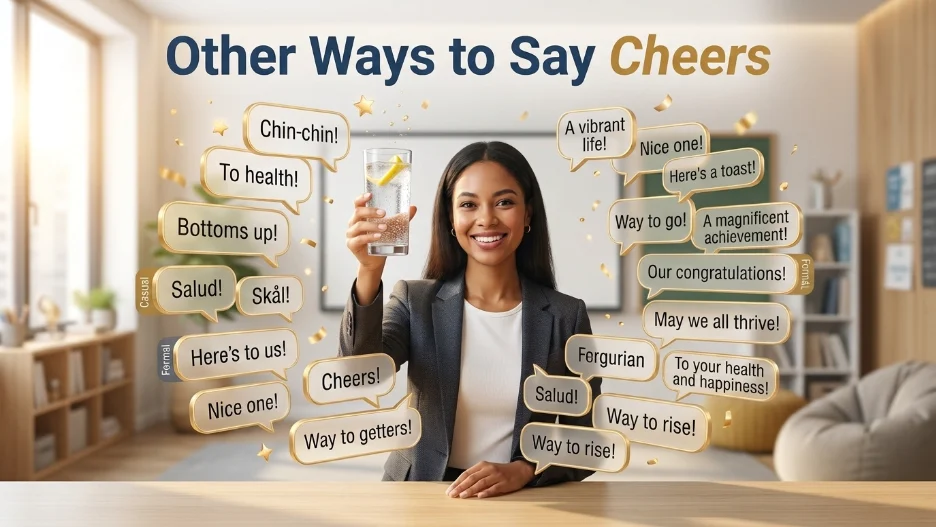
Cheers is a versatile English expression used for toasting, thanking, and saying goodbye. Top alternatives include: Here’s to you, Salute, To your health, Bottoms up, and Prosit.
The word cheers has become one of the most recognizable English expressions worldwide. Whether you’re raising a glass at a celebration, thanking someone casually, or signing off an email, cheers appears in countless everyday situations.
However, relying too heavily on this single word can make your English sound repetitive or overly informal in certain settings. Understanding alternatives to cheers will help you express excitement in English more effectively and adapt your language to any situation from formal business dinners to casual gatherings with friends.
Quick Categories
Formal Alternatives to Cheers
- To your health
- Here’s to you
- Salutations
- I raise my glass to you
Casual Alternatives
- Bottoms up
- Here’s to
- To us
- Skål
Professional Alternatives
- Many thanks
- Much appreciated
- Grateful for your support
- Thank you kindly
Informal Expressions
- Sláinte
- Prost
- Chin chin
- Down the hatch
“The right tone makes your English sound professional and confident.”
Common Mistakes
- Using “cheers” in formal business emails
- ❌ “Cheers for reviewing the quarterly report.”
- ✅ “Thank you for reviewing the quarterly report.”
- Using “cheers” when you should express genuine gratitude
- ❌ “Cheers for saving my career.”
- ✅ “I am deeply grateful for your support.”
- Using “cheers” to close a complaint letter
- ❌ “Cheers, I expect a refund.”
- ✅ “Sincerely, I await your response.”
- Overusing “cheers” in one conversation
- ❌ “Cheers! Cheers everyone. Cheers.”
- ✅ “To everyone here—let’s raise our glasses.”
- Using “cheers” in a eulogy or memorial speech
- ❌ “Cheers to Grandma.”
- ✅ “To the memory of our beloved grandmother.”
What Does “Cheers” Mean?
Definition: A multi purpose expression used primarily for toasting, showing gratitude, or saying goodbye informally.
Grammar: Can function as an interjection, noun, or verb. The most common usage is as an interjection to signal goodwill or appreciation.
Example: “Cheers for helping me move the furniture.”
When to Use “Cheers”
Common contexts include:
- Toasting at social gatherings and celebrations
- Showing casual gratitude among friends
- Signing off informal emails and messages
- Pub culture and drinking contexts
- Expressing friendly acknowledgment
Spoken vs Written:
- Spoken: Very common in British and Australian English
- Written: Acceptable in informal emails and text messages
Formal vs Informal:
- Informal: Perfectly natural and expected
- Formal: Generally inappropriate in professional settings
Is It Professional or Polite to Say “Cheers”?
Polite? ✔️ Yes, in appropriate contexts
Professional? ❌ No, in most business scenarios
Business style example: “Cheers for your feedback.” → Better: “I appreciate your thoughtful feedback.”
While cheers is undeniably polite in casual settings, it lacks the professionalism required for formal business correspondence, client meetings, or official documentation.
“Knowing when NOT to use a word is just as important as knowing when to use it.”
Pros and Cons of Using “Cheers”
Pros:
- Simple and natural in everyday conversation
- Friendly and approachable tone
- Widely understood across English speaking regions
- Easy to use and remember
Cons:
- Too informal for professional environments
- Overused and can sound repetitive
- Limited emotional range compared to alternatives
- Not suitable for formal writing or speeches
Other Ways to Say Cheers (With Examples)
These alternatives will help you sound more fluent, confident, and natural in different situations. Use them according to tone, context, and audience to express excitement, admiration, or approval.
Formal Alternatives
1. Phrase: To your health
Meaning: A traditional toast wishing someone good health.
Explanation: This classic expression dates back centuries and is appropriate for formal events.
Example Sentence: “To your health and continued success in the coming year.”
Best Use: Formal dinners
Worst Use: Text messages
Tone: Traditional, respectful
Context Variability: Casual “To your health, mate.” | Professional “To your health and prosperity.”
2. Phrase: Here’s to you
Meaning: A dedication or salute to a specific person.
Explanation: Focuses attention on an individual deserving of recognition.
Example Sentence: “Here’s to you and all the effort you’ve invested in this project.”
Best Use: Speeches, toasts
Worst Use: Quick casual conversations
Tone: Warm, appreciative
Context Variability: Casual “Here’s to you, champ.” | Professional “Here’s to you and your outstanding contributions.”
3. Phrase: I raise my glass to you
Meaning: A physical and verbal gesture of respect or admiration.
Explanation: More formal than simple “cheers” and emphasizes the gesture itself.
Example Sentence: “I raise my glass to you for your decades of dedicated service.”
Best Use: Formal ceremonies
Worst Use: Everyday situations
Tone: Honouring, ceremonial
Context Variability: Professional “I raise my glass to your achievements.” | Formal “I raise my glass to our partnership.”
4. Phrase: Salutations
Meaning: A formal greeting or acknowledgment.
Explanation: Used more as a greeting than a drinking toast in formal contexts.
Example Sentence: “Salutations, esteemed guests, and welcome to our annual gathering.”
Best Use: Written invitations
Worst Use: Pub settings
Tone: Formal, old fashioned
Context Variability: Written “Salutations to all attending members.”
5. Phrase: To our continued success
Meaning: A forward looking toast wishing ongoing achievement.
Explanation: Ideal for business settings and partnership celebrations.
Example Sentence: “To our continued success and the bright future ahead of us.”
Best Use: Corporate events
Worst Use: Casual parties
Tone: Optimistic, professional
Context Variability: Professional “To our continued success together.”
6. Phrase: May you prosper
Meaning: A wish for wealth and good fortune.
Explanation: Formal blessing often used in ceremonial settings.
Example Sentence: “May you prosper in all your future endeavors.”
Best Use: Retirement parties
Worst Use: Quick interactions
Tone: Blessing, sincere
Context Variability: Formal “May you prosper in the years ahead.”
7. Phrase: With gratitude
Meaning: Expressing thankfulness formally.
Explanation: Often used as a written closing rather than spoken toast.
Example Sentence: “With gratitude for your unwavering support throughout this journey.”
Best Use: Letters, emails
Worst Use: Live toasts
Tone: Thankful, formal
Context Variability: Professional “With gratitude for your guidance.”
“Expanding your vocabulary transforms you from a basic speaker into a confident communicator.”
Casual Alternatives
8. Phrase: Bottoms up
Meaning: A call to finish one’s drink completely.
Explanation: Encourages drinking the entire glass at once, often in celebratory groups.
Example Sentence: “Bottoms up, everyone—this round’s on me!”
Best Use: Party settings
Worst Use: Formal events
Tone: Playful, energetic
Context Variability: Spoken “Bottoms up and let’s enjoy the evening.”
9. Phrase: Here’s to
Meaning: A general toast or acknowledgment.
Explanation: Versatile casual expression for dedicating a toast to someone or something.
Example Sentence: “Here’s to old friends and new adventures.”
Best Use: Toasts at parties
Worst Use: Business meetings
Tone: Warm, inclusive
Context Variability: Casual “Here’s to good times ahead.”
10. Phrase: To us
Meaning: Celebrating a shared experience or relationship.
Explanation: Creates a sense of unity and togetherness.
Example Sentence: “To us—we’ve come so far together.”
Best Use: Couples, friendships
Worst Use: Professional settings
Tone: Intimate, celebratory
Context Variability: Spoken “To us and all the memories.”
11. Phrase: Skål
Meaning: Scandinavian toast meaning “bowl.”
Explanation: Borrowed from Norse culture, popular in Scandinavian countries.
Example Sentence: “Skål, my friends, and happy midsummer!”
Best Use: Themed events
Worst Use: Professional contexts
Tone: Traditional, cultural
Context Variability: Casual “Skål to the weekend!”
12. Phrase: Prost
Meaning: German toast meaning “cheers.”
Explanation: Widely recognized in many countries due to Oktoberfest culture.
Example Sentence: “Prost and good health to everyone here tonight.”
Best Use: Oktoberfest, German restaurants
Worst Use: Business meetings
Tone: Festive, German
Context Variability: Casual “Prost, my friends!”
13. Phrase: Sláinte
Meaning: Irish toast meaning “health.”
Explanation: Traditional Irish Gaelic expression often accompanied by raising a glass.
Example Sentence: “Sláinte—to good health and happiness.”
Best Use: Irish gatherings
Worst Use: Formal events
Tone: Traditional, friendly
Context Variability: Casual “Sláinte, everyone!”
14. Phrase: Chin chin
Meaning: A lighthearted toast originating from Chinese “qing qing.”
Explanation: Popular in British English and among expatriate communities.
Example Sentence: “Chin chin, and here’s to a wonderful evening.”
Best Use: Casual gatherings
Worst Use: Professional settings
Tone: Cheerful, light
Context Variability: Spoken “Chin chin, everyone!”
15. Phrase: Down the hatch
Meaning: A humorous expression for drinking alcohol.
Explanation: Playful phrase comparing drinking to sending cargo down a hatch.
Example Sentence: “Down the hatch—this one’s for the good times.”
Best Use: Pubs, parties
Worst Use: Formal occasions
Tone: Humorous, casual
Context Variability: Spoken “Down the hatch and here we go!”
16. Phrase: To good times
Meaning: Celebrating positive experiences and memories.
Explanation: Optimistic expression appropriate for various social settings.
Example Sentence: “To good times and great company tonight.”
Best Use: Social gatherings
Worst Use: Business meetings
Tone: Optimistic, friendly
Context Variability: Casual “To good times with wonderful friends.”
17. Phrase: What a night
Meaning: Reflecting on an enjoyable evening or experience.
Explanation: Combines celebration with appreciation for the moment.
Example Sentence: “What a night—cheers to everyone who made it special.”
Best Use: End of events
Worst Use: Formal settings
Tone: Excited, reflective
Context Variability: Spoken “What a night this has been!”
Professional Alternatives
18. Phrase: Much appreciated
Meaning: Professional expression of gratitude.
Explanation: Concise, polite, and formal enough for workplace communication.
Example Sentence: “Your assistance with the presentation was much appreciated.”
Best Use: Workplace emails
Worst Use: Drinking toasts
Tone: Grateful, professional
Context Variability: Professional “Your feedback is much appreciated.”
19. Phrase: Grateful for your support
Meaning: Expressing thanks for help or assistance.
Explanation: Formal way to acknowledge contributions in professional contexts.
Example Sentence: “We are grateful for your support throughout this project.”
Best Use: Business correspondence
Worst Use: Social drinking
Tone: Formal, appreciative
Context Variability: Professional “We are grateful for your support.”
20. Phrase: Thank you kindly
Meaning: Polite and slightly formal expression of thanks.
Explanation: Adds warmth to professional appreciation without being casual.
Example Sentence: “Thank you kindly for your valuable insights during our meeting.”
Best Use: Client communications
Worst Use: Toasts
Tone: Polite, warm
Context Variability: Professional “Thank you kindly for your time.”
21. Phrase: I’m truly grateful
Meaning: Deep expression of appreciation.
Explanation: Emphasizes sincerity in professional gratitude.
Example Sentence: “I’m truly grateful for the opportunity to work with your team.”
Best Use: Formal acknowledgments
Worst Use: Casual settings
Tone: Sincere, professional
Context Variability: Formal “I’m truly grateful for this opportunity.”
22. Phrase: Your efforts haven’t gone unnoticed
Meaning: Acknowledging someone’s contributions.
Explanation: Recognizes work and dedication in professional settings.
Example Sentence: “Your efforts haven’t gone unnoticed—the team appreciates your dedication.”
Best Use: Performance reviews
Worst Use: Social drinking
Tone: Encouraging, formal
Context Variability: Professional “Your efforts haven’t gone unnoticed.”
23. Phrase: I deeply appreciate
Meaning: Strong expression of gratitude.
Explanation: More formal than standard “thank you” and adds emotional depth.
Example Sentence: “I deeply appreciate your patience during this transition period.”
Best Use: Formal communications
Worst Use: Casual toasts
Tone: Sincere, formal
Context Variability: Professional “I deeply appreciate your contribution.”
“Professional communication is about choosing the right words for the right people.”
Informal Expressions
24. Phrase: All the best
Meaning: Friendly closing with well wishes.
Explanation: Commonly used to close emails and informal conversations.
Example Sentence: “All the best, and I hope to see you again soon.”
Best Use: Email closings
Worst Use: Drinking toasts
Tone: Friendly, optimistic
Context Variability: Casual “All the best for the future.”
25. Phrase: Take care
Meaning: Caring farewell expression.
Explanation: Expresses concern and friendliness in parting.
Example Sentence: “Take care—I’ll catch you later.”
Best Use: Goodbyes
Worst Use: Formal closings
Tone: Caring, warm
Context Variability: Casual “Take care of yourself.”
26. Phrase: Speak soon
Meaning: Anticipating future conversation.
Explanation: Casual way to end a conversation or message.
Example Sentence: “Speak soon—we’ll continue this discussion then.”
Best Use: Quick sign offs
Worst Use: Professional closings
Tone: Friendly, informal
Context Variability: Casual “Speak soon, mate.”
27. Phrase: Catch you later
Meaning: Informal way to say goodbye.
Explanation: Very casual, best used with friends and close colleagues.
Example Sentence: “Catch you later—thanks for the great conversation.”
Best Use: Friends, peers
Worst Use: Professional settings
Tone: Relaxed, familiar
Context Variability: Casual “Catch you later, mate.”
28. Phrase: Ta
Meaning: British informal expression of thanks.
Explanation: Extremely casual and regional, used primarily in UK and Australia.
Example Sentence: “Ta for the coffee, I really needed that.”
Best Use: Quick thanks
Worst Use: Formal occasions
Tone: Very casual
Context Variability: Spoken “Ta, mate!”
29. Phrase: Nice one
Meaning: Expressing approval or thanks casually.
Explanation: Informal recognition of someone’s effort or action.
Example Sentence: “Nice one—that was exactly what we needed.”
Best Use: Quick appreciation
Worst Use: Formal settings
Tone: Approving, casual
Context Variability: Casual “Nice one for sorting that out!”
30. Phrase: Good on you
Meaning: Australian/UK expression of approval.
Explanation: Recognizes someone’s positive action or achievement.
Example Sentence: “Good on you for volunteering to organise the event.”
Best Use: Friends, casual peers
Worst Use: Professional context
Tone: Encouraging, informal
Context Variability: Casual “Good on you, mate!”
“Mastering tone transforms average English into brilliant communication.”
Mini Quiz / Self Check
Question 1:
You are attending a formal charity gala. Which alternative should you use?
- a) Bottoms up
- b) To your health
- c) Nice one
- d) Catch you later
Answer: b) To your health
Question 2:
You need to close a professional email to your director. Which expression is most appropriate?
- a) Cheers
- b) Ta
- c) Much appreciated
- d) Speak soon
Answer: c) Much appreciated
Question 3:
You are at a pub with friends celebrating a promotion. Which alternative fits best?
- a) I raise my glass to you
- b) Down the hatch
- c) I’m truly grateful
- d) Your efforts haven’t gone unnoticed
Answer: b) Down the hatch (or a) depending on formality level)
Comparison Table: Top 10 Alternatives
| Phrase | Tone | Best Use |
| To your health | Formal | Formal dinners, speeches |
| Here’s to you | Warm, appreciative | Dedications, toasts |
| Bottoms up | Playful, casual | Parties, groups |
| Much appreciated | Professional, grateful | Business emails |
| Skål | Traditional, cultural | Scandinavian themed events |
| Prost | Festive | German settings, Oktoberfest |
| Sláinte | Traditional, friendly | Irish gatherings |
| I raise my glass | Honouring, formal | Ceremonies, formal events |
| Grateful for your support | Formal, appreciative | Business correspondence |
| To good times | Optimistic, casual | Social gatherings |
FAQs
1. Is “cheers” acceptable in professional emails?
Generally no. While “cheers” is common in informal workplace communication, it’s best avoided in formal emails to clients, senior management, or external partners.
2. What’s the most formal alternative to cheers?
“I raise my glass to you” and “To your health” are among the most formal alternatives suitable for formal banquets and ceremonies.
3. Can I use “cheers” to say thank you?
Yes, particularly in British and Australian English. However, it’s considered casual and should be used only with friends or close colleagues.
4. Are foreign phrases like “Prost” and “Sláinte” acceptable?
Yes, these are widely recognized and acceptable in appropriate cultural contexts. They add variety and cultural awareness to your English vocabulary.
5. How do I know which alternative to choose?
Consider your audience, setting, and purpose. Formal situations require formal alternatives; casual friends appreciate casual expressions. When in doubt, err on the side of formality.
Conclusion
Learning alternatives to cheers significantly enhances your English fluency and professional communication skills. Each situation calls for a different tone, and having a variety of expressions at your disposal ensures you’ll always sound appropriate and confident.
Start incorporating these alternatives into your daily conversations and professional correspondence. Pay attention to the context and tone the right word at the right time makes all the difference in creating meaningful connection.

John Green is an American writer who contributes to QuickResponsess.com, creating clear and practical content on English grammar, vocabulary and everyday language. His goal is to make learning English simple, engaging and easy to apply.