Quick Answer
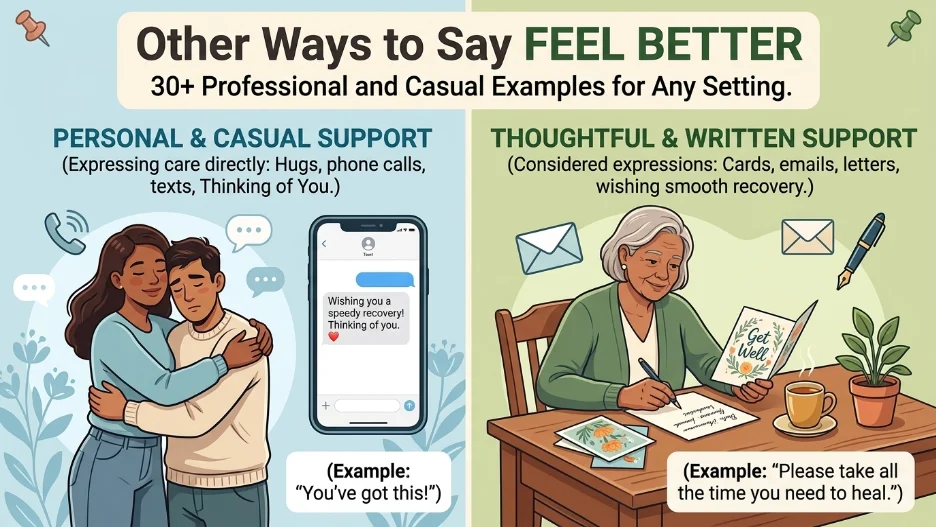
Looking for alternatives to “feel better”? Here are 5 top options: Get well soon, Take care of yourself, Wishing you a speedy recovery, I hope you’re feeling better soon, and Sending healing thoughts your way.
The phrase “feel better” is one of the most common expressions of care in English. You use it when someone is unwell, recovering from an illness, or going through a difficult time emotionally. It’s a simple, friendly way to show you care.
But relying on this single phrase can make your English feel repetitive and limited. Learning alternatives to “feel better” helps you express excitement in English, concern, and empathy with greater precision. Whether you’re writing a professional email to a colleague or sending a supportive message to a friend, having a varied vocabulary lets you match the right tone to the right situation.
Quick Categories
Formal Alternatives to “Feel Better”
- Wishing you a speedy recovery
- I hope you recover soon
- May you have a swift return to health
- I wish you a full recovery
Casual Alternatives
- Take it easy
- Hope you’re back on your feet soon
- Rest up
- Feel better soon
Professional Alternatives
- I hope you’re feeling better
- Wishing you well in your recovery
- Please take the time you need to recover
- I hope you’re on the mend
Informal Expressions
- Hang in there
- Get well soon!
- Hope you feel better in no time
- You’ll be right as rain soon
💡 Pro Tip: Always consider your relationship with the person and the severity of the situation. A minor cold allows for casual phrases, while a serious illness calls for more thoughtful, formal expressions .
Common Mistakes to Avoid
| Mistake | Example |
| Using “feel improved” instead of “feel better” | ❌ “I hope you feel improved soon” |
| Overusing “get well soon” for minor issues | ❌ “Get well soon!” (for a friend who just has a hangover) |
| Being too casual in serious situations | ❌ “Chin up!” (to someone with a chronic illness) |
| Forgetting to add context to “feel better” | ❌ “Feel better” (without acknowledging what’s wrong) |
| Using “feel much better” in overly formal writing | ❌ “We trust you feel much better after the procedure” (in a business letter) |
What Does “Feel Better” Mean?
“Feel better” is a common expression of hope that someone’s physical health, emotional state, or overall well being improves. It can refer to recovery from illness, relief from emotional distress, or simply feeling more comfortable in a situation .
Example Sentence: “I hope you feel better after getting some rest.”
When to Use “Feel Better”
- Physical illness: When someone has a cold, flu, or minor injury
- Emotional distress: After a breakup, job loss, or difficult experience
- Recovery: During or after medical treatment
- Daily discomfort: For headaches, fatigue, or minor aches
Spoken vs Written: Used frequently in both, but written contexts often allow for more thoughtful alternatives.
Formal vs Informal: Leans casual. Formal settings call for more polished alternatives.
Is It Professional or Polite to Say “Feel Better”?
Polite? ✔️ Yes
Professional? ❌ No (in most formal contexts)
While “feel better” is perfectly polite, it lacks the formality required in professional writing. In business emails, consider phrases like “Wishing you a speedy recovery” instead.
Business Style Example: “We were sorry to hear about your illness and wish you a full recovery before your return.”
Pros and Cons of Using “Feel Better”
Pros
- Simple and natural
- Friendly tone
- Common usage
- Easy to understand
Cons
- Too informal for work
- Overused
- Limited emotional range
- Not suitable for formal writing
Other Ways to Say “Feel Better” (With Examples)
These 30 alternatives will help you sound more fluent, confident, and natural in different situations. Use them according to tone, context, and audience to express care and concern with precision.
“The right phrase shows you truly understand the situation—not just that you’ve memorized a script.”
Direct Wishes for Recovery
1. Phrase: Get well soon
- Meaning: A straightforward wish for someone’s recovery.
- Explanation: Used for physical illness or injury, it’s warm and classic.
- Example: “I heard you have the flu. Get well soon!”
- Best Use: Short messages
- Worst Use: Emotional distress
- Tone: Warm, direct
- Context Variability: Casual
2. Phrase: Wishing you a speedy recovery
- Meaning: Hope they recover quickly.
- Explanation: More formal and thoughtful than “get well soon.”
- Example: “Wishing you a speedy recovery from all of us in the office.”
- Best Use: Professional settings
- Worst Use: Minor complaints
- Tone: Supportive, professional
- Context Variability: Professional
3. Phrase: I hope you’re back on your feet soon
- Meaning: Hope they return to normal health and routine.
- Explanation: Encouraging and visual; implies being active again.
- Example: “Sorry to hear about your surgery. I hope you’re back on your feet soon.”
- Best Use: Encouragement
- Worst Use: Emotional issues
- Tone: Encouraging, warm
- Context Variability: Casual
4. Phrase: May you have a swift return to health
- Meaning: Formal wish for rapid recovery.
- Explanation: Suitable for written notes, emails, or official messages.
- Example: “We hope your time off is restful and may you have a swift return to health.”
- Best Use: Formal messages
- Worst Use: Friends
- Tone: Formal, caring
- Context Variability: Formal/Professional
5. Phrase: I hope you recover soon
- Meaning: Direct expression of hope for recovery.
- Explanation: Slightly more formal than “feel better.”
- Example: “I’m so sorry you’re sick. I hope you recover soon.”
- Best Use: General well wishing
- Worst Use: Emotional situations
- Tone: Neutral, caring
- Context Variability: General
6. Phrase: Wishing you a full and complete recovery
- Meaning: Hope they recover entirely, not just partially.
- Explanation: Emphasizes thorough healing; good for serious illnesses.
- Example: “We’re all rooting for you and wishing you a full and complete recovery.”
- Best Use: Serious illnesses
- Worst Use: Minor issues
- Tone: Empathetic, formal
- Context Variability: Formal
7. Phrase: Hope you’re on the mend
- Meaning: Hope you’re in the process of recovery.
- Explanation: The word “mend” suggests a gradual, natural healing process.
- Example: “Glad to see you’re back home. Hope you’re on the mend!”
- Best Use: After hospital stays
- Worst Use: Emotional distress
- Tone: Caring, gentle
- Context Variability: Casual
8. Phrase: Get back in the game soon
- Meaning: Return to normal activities, especially for athletes or active people.
- Explanation: Encouraging and energetic; for active individuals.
- Example: “We miss you on the team! Get back in the game soon.”
- Best Use: Athletes
- Worst Use: Serious illness
- Tone: Uplifting
- Context Variability: Spoken
9. Phrase: Wishing you restored health
- Meaning: Formal, focused on regaining good health.
- Explanation: Rare but meaningful; emphasizes the return of health.
- Example: “It was a pleasure working with you. Wishing you restored health.”
- Best Use: Formal correspondence
- Worst Use: Casual settings
- Tone: Formal, dignified
- Context Variability: Formal/Professional
Expressions of Hope & Optimism
10. Phrase: I hope you feel better soon
- Meaning: Common, caring expression of hope for improvement.
- Explanation: The most natural and common alternative.
- Example: “I heard you’re not feeling well. I hope you feel better soon.”
- Best Use: Almost any situation
- Worst Use: Serious illness
- Tone: Warm, caring
- Context Variability: General
11. Phrase: Hope you’re feeling a bit better today
- Meaning: Shows you’re checking in and noticed their progress.
- Explanation: Demonstrates ongoing concern about their condition.
- Example: “Hi there! Hope you’re feeling a bit better today.”
- Best Use: Follow up messages
- Worst Use: First contact
- Tone: Gentle, attentive
- Context Variability: Casual/Spoken
12. Phrase: I hope you’re on the road to recovery
- Meaning: Suggests they have started the recovery process and are making progress.
- Explanation: Optimistic and encouraging.
- Example: “It’s good to see you back at work. I hope you’re on the road to recovery.”
- Best Use: After treatment starts
- Worst Use: Before diagnosis
- Tone: Encouraging, positive
- Context Variability: General
13. Phrase: Hope each day brings you closer to feeling better
- Meaning: Emphasizes daily progress and healing.
- Explanation: Warm, thoughtful, and patient; good for long recoveries.
- Example: “I know recovery takes time. Hope each day brings you closer to feeling better.”
- Best Use: Long recoveries
- Worst Use: Short term issues
- Tone: Patient, empathetic
- Context Variability: General
14. Phrase: I hope you’re getting some rest
- Meaning: Emphasizes the importance of rest in recovery.
- Explanation: Practical and caring; shows understanding of what they need.
- Example: “I hope you’re getting some rest and taking it easy.”
- Best Use: Illness and exhaustion
- Worst Use: Emotional distress
- Tone: Caring, practical
- Context Variability: Casual
15. Phrase: I hope you’re taking it easy
- Meaning: Hope they’re not overexerting themselves.
- Explanation: Encourages rest and avoiding stress.
- Example: “Don’t worry about work. I hope you’re taking it easy.”
- Best Use: After hospitalization
- Worst Use: Minor discomfort
- Tone: Gentle, reassuring
- Context Variability: Casual
Offers of Support &
16. Phrase: Let me know if you need anything
- Meaning: Offering practical support.
- Explanation: Shows willingness to help beyond just words.
- Example: “I’m thinking of you. Let me know if you need anything.”
- Best Use: Close relationships
- Worst Use: Professional formal settings
- Tone: Supportive, caring
- Context Variability: Casual
17. Phrase: Is there anything I can do to help?
- Meaning: Direct offer of assistance.
- Explanation: More specific than a general offer; invites them to ask.
- Example: “I’m so sorry you’re going through this. Is there anything I can do to help?”
- Best Use: Emotional support
- Worst Use: Very formal settings
- Tone: Caring, proactive
- Context Variability: General
18. Phrase: I’m here if you need to talk
- Meaning: Offering emotional support.
- Explanation: Important for emotional distress or serious illness.
- Example: “Please know I’m here if you need to talk. You don’t have to go through this alone.”
- Best Use: Emotional difficulty
- Worst Use: Minor colds
- Tone: Empathetic, supportive
- Context Variability: Casual/Spoken
19. Phrase: Don’t hesitate to reach out if you need anything at all
- Meaning: Repeated, open ended offer of assistance.
- Explanation: More formal and polite way to offer help.
- Example: “Please don’t hesitate to reach out if you need anything at all during your recovery.”
- Best Use: Professional correspondence
- Worst Use: Close friends
- Tone: Formal, caring
- Context Variability: Professional
20. Phrase: I’m thinking of you
- Meaning: You’re in their thoughts and they care.
- Explanation: Simple but powerful; often used with illness or stress.
- Example: “Just wanted to say I’m thinking of you and hope you’re doing well.”
- Best Use: Emotional support
- Worst Use: Minor issues
- Tone: Warm, empathetic
- Context Variability: General
21. Phrase: Let me know if you want some company
- Meaning: Offering companionship.
- Explanation: Good for someone feeling lonely or isolated during recovery.
- Example: “Let me know if you want some company while you’re recovering.”
- Best Use: Close relationships
- Worst Use: Formal settings
- Tone: Friendly, warm
- Context Variability: Casual/Spoken
“Empathy in language is about matching your words to the emotional temperature of the moment.”
Empathetic
22. Phrase: I’m so sorry you’re going through this
- Meaning: Acknowledges their suffering.
- Explanation: Shows empathy; good for serious or emotional situations.
- Example: “I’m so sorry you’re going through this. Please know I’m here for you.”
- Best Use: Serious illness
- Worst Use: Minor colds
- Tone: Empathetic, caring
- Context Variability: General
23. Phrase: That must be really tough
- Meaning: Acknowledges the difficulty of their situation.
- Explanation: Validates their feelings; shows you understand.
- Example: “That must be really tough. I’m so sorry you’re dealing with this.”
- Best Use: Emotional distress
- Worst Use: Physical minor illness
- Tone: Empathetic, supportive
- Context Variability: Casual/Spoken
24. Phrase: I can only imagine what you’re going through
- Meaning: Acknowledges the difficulty of their experience without claiming to understand.
- Explanation: Good when you haven’t experienced a similar situation.
- Example: “I can only imagine what you’re going through right now.”
- Best Use: Serious illness or loss
- Worst Use: Minor illness
- Tone: Respectful, empathetic
- Context Variability: General
25. Phrase: Please take care of yourself
- Meaning: Encourages self care.
- Explanation: Broad and caring; suitable for many situations.
- Example: “I hope you feel better soon. Please take care of yourself.”
- Best Use: Any situation
- Worst Use: Very formal contexts
- Tone: Caring, warm
- Context Variability: General
26. Phrase: You’re in my thoughts
- Meaning: You’re thinking of them with care.
- Explanation: Similar to “I’m thinking of you” but slightly more formal.
- Example: “You’re in my thoughts and prayers. Hope you feel better soon.”
- Best Use: Emotional support
- Worst Use: Minor illness
- Tone: Warm, caring
- Context Variability: General
27. Phrase: Sending healing thoughts your way
- Meaning: Positive thoughts for their recovery.
- Explanation: Warm and supportive; implies you’re doing something for them.
- Example: “Sending healing thoughts your way and hoping for your swift recovery.”
- Best Use: Supportive messages
- Worst Use: Professional formal settings
- Tone: Warm, caring
- Context Variability: Casual
28. Phrase: I’m rooting for you
- Meaning: I’m supporting you and cheering you on.
- Explanation: Encouraging and optimistic; good for long recoveries.
- Example: “I know this is tough, but I’m rooting for you every step of the way.”
- Best Use: Encouragement
- Worst Use: Emotional distress
- Tone: Uplifting, motivating
- Context Variability: Casual/Spoken
Relaxed and Encouraging Alternatives
29. Phrase: Hang in there
- Meaning: Don’t give up; persevere.
- Explanation: For difficult times requiring patience and strength.
- Example: “I know this isn’t easy. Hang in there!”
- Best Use: Encouragement
- Worst Use: Physical illness
- Tone: Encouraging, casual
- Context Variability: Casual/Spoken
30. Phrase: You’ll be right as rain soon
- Meaning: You’ll be completely fine soon.
- Explanation: British/Commonwealth expression meaning back to normal.
- Example: “Don’t worry, you’ll be right as rain soon!”
- Best Use: Minor complaints
- Worst Use: Serious illness
- Tone: Lighthearted, optimistic
- Context Variability: Casual/Spoken
31. Phrase: Take it easy
- Meaning: Rest and don’t overdo it.
- Explanation: Encourages rest; good for illness or stress.
- Example: “I hope you’re resting. Take it easy for a few days.”
- Best Use: Illness and stress
- Worst Use: Emotional distress
- Tone: Gentle, caring
- Context Variability: Casual/Spoken
32. Phrase: Rest up
- Meaning: Ensure you get enough rest.
- Explanation: Simple and direct; emphasizes rest’s importance.
- Example: “Rest up and let your body heal. See you when you’re better.”
- Best Use: Illness and exhaustion
- Worst Use: Formal settings
- Tone: Warm, direct
- Context Variability: Casual/Spoken
Comparison Table: Top 10 Alternatives
| Phrase | Tone | Best Use |
| Get well soon | Warm, direct | Short, casual messages |
| Wishing you a speedy recovery | Formal, supportive | Professional correspondence |
| I hope you’re back on your feet soon | Encouraging, warm | Encouragement |
| I’m here if you need to talk | Empathetic, supportive | Emotional support |
| Please take care of yourself | Caring, gentle | Any situation |
| Hang in there | Encouraging, casual | Difficult times |
| I’m thinking of you | Warm, empathetic | Emotional situations |
| Hope you’re on the mend | Caring, gentle | After treatment starts |
| Let me know if you need anything | Supportive, caring | Close relationships |
| Wishing you restored health | Formal, dignified | Very formal situations |
Mini Quiz: Test Your Knowledge
1. Which phrase is best for a professional email to a colleague recovering from surgery?
A. “Hang in there!”
B. “Wishing you a speedy recovery.”
C. “You’ll be right as rain soon.”
Answer: B. “Wishing you a speedy recovery” is appropriately formal for professional communication.
2. Which alternative is most suitable for a friend dealing with emotional distress?
A. “I hope you’re back on your feet soon.”
B. “I’m here if you need to talk.”
C. “Get well soon.”
Answer: B. “I’m here if you need to talk” offers emotional support, which is appropriate for distress.
3. Which phrase should you avoid using for someone with a minor cold?
A. “Take it easy.”
B. “Rest up.”
C. “Wishing you restored health.”
Answer: C. “Wishing you restored health” is overly formal for a minor cold.
4. Which alternative is best for an encouraging message to an athlete recovering from injury?
A. “I hope you’re on the mend.”
B. “Get back in the game soon.”
C. “Sending healing thoughts your way.”
Answer: B. “Get back in the game soon” is specifically encouraging for athletes.
FAQs
1. What are formal ways to say “feel better”?
Formal alternatives include “Wishing you a speedy recovery,” “May you have a swift return to health,” and “I hope you recover soon.” Use these in professional emails or formal notes .
2. Is “get well soon” more formal than “feel better”?
Yes, “get well soon” is considered more formal and is suitable for more serious illnesses. “Feel better” is very casual and works best for minor ailments .
3. Can I say “feel improved” instead of “feel better”?
No, “feel improved” is not standard in English and sounds awkward. Stick with “feel better” or the alternatives listed above .
4. What’s the difference between “I feel better” and “I felt better”?
“I feel better” refers to your current state of improvement, while “I felt better” describes a past experience of feeling improved .
5. How can I express “feel better” professionally in an email?
Use phrases like “Wishing you a full recovery,” “We hope you’re feeling better soon,” or “Please take the time you need to recover” for professional tone.
Conclusion
Learning alternatives to “feel better” doesn’t just expand your vocabulary it makes your English more precise and empathetic. You can now express care and concern in ways that match any situation: casual, professional, formal, or deeply emotional. Each alternative carries its own tone, from the warmth of “I’m thinking of you” to the professionalism of “Wishing you a speedy recovery.”
The key to using these phrases effectively is context. Consider your relationship with the person, the severity of the situation, and the medium of communication. With practice, choosing the right alternative will become natural, helping you connect more meaningful.

John Green is an American writer who contributes to QuickResponsess.com, creating clear and practical content on English grammar, vocabulary and everyday language. His goal is to make learning English simple, engaging and easy to apply.