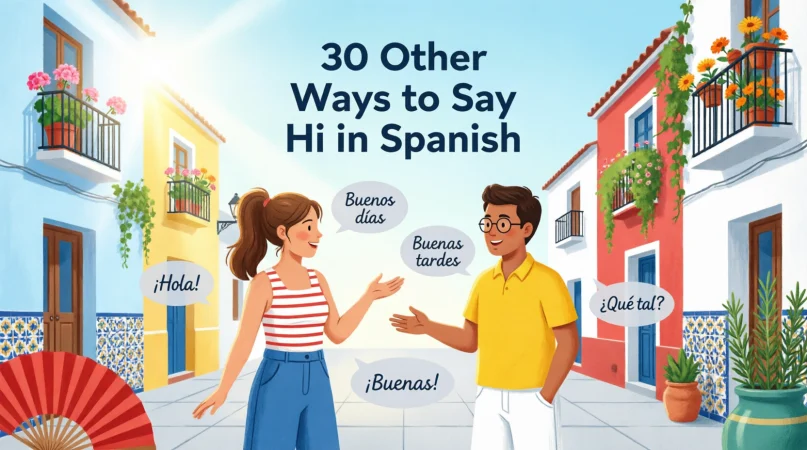
Quick Answer: The most common way to say “hi” in Spanish is ¡Hola! For a richer vocabulary, try Buenos días, Buenas tardes, Buenas noches, ¿Qué tal?, or ¡Buenas!
You already know that ¡Hola! means “hello” in Spanish. But relying solely on this one word limits your ability to connect naturally with Spanish speakers across different contexts and regions.
Learning multiple alternatives to “hi” in Spanish helps you sound more fluent, culturally aware, and confident. Whether you’re greeting a colleague in Madrid, a friend in Mexico City, or answering a phone call in Buenos Aires, the right greeting sets the tone for the entire conversation . This guide provides 30+ practical alternatives organized by formality level, with clear examples showing exactly when and how to use each one.
Quick Categories
Formal Alternatives to “Hi” in Spanish
- Buenos días
- Buenas tardes
- Buenas noches
- ¿Cómo está (usted)?
- Estimado señor/señora
Casual Alternatives
- ¿Qué tal?
- ¿Cómo estás?
- ¿Qué pasa?
- ¿Qué onda?
- ¡Ey!
Professional Alternatives
- Buenos días (with title)
- Buen día
- ¿Cómo se encuentra?
Informal Expressions
- ¡Buenas!
- ¿Qué hubo?
- ¿Qué hay de nuevo?
- ¡Aló! (phone)
Pro Tip: When in doubt, start with ¡Hola! – it works in almost every situation. Then adapt based on the time of day and your relationship with the person .
Common Mistakes to Avoid
- Using “¿Qué pasa?” in formal settings. This casual greeting is for friends, not business meetings. Incorrect: “¿Qué pasa, señor director?”
- Mispronouncing the silent “h.” Hola is pronounced “oh la,” not “ho la.”
- Using “buenas noches” to say goodnight when leaving. This phrase works for both greeting and farewell, but context matters. Incorrect: saying “buenas noches” when entering a morning meeting.
- Forgetting to ask how someone is. In Spanish speaking cultures, it’s impolite not to follow a greeting with a question like ¿Cómo estás?
- Using the wrong “you” form. ¿Cómo está? (formal) vs. ¿Cómo estás? (informal) – using the wrong one can seem disrespectful .
What Does “Hi” in Spanish Mean?
¡Hola! is the standard Spanish greeting equivalent to both “hello” and “hi” in English. Unlike English, which distinguishes between formal and informal greetings, hola works in virtually all contexts across every Spanish speaking region .
Example: ¡Hola, Rafael! ¿Cómo estás? – “Hi, Rafael! How are you?”
When to Use “Hola” in Spanish
- Greeting friends and family
- Starting a conversation with strangers
- Answering the phone
- Entering a shop or restaurant
- Beginning an email or message
Spoken vs Written: Hola is equally common in both spoken and written Spanish. In text messages, you might see abbreviated versions like hla .
Formal vs Informal: Hola bridges both categories, making it the safest choice when you’re unsure about formality level .
Is It Professional or Polite to Say “Hola”?
Polite? ✔️ Yes – hola is always polite when used appropriately.
Professional? ❌ Mostly no – in formal business settings, time based greetings (Buenos días, Buenas tardes) are preferred .
Business Example: Buenos días, soy Miguel, el nuevo asistente de marketing. – “Good morning, I am Miguel, the new marketing assistant.”
Pros and Cons of Using “Hola”
Pros:
- Simple and universally understood
- Friendly and warm tone
- Works in any Spanish speaking country
- Easy to remember and pronounce
Cons:
- Overused and generic
- Limited emotional range
- Can seem too casual in professional contexts
- Doesn’t show cultural or regional awareness
Other Ways to Say “Hi” in Spanish (With Examples)
These alternatives will help you sound more fluent, confident, and natural in different situations. Use them according to tone, context, and audience to express warmth, respect, or casual friendliness.
1. Phrase: Buenos días
Meaning: Good morning or good day.
Explanation: Used from sunrise until about noon, this is a polite greeting for any situation.
Example Sentence: Buenos días, ¿cómo amaneció? – “Good morning, how did you wake up?”
Best Use: Morning meetings
Worst Use: Afternoon or evening
Tone: Respectful, warm
Context Variability: Works in professional, formal, and casual morning settings
2. Phrase: Buenas tardes
Meaning: Good afternoon.
Explanation: Used from around 1:00 PM until dusk or dinner time.
Example Sentence: Buenas tardes, ¿en qué puedo servirle? – “Good afternoon, how can I help you?”
Best Use: Afternoon business interactions
Worst Use: Morning or late night
Tone: Formal, courteous
Context Variability: Essential for professional settings; also used casually
3. Phrase: Buenas noches
Meaning: Good evening / good night.
Explanation: Used after dark as both a greeting and farewell.
Example Sentence: Buenas noches, ¿tienen mesa para dos? – “Good evening, do you have a table for two?”
Best Use: Evening events
Worst Use: Daytime hours
Tone: Warm, formal
Context Variability: Both greeting and farewell; appropriate in all evening settings
4. Phrase: Buen día
Meaning: Good day (singular form).
Explanation: A slightly shorter, more casual version of buenos días, common in Latin America.
Example Sentence: Buen día, vecino – “Good day, neighbor.”
Best Use: Casual morning encounters
Worst Use: Very formal business settings
Tone: Friendly, relaxed
Context Variability: More common in Latin America than Spain
“The right greeting in Spanish shows respect and cultural awareness – it’s your first impression, so make it count.”
5. Phrase: ¡Buenas!
Meaning: A shortened, informal “good (day/afternoon/evening).”
Explanation: Used as a quick, friendly greeting at any time of day – a popular shortcut among friends.
Example Sentence: ¡Buenas! ¿Qué tal todo? – “Hi! How’s everything?”
Best Use: Casual encounters
Worst Use: Formal or professional contexts
Tone: Relaxed, friendly
Context Variability: Very informal; common in Spain and Latin America
6. Phrase: ¿Qué tal?
Meaning: What’s up? / How’s it going?
Explanation: One of the most common informal greetings across the Spanish speaking world.
Example Sentence: ¿Qué tal, Jaime? Cuanto tiempo sin verte. – “How’s it going, Jaime? Long time no see.”
Best Use: Friends and acquaintances
Worst Use: Formal business meetings
Tone: Warm, conversational
Context Variability: Casual / Spoken – one of the most natural Spanish greetings
7. Phrase: ¿Cómo estás?
Meaning: How are you? (informal)
Explanation: A standard way to ask about someone’s well being among friends and peers.
Example Sentence: Hola, ¿cómo estás? – “Hi, how are you?”
Best Use: Casual conversations
Worst Use: Formal situations
Tone: Friendly, personal
Context Variability: Informal / Spoken; use ¿Cómo está? for formal
8. Phrase: ¿Cómo está (usted)?
Meaning: How are you? (formal)
Explanation: Shows respect when speaking to elders, authority figures, or in professional contexts.
Example Sentence: Buenos días, ¿cómo está usted? – “Good morning, how are you?”
Best Use: Professional and respectful interactions
Worst Use: Among close friends
Tone: Respectful, polite
Context Variability: Formal / Spoken & Written
9. Phrase: ¿Qué pasa?
Meaning: What’s happening? / What’s up?
Explanation: Very common casual greeting among friends, especially in Spain.
Example Sentence: ¿Qué pasa, tío? – “What’s up, dude?”
Best Use: Friends and peers
Worst Use: Professional contexts
Tone: Casual, energetic
Context Variability: Informal / Spoken – note this also means “what’s wrong?” in other contexts
10. Phrase: ¿Qué onda?
Meaning: What’s up?
Explanation: Popular casual greeting throughout Latin America, especially Mexico.
Example Sentence: ¿Qué onda, amigo? – “What’s up, friend?”
Best Use: Friends and peers
Worst Use: Formal settings
Tone: Relaxed, youthful
Context Variability: Informal / Spoken – regional variation
11. Phrase: ¿Qué hubo?
Meaning: What’s up? / How’s it going?
Explanation: Common in Mexico, Colombia, and Argentina – informal and friendly.
Example Sentence: ¿Qué hubo, parcero? – “What’s up, buddy?” (Colombia)
Best Use: Casual settings
Worst Use: Formal or professional contexts
Tone: Friendly, regional
Context Variability: Informal / Spoken – remember silent ‘h’
12. Phrase: ¡Ey!
Meaning: Hey!
Explanation: The Spanish equivalent of “hey!” – very casual and quick.
Example Sentence: ¡Ey! ¿Cómo va todo? – “Hey! How’s everything going?”
Best Use: Quick greetings
Worst Use: Formal contexts
Tone: Casual, energetic
Context Variability: Very informal / Spoken
13. Phrase: ¿Cómo va?
Meaning: How’s it going?
Explanation: A versatile, casual greeting that works in most everyday situations.
Example Sentence: ¡Hola, Amanda! ¿Cómo va? – “Hi, Amanda! How’s it going?”
Best Use: Everyday small talk
Worst Use: Formal business settings
Tone: Friendly, neutral
Context Variability: Casual / Spoken
14. Phrase: ¿Qué hay de nuevo?
Meaning: What’s new?
Explanation: A friendly way to ask for updates or news.
Example Sentence: ¿Qué hay de nuevo? Hace tiempo que no te veo. – “What’s new? I haven’t seen you in a while.”
Best Use: Greeting someone you haven’t seen recently
Worst Use: Formal situations
Tone: Friendly, interested
Context Variability: Informal / Spoken
15. Phrase: ¡Hace tiempo que no te veo!
Meaning: It’s been a while since I’ve seen you!
Explanation: Used when greeting someone after a long absence.
Example Sentence: ¡Hace tiempo que no te veo! Cuéntame qué has hecho. – “It’s been a while! Tell me what you’ve been up to.”
Best Use: Reunions
Worst Use: Daily encounters
Tone: Warm, excited
Context Variability: Casual / Spoken
“Learning regional greetings like ¿Qué onda? or ¿Qué hubo? shows cultural awareness and helps you connect with native speakers.”
Phone Greetings
16. Phrase: ¿Aló?
Meaning: Hello? (phone)
Explanation: Common phone answering greeting in many Spanish speaking countries.
Example Sentence: ¿Aló? ¿Quién habla? – “Hello? Who’s speaking?”
Best Use: Answering calls
Worst Use: In person greetings
Tone: Neutral, casual
Context Variability: Phone calls only – regional variation
17. Phrase: ¡Diga! / ¡Dígame!
Meaning: Speak! / Tell me!
Explanation: Very common phone greeting in Spain.
Example Sentence: ¡Dígame! ¿Con quién hablo? – “Speak! Who am I speaking with?”
Best Use: Answering calls (Spain)
Worst Use: In person greetings
Tone: Direct, neutral
Context Variability: Phone calls – primarily in Spain
18. Phrase: ¿Sí?
Meaning: Yes?
Explanation: A brief, direct way to answer the phone.
Example Sentence: ¿Sí? ¿Quién es? – “Yes? Who is it?”
Best Use: Quick phone answers
Worst Use: In person greetings
Tone: Direct, neutral
Context Variability: Phone calls only
First Time Meeting Introductions
19. Phrase: Mucho gusto
Meaning: Nice to meet you.
Explanation: The standard phrase when meeting someone for the first time.
Example Sentence: Hola, soy Carlos. Mucho gusto. – “Hi, I’m Carlos. Nice to meet you.”
Best Use: First meetings
Worst Use: Among friends you already know
Tone: Polite, friendly
Context Variability: Formal / Casual – works in both
20. Phrase: Encantado / Encantada
Meaning: Pleased to meet you.
Explanation: Literally “delighted” – adjust ending to match your gender.
Example Sentence: Encantado de conocerle, señor. – “Pleased to meet you, sir.”
Best Use: First meetings, formal introductions
Worst Use: Casual meetings with friends
Tone: Polite, warm
Context Variability: Formal / Spoken – more formal than mucho gusto
21. Phrase: El gusto es mío
Meaning: The pleasure is mine.
Explanation: A polite response when someone says mucho gusto to you.
Example Sentence: A: Mucho gusto. B: El gusto es mío. – “A: Nice to meet you. B: The pleasure is mine.”
Best Use: Responding to introductions
Worst Use: Starting a conversation
Tone: Polite, gracious
Context Variability: Formal / Casual – appropriate in both
Welcome Greetings
22. Phrase: Bienvenido / Bienvenida
Meaning: Welcome.
Explanation: Used when welcoming someone to a place or event – adjust for gender.
Example Sentence: Bienvenidos a mi casa – “Welcome to my home.”
Best Use: Greeting guests
Worst Use: Everyday encounters
Tone: Warm, hospitable
Context Variability: Formal / Casual – appropriate in both
23. Phrase: Mi casa es su casa
Meaning: My house is your house.
Explanation: A warm welcome making guests feel at home.
Example Sentence: Pasen, mi casa es su casa. – “Come in, my house is your house.”
Best Use: Hosting guests
Worst Use: Professional contexts
Tone: Warm, generous
Context Variability: Casual / Spoken – primarily social settings
“Spanish greetings often include a question about well being. Skipping this step can seem impolite – always ask ¿Cómo está? or ¿Cómo estás?”
24. Phrase: ¿Qué más?
Meaning: What’s up? (literally “What more?”)
Explanation: Very common casual greeting in Colombia and parts of the Caribbean.
Example Sentence: ¿Qué más, parce? – “What’s up, buddy?”
Best Use: Casual settings in Colombia
Worst Use: Formal contexts
Tone: Friendly, regional
Context Variability: Informal / Spoken – regional to Colombia
25. Phrase: ¿Qué pex?
Meaning: What’s up?
Explanation: Slang greeting in Mexico, an abbreviation of ¿Qué pedo?
Example Sentence: ¿Qué pex, carnal? – “What’s up, bro?”
Best Use: Very casual Mexican settings
Worst Use: Formal or professional contexts
Tone: Extremely casual, slang
Context Variability: Very informal / Spoken – Mexico only
26. Phrase: ¿Quiúbole?
Meaning: What’s up?
Explanation: Mexican slang greeting, a contraction of ¿Qué hubo?
Example Sentence: ¿Quiúbole, compa? – “What’s up, pal?”
Best Use: Casual Mexican settings
Worst Use: Formal contexts
Tone: Casual, regional
Context Variability: Very informal / Spoken – Mexico
27. Phrase: Háblame
Meaning: Talk to me (used as greeting in Venezuela).
Explanation: A casual way to say “hello” among friends in Venezuela.
Example Sentence: ¡Háblame, pana! – “Hey, buddy!”
Best Use: Casual settings in Venezuela
Worst Use: Formal contexts
Tone: Casual, energetic
Context Variability: Informal / Spoken – Venezuela
28. Phrase: ¿Qué hacés?
Meaning: What are you doing? / What’s up?
Explanation: Argentine version of ¿Qué haces? using the voseo conjugation.
Example Sentence: ¿Qué hacés, che? – “What’s up, man?”
Best Use: Casual settings in Argentina
Worst Use: Formal contexts
Tone: Casual, regional
Context Variability: Informal / Spoken – Argentina
29. Phrase: ¿Cómo andas?
Meaning: How are you doing?
Explanation: A casual “how’s it going” used in several Latin American countries.
Example Sentence: ¿Cómo andas, amigo? – “How’s it going, friend?”
Best Use: Casual greetings
Worst Use: Formal settings
Tone: Friendly, relaxed
Context Variability: Informal / Spoken
30. Phrase: ¡Saludos!
Meaning: Greetings!
Explanation: A friendly, generic greeting that works in various contexts.
Example Sentence: ¡Saludos desde Madrid! – “Greetings from Madrid!”
Best Use: Starting emails, messages, or casual in person greetings
Worst Use: Very formal business letters
Tone: Friendly, neutral
Context Variability: Works in both spoken and written contexts
Professional & Email Greetings
31. Phrase: Estimado señor / Estimada señora
Meaning: Dear Sir / Dear Madam.
Explanation: Standard formal opening for letters and emails when you know the recipient’s title.
Example Sentence: Estimado Señor Rodríguez: – “Dear Mr. Rodríguez:”
Best Use: Formal written communication
Worst Use: In person greetings
Tone: Formal, respectful
Context Variability: Professional / Written
32. Phrase: A quien corresponda
Meaning: To whom it may concern.
Explanation: Used when you don’t know the name of the recipient.
Example Sentence: A quien corresponda: – “To whom it may concern:”
Best Use: Formal letters to unknown recipients
Worst Use: Personal communication
Tone: Very formal, impersonal
Context Variability: Professional / Written
33. Phrase: Querido / Querida
Meaning: Dear.
Explanation: Used in informal or semi formal written communication with people you know.
Example Sentence: Querido Paco: – “Dear Paco:”
Best Use: Friendly emails and letters
Worst Use: Very formal business communication
Tone: Warm, personal
Context Variability: Informal / Written
“In Spanish, professional emails use a colon (:) after the greeting, not a comma. This is a common mistake to avoid.”
Mini Quiz / Self Check
1. You’re meeting your new boss for the first time. Which greeting is most appropriate?
- a) ¿Qué onda?
- b) Hola, ¿cómo estás?
- c) Buenos días, mucho gusto
- d) ¡Ey!
Answer: c – This is formal and respectful for a first professional meeting.
2. You’re greeting a close friend in Mexico. Which greeting would sound natural?
- a) ¿Qué pasa, tío?
- b) ¿Qué onda, amigo?
- c) Buenos días, señor
- d) Estimado señor
Answer: b – ¿Qué onda? is very common in Mexico for casual greetings.
3. True or False: “Buenas noches” can only be used as a goodbye, not a greeting.
- a) True
- b) False
Answer: b – False. Buenas noches works as both a greeting (in the evening) and a farewell.
4. You’re answering the phone in Spain. What would a native Spanish speaker likely say?
- a) ¿Aló?
- b) ¡Diga!
- c) ¿Qué pasa?
- d) ¡Ey!
Answer: b – ¡Diga! is one of the most common phone greetings in Spain.
Comparison Table: Top 10 Alternatives
| Phrase | Tone | Best Use |
| ¡Hola! | Neutral | Universal, any context |
| Buenos días | Respectful | Morning professional settings |
| Buenas tardes | Polite | Afternoon professional settings |
| Buenas noches | Formal | Evening events |
| ¿Qué tal? | Warm, casual | Everyday conversations |
| ¿Cómo está? | Respectful | Formal interactions |
| ¿Cómo estás? | Friendly | Friends and peers |
| ¡Buenas! | Relaxed | Quick casual greetings |
| Mucho gusto | Polite | First time meetings |
| ¿Qué onda? | Casual, regional | Latin American friends |
FAQs
1. What is the most common way to say “hi” in Spanish?
¡Hola! (OH-lah)
¡Hola! is the most common Spanish greeting and is appropriate in both formal and informal situations.
2. Is “hola” formal or informal?
Hola is a neutral greeting that works well in both formal and casual conversations.
3. How do you say “hi” in Spanish formally?
Use greetings like Buenos días, Buenas tardes, or Buenas noches to sound polite and professional.
4. What are some casual ways to say “hello” in Spanish?
Informal greetings include ¿Qué tal?, ¿Qué pasa?, ¡Ey!, and ¡Buenas!, which are common among friends.
5. How do Spanish speakers greet each other physically?
Greetings vary by country, but common customs include a handshake in professional settings and a cheek kiss or hug among friends and family.
Conclusion
Mastering multiple ways to say “hi” in Spanish transforms you from a beginner into a more confident, culturally aware speaker. Each greeting carries a specific tone – formal (Buenos días, Estimado señor), casual (¿Qué tal?, ¿Qué onda?), or professional (Buenas tardes, ¿Cómo está usted?) – and choosing the right one shows respect and cultural understanding.
Start practicing today. Begin with ¡Hola! and gradually add time based greetings and casual alternatives to your vocabulary. Pay attention to how native speakers greet each other in different situations – whether you’re in a business meeting or grabbing coffee with friends, the right greeting opens doors and builds connections.

John Green is an American writer who contributes to QuickResponsess.com, creating clear and practical content on English grammar, vocabulary and everyday language. His goal is to make learning English simple, engaging and easy to apply.