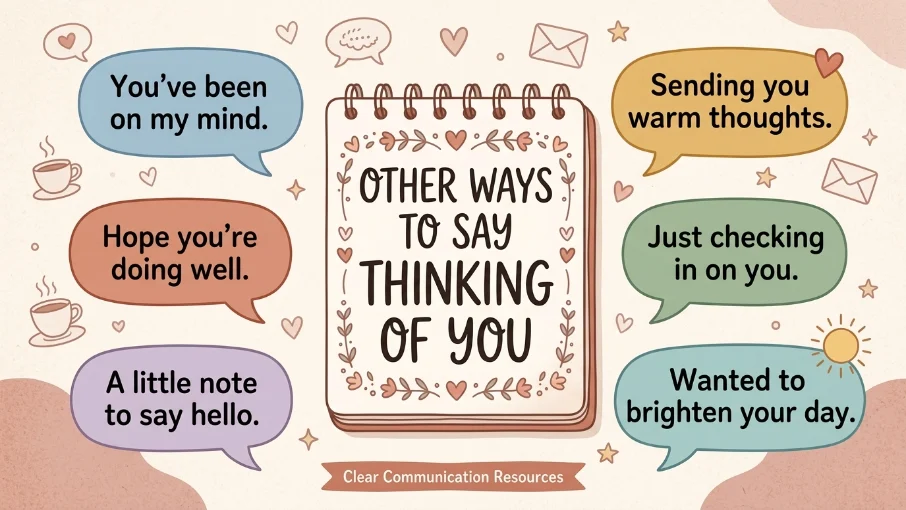
Alternatives to “thinking of you” Try: You’re on my mind, You’re in my thoughts, I’m keeping you in mind, You’ve been on my heart, or Sending positive thoughts your way. Choose based on your relationship and situation.
Saying “Thinking of you” is a thoughtful way to let someone know they’re on your mind. Whether you’re comforting a friend, checking in on a loved one, or sending a heartfelt message, using different expressions can make your words feel more personal, sincere, and meaningful.
In this guide, you’ll discover 30 other ways to say “Thinking of You”, including warm, supportive, romantic, and professional alternatives. Each phrase includes examples to help you choose the right expression for any situation and communicate your care with confidence.
Quick Categories
Formal Alternatives to “Thinking of You”
- You are in my thoughts
- I have you in my thoughts
- My thoughts are with you
- You are in our thoughts
- I’m keeping you in mind
Pro Tip: Use these when writing to colleagues, clients, or during difficult times. They show care while maintaining professional boundaries.
Professional Alternatives
- I’ve been reflecting on our conversation
- Your insights have been on my mind
- I’m considering your input
- You’ve been on my radar
- I’m keeping you in mind for future opportunities
Pro Tip: These phrases work well in emails and workplace communication. They combine thoughtfulness with professional courtesy.
Casual Alternatives
- You’re on my mind
- You crossed my mind
- Just checking in on you
- I’ve been thinking about you
- You popped into my head
Pro Tip: Use these with friends and family. They feel natural and friendly without being overly emotional.
Informal Expressions
- You’ve been on my mind lately
- Can’t stop thinking about you
- Miss you big time
- Just wanted to say hi
- You’re in my heart
Pro Tip: These are great for close relationships, text messages, and personal notes. They convey warmth and affection.
Common Mistakes to Avoid
- Overusing the phrase in professional settings
- ❌ “I’m thinking of you” in a formal email to a client
- ✅ “You are in my thoughts during this time”
- Using an overly emotional phrase with a casual acquaintance
- ❌ “You’re always in my heart” to a new colleague
- ✅ “You’ve been on my mind” to a casual friend
- Confusing “thinking of you” with “thinking about you”
- ❌ Using them interchangeably in the wrong context
- ✅ “Thinking of you” = caring, supportive; “Thinking about you” = considering, reflecting
- Using informal alternatives in formal writing
- ❌ “Just checking in on you” in a sympathy card
- ✅ “My thoughts are with you” in a formal message
- Being too vague when specific support is needed
- ❌ “I’m thinking of you” (without context)
- ✅ “I’m thinking of you during this difficult time”
What Does “Thinking of You” Mean?
“Thinking of you” means you are remembering someone, caring about them, or having them in your thoughts . It expresses emotional presence and concern.
Example Sentence:
“I was thinking of you when I saw your favorite coffee shop.”
When to Use “Thinking of You”
- Spoken: Casual conversations, phone calls, and face to face check ins
- Written: Text messages, personal emails, greeting cards, social media messages
- Formal: Rarely—it’s better suited for personal contexts
- Informal: Ideal for friends, family, and romantic partners
Is It Professional or Polite to Say “Thinking of You”?
- Polite? ✔️ Yes. It’s kind and caring in personal contexts.
- Professional? ❌ No (in most cases). It’s too friendly and conversational for formal emails .
Business Style Example:
“We are keeping you in mind as we move forward with the project.”
Pros and Cons of Using “Thinking of You”
Pros
- Simple and natural
- Friendly and caring tone
- Widely understood and common
- Easy to use in daily conversation
Cons
- Too informal for work settings
- Overused and generic
- Lacks emotional depth
- Not suitable for formal writing
Other Ways to Say “Thinking of You” (With Examples)
These alternatives will help you sound more fluent, confident, and natural in different situations. Use them according to tone, context, and audience to express care, support, or affection.
Formal Alternatives (Professional & Respectful)
1. Phrase: You are in my thoughts
Meaning: A respectful way to say someone is on your mind.
Explanation: Often used in formal or compassionate contexts.
Example Sentence: “You are in my thoughts during this challenging time.”
Best Use: Sympathy cards
Worst Use: Casual texts
Tone: Respectful, formal
Context Variability: Professional / written
2. Phrase: My thoughts are with you
Meaning: I am thinking of you and wishing you well.
Explanation: A gentle, formal expression of support.
Example Sentence: “My thoughts are with you and your family.”
Best Use: Difficult times
Worst Use: Romantic messages
Tone: Compassionate, formal
Context Variability: Professional / spoken
3. Phrase: I have you in my thoughts
Meaning: You are being remembered intentionally.
Explanation: Slightly more personal than “my thoughts are with you.”
Example Sentence: “I have you in my thoughts as you prepare for your surgery.”
Best Use: Supportive messages
Worst Use: Happy occasions
Tone: Warm, formal
Context Variability: Professional / written
4. Phrase: I’m keeping you in mind
Meaning: I am remembering you and your situation.
Explanation: Useful in both personal and professional contexts.
Example Sentence: “I’m keeping you in mind for the upcoming position.”
Best Use: Career opportunities
Worst Use: Emotional support
Tone: Neutral, professional
Context Variability: Professional / spoken
5. Phrase: You are in our thoughts
Meaning: A group or team is thinking of you.
Explanation: Shows collective care and support.
Example Sentence: “You are in our thoughts during this difficult period.”
Best Use: Office messages
Worst Use: Personal conversations
Tone: Supportive, formal
Context Variability: Professional / written
Professional Alternatives (Workplace Friendly)
6. Phrase: I’ve been reflecting on our conversation
Meaning: I’ve been considering what we discussed.
Explanation: Shows thoughtful engagement.
Example Sentence: “I’ve been reflecting on our conversation and your valuable insights.”
Best Use: Follow up emails
Worst Use: Personal relationships
Tone: Professional, thoughtful
Context Variability: Professional / written
7. Phrase: Your insights have been on my mind
Meaning: I value your ideas and suggestions.
Explanation: Shows respect for someone’s expertise.
Example Sentence: “Your insights have been on my mind as we develop the strategy.”
Best Use: Work collaboration
Worst Use: Casual check ins
Tone: Respectful, professional
Context Variability: Professional / written
8. Phrase: You’ve been on my radar
Meaning: I’ve been aware of you or your work.
Explanation: A modern, professional alternative.
Example Sentence: “You’ve been on my radar for the new project.”
Best Use: Business contexts
Worst Use: Personal messages
Tone: Professional, modern
Context Variability: Professional / spoken
9. Phrase: I’m considering your input
Meaning: I value and am thinking about your contribution.
Explanation: Respectful and action oriented.
Example Sentence: “I’m considering your input as we finalize the decision.”
Best Use: Decision making
Worst Use: Personal check ins
Tone: Professional, formal
Context Variability: Professional / written
Casual & Friendly Alternatives
10. Phrase: You’re on my mind
Meaning: I’ve been thinking about you.
Explanation: A simple, warm alternative.
Example Sentence: “You’ve been on my mind today—hope you’re doing well!”
Best Use: Everyday check ins
Worst Use: Professional emails
Tone: Warm, natural
Context Variability: Casual / spoken
11. Phrase: You crossed my mind
Meaning: I thought of you briefly.
Explanation: Light and spontaneous.
Example Sentence: “You crossed my mind, so I thought I’d say hi.”
Best Use: Quick messages
Worst Use: Emotional situations
Tone: Friendly, casual
Context Variability: Casual / spoken
12. Phrase: Just checking in on you
Meaning: I want to see how you’re doing.
Explanation: Shows care and concern.
Example Sentence: “Just checking in on you—how are things going?”
Best Use: Supportive check ins
Worst Use: Formal contexts
Tone: Caring, casual
Context Variability: Casual / spoken
13. Phrase: I’ve been thinking about you
Meaning: You’ve been in my thoughts recently.
Explanation: Slightly more active than “thinking of you.”
Example Sentence: “I’ve been thinking about you and our last conversation.”
Best Use: Reconnecting
Worst Use: Quick messages
Tone: Warm, thoughtful
Context Variability: Casual / spoken
14. Phrase: You popped into my head
Meaning: You came to mind suddenly.
Explanation: Playful and lighthearted.
Example Sentence: “You popped into my head today, so I wanted to reach out.”
Best Use: Friendly messages
Worst Use: Professional settings
Tone: Playful, casual
Context Variability: Casual / spoken
Informal Expressions (Close Relationships)
15. Phrase: You’ve been on my mind lately
Meaning: I’ve been thinking of you often.
Explanation: Shows consistent care.
Example Sentence: “You’ve been on my mind lately—hope everything’s okay.”
Best Use: Catching up
Worst Use: Formal contexts
Tone: Caring, warm
Context Variability: Informal / spoken
16. Phrase: Can’t stop thinking about you
Meaning: You’re constantly in my thoughts.
Explanation: Strong emotional expression.
Example Sentence: “I can’t stop thinking about you—miss you so much!”
Best Use: Romantic messages
Worst Use: Professional settings
Tone: Intense, emotional
Context Variability: Informal / spoken
17. Phrase: You’re in my heart
Meaning: You hold a special emotional place.
Explanation: Deeply affectionate.
Example Sentence: “You’re always in my heart, no matter where you are.”
Best Use: Romantic or family messages
Worst Use: Workplace communication
Tone: Loving, tender
Context Variability: Informal / spoken
18. Phrase: Miss you big time
Meaning: I really miss you.
Explanation: Casual and heartfelt.
Example Sentence: “Miss you big time—can’t wait to see you!”
Best Use: Close relationships
Worst Use: Professional contexts
Tone: Emotional, friendly
Context Variability: Informal / spoken
19. Phrase: Just wanted to say hi
Meaning: I’m thinking of you casually.
Explanation: Light and low pressure.
Example Sentence: “Just wanted to say hi and see how you’re doing.”
Best Use: Casual check ins
Worst Use: Serious situations
Tone: Friendly, casual
Context Variability: Informal / spoken
Supportive & Comforting Alternatives
20. Phrase: You’ve been on my heart
Meaning: I’m emotionally thinking of you.
Explanation: Deeper than “on my mind.”
Example Sentence: “You’ve been on my heart—I hope you’re finding peace.”
Best Use: Emotional support
Worst Use: Lighthearted messages
Tone: Compassionate, heartfelt
Context Variability: Casual / spoken
21. Phrase: Sending positive thoughts your way
Meaning: I’m wishing you well.
Explanation: Encouraging and hopeful.
Example Sentence: “Sending positive thoughts your way as you prepare for your interview.”
Best Use: Encouragement
Worst Use: Romantic messages
Tone: Hopeful, warm
Context Variability: Casual / spoken
22. Phrase: I’m here for you
Meaning: You have my support.
Explanation: Reassures someone they’re not alone.
Example Sentence: “No matter what, I’m here for you.”
Best Use: Difficult times
Worst Use: Casual acquaintances
Tone: Strong, dependable
Context Variability: Casual / spoken
23. Phrase: I’m keeping you in my prayers
Meaning: I’m praying for you.
Explanation: Faith based support.
Example Sentence: “I’m keeping you in my prayers during this challenging time.”
Best Use: Spiritual contexts
Worst Use: Non religious audiences
Tone: Spiritual, supportive
Context Variability: Casual / written
Unique & Creative Alternatives
24. Phrase: You’re never far from my thoughts
Meaning: I think of you often.
Explanation: Shows consistent emotional presence.
Example Sentence: “Even though we’re far apart, you’re never far from my thoughts.”
Best Use: Long distance relationships
Worst Use: Professional contexts
Tone: Loving, sentimental
Context Variability: Casual / spoken
25. Phrase: I’m holding you in my thoughts
Meaning: I’m intentionally keeping you in mind.
Explanation: Gentle and caring.
Example Sentence: “I’m holding you in my thoughts as you go through this.”
Best Use: Difficult situations
Worst Use: Romantic messages
Tone: Soft, comforting
Context Variability: Casual / spoken
26. Phrase: You matter to me
Meaning: You are important to me.
Explanation: Direct and affirming.
Example Sentence: “I hope you know you matter to me.”
Best Use: Reassurance
Worst Use: New relationships
Tone: Affirming, kind
Context Variability: Casual / spoken
27. Phrase: I’m sending you good vibes
Meaning: I’m thinking positively about you.
Explanation: Modern and uplifting.
Example Sentence: “Sending you good vibes for your big presentation!”
Best Use: Encouragement
Worst Use: Serious situations
Tone: Upbeat, casual
Context Variability: Casual / spoken
28. Phrase: You’re not alone
Meaning: I’m supporting you emotionally.
Explanation: Powerful and comforting.
Example Sentence: “Remember, you’re not alone—I’m here for you.”
Best Use: Emotional struggles
Worst Use: Romantic contexts
Tone: Reassuring, steady
Context Variability: Casual / spoken
29. Phrase: I’ve been remembering you
Meaning: I’ve been thinking about memories of you.
Explanation: Reflective and nostalgic.
Example Sentence: “I’ve been remembering you and our great conversations.”
Best Use: Reconnecting after time apart
Worst Use: Quick check ins
Tone: Warm, nostalgic
Context Variability: Casual / spoken
30. Phrase: You’re always on my mind
Meaning: I think of you constantly.
Explanation: A stronger, more consistent version.
Example Sentence: “You’re always on my mind—can’t wait to see you!”
Best Use: Close relationships
Worst Use: Professional messages
Tone: Emotional, affectionate
Context Variability: Informal / spoken
“The right tone makes your English sound professional and confident.”
Mini Quiz: Self Check
1. Which phrase would you use in a professional email to a colleague going through a difficult time?
- a) “Can’t stop thinking about you”
- b) “You are in my thoughts”
- c) “Miss you big time”
- Answer: b) “You are in my thoughts”
2. You want to send a light, casual message to a friend you haven’t spoken to in a while. Which is best?
- a) “You crossed my mind”
- b) “My thoughts are with you”
- c) “You’re always in my heart”
- Answer: a) “You crossed my mind”
3. Which phrase is NOT suitable for formal writing?
- a) “I’m keeping you in mind”
- b) “Your insights have been on my mind”
- c) “Miss you big time”
- Answer: c) “Miss you big time”
4. Your friend is going through a tough time. Which phrase shows the most emotional support?
- a) “Just checking in on you”
- b) “You’ve been on my heart”
- c) “You popped into my head”
- Answer: b) “You’ve been on my heart”
Comparison Table: Top Alternatives
| Phrase | Tone | Best Use |
| You are in my thoughts | Formal, respectful | Sympathy, professional support |
| My thoughts are with you | Compassionate, formal | Difficult times |
| You’re on my mind | Warm, casual | Friendly check ins |
| You crossed my mind | Casual, light | Quick messages |
| I’ve been thinking about you | Warm, thoughtful | Reconnecting |
| You’ve been on my heart | Emotional, caring | Deep emotional support |
| Sending positive thoughts | Hopeful, encouraging | Motivation |
| I’m here for you | Strong, dependable | Offering support |
| You’re in my heart | Loving, tender | Romantic or family messages |
| Can’t stop thinking about you | Intense, emotional | Romantic messages |
FAQs
1. What is a more professional way to say “Thinking of You”?
Use “You are in my thoughts” or “My thoughts are with you.” These expressions are caring yet appropriate for professional situations.
2. Can I say “Thinking of You” in a business email?
It’s usually too personal for business emails. Instead, use “I’m keeping you in mind” or “Wishing you all the best.”
3. What is the difference between “Thinking of You” and “Thinking About You”?
“Thinking of you” expresses care and affection, while “thinking about you” often suggests reflecting on someone or their situation.
4. How do you say “Thinking of You” in a romantic way?
Romantic alternatives include “You’re always on my mind,” “I can’t stop thinking about you,” and “You’re in my heart.”
5. What are casual alternatives to “Thinking of You”?
Friendly options include “You’re on my mind,” “You crossed my mind,” and “Just checking in on you.”
- Other Ways to Say “I Miss You” – Explore more emotional expressions.
- Professional English Communication Guide – Enhance your workplace vocabulary.
Conclusion
Expanding your vocabulary with alternatives to “thinking of you” will help you sound more fluent, confident, and emotionally aware. Whether you need a formal expression for a colleague or a casual phrase for a friend, choosing the right words makes your message more impactful.
Remember to consider tone, context, and your relationship with the recipient. Practice using these alternatives daily—soon, you’ll naturally reach for the perfect phrase in any situation.

Sally Rooney is an American writer who contributes to QuickResponsess.com, creating clear and practical content for English learners. Her articles help readers build confidence in using words and expressions accurately in everyday and professional communication.