Quick Answer:Here are 5 top alternatives: I believe in you, You’re fully capable, You’ve got what it takes, You can handle this, and I trust your abilities.
The phrase “You got this” is a popular way to encourage someone before a challenge, whether it’s an exam, job interview, presentation, or personal goal. While it’s positive and motivating, using the same expression repeatedly can become predictable. Learning different ways to offer encouragement helps your words feel more genuine and appropriate for different situations.
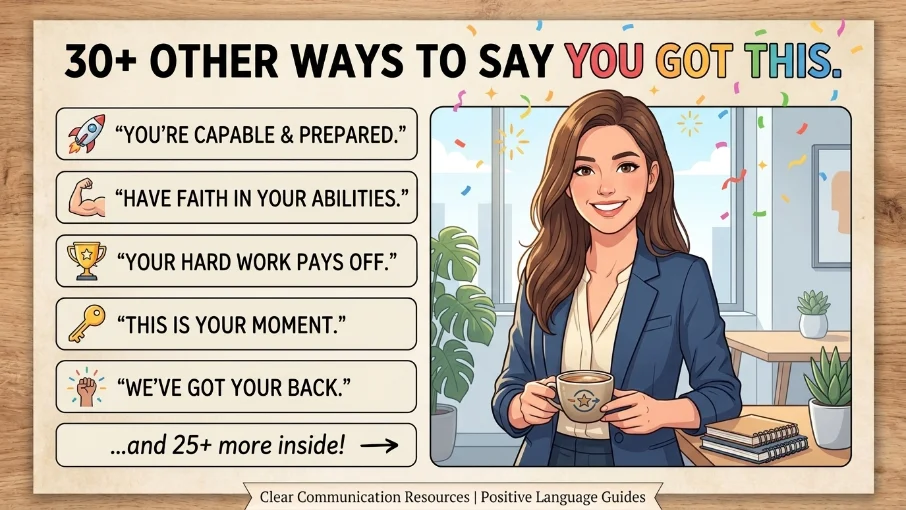
In this guide, you’ll discover 30 other ways to say “You Got This,” including formal, casual, supportive, and inspiring alternatives. Each phrase comes with practical examples to help you encourage others with confidence, build stronger connections, and make your communication more natural and impactful.
Quick Categories
Formal Alternatives to “You Got This”
- I have complete confidence in you
- You are fully capable
- I trust your abilities
- You are well prepared
Casual Alternatives
- You’ll nail it
- Go crush it
- You’ve got this in the bag
- Crush it out there
Professional Alternatives
- I’m confident in your skills
- You have everything needed to succeed
- You’re ready to excel
- This is well within your capabilities
Informal Expressions
- You’re unstoppable
- Own it
- Go get ’em
- Show them what you’re made of
Pro Tip: Match your phrase to the situation. Formal settings demand professional language, while casual environments welcome energetic, playful expressions.
What Does “You Got This” Mean?
“You got this” is a motivational phrase that expresses confidence in someone’s ability to succeed, handle a challenge, or overcome a difficult situation . It reassures the listener that they have the strength, skills, and determination required for the task ahead.
Grammar note: The phrase is colloquial. The grammatically correct form is “I’ve got this” (I have got this), but “I got this” has become widely accepted in informal speech .
Example Sentence: “Don’t worry about the interview—you got this!”
When to Use “You Got This”
- Before a challenge: Exams, presentations, interviews, or competitions
- During stressful moments: When someone feels overwhelmed or anxious
- Supporting a friend or colleague: Offering reassurance in personal or professional situations
- Spoken vs. Written: Primarily used in spoken English and informal written communication (texts, emails to friends)
- Formal vs. Informal: Typically informal; avoid in formal business documents or professional correspondence
Is It Professional or Polite to Say “You Got This”?
“You got this” is polite and friendly, but it lacks the formality required in most professional contexts .
Polite? ✔️ Yes – it shows kindness and support.
Professional? ❌ No – it’s too casual for formal workplaces .
Business Style Example: Instead of saying “You got this,” try: “We have full confidence in your ability to deliver this project successfully.”
Pros and Cons of Using “You Got This”
Pros:
- Simple and natural to use
- Friendly and supportive tone
- Commonly understood across English speakers
- Easy to remember and say
Cons:
- Too informal for professional contexts
- Overused, making it less impactful
- Limited emotional range
- Not suitable for formal writing or presentations
Other Ways to Say “You Got This” (With Examples)
These 30+ alternatives will help you sound more fluent, confident, and natural in different situations. Use them according to tone, context, and audience to express excitement, admiration, or approval.
Formal and Professional Alternatives
1. Phrase: I have complete confidence in you
Meaning: A strong, professional expression of trust.
Explanation: Perfect for managers or mentors reassuring team members.
Example Sentence: “I have complete confidence in your ability to lead this project.”
Best Use: Workplace leadership
Worst Use: Casual conversations with friends
Tone: Professional, reassuring
Context Variability: Formal and professional settings.
2. Phrase: You are fully capable of handling this
Meaning: A direct acknowledgment of someone’s competence.
Explanation: Emphasizes skill and readiness for the task.
Example Sentence: “You are fully capable of handling this client presentation.”
Best Use: Professional encouragement
Worst Use: Very casual settings
Tone: Confident, respectful
Context Variability: Best for professional environments.
3. Phrase: I trust your abilities
Meaning: A statement of confidence in someone’s skills.
Explanation: Shows respect for their expertise and judgment.
Example Sentence: “I trust your abilities to make the right decision here.”
Best Use: Giving responsibility
Worst Use: When someone lacks experience
Tone: Respectful, supportive
Context Variability: Professional and personal support contexts .
4. Phrase: You are well prepared for this
Meaning: Acknowledges the effort and planning invested.
Explanation: Reinforces that preparation leads to success.
Example Sentence: “You are well prepared for this interview—just relax and be yourself.”
Best Use: Before big events
Worst Use: When someone is genuinely unprepared
Tone: Reassuring, factual
Context Variability: Professional and academic contexts .
5. Phrase: You have what it takes
Meaning: Confirms the person possesses all necessary qualities.
Explanation: A direct vote of confidence in their capabilities.
Example Sentence: “You have what it takes to succeed in this role.”
Best Use: Encouraging new challenges
Worst Use: When specific skills are lacking
Tone: Empowering, direct
Context Variability: Both professional and personal settings .
Casual and Friendly Alternatives
6. Phrase: You’ll nail it
Meaning: A confident prediction of success.
Explanation: Informal, energetic encouragement.
Example Sentence: “Don’t stress about the test—you’ll nail it!”
Best Use: Friends, classmates
Worst Use: Formal emails
Tone: Energetic, supportive
Context Variability: Casual spoken English .
7. Phrase: Go crush it
Meaning: Do extremely well; succeed impressively.
Explanation: High energy encouragement for upcoming challenges.
Example Sentence: “It’s your time to shine—go crush it!”
Best Use: Sports, performances
Worst Use: Professional contexts
Tone: Bold, motivating
Context Variability: Spoken casual .
8. Phrase: You’ve got this in the bag
Meaning: Success is virtually guaranteed.
Explanation: Confidence building idiom meaning the outcome is certain.
Example Sentence: “With all your experience, you’ve got this in the bag.”
Best Use: Confident encouragement
Worst Use: If the outcome is truly uncertain
Tone: Assured, playful
Context Variability: Casual and semi casual .
9. Phrase: You’re on the right track
Meaning: Progress is being made in the right direction.
Explanation: Encourages continued effort and reinforces progress.
Example Sentence: “Your work is improving every day—you’re on the right track.”
Best Use: Longer projects
Worst Use: When someone needs immediate correction
Tone: Guiding, positive
Context Variability: Versatile in various spoken contexts .
10. Phrase: Own it
Meaning: Take full control and demonstrate confidence.
Explanation: Encourages commanding presence and self assurance.
Example Sentence: “This is your moment—own it and show them who you are.”
Best Use: Public speaking
Worst Use: When someone lacks confidence
Tone: Bold, assertive
Context Variability: Spoken informal to semi formal .
Supportive and Encouraging Alternatives
11. Phrase: I believe in you
Meaning: A deeply personal expression of faith in someone.
Explanation: Creates emotional connection and reassurance.
Example Sentence: “Whatever happens, I believe in you completely.”
Best Use: Emotional support
Worst Use: Formal business settings
Tone: Warm, trusting
Context Variability: Best for close relationships .
12. Phrase: You can handle this
Meaning: Trust in their ability to manage the situation.
Explanation: Calm, steady reassurance.
Example Sentence: “It’s a lot, but you can handle this—you always do.”
Best Use: Overwhelming situations
Worst Use: When someone needs practical help
Tone: Calm, confident
Context Variability: Spoken and written, personal and semi professional .
13. Phrase: You’re stronger than you think
Meaning: A reminder of hidden resilience.
Explanation: Helps someone recognize their own inner strength.
Example Sentence: “You’ve overcome challenges before—you’re stronger than you think.”
Best Use: Emotional difficulty
Worst Use: When strength isn’t the issue
Tone: Empathetic, empowering
Context Variability: Personal conversations .
14. Phrase: You were made for this
Meaning: This challenge perfectly suits their abilities.
Explanation: Instills confidence through a sense of destiny or fit.
Example Sentence: “You’ve been preparing your whole life for this moment—you were made for this!”
Best Use: Big opportunities
Worst Use: If the person feels unsuited
Tone: Inspiring, bold
Context Variability: Spoken encouragement .
15. Phrase: I’m behind you all the way
Meaning: Complete support regardless of outcome.
Explanation: Shows loyalty and unconditional encouragement.
Example Sentence: “Whatever you decide, I’m behind you all the way.”
Best Use: Major decisions
Worst Use: Casual, everyday situations
Tone: Warm, committed
Context Variability: Personal relationships .
Short and Energetic Alternatives
16. Phrase: You’ve got this covered
Meaning: Total confidence in their ability to handle a specific task.
Explanation: Professional yet friendly reassurance about task completion.
Example Sentence: “No need to worry—you’ve got this covered.”
Best Use: Work tasks
Worst Use: Emotional support
Tone: Confident, reliable
Context Variability: Professional contexts .
17. Phrase: You’re ready for this
Meaning: Confirms preparedness and readiness.
Explanation: Helps reduce anxiety before big moments.
Example Sentence: “You studied for weeks—you’re ready for this exam.”
Best Use: Before tests or presentations
Worst Use: When clearly unprepared
Tone: Calm, steady
Context Variability: Spoken and written .
18. Phrase: You’re unstoppable
Meaning: Nothing can prevent their success.
Explanation: High confidence, motivating phrase.
Example Sentence: “You’ve overcome every obstacle—you’re unstoppable!”
Best Use: High stakes challenges
Worst Use: When someone needs caution
Tone: Empowering, bold
Context Variability: Spoken encouragement .
19. Phrase: Show them what you’re made of
Meaning: Demonstrate true ability and character.
Explanation: Motivates performance and self expression.
Example Sentence: “This is your chance—show them what you’re made of.”
Best Use: Competitive situations
Worst Use: When someone lacks confidence
Tone: Bold, challenging
Context Variability: Spoken contexts .
20. Phrase: You always rise to the challenge
Meaning: Recognizes a pattern of overcoming difficulties.
Explanation: References past success to build future confidence.
Example Sentence: “You always rise to the challenge when things get tough.”
Best Use: Recurring challenges
Worst Use: When someone hasn’t succeeded before
Tone: Affirming, confident
Context Variability: Professional and personal .
21. Phrase: You can do it
Meaning: Simple, direct encouragement.
Explanation: Classic, universally understood phrase.
Example Sentence: “You’ve practiced so hard—you can do it!”
Best Use: Any situation
Worst Use: When more specific support is needed
Tone: Motivational, caring
Context Variability: Versatile in all spoken contexts .
22. Phrase: Keep pushing forward
Meaning: Persist despite obstacles.
Explanation: Encourages continued effort and resilience.
Example Sentence: “The training is intense, but keep pushing forward!”
Best Use: Long term goals
Worst Use: When someone needs rest
Tone: Determined, encouraging
Context Variability: Spoken motivation .
23. Phrase: Go for it
Meaning: Take action with confidence.
Explanation: Encourages decisive, bold action.
Example Sentence: “You’ve been thinking about it for weeks—go for it!”
Best Use: Taking new opportunities
Worst Use: Risky situations
Tone: Bold, encouraging
Context Variability: Casual spoken .
24. Phrase: You’re going to do amazing
Meaning: A positive prediction of outstanding performance.
Explanation: Builds confidence through optimistic expectation.
Example Sentence: “Just be yourself—you’re going to do amazing.”
Best Use: Before performances
Worst Use: If pressure is unwanted
Tone: Cheerful, warm
Context Variability: Spoken encouragement .
25. Phrase: You’re more than capable
Meaning: Capability extends beyond the challenge.
Explanation: Reassures someone who underestimates themselves.
Example Sentence: “You’re more than capable of handling this promotion.”
Best Use: Self doubt situations
Worst Use: When someone lacks skills
Tone: Affirming, respectful
Context Variability: Professional and personal .
26. Phrase: You’ve come this far—keep going
Meaning: Recognize progress and encourage persistence.
Explanation: Highlights past achievements to maintain momentum.
Example Sentence: “You’ve completed the hardest part—keep going!”
Best Use: Long projects
Worst Use: When someone needs direction
Tone: Encouraging, motivating
Context Variability: Spoken support .
27. Phrase: Make it happen
Meaning: Take action and create success.
Explanation: Empowers action and results.
Example Sentence: “You have the resources—now make it happen!”
Best Use: Professional tasks
Worst Use: When support is needed
Tone: Confident, direct
Context Variability: Professional contexts .
28. Phrase: Trust yourself
Meaning: Rely on your own judgment.
Explanation: Encourages inner confidence and self belief.
Example Sentence: “You know what to do—trust yourself.”
Best Use: Decision making
Worst Use: When someone needs guidance
Tone: Gentle, guiding
Context Variability: Personal and professional .
29. Phrase: I know you can do this
Meaning: Personal certainty in their ability.
Explanation: More specific and reassuring than general encouragement.
Example Sentence: “I know you can do this—you’ve worked so hard.”
Best Use: Close relationships
Worst Use: Formal settings
Tone: Warm, genuine
Context Variability: Personal conversations .
30. Phrase: You’re built for this
Meaning: The challenge matches their natural abilities.
Explanation: Emphasizes inherent suitability and strength.
Example Sentence: “You’re a natural leader—you’re built for this role.”
Best Use: New challenges
Worst Use: Emotional support
Tone: Empowering, bold
Context Variability: Spoken encouragement .
“The right tone makes your English sound professional and confident.”
Common Mistakes to Avoid with “You Got This”
Mistake 1: Using it in formal business correspondence
“You got this” is too casual for official emails or reports.
❌ “Regarding the quarterly report, you got this.”
✅ “I am confident in your ability to complete the quarterly report effectively.”
Mistake 2: Overusing it in professional settings
Repeating the same phrase loses impact and sounds unprofessional.
❌ “You got this! You got this presentation. You got this meeting.”
✅ “You’re fully prepared for this presentation, and I trust your expertise in the meeting.”
Mistake 3: Misunderstanding the register (formal vs. informal)
Using it in situations that demand more formal language.
❌ “Your thesis proposal is excellent—you got this!”
✅ “Your thesis proposal is excellent. You are well prepared for this defense.”
Mistake 4: Using it when the person needs practical help
Encouragement isn’t always enough—sometimes action is needed.
❌ “You got this! Just figure it out yourself.”
✅ “I believe you can handle this. Let me know if you need any resources or support.”
Mistake 5: Grammatical confusion in writing
Using it in formal written English without recognizing it’s informal.
❌ “We are confident you got this project.”
✅ “We are confident you can successfully manage this project” .
Comparison Table: Top 10 Alternatives
| Phrase | Tone | Best Use |
| I have complete confidence in you | Professional, formal | Leadership and workplace encouragement |
| I believe in you | Warm, personal | Emotional support and personal relationships |
| You’re fully capable | Respectful, formal | Professional acknowledgment of skills |
| You’ll nail it | Casual, energetic | Friends and informal encouragement |
| You can handle this | Calm, reassuring | Overwhelming or difficult situations |
| You’ve got what it takes | Confident, empowering | New challenges and career moves |
| You’re ready for this | Steady, positive | Before exams, interviews, presentations |
| Go crush it | Bold, energetic | Sports, performances, casual settings |
| You’re unstoppable | Empowering, strong | High stakes or competitive situations |
| I trust your abilities | Professional, supportive | Delegating responsibility |
Quick Quiz: Test Your Knowledge
1. Which phrase is most appropriate for a formal work email?
- A) You’ll nail it
- B) I have complete confidence in your abilities
- C) Go crush it
- Answer: B – “I have complete confidence in your abilities” is professional and formal.
2. Your friend is nervous about a job interview. Which alternative sounds most supportive?
- A) You’re unstoppable
- B) You’ve got this in the bag
- C) I believe in you
- Answer: C – “I believe in you” offers personal, reassuring support.
3. True or False: “You got this” is acceptable in formal business letters.
- Answer: False – “You got this” is too informal for formal business correspondence.
4. Your colleague is about to give their first major presentation. Which is the most appropriate professional encouragement?
- A) Go crush it!
- B) You’re well prepared for this
- C) Own it!
- Answer: B – “You’re well prepared for this” acknowledges effort in a professional way.
FAQs
1. What is a professional way to say “You Got This”?
Professional alternatives include “I have complete confidence in your abilities” and “You’re fully capable of handling this.” They offer encouragement while maintaining a professional tone.
2. What are other ways to say “You Got This” in a text message?
For casual texts, try “You’ll nail it,” “Go crush it,” or “You’ve got this in the bag.” These sound friendly and motivating.
3. What are alternatives to “You Got This” for motivating a team?
Use phrases like “We believe in this team,” “We’re ready for this challenge,” or “Let’s do our best together.” They build confidence and teamwork.
4. What are some emotional or personal ways to say “You Got This” to a friend?
Supportive options include “I believe in you,” “You’re stronger than you think,” and “I’m cheering you on.” These express genuine encouragement.
5. Is “You Got This” grammatically correct?
Yes, “You got this” is widely accepted in informal English. However, “You’ve got this” is the more grammatically complete and traditional form
Conclusion
Expanding your vocabulary with alternatives to “you got this” makes your English more versatile and effective. Whether you’re encouraging a colleague in a professional setting, supporting a friend through a challenge, or motivating yourself, the right phrase strengthens your message and builds deeper connections .
Practice using these alternatives daily. Notice the tone and context where each phrase fits best. The more you practice, the more natural your spoken and written English will become. The right words at the right moment can make all the difference—so choose wisely and encourage with confidence.

Sally Rooney is an American writer who contributes to QuickResponsess.com, creating clear and practical content for English learners. Her articles help readers build confidence in using words and expressions accurately in everyday and professional communication.