Quick Answer
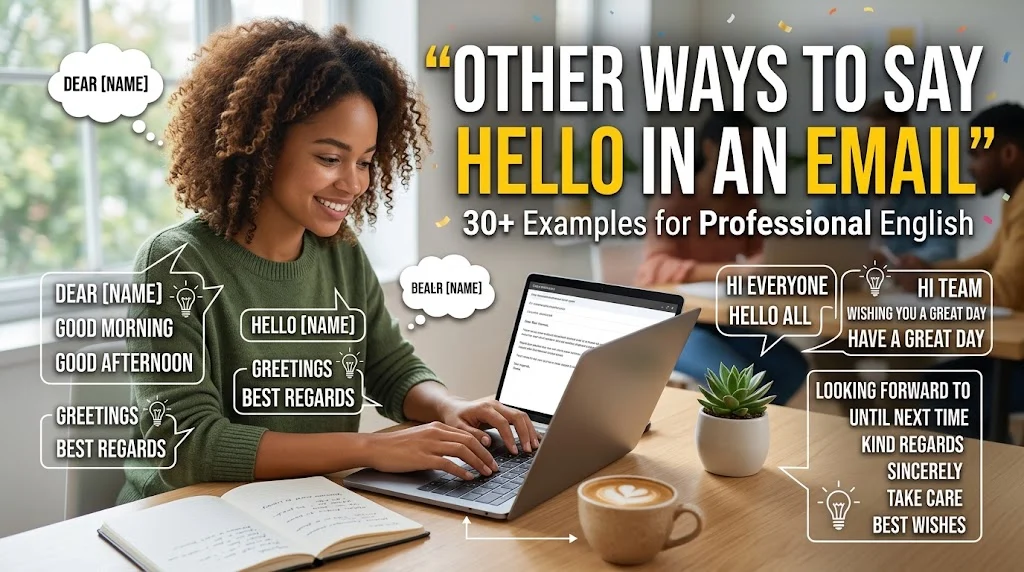
“Hello” is a standard email greeting used to open a message politely. For more variety and professionalism, try alternatives like “Dear [Name],” “Hi [Name],” “Good morning,” “I hope this email finds you well,” “Greetings,” or “I am reaching out regarding.”
“Hello” is one of the first words every English learner uses in an email. It is safe, neutral, and universally understood. Because it is so easy, many learners open every message the same way, whether they are writing to a client, a manager, a colleague, or a friend. That habit makes emails feel repetitive and sometimes too casual for the situation.
This guide provides 30 practical alternatives with meanings, examples, and clear notes on tone. Whether you are drafting a formal proposal or a quick update, these options will help you open your emails with confidence and precision.
Pull Quote: “The first line of an email sets the tone for everything that follows.”
Quick Categories
Formal alternatives to “Hello”
- Dear [Name]
- Dear Sir or Madam
- To whom it may concern
- I hope this email finds you well
Pro Tip: Formal alternatives suit job applications, client emails, and official correspondence.
Casual alternatives
- Hi there
- Hey [Name]
- Hello there
- Hi everyone
Pro Tip: Casual options work with friends, close colleagues, and informal team chats.
Professional alternatives
- Good morning [Name]
- I am reaching out regarding
- Following up on our conversation
- I am writing to you about
Pro Tip: Professional alternatives should match the purpose of the email and the relationship you have with the recipient.
Informal expressions
- Long time no see
- It has been a while
- Just a quick note to say
- Thanks for getting back to me
Pro Tip: Informal expressions belong in messages to people you already know well.
Pull Quote: “The right tone makes your English sound professional and confident.”
Common Mistakes
- Using “Hey” in a formal email.
Example: “Hey Mr Johnson, I am applying for the position.” This is far too casual for a formal application. - Using “To whom it may concern” when you know the recipient’s name.
Example: “To whom it may concern” when the hiring manager’s name is on the job listing. - Forgetting the comma after the greeting.
Example: “Hi John” instead of “Hi John,” followed by the message. - Mixing formal and informal elements in one greeting.
Example: “Dear Sir, hey there, hope you are well.” The tone clashes badly. - Using “Hello” with no name in a professional email.
Example: “Hello, I am writing about the project.” This sounds impersonal and slightly abrupt.
What Does “Hello in an Email” Mean?
Definition
It refers to the opening greeting or salutation used at the start of an email to address the recipient politely.
Grammar Explanation
Email greetings are usually followed by a comma in British English or a comma or colon in American English. The greeting can be a single word (“Hello”), a title with a name (“Dear Dr Smith”), or a short phrase (“I hope this email finds you well”).
Example Sentence
“Dear Ms Patel, I hope this email finds you well.”
When to Use “Hello in an Email”
Common Contexts
- Job applications: Opening a cover letter or enquiry.
- Client communication: Starting a professional message.
- Internal emails: Writing to colleagues or managers.
- Customer service: Responding to a complaint or request.
- Personal emails: Writing to friends and family.
Spoken vs Written
- Spoken: “Hello” is extremely common in conversation and phone calls.
- Written: In emails, it competes with many more specific and formal alternatives.
Formal vs Informal
- Formal: “Dear [Name]” and “To whom it may concern” are standard.
- Informal: “Hi,” “Hey,” and “Hello there” are common in casual messages.
Is It Professional or Polite to Say “Hello in an Email”?
Politeness vs Professionalism
“Hello” is polite and safe, but it can sound generic in professional writing. A more specific greeting, such as “Dear Ms Chen” or “Good morning James,” shows attention and respect. Using the recipient’s name is almost always stronger than a generic greeting.
Business-Style Example
“Dear Ms Chen, I hope this email finds you well. I am writing to follow up on our meeting last Thursday.”
Polite? Yes
Professional? Sometimes, but specific greetings are usually stronger
Pull Quote: “A generic greeting opens a message. A personal one opens a relationship.”
Pros and Cons of Using “Hello in an Email”
Pros
- Simple and natural: Easy to write and understand.
- Friendly tone: Warm and approachable.
- Common usage: Recognised in every English speaking country.
- Easy to understand: Requires no advanced vocabulary.
Cons
- Too informal for work: Can sound generic in formal correspondence.
- Overused: Loses impact when every email opens the same way.
- Limited emotional range: Cannot express formality, warmth, or urgency.
- Not suitable for formal writing: Often replaced by “Dear [Name]” in official contexts.
Other Ways to Say “Hello in an Email” (With Examples)
These alternatives will help you sound more fluent, confident, and natural in different situations. Use them according to tone, context, and audience to express excitement, admiration, or approval.
1. Dear [Name]
Meaning: A standard formal greeting used in professional emails.
Explanation: The safest and most respectful opening in business writing.
Example Sentence: “Dear Ms Patel, thank you for your prompt response.”
Best Use: Formal emails
Worst Use: Close friends
Tone: Formal, respectful, standard
Context Variability: Professional and written
2. Hi [Name]
Meaning: A friendly and slightly informal greeting.
Explanation: Common in workplaces with relaxed communication.
Example Sentence: “Hi James, just following up on the report.”
Best Use: Colleagues, clients
Worst Use: Legal letters
Tone: Friendly, professional, warm
Context Variability: Professional and casual
3. Hello [Name]
Meaning: A polite but neutral greeting.
Explanation: Slightly more formal than “Hi” but less formal than “Dear.”
Example Sentence: “Hello Sarah, I hope you are well.”
Best Use: General emails
Worst Use: Very formal writing
Tone: Neutral, polite, standard
Context Variability: Professional and casual
4. Good morning [Name]
Meaning: A time specific formal greeting.
Explanation: Adds warmth and personal attention.
Example Sentence: “Good morning David, I wanted to share a quick update.”
Best Use: Morning emails
Worst Use: Evening emails
Tone: Formal, warm, considerate
Context Variability: Professional and written
5. Good afternoon [Name]
Meaning: A polite greeting for the afternoon.
Explanation: Common in business correspondence.
Example Sentence: “Good afternoon Laura, thank you for your patience.”
Best Use: Afternoon emails
Worst Use: Morning emails
Tone: Formal, polite, professional
Context Variability: Professional and written
6. Good evening [Name]
Meaning: A polite greeting for the evening.
Explanation: Less common but appropriate for evening messages.
Example Sentence: “Good evening Mr Brown, I am writing regarding tomorrow’s meeting.”
Best Use: Evening emails
Worst Use: Morning emails
Tone: Formal, polite, calm
Context Variability: Professional and written
7. Dear Sir or Madam
Meaning: A formal greeting when the recipient’s name is unknown.
Explanation: Very traditional and formal.
Example Sentence: “Dear Sir or Madam, I am writing to enquire about the position.”
Best Use: Formal enquiries
Worst Use: Known recipients
Tone: Formal, distant, traditional
Context Variability: Professional and written
8. To whom it may concern
Meaning: A formal greeting for an unknown recipient.
Explanation: Common in reference letters and official documents.
Example Sentence: “To whom it may concern, I am writing to confirm her employment.”
Best Use: Official documents
Worst Use: Known recipients
Tone: Formal, impersonal, official
Context Variability: Professional and written
9. Greetings
Meaning: A neutral and slightly old fashioned greeting.
Explanation: Short and unusual in modern email.
Example Sentence: “Greetings, I hope this message finds you well.”
Best Use: Neutral contexts
Worst Use: Business emails
Tone: Neutral, formal, unusual
Context Variability: Written and formal
10. Warm greetings
Meaning: A friendly and slightly formal greeting.
Explanation: Adds warmth to a standard opener.
Example Sentence: “Warm greetings from the marketing team.”
Best Use: Newsletters
Worst Use: Legal documents
Tone: Warm, friendly, formal
Context Variability: Professional and written
11. Hi there
Meaning: A casual and friendly greeting.
Explanation: Common in informal workplace messages.
Example Sentence: “Hi there, just checking in on the timeline.”
Best Use: Colleagues, teams
Worst Use: Formal letters
Tone: Casual, friendly, relaxed
Context Variability: Casual and spoken
12. Hey [Name]
Meaning: A very informal greeting.
Explanation: Common among friends and close colleagues.
Example Sentence: “Hey Mike, are we still on for tomorrow?”
Best Use: Friends
Worst Use: Client emails
Tone: Very casual, friendly, informal
Context Variability: Casual and spoken
13. Hello there
Meaning: A slightly playful version of hello.
Explanation: Common in informal emails.
Example Sentence: “Hello there, it has been a while.”
Best Use: Acquaintances
Worst Use: Formal writing
Tone: Friendly, playful, casual
Context Variability: Casual and spoken
14. Dear team
Meaning: A greeting addressed to a group.
Explanation: Common in internal communication.
Example Sentence: “Dear team, please find the updated schedule attached.”
Best Use: Team emails
Worst Use: Personal messages
Tone: Professional, inclusive, formal
Context Variability: Professional and written
15. Dear all
Meaning: A formal greeting to a group.
Explanation: Common in workplace announcements.
Example Sentence: “Dear all, I am pleased to announce the new policy.”
Best Use: Announcements
Worst Use: Personal messages
Tone: Formal, inclusive, professional
Context Variability: Professional and written
16. Hi everyone
Meaning: A friendly greeting to a group.
Explanation: Casual and warm.
Example Sentence: “Hi everyone, just a reminder about the meeting.”
Best Use: Team chats
Worst Use: Formal announcements
Tone: Friendly, casual, inclusive
Context Variability: Casual and professional
17. Good day
Meaning: A neutral, slightly formal greeting.
Explanation: More common in Australian and South African English.
Example Sentence: “Good day, I am writing to confirm our appointment.”
Best Use: Formal contexts
Worst Use: Informal chats
Tone: Neutral, formal, traditional
Context Variability: Professional and written
18. I hope this email finds you well
Meaning: A polite opening line that precedes the main message.
Explanation: Very common in professional emails.
Example Sentence: “I hope this email finds you well. I am writing to discuss the proposal.”
Best Use: Business emails
Worst Use: Quick texts
Tone: Formal, polite, standard
Context Variability: Professional and written
19. I hope you are doing well
Meaning: A warm and personal opening line.
Explanation: Slightly less formal than the previous option.
Example Sentence: “I hope you are doing well. It has been a busy month here.”
Best Use: Colleagues, clients
Worst Use: Formal reports
Tone: Warm, polite, personal
Context Variability: Professional and written
20. I trust this message finds you well
Meaning: A formal and slightly old fashioned opener.
Explanation: Common in traditional business correspondence.
Example Sentence: “I trust this message finds you well. I am writing regarding the contract.”
Best Use: Formal emails
Worst Use: Casual chats
Tone: Formal, traditional, polite
Context Variability: Professional and written
21. I hope your week is going well
Meaning: A friendly and specific opener.
Explanation: Adds a personal touch.
Example Sentence: “I hope your week is going well. Could you review the attached draft?”
Best Use: Colleagues
Worst Use: Formal letters
Tone: Warm, friendly, personal
Context Variability: Professional and written
22. Hope all is well
Meaning: A short, warm opener.
Explanation: Common in both professional and personal emails.
Example Sentence: “Hope all is well. Just wanted to share a quick update.”
Best Use: General emails
Worst Use: Formal writing
Tone: Warm, casual, friendly
Context Variability: Casual and professional
23. Nice to meet you
Meaning: A greeting for a first contact.
Explanation: Warm and personal.
Example Sentence: “Nice to meet you. I enjoyed our conversation at the conference.”
Best Use: First contact
Worst Use: Repeat emails
Tone: Warm, friendly, personal
Context Variability: Professional and spoken
24. Pleasure to connect
Meaning: A polite greeting for a new contact.
Explanation: Professional and slightly formal.
Example Sentence: “Pleasure to connect. I look forward to working together.”
Best Use: Networking
Worst Use: Close friends
Tone: Professional, polite, warm
Context Variability: Professional and written
25. Following up on our conversation
Meaning: An opener that references a previous discussion.
Explanation: Specific and professional.
Example Sentence: “Following up on our conversation, I have attached the requested documents.”
Best Use: Business emails
Worst Use: First contact
Tone: Professional, specific, direct
Context Variability: Professional and written
26. I am reaching out regarding
Meaning: A clear opener that states the purpose.
Explanation: Professional and efficient.
Example Sentence: “I am reaching out regarding the upcoming project deadline.”
Best Use: Business emails
Worst Use: Personal messages
Tone: Professional, clear, direct
Context Variability: Professional and written
27. I am writing to you about
Meaning: A direct opener that names the topic.
Explanation: Simple and professional.
Example Sentence: “I am writing to you about the invoice sent last week.”
Best Use: Business emails
Worst Use: Casual chats
Tone: Professional, direct, clear
Context Variability: Professional and written
28. Just a quick note to say
Meaning: A light and friendly opener.
Explanation: Signals a short message.
Example Sentence: “Just a quick note to say thank you for your help.”
Best Use: Short messages
Worst Use: Formal reports
Tone: Friendly, casual, brief
Context Variability: Casual and professional
29. Thank you for your email
Meaning: A polite opener that acknowledges the previous message.
Explanation: Common in replies.
Example Sentence: “Thank you for your email. I have reviewed the details you sent.”
Best Use: Replies
Worst Use: First contact
Tone: Polite, professional, appreciative
Context Variability: Professional and written
30. Thanks for getting back to me
Meaning: A warm opener that acknowledges a reply.
Explanation: Slightly more casual than the previous option.
Example Sentence: “Thanks for getting back to me. I will review the options and respond by Friday.”
Best Use: Colleagues, clients
Worst Use: Formal letters
Tone: Warm, appreciative, casual
Context Variability: Professional and casual
Pull Quote: “Professional reaction phrases and thoughtful greetings both show the same thing: you see the person behind the message.”
Mini Quiz / Self-Check
- Scenario: You are applying for a job and do not know the hiring manager’s name. Which greeting fits best?
- A) Hey there.
- B) Dear Sir or Madam.
- C) Hi everyone.
- Scenario: You are emailing a colleague you know well about a project update. Which is most natural?
- A) To whom it may concern.
- B) Hi James, just following up on the report.
- C) Dear Sir or Madam.
- Scenario: You are writing to a client after a meeting. Which opener is most professional?
- A) Hey, what’s up?
- B) Following up on our conversation, I have attached the requested documents.
- C) Long time no see.
- Scenario: Which greeting is generally too informal for a business email?
- A) Dear Ms Patel.
- B) Hey Mike.
- C) Good morning David.
Comparison Table: Top Alternatives
| Phrase | Tone | Best Use |
| Dear [Name] | Formal, respectful | Job applications, clients |
| Hi [Name] | Friendly, professional | Colleagues, clients |
| Good morning [Name] | Formal, warm | Morning emails |
| To whom it may concern | Formal, impersonal | Unknown recipients |
| I hope this email finds you well | Formal, polite | Business emails |
| Hi there | Casual, friendly | Team messages |
| Hey [Name] | Very casual | Friends, close colleagues |
| I am reaching out regarding | Professional, direct | Business emails |
| Following up on our conversation | Professional, specific | Business follow ups |
| Thanks for getting back to me | Warm, appreciative | Replies |
FAQs
1. What is a formal alternative to “Hello” in an email?
“Dear [Name]” or “Dear Sir or Madam” are the most formal alternatives, suitable for job applications, client emails, and official correspondence.
2. How do I start an email professionally?
Use a specific greeting such as “Dear Ms Chen” or “Good morning James,” followed by a clear opening line like “I hope this email finds you well.”
3. Is “Hey” acceptable in a business email?
“Hey” is very casual and should only be used with close colleagues or friends. In professional writing, “Hi [Name]” or “Dear [Name]” is safer.
4. What can I say instead of “Hello” in a quick email to a colleague?
“Hi there,” “Hope all is well,” and “Just a quick note to say” are natural and friendly alternatives for internal messages.
5. What is the difference between “Dear” and “Hi” in an email?
“Dear” is formal and respectful, while “Hi” is friendly and slightly more casual. The right choice depends on the relationship and the context.
Conclusion
Learning other ways to say hello in an email gives you the ability to open every message with the right tone. Whether you are writing to a client, a manager, or a friend, the first line sets the impression for everything that follows. These alternatives to hello in an email help you move beyond one overused greeting and into more thoughtful, professional communication.
Practise by choosing one new greeting each week and using it in a real email. Pay close attention to tone and audience, because the right phrase depends on the relationship and the purpose. With steady practice, these informal expressions in English and their formal counterparts will become part of your everyday fluency.

Sally Rooney is an American writer who contributes to QuickResponsess.com, creating clear and practical content for English learners. Her articles help readers build confidence in using words and expressions accurately in everyday and professional communication.