Quick Answer
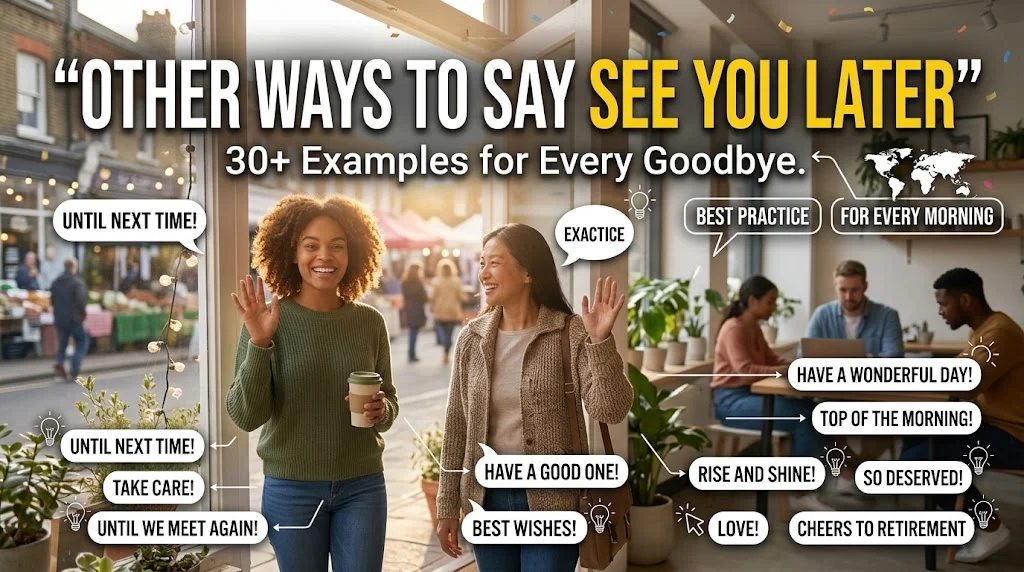
“See you later” is a casual farewell used when you expect to meet someone again. For more variety and precision, try alternatives like “Catch you later,” “Talk soon,” “Until next time,” “Take care,” or “See you around.”
“See you later” is one of the most common farewells in English. It appears at the end of phone calls, meetings, coffee dates, and text conversations. It is warm, casual, and reassuring because it implies that another meeting will happen.
This guide provides 30 practical alternatives with clear notes on tone, context, and audience. You will learn how to close conversations naturally, how to express excitement in English about meeting again, and how to use professional reaction phrases when leaving a workplace setting. Whether you are saying goodbye in person, on the phone, or in writing, these options will help you sound fluent and confident.
Pull Quote: “A goodbye is the last thing people remember. Choose words that leave the right impression.”
Quick Categories
Formal alternatives to “See you later”
- I look forward to our next meeting.
- Until we meet again.
- I wish you well until then.
- Farewell for now.
Pro Tip: Formal alternatives suit client meetings, official correspondence, and professional farewells.
Casual alternatives
- Catch you later.
- See you around.
- Later.
- Bye for now.
Pro Tip: Casual options work with friends, family, and familiar colleagues.
Professional alternatives
- Looking forward to our next conversation.
- Speak soon.
- Until our next meeting.
- Have a productive rest of your day.
Pro Tip: Professional alternatives should feel warm but remain appropriate for workplace communication.
Informal expressions
- Catch you on the flip side.
- See you in a bit.
- Take it easy.
- Catch you soon.
Pro Tip: Informal expressions belong in texts, chats, and spoken English with close contacts.
Pull Quote: “The right tone makes your English sound professional and confident.”
Common Mistakes
- Using “see you later” when you will not meet again.
Example: Saying “see you later” to someone moving abroad permanently. “Take care” or “All the best” fits better. - Using it in a formal business letter.
Example: “Dear Sir, see you later.” This is far too casual for formal correspondence. - Using it to end a difficult conversation.
Example: “We need to discuss your performance. See you later.” The farewell feels dismissive. - Repeating it multiple times in one goodbye.
Example: “See you later. See you soon. See you around.” Repetition weakens impact. - Using it when the meeting time is already confirmed.
Example: “See you later” when you have a scheduled appointment tomorrow. “See you tomorrow” is more precise.
What Does “See You Later” Mean?
Definition
It is a casual farewell that implies you expect to meet the other person again, though the exact time is not specified.
Grammar Explanation
“See” is a verb, “you” is the object, and “later” is an adverb of time. The phrase functions as a complete farewell and is often shortened to “later” in very informal speech.
Example Sentence
“I have to run to a meeting. See you later.”
When to Use “See You Later”
Common Contexts
- Workplace: Leaving a colleague at the end of the day.
- Phone calls: Ending a friendly conversation.
- Social settings: Saying goodbye after meeting friends.
- Text messages: Closing a chat casually.
- Family: Leaving home or ending a visit.
Spoken vs Written
- Spoken: Extremely common in daily conversation.
- Written: Common in texts and informal messages, less so in formal writing.
Formal vs Informal
- Formal: Rarely appropriate in formal settings.
- Informal: The default choice in everyday speech.
Is It Professional or Polite to Say “See You Later”?
Politeness vs Professionalism
The phrase is polite and friendly, but it is not professional in most formal contexts. It works well with colleagues you know well, but for clients or official correspondence, a more formal farewell is safer.
Business-Style Example
“Thank you for your time today. I look forward to our next meeting.”
Polite? Yes
Professional? Not usually in formal correspondence
Pull Quote: “A farewell that fits a coffee shop can feel out of place in a boardroom.”
Pros and Cons of Using “See You Later”
Pros
- Simple and natural: Easy to say and understand.
- Friendly tone: Warm and approachable.
- Common usage: Recognised in every English speaking country.
- Easy to understand: Requires no advanced vocabulary.
Cons
- Too informal for work: Rarely appropriate in formal writing.
- Overused: Loses impact through repetition.
- Limited emotional range: Cannot express sincerity or affection.
- Not suitable for formal writing: Avoid in reports, letters, and official documents.
Other Ways to Say “See You Later” (With Examples)
These alternatives will help you sound more fluent, confident, and natural in different situations. Use them according to tone, context, and audience to express excitement, admiration, or approval.
1. Catch you later
Meaning: A casual farewell implying you will meet again.
Explanation: Very common in informal English.
Example Sentence: “I am off to class. Catch you later.”
Best Use: Friends, colleagues
Worst Use: Formal emails
Tone: Casual, friendly, relaxed
Context Variability: Casual and spoken
2. See you around
Meaning: A farewell suggesting you will meet again casually.
Explanation: Implies no specific plan.
Example Sentence: “It was great seeing you. See you around.”
Best Use: Acquaintances, social
Worst Use: Formal writing
Tone: Casual, light, friendly
Context Variability: Casual and spoken
3. Talk soon
Meaning: A farewell suggesting you will speak again soon.
Explanation: Common in phone calls and messages.
Example Sentence: “I will send that file today. Talk soon.”
Best Use: Phone calls, emails
Worst Use: In person farewells
Tone: Friendly, professional, warm
Context Variability: Professional and spoken
4. Until next time
Meaning: A farewell implying another meeting will happen.
Explanation: Slightly more formal and elegant.
Example Sentence: “It was a pleasure. Until next time.”
Best Use: Events, meetings
Worst Use: Casual chats
Tone: Formal, warm, polite
Context Variability: Professional and spoken
5. Take care
Meaning: A warm farewell wishing someone wellbeing.
Explanation: Simple and universally understood.
Example Sentence: “Take care, and I will see you next week.”
Best Use: Everyday farewells
Worst Use: Formal letters
Tone: Warm, kind, neutral
Context Variability: Casual and professional
6. See you soon
Meaning: A farewell implying a near future meeting.
Explanation: More specific than “later.”
Example Sentence: “Enjoy your holiday. See you soon.”
Best Use: Friends, family
Worst Use: Formal correspondence
Tone: Warm, friendly, casual
Context Variability: Casual and spoken
7. Later
Meaning: A very short, casual farewell.
Explanation: Common among friends and peers.
Example Sentence: “I have to go. Later.”
Best Use: Close friends
Worst Use: Professional settings
Tone: Very casual, brief, informal
Context Variability: Casual and spoken
8. Bye for now
Meaning: A temporary farewell.
Explanation: Suggests the goodbye is not final.
Example Sentence: “I will call you tomorrow. Bye for now.”
Best Use: Phone calls, texts
Worst Use: Formal writing
Tone: Friendly, casual, warm
Context Variability: Casual and spoken
9. I look forward to our next meeting
Meaning: A formal farewell expressing anticipation.
Explanation: Common in business correspondence.
Example Sentence: “Thank you for your time. I look forward to our next meeting.”
Best Use: Client meetings
Worst Use: Casual chats
Tone: Formal, professional, polite
Context Variability: Professional and written
10. Until we meet again
Meaning: A slightly dramatic farewell.
Explanation: Formal and sometimes literary.
Example Sentence: “Safe travels. Until we meet again.”
Best Use: Formal farewells
Worst Use: Quick texts
Tone: Formal, dramatic, warm
Context Variability: Professional and written
11. Farewell for now
Meaning: A formal goodbye with the possibility of return.
Explanation: Slightly old fashioned but elegant.
Example Sentence: “Farewell for now, and thank you for everything.”
Best Use: Formal farewells
Worst Use: Casual chats
Tone: Formal, elegant, traditional
Context Variability: Professional and written
12. Speak soon
Meaning: A farewell suggesting another conversation will follow.
Explanation: Common in British English.
Example Sentence: “I will update you next week. Speak soon.”
Best Use: Phone calls, emails
Worst Use: In person farewells
Tone: Friendly, professional, warm
Context Variability: Professional and spoken
13. Catch you on the flip side
Meaning: A playful farewell.
Explanation: Very informal and slightly dated.
Example Sentence: “Off to my shift. Catch you on the flip side.”
Best Use: Close friends
Worst Use: Business emails
Tone: Playful, informal, humorous
Context Variability: Casual and spoken
14. See you in a bit
Meaning: A farewell implying you will meet shortly.
Explanation: Specific about timing.
Example Sentence: “I am just getting coffee. See you in a bit.”
Best Use: Colleagues, friends
Worst Use: Formal writing
Tone: Casual, friendly, specific
Context Variability: Casual and spoken
15. Take it easy
Meaning: A relaxed farewell wishing someone calm.
Explanation: Common in informal English.
Example Sentence: “Enjoy your weekend. Take it easy.”
Best Use: Friends, colleagues
Worst Use: Formal letters
Tone: Relaxed, friendly, informal
Context Variability: Casual and spoken
16. Have a good one
Meaning: A casual farewell wishing someone a good day.
Explanation: Short and friendly.
Example Sentence: “See you tomorrow. Have a good one.”
Best Use: Informal settings
Worst Use: Formal writing
Tone: Casual, friendly, relaxed
Context Variability: Casual and spoken
17. I will be in touch
Meaning: A professional farewell promising future contact.
Explanation: Common in business correspondence.
Example Sentence: “Thank you for your time. I will be in touch.”
Best Use: Client emails
Worst Use: Casual chats
Tone: Professional, formal, neutral
Context Variability: Professional and written
18. Looking forward to catching up
Meaning: A warm farewell anticipating a future conversation.
Explanation: Personal and friendly.
Example Sentence: “It was great seeing you. Looking forward to catching up.”
Best Use: Friends, colleagues
Worst Use: Formal writing
Tone: Warm, friendly, personal
Context Variability: Casual and spoken
19. Until our next conversation
Meaning: A formal farewell anticipating future contact.
Explanation: Professional and polite.
Example Sentence: “Thank you for the call. Until our next conversation.”
Best Use: Business calls
Worst Use: Casual chats
Tone: Formal, professional, polite
Context Variability: Professional and spoken
20. See you then
Meaning: A farewell confirming a specific future meeting.
Explanation: Precise and practical.
Example Sentence: “The meeting is at ten. See you then.”
Best Use: Scheduled meetings
Worst Use: Vague goodbyes
Tone: Practical, friendly, specific
Context Variability: Professional and spoken
21. Have a safe trip
Meaning: A farewell for someone travelling.
Explanation: Practical and caring.
Example Sentence: “Thanks for visiting. Have a safe trip.”
Best Use: Departures
Worst Use: Office farewells
Tone: Caring, practical, warm
Context Variability: Casual and spoken
22. Rest well
Meaning: A farewell wishing someone good rest.
Explanation: Gentle and caring.
Example Sentence: “You have had a long day. Rest well.”
Best Use: Evening farewells
Worst Use: Morning contexts
Tone: Gentle, caring, warm
Context Variability: Casual and spoken
23. Enjoy the rest of your day
Meaning: A warm farewell for the remainder of the day.
Explanation: Polite and considerate.
Example Sentence: “It was lovely speaking with you. Enjoy the rest of your day.”
Best Use: Phone calls, emails
Worst Use: Quick chats
Tone: Warm, polite, considerate
Context Variability: Professional and spoken
24. Catch you soon
Meaning: A casual farewell suggesting a near future meeting.
Explanation: Friendly and informal.
Example Sentence: “I am off now. Catch you soon.”
Best Use: Friends, colleagues
Worst Use: Formal writing
Tone: Casual, friendly, warm
Context Variability: Casual and spoken
25. All the best
Meaning: A warm farewell wishing success.
Explanation: Common in British English.
Example Sentence: “Good luck with the move. All the best.”
Best Use: Farewells, cards
Worst Use: Quick texts
Tone: Warm, polite, standard
Context Variability: Professional and written
26. See you next time
Meaning: A farewell implying another meeting.
Explanation: Slightly more specific than “later.”
Example Sentence: “Thanks for coming. See you next time.”
Best Use: Events, service
Worst Use: Final farewells
Tone: Friendly, warm, casual
Context Variability: Casual and spoken
27. Have a wonderful evening
Meaning: A warm farewell for the evening.
Explanation: Elegant and slightly formal.
Example Sentence: “It was lovely seeing you. Have a wonderful evening.”
Best Use: Evening farewells
Worst Use: Morning contexts
Tone: Warm, elegant, polite
Context Variability: Professional and spoken
28. See you on Monday
Meaning: A precise farewell naming the next meeting.
Explanation: Specific and practical.
Example Sentence: “Have a good weekend. See you on Monday.”
Best Use: Workplace
Worst Use: Vague goodbyes
Tone: Practical, friendly, specific
Context Variability: Professional and spoken
29. Take care of yourself
Meaning: A caring farewell wishing someone wellbeing.
Explanation: Warmer and more personal than “take care.”
Example Sentence: “It was good to see you. Take care of yourself.”
Best Use: Personal farewells
Worst Use: Quick texts
Tone: Caring, warm, personal
Context Variability: Casual and spoken
30. Until tomorrow
Meaning: A farewell confirming a meeting the next day.
Explanation: Short and precise.
Example Sentence: “Get some rest. Until tomorrow.”
Best Use: Workplace, friends
Worst Use: Final farewells
Tone: Friendly, practical, warm
Context Variability: Professional and spoken
Pull Quote: “Professional reaction phrases and warm farewells both show the same thing: you value the relationship, not just the conversation.”
Mini Quiz / Self-Check
- Scenario: You are ending a client meeting and want to sound professional. Which fits best?
- A) Catch you later.
- B) I look forward to our next meeting.
- C) Later.
- Scenario: You are saying goodbye to a close friend after coffee. Which is most natural?
- A) I look forward to our next meeting.
- B) Catch you later.
- C) Until we meet again.
- Scenario: You are ending a phone call with a colleague you will speak to next week. Which is most appropriate?
- A) Talk soon.
- B) Catch you on the flip side.
- C) Farewell for now.
- Scenario: Which phrase is generally too informal for a business email?
- A) I will be in touch.
- B) Later.
- C) Speak soon.
Comparison Table: Top Alternatives
| Phrase | Tone | Best Use |
| Catch you later | Casual, friendly | Friends, colleagues |
| Talk soon | Friendly, professional | Phone calls, emails |
| Until next time | Formal, warm | Events, meetings |
| Take care | Warm, kind | Everyday farewells |
| See you soon | Warm, friendly | Friends, family |
| I look forward to our next meeting | Formal, professional | Client meetings |
| Speak soon | Friendly, professional | Phone calls, emails |
| See you then | Practical, specific | Scheduled meetings |
| All the best | Warm, polite | Farewells, cards |
| Have a wonderful evening | Warm, elegant | Evening farewells |
FAQs
1. What is a formal alternative to “see you later”?
“I look forward to our next meeting” or “Until we meet again” are strong formal alternatives suitable for client meetings and official correspondence.
2. How do I say goodbye professionally without sounding cold?
Use warm but specific phrases such as “Thank you for your time. I look forward to our next conversation” to balance professionalism with warmth.
3. What can I say instead of “see you later” in a text message?
“Catch you later,” “Talk soon,” and “Bye for now” are natural and friendly alternatives for texts.
4. Is “see you later” too informal for business emails?
It is generally too casual for formal business writing. Use “I will be in touch” or “Looking forward to our next conversation” instead.
5. What is the difference between “see you later” and “see you soon”?
“See you later” is vague about timing, while “see you soon” suggests a meeting in the near future.
Conclusion
Learning other ways to say see you later gives you the ability to close conversations with warmth, precision, and personality. Whether you are leaving a meeting, ending a phone call, or saying goodbye to a friend, the right phrase makes your English sound thoughtful rather than automatic. These alternatives to see you later help you move beyond one overused farewell and into richer expression.
Practise by choosing one new goodbye phrase each week and using it in a real conversation. Pay close attention to tone and audience, because the right phrase depends on the relationship and the occasion. With steady practice, these informal expressions in English and their formal counterparts will become part of your everyday fluency.

Stephen King is an American writer and language enthusiast who enjoys creating clear, practical content that helps readers communicate with confidence. His work at QuickResponsess.com focuses on making English easier to understand through simple explanations and everyday examples.