Quick Answer
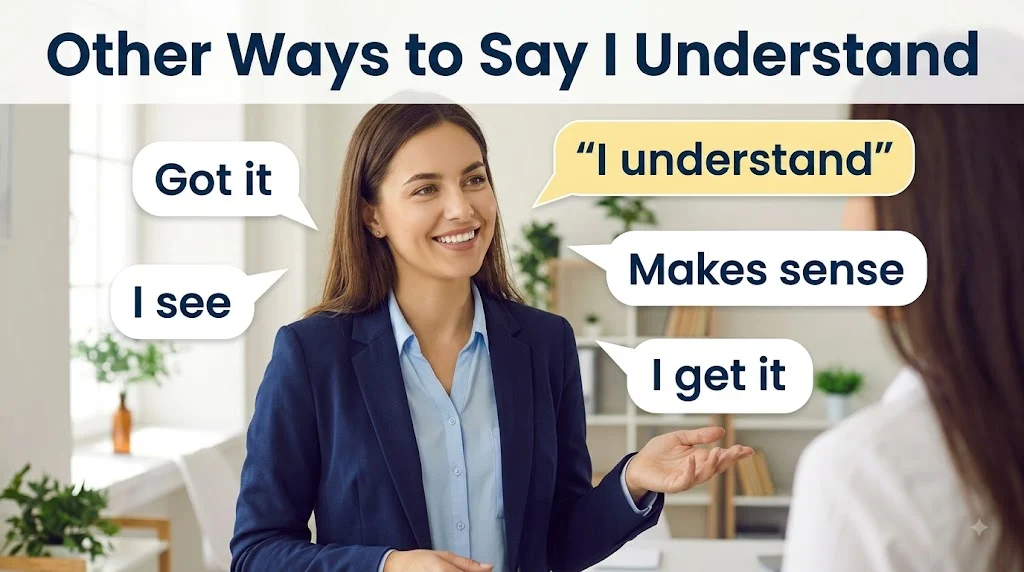
Looking for alternatives to “I understand”? Try these top picks: I see your point, That makes sense, I follow you, I hear you, and Understood each suited for different tones and contexts.
“I understand” is one of the most common phrases in English. It confirms that you have received, processed, and comprehended what someone has communicated. Whether you are in a meeting, chatting with a friend, or replying to an email, this phrase signals active listening and acknowledgment.
However, using the same expression repeatedly can make your speech and writing feel repetitive and uninspired. Learning alternatives to “I understand” helps you sound more fluent, confident, and emotionally aware. Different situations call for different tones and knowing which phrase to use can elevate your professional presence and deepen your personal connections. It also helps you express excitement in English or show empathy, depending on what the moment requires.
“The right tone makes your English sound professional and confident.”
Quick Categories
Formal Alternatives to “I Understand”
- I acknowledge your point
- I appreciate your explanation
- Your point is well taken
- I have fully grasped the situation
Casual Alternatives
- I get it
- Got it
- I see
- Makes sense
Professional Alternatives
- I am aligned with your perspective
- I follow your reasoning
- I am on the same page
- I have taken note of that
Informal Expressions
- I hear you
- I feel you
- Gotcha
- Roger that
Pro Tip: Match your phrase to your audience. Formal settings demand precision; casual settings reward warmth and brevity.
What Does “I Understand” Mean?
To understand something is to perceive its meaning, nature, or significance. In conversation, saying “I understand” indicates that you have comprehended the speaker’s message, whether it is factual information, an emotional sentiment, or a set of instructions.
Example: “I understand the deadline is Friday at noon.”
When to Use “I Understand”
- In spoken English — during conversations, meetings, and casual chats
- In written English — emails, messages, and formal correspondence
- In professional settings — to confirm instructions or acknowledge feedback
- In personal contexts — to show empathy or agreement
- Formal vs Informal — “I understand” is neutral but leans formal in writing
Is It Professional or Polite to Say “I Understand”?
Polite? ✔️ Yes
Professional? ❌ Not in most cases
While “I understand” is polite and widely accepted, it lacks the sophistication expected in high level professional communication. In business emails or client interactions, it can sound overly simple or even dismissive.
Business style example: “I understand your concerns and will address them in the next revision.” — polite but basic. A more professional alternative would be: “Your concerns are well taken, and I will ensure they are addressed.”
Pros and Cons of Using “I Understand”
Pros
- Simple and natural
- Friendly tone
- Common usage — universally understood
- Easy to understand
Cons
- Too informal for work in many contexts
- Overused — can sound repetitive
- Limited emotional range
- Not suitable for formal writing
Common Mistakes When Using “I Understand”
- Using it too often — “I understand. I understand. I understand.” Repetition weakens impact.
- Using it sarcastically — “Oh, I understand now.” Sarcasm can offend.
- Using it without actually understanding — Nodding and saying “I understand” when you are confused is misleading.
- Using it in formal writing — “I understand the terms and conditions” sounds weak; use “I acknowledge” instead.
- Forgetting tone — “I understand” can sound cold in emotional conversations. Try “I hear you” instead.
Other Ways to Say “I Understand” — 30 Alternatives with Examples
These alternatives will help you sound more fluent, confident, and natural in different situations. Use them according to tone, context, and audience to express excitement, admiration, or approval.
1. Phrase: I see your point
- Meaning: You recognize and comprehend the other person’s argument or perspective.
- Explanation: A respectful way to show you have considered their viewpoint.
- Example Sentence: “I see your point about extending the deadline — let me think it over.”
- Best Use: Professional discussions
- Worst Use: Casual texting
- Tone: Respectful, thoughtful
- Context Variability: Professional
2. Phrase: That makes sense
- Meaning: The information is logical and clear to you.
- Explanation: Confirms that you follow the reasoning behind the statement.
- Example Sentence: “That makes sense — I’ll update the report accordingly.”
- Best Use: Meetings and emails
- Worst Use: Emotional conversations
- Tone: Neutral, agreeable
- Context Variability: Professional / Casual
3. Phrase: I follow you
- Meaning: You are keeping up with the speaker’s line of thought.
- Explanation: Assures the speaker that you are tracking their explanation.
- Example Sentence: “I follow you — so the next step is to contact the client?”
- Best Use: Complex explanations
- Worst Use: Formal writing
- Tone: Attentive, engaged
- Context Variability: Spoken
4. Phrase: I hear you
- Meaning: You acknowledge what someone is saying, often with empathy.
- Explanation: Shows you are listening and value their input.
- Example Sentence: “I hear you — that deadline is really tight.”
- Best Use: Emotional or casual conversations
- Worst Use: Formal reports
- Tone: Empathetic, warm
- Context Variability: Casual / Spoken
5. Phrase: Understood
- Meaning: A concise confirmation that you have received and comprehended the message.
- Explanation: Short, clear, and professional.
- Example Sentence: “Understood. I will proceed with the changes.”
- Best Use: Email replies and task confirmations
- Worst Use: Personal, emotional talks
- Tone: Direct, efficient
- Context Variability: Professional
6. Phrase: I get it
- Meaning: You fully comprehend the point being made.
- Explanation: Very common in everyday speech.
- Example Sentence: “I get it — you want the design to be more modern.”
- Best Use: Casual conversations
- Worst Use: Formal presentations
- Tone: Relaxed, friendly
- Context Variability: Casual
7. Phrase: Got it
- Meaning: You have understood and will act on the information.
- Explanation: Informal and efficient.
- Example Sentence: “Got it — I’ll send the file by noon.”
- Best Use: Quick confirmations
- Worst Use: Formal emails
- Tone: Brief, confident
- Context Variability: Casual / Spoken
8. Phrase: I appreciate that
- Meaning: You value and understand the information or effort shared.
- Explanation: Combines understanding with gratitude.
- Example Sentence: “I appreciate that you took the time to explain this.”
- Best Use: Professional emails
- Worst Use: Very casual chats
- Tone: Grateful, respectful
- Context Variability: Professional
9. Phrase: I acknowledge your point
- Meaning: You formally recognize and accept the other person’s argument.
- Explanation: Shows respect and intellectual honesty.
- Example Sentence: “I acknowledge your point about the budget constraints.”
- Best Use: Formal debates or negotiations
- Worst Use: Text messages
- Tone: Formal, respectful
- Context Variability: Professional / Written
10. Phrase: I am on the same page
- Meaning: You share the same understanding or agreement.
- Explanation: Indicates alignment in thought.
- Example Sentence: “I am on the same page — let’s move forward with this plan.”
- Best Use: Team meetings
- Worst Use: Formal legal documents
- Tone: Collaborative, confident
- Context Variability: Professional / Casual
11. Phrase: I follow your reasoning
- Meaning: You understand the logic behind someone’s argument.
- Explanation: A precise way to acknowledge complex thought.
- Example Sentence: “I follow your reasoning, but I have a different perspective.”
- Best Use: Intellectual discussions
- Worst Use: Everyday small talk
- Tone: Analytical, respectful
- Context Variability: Professional
12. Phrase: Your point is well taken
- Meaning: You accept and appreciate the other person’s point.
- Explanation: A polished, professional acknowledgment.
- Example Sentence: “Your point is well taken — I will reconsider the approach.”
- Best Use: Business correspondence
- Worst Use: Casual conversations
- Tone: Formal, gracious
- Context Variability: Professional / Written
13. Phrase: I comprehend
- Meaning: You fully understand the meaning or significance.
- Explanation: A more formal synonym for “understand.”
- Example Sentence: “I comprehend the complexity of this issue.”
- Best Use: Academic or legal contexts
- Worst Use: Everyday speech
- Tone: Formal, precise
- Context Variability: Professional / Written
14. Phrase: I grasp the concept
- Meaning: You have mentally taken hold of the idea.
- Explanation: Implies full intellectual engagement.
- Example Sentence: “I grasp the concept — now let me apply it.”
- Best Use: Learning environments
- Worst Use: Casual texting
- Tone: Intellectual, clear
- Context Variability: Professional / Academic
15. Phrase: I see what you mean
- Meaning: You understand the other person’s intended message.
- Explanation: A neutral and widely used alternative.
- Example Sentence: “I see what you mean about the user interface.”
- Best Use: General conversations
- Worst Use: Formal writing
- Tone: Neutral, agreeable
- Context Variability: Professional / Casual
16. Phrase: I get where you are coming from
- Meaning: You understand someone’s perspective or background.
- Explanation: Shows empathy and open mindedness.
- Example Sentence: “I get where you are coming from — I used to think the same way.”
- Best Use: Emotional or personal discussions
- Worst Use: Professional reports
- Tone: Empathetic, understanding
- Context Variability: Casual / Spoken
17. Phrase: Noted
- Meaning: You have registered the information.
- Explanation: Short and professional.
- Example Sentence: “Noted — I will adjust the timeline.”
- Best Use: Email replies
- Worst Use: Personal conversations
- Tone: Brief, professional
- Context Variability: Professional / Written
18. Phrase: I am aligned with your perspective
- Meaning: You share the same viewpoint or understanding.
- Explanation: A polished way to show agreement and comprehension.
- Example Sentence: “I am aligned with your perspective on this matter.”
- Best Use: Executive communications
- Worst Use: Casual chats
- Tone: Formal, strategic
- Context Variability: Professional
19. Phrase: I catch your drift
- Meaning: You understand the subtle or implied meaning.
- Explanation: Informal and slightly playful.
- Example Sentence: “I catch your drift — let’s keep this between us.”
- Best Use: Friendly conversations
- Worst Use: Professional settings
- Tone: Casual, witty
- Context Variability: Casual / Spoken
20. Phrase: I get the gist
- Meaning: You understand the main idea without needing every detail.
- Explanation: Useful when you want to acknowledge the core message.
- Example Sentence: “I get the gist — you want a more minimalist design.”
- Best Use: Quick summaries
- Worst Use: Detailed instructions
- Tone: Informal, efficient
- Context Variability: Casual
21. Phrase: I take your point
- Meaning: You accept and understand the other person’s argument.
- Explanation: A respectful way to acknowledge a viewpoint.
- Example Sentence: “I take your point — we should consider the risks.”
- Best Use: Discussions and debates
- Worst Use: Casual texting
- Tone: Respectful, thoughtful
- Context Variability: Professional / Casual
22. Phrase: Fair enough
- Meaning: You accept what someone has said as reasonable.
- Explanation: Informal and agreeable.
- Example Sentence: “Fair enough — I’ll go with your suggestion.”
- Best Use: Casual conversations
- Worst Use: Formal writing
- Tone: Relaxed, accepting
- Context Variability: Casual / Spoken
23. Phrase: I am with you
- Meaning: You agree and understand.
- Explanation: Shows solidarity and comprehension.
- Example Sentence: “I am with you — let’s take that approach.”
- Best Use: Team discussions
- Worst Use: Formal documents
- Tone: Supportive, collaborative
- Context Variability: Professional / Casual
24. Phrase: Message received
- Meaning: You have understood the communication.
- Explanation: Clear confirmation, often used in professional contexts.
- Example Sentence: “Message received — I will update the team.”
- Best Use: Workplace communications
- Worst Use: Personal conversations
- Tone: Direct, professional
- Context Variability: Professional
25. Phrase: I have full visibility
- Meaning: You clearly understand the situation or details.
- Explanation: A modern business phrase indicating complete comprehension.
- Example Sentence: “I have full visibility into the project status now.”
- Best Use: Corporate environments
- Worst Use: Casual chats
- Tone: Professional, clear
- Context Variability: Professional
26. Phrase: I am aware
- Meaning: You know and understand the information.
- Explanation: Indicates prior knowledge or acknowledgment.
- Example Sentence: “I am aware of the scheduling conflict.”
- Best Use: Brief acknowledgments
- Worst Use: Emotional conversations
- Tone: Neutral, informed
- Context Variability: Professional / Casual
27. Phrase: I have taken note of that
- Meaning: You have recorded and understood the information.
- Explanation: Formal and action oriented.
- Example Sentence: “I have taken note of your feedback and will implement it.”
- Best Use: Formal correspondence
- Worst Use: Text messages
- Tone: Formal, attentive
- Context Variability: Professional / Written
28. Phrase: I see
- Meaning: A simple acknowledgment of understanding.
- Explanation: Brief and neutral.
- Example Sentence: “I see — that changes things.”
- Best Use: Everyday conversations
- Worst Use: Formal reports
- Tone: Neutral, simple
- Context Variability: Professional / Casual
29. Phrase: I feel you
- Meaning: You empathize and understand someone’s emotions.
- Explanation: Highly informal and emotionally connected.
- Example Sentence: “I feel you — that situation is really tough.”
- Best Use: Close friends and family
- Worst Use: Professional settings
- Tone: Empathetic, informal
- Context Variability: Casual / Spoken
30. Phrase: Roger that
- Meaning: Confirmation that you have received and understood the message.
- Explanation: Borrowed from radio communication, now used informally.
- Example Sentence: “Roger that — I will be there at 3 PM.”
- Best Use: Informal confirmations
- Worst Use: Formal writing
- Tone: Casual, clear
- Context Variability: Casual / Spoken
“Fluency is not just about knowing words — it is about knowing which word fits the moment.”
Mini Quiz / Self Check
1. Which phrase is best for a formal business email?
- A) Gotcha
- B) I hear you
- C) Your point is well taken
- D) I feel you
Answer: C “Your point is well taken” is polished and professional.
2. You are in a casual conversation with a friend who is explaining a problem. Which phrase shows empathy?
- A) Noted
- B) I acknowledge your point
- C) I feel you
- D) Roger that
Answer: C “I feel you” is empathetic and informal.
3. Your manager gives you instructions in a meeting. Which response is most professional?
- A) Got it
- B) Understood
- C) I catch your drift
- D) Fair enough
Answer: B “Understood” is clear and professional.
4. A colleague presents a complex argument. Which phrase shows you are following the logic?
- A) I see
- B) I follow your reasoning
- C) I get it
- D) Message received
Answer: “I follow your reasoning” is precise and shows intellectual engagement.
Comparison Table: Top 10 Alternatives
| Phrase | Tone | Best Use |
| I see your point | Respectful | Professional discussions |
| That makes sense | Neutral | Meetings and emails |
| I follow you | Attentive | Complex explanations |
| I hear you | Empathetic | Emotional conversations |
| Understood | Direct | Email replies |
| I get it | Relaxed | Casual conversations |
| I appreciate that | Grateful | Professional emails |
| I am on the same page | Collaborative | Team meetings |
| Your point is well taken | Formal | Business correspondence |
| I acknowledge your point | Formal | Formal debates |
FAQs
1. What is the most professional way to say “I understand”?
The most professional alternatives include “Your point is well taken,” “I acknowledge your point,” and “I am aligned with your perspective.” These phrases convey respect and comprehension in formal settings.
2. What is a casual way to say “I understand”?
Casual alternatives include “I get it,” “Got it,” “I hear you,” and “Fair enough.” These are perfect for everyday conversations with friends and colleagues.
3. Can I use “I understand” in professional emails?
Yes, but it is better to use more polished alternatives like “Understood,” “Noted,” or “I appreciate that” to sound more professional and engaged.
4. What is the difference between “I hear you” and “I understand”?
“I hear you” emphasizes empathy and active listening, while “I understand” focuses on intellectual comprehension. “I hear you” is warmer and more personal.
5. How can I avoid overusing “I understand”?
Rotate between formal, casual, and professional alternatives depending on the context. Keep a mental list of 5–10 go to phrases and practice using them in daily conversations.
Conclusion
Learning alternatives to “I understand” is one of the simplest ways to elevate your English communication. Whether you are in a boardroom, a classroom, or a coffee shop, the ability to choose the right phrase for the right moment signals emotional intelligence, cultural awareness, and linguistic fluency.
Start small pick three alternatives from this list and use them this week. Pay attention to the tone of each conversation and match your response accordingly. With practice, these phrases will become second nature, and you will sound more confident, professional, and engaging.

Stephen King is an American writer and language enthusiast who enjoys creating clear, practical content that helps readers communicate with confidence. His work at QuickResponsess.com focuses on making English easier to understand through simple explanations and everyday examples.