Quick Answer
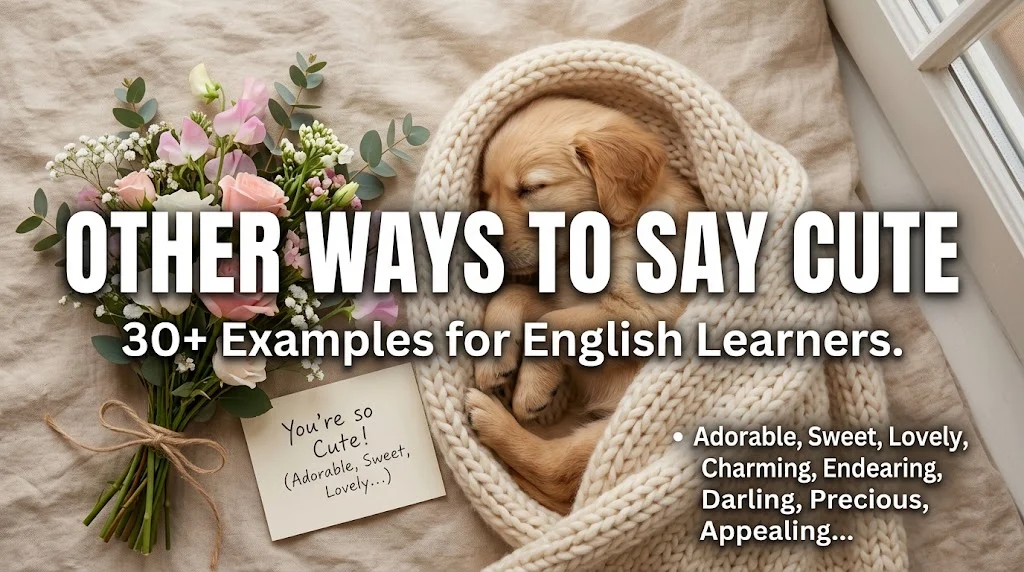
“Cute” is an informal adjective used to describe something or someone attractive in a sweet, endearing, or charming way. For more variety and precision, try alternatives like “adorable,” “charming,” “precious,” “lovely,” “sweet,” or “endearing.”
“Cute” is one of the most flexible words in English. It describes babies, puppies, outfits, apartments, and even clever comments. Because it covers so many situations, learners often rely on it for almost everything that looks pleasant or appealing. That habit makes descriptions feel repetitive and vague.
This guide presents 30 practical alternatives with meanings, examples, and clear guidance on tone and context. You will learn when “cute” works well and when a more precise word makes a stronger impression.
Pull Quote: “One word cannot capture every kind of charm. Precision is what makes your English sound advanced.”
Quick Categories
Formal alternatives to “Cute”
- Charming
- Endearing
- Winsome
- Delightful
Pro Tip: Formal alternatives work well in written descriptions, reviews, and professional creative writing.
Casual alternatives
- Adorable
- Sweet
- Lovely
- Precious
Pro Tip: Casual alternatives suit everyday conversation, texts, and social media posts.
Professional alternatives
- Attractive
- Appealing
- Elegant
- Polished
Pro Tip: Professional alternatives focus on design, presentation, and impression rather than emotion.
Informal expressions
- Too cute
- So cute
- Absolutely adorable
- Cute as a button
Pro Tip: Informal expressions belong in spoken English and private messages, not formal documents.
Pull Quote: “The right tone makes your English sound professional and confident.”
Common Mistakes
- Using “cute” to describe professional work.
Example: “The quarterly report looks cute.” This sounds inappropriate in a business context. - Using “cute” for serious or formal topics.
Example: “The memorial design is cute.” This can seem disrespectful. - Overusing “cute” for everything attractive.
Example: “The hotel was cute, the food was cute, the view was cute.” Repetition weakens impact. - Using “cute” to describe a man in a formal setting.
Example: “Your suit is cute.” This can sound condescending in professional contexts. - Confusing “cute” with “attractive” in adult contexts.
Example: “She looked cute at the gala.” “Attractive” or “elegant” may be more appropriate.
What Does “Cute” Mean?
Definition
“Cute” is an adjective describing something or someone that is attractive in a sweet, endearing, or charming way. It can also mean clever or amusing in informal American English.
Grammar Explanation
“Cute” functions as a regular adjective. It can be modified by adverbs such as “very,” “really,” or “absolutely.” The comparative form is “cuter” and the superlative is “cutest.”
Example Sentence
“Their new puppy is so cute that everyone stops to pet it.”
When to Use “Cute”
Common Contexts
- Babies and children: Describing young ones affectionately.
- Animals: Describing pets and wildlife.
- Fashion: Describing outfits and accessories in casual conversation.
- Interiors: Describing small, cosy spaces.
- Behaviour: Describing sweet or endearing actions.
Spoken vs Written
- Spoken: Extremely common in daily conversation.
- Written: Common in texts, social posts, and informal writing, less so in formal documents.
Formal vs Informal
- Formal: Rarely appropriate except in creative writing.
- Informal: The default choice in everyday speech.
Is It Professional or Polite to Say “Cute”?
Politeness vs Professionalism
“Cute” is polite in casual settings, but it can sound unprofessional or even condescending in business contexts. In professional communication, words like “attractive,” “elegant,” or “appealing” are safer and more precise.
Business-Style Example
“The new packaging design is clean, elegant, and appealing to our target market.”
Polite? Yes
Professional? Not usually in formal business contexts
Pull Quote: “In professional English, precision beats affection. Choose words that respect the context.”
Pros and Cons of Using “Cute”
Pros
- Simple and natural: Easy to say and understand.
- Friendly tone: Warm and approachable.
- Common usage: Universally recognised.
- Easy to understand: Requires no advanced vocabulary.
Cons
- Too informal for work: Can sound out of place in professional settings.
- Overused: Loses impact through repetition.
- Limited emotional range: Cannot express elegance, beauty, or sophistication.
- Not suitable for formal writing: Avoid in business reports and academic texts.
Other Ways to Say “Cute” (With Examples)
These alternatives will help you sound more fluent, confident, and natural in different situations. Use them according to tone, context, and audience to express excitement, admiration, or approval.
1. Adorable
Meaning: Extremely charming and lovable.
Explanation: Stronger than “cute” and often used for babies and animals.
Example Sentence: “Their newborn twins are absolutely adorable.”
Best Use: Babies, animals
Worst Use: Business reports
Tone: Warm, affectionate, enthusiastic
Context Variability: Casual and spoken
2. Precious
Meaning: Valuable and cherished.
Explanation: Adds emotional weight to the description.
Example Sentence: “The little girl gave a precious smile to her grandmother.”
Best Use: Family moments
Worst Use: Casual fashion
Tone: Tender, emotional, warm
Context Variability: Casual and written
3. Charming
Meaning: Attractive in a pleasant, delightful way.
Explanation: Works for people, places, and designs.
Example Sentence: “They stayed in a charming cottage by the sea.”
Best Use: Places, people
Worst Use: Loud parties
Tone: Pleasant, elegant, warm
Context Variability: Professional and written
4. Sweet
Meaning: Kind, gentle, and pleasant.
Explanation: Focuses on personality or small gestures.
Example Sentence: “It was sweet of you to remember my birthday.”
Best Use: Gestures, personality
Worst Use: Formal design
Tone: Warm, gentle, affectionate
Context Variability: Casual and spoken
5. Lovely
Meaning: Beautiful and pleasant.
Explanation: A versatile British favourite.
Example Sentence: “What a lovely dress you are wearing.”
Best Use: Everyday compliments
Worst Use: Technical reports
Tone: Warm, polite, pleasant
Context Variability: Casual and professional
6. Endearing
Meaning: Inspiring affection.
Explanation: Focuses on qualities that make someone lovable.
Example Sentence: “His habit of humming while he works is quite endearing.”
Best Use: Personality traits
Worst Use: Product design
Tone: Warm, thoughtful, formal
Context Variability: Professional and written
7. Darling
Meaning: Beloved and charming.
Explanation: Affectionate and slightly old fashioned.
Example Sentence: “She wore a darling little hat to the party.”
Best Use: Fashion, affection
Worst Use: Business writing
Tone: Affectionate, charming, warm
Context Variability: Casual and written
8. Delightful
Meaning: Causing great pleasure.
Explanation: Stronger and more formal than cute.
Example Sentence: “We had a delightful afternoon in the garden.”
Best Use: Experiences, places
Worst Use: Everyday objects
Tone: Formal, warm, positive
Context Variability: Professional and written
9. Attractive
Meaning: Pleasing to look at.
Explanation: Neutral and suitable for professional contexts.
Example Sentence: “The new storefront is clean and attractive.”
Best Use: Design, people
Worst Use: Babies
Tone: Neutral, professional, positive
Context Variability: Professional and written
10. Pretty
Meaning: Pleasing in a delicate way.
Explanation: Common and versatile.
Example Sentence: “She wore a pretty floral dress to the picnic.”
Best Use: Fashion, nature
Worst Use: Formal reviews
Tone: Gentle, pleasant, casual
Context Variability: Casual and spoken
11. Beautiful
Meaning: Pleasing to the senses.
Explanation: Stronger and more emotional than pretty.
Example Sentence: “The sunset over the lake was beautiful.”
Best Use: Nature, people
Worst Use: Small objects
Tone: Emotional, warm, elevated
Context Variability: Professional and personal
12. Gorgeous
Meaning: Very beautiful or attractive.
Explanation: Emphatic and enthusiastic.
Example Sentence: “You look gorgeous in that colour.”
Best Use: Compliments
Worst Use: Formal writing
Tone: Enthusiastic, warm, emphatic
Context Variability: Casual and spoken
13. Dainty
Meaning: Small and delicate.
Explanation: Describes fine features or small objects.
Example Sentence: “She wore a dainty silver bracelet.”
Best Use: Jewellery, features
Worst Use: Large objects
Tone: Delicate, refined, gentle
Context Variability: Professional and written
14. Petite
Meaning: Small and attractively formed.
Explanation: Often used for clothing sizes and body descriptions.
Example Sentence: “The petite vase fits perfectly on the shelf.”
Best Use: Fashion, objects
Worst Use: Large furniture
Tone: Neutral, elegant, descriptive
Context Variability: Professional and written
15. Cuddly
Meaning: Soft and inviting to hug.
Explanation: Physical and affectionate.
Example Sentence: “The teddy bear was soft and cuddly.”
Best Use: Toys, animals
Worst Use: Formal design
Tone: Warm, soft, affectionate
Context Variability: Casual and spoken
16. Lovable
Meaning: Easy to love.
Explanation: Focuses on personality and charm.
Example Sentence: “He is a lovable little puppy.”
Best Use: Pets, children
Worst Use: Objects
Tone: Warm, affectionate, personal
Context Variability: Casual and spoken
17. Winsome
Meaning: Attractive in a childlike, innocent way.
Explanation: Literary and slightly old fashioned.
Example Sentence: “She gave a winsome smile that melted everyone.”
Best Use: Literature, descriptions
Worst Use: Everyday chat
Tone: Literary, charming, innocent
Context Variability: Professional and written
18. Enchanting
Meaning: Delightfully charming.
Explanation: Suggests magic and wonder.
Example Sentence: “The village was enchanting in the evening light.”
Best Use: Places, experiences
Worst Use: Everyday objects
Tone: Magical, warm, elevated
Context Variability: Professional and creative
19. Angelic
Meaning: Like an angel, pure and beautiful.
Explanation: Strongly positive and slightly religious in tone.
Example Sentence: “The child had an angelic face.”
Best Use: Children, art
Worst Use: Casual fashion
Tone: Pure, beautiful, elevated
Context Variability: Professional and written
20. Doll-like
Meaning: Resembling a doll in appearance.
Explanation: Describes small, neat features.
Example Sentence: “She had a doll-like face with bright eyes.”
Best Use: Appearance
Worst Use: Business writing
Tone: Descriptive, delicate, visual
Context Variability: Casual and written
21. Baby-faced
Meaning: Having a young looking face.
Explanation: Neutral and descriptive.
Example Sentence: “He is baby-faced but very experienced.”
Best Use: Physical description
Worst Use: Formal compliments
Tone: Neutral, descriptive, casual
Context Variability: Casual and spoken
22. Twee
Meaning: Excessively quaint or sentimental.
Explanation: Often negative in British English.
Example Sentence: “The cafe was a bit twee for my taste.”
Best Use: Criticism, humour
Worst Use: Compliments
Tone: Critical, British, ironic
Context Variability: Casual and written
23. Quaint
Meaning: Attractively unusual or old fashioned.
Explanation: Positive but slightly nostalgic.
Example Sentence: “We stayed in a quaint little inn.”
Best Use: Places, villages
Worst Use: Modern design
Tone: Nostalgic, charming, warm
Context Variability: Professional and written
24. Whimsical
Meaning: Playfully quaint or fanciful.
Explanation: Suggests creativity and imagination.
Example Sentence: “The illustrations were whimsical and full of detail.”
Best Use: Art, design
Worst Use: Formal reports
Tone: Playful, creative, imaginative
Context Variability: Professional and creative
25. Cheeky
Meaning: Playfully impudent or irreverent.
Explanation: Common in British English.
Example Sentence: “He gave a cheeky grin and ran off.”
Best Use: Personality, humour
Worst Use: Formal writing
Tone: Playful, informal, British
Context Variability: Casual and spoken
26. Mischievous
Meaning: Playfully naughty.
Explanation: Suggests harmless trouble.
Example Sentence: “The puppy had a mischievous look in its eyes.”
Best Use: Children, animals
Worst Use: Professional settings
Tone: Playful, naughty, warm
Context Variability: Casual and written
27. Kitsch
Meaning: Art or objects considered tacky but endearing.
Explanation: Often ironic or nostalgic.
Example Sentence: “The souvenir shop was full of kitsch ornaments.”
Best Use: Art, decor
Worst Use: Formal design
Tone: Ironic, nostalgic, critical
Context Variability: Professional and written
28. Comely
Meaning: Pleasant to look at.
Explanation: Literary and old fashioned.
Example Sentence: “The comely young woman smiled at the guests.”
Best Use: Literature
Worst Use: Everyday chat
Tone: Literary, formal, old-fashioned
Context Variability: Written and formal
29. Bonny
Meaning: Attractive and healthy looking.
Explanation: Scottish and Northern English.
Example Sentence: “She was a bonny baby with rosy cheeks.”
Best Use: Regional speech
Worst Use: Formal documents
Tone: Warm, regional, affectionate
Context Variability: Casual and spoken
30. Diminutive
Meaning: Extremely small.
Explanation: Formal and precise.
Example Sentence: “The diminutive cottage was perfect for two.”
Best Use: Formal description
Worst Use: Casual compliments
Tone: Formal, precise, neutral
Context Variability: Professional and written
Pull Quote: “Professional reaction phrases and warm compliments serve different purposes. Choose wisely.”
Mini Quiz / Self-Check
- Scenario: You are complimenting a colleague on their new office decor. Which fits best?
- A) Your office is so cute.
- B) Your office is really charming.
- C) Your office is adorable.
- Scenario: You are describing a baby in a birth announcement. Which is most natural?
- A) The baby is attractive.
- B) The baby is adorable.
- C) The baby is winsome.
- Scenario: You are writing a product description for a luxury handbag. Which is most appropriate?
- A) This bag is cute.
- B) This bag is elegant and refined.
- C) This bag is cuddly.
- Scenario: Which word is often negative in British English?
- A) Charming.
- B) Twee.
- C) Lovely.
Comparison Table: Top Alternatives
| Phrase | Tone | Best Use |
| Adorable | Warm, affectionate | Babies, animals |
| Charming | Pleasant, elegant | Places, people |
| Endearing | Warm, thoughtful | Personality traits |
| Delightful | Formal, warm | Experiences, places |
| Attractive | Neutral, professional | Design, people |
| Lovely | Warm, polite | Everyday compliments |
| Sweet | Gentle, affectionate | Gestures, personality |
| Pretty | Gentle, pleasant | Fashion, nature |
| Gorgeous | Enthusiastic, warm | Compliments |
| Quaint | Nostalgic, charming | Places, villages |
FAQs
1. What is a formal alternative to “cute”?
“Charming,” “endearing,” and “delightful” are formal alternatives suitable for written descriptions and professional creative writing.
2. How do I compliment someone professionally without saying “cute”?
Use words like “elegant,” “polished,” “attractive,” or “well presented” to keep your compliment appropriate for the workplace.
3. Is “cute” appropriate for describing a man?
It depends on context. In casual conversation it is common, but in professional settings, “attractive,” “charming,” or “well dressed” are safer choices.
4. What can I say instead of “cute” for a baby?
“Adorable,” “precious,” “sweet,” and “lovable” are natural and warm alternatives for describing babies.
5. What is the difference between “cute” and “pretty”?
“Cute” suggests charm and endearment, while “pretty” focuses more on visual beauty and delicacy.
Conclusion
Learning other ways to say cute gives you the ability to describe charm, beauty, and endearment with far greater precision. A baby can be adorable, a cottage can be charming, and a gesture can be endearing. These alternatives to cute help you move beyond one overused word and into richer, more natural English.
Practice by describing the people, places, and objects around you each day. Pay close attention to tone and audience, because the right word depends on the context. With steady practice, these informal expressions in English and their formal counterparts will become part of your everyday fluency.

John Green is an American writer who contributes to QuickResponsess.com, creating clear and practical content on English grammar, vocabulary and everyday language. His goal is to make learning English simple, engaging and easy to apply.