Quick Answer 🔥
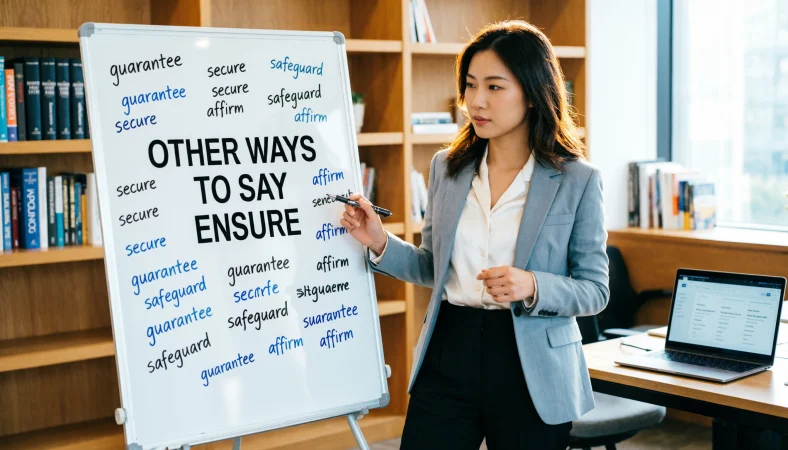
Looking for alternatives to ensure? Use guarantee, make sure, assure, secure, and confirm in most everyday situations. For professional writing, try verify, ascertain, validate, or establish. For casual conversation, make certain, see to it, or double check work perfectly.
The verb ensure means to make certain that something happens or is true. It is a formal, confident word commonly used in business writing, academic papers, and professional communication. You might say, “Please ensure the doors are locked before you leave,” or “We must ensure all employees receive fair treatment.”
However, relying on the same word repeatedly can make your English sound monotonous and less engaging. Learning alternatives to ensure will help you express excitement in English, adapt your tone to any audience, and sound more fluent and natural. Whether you are writing a formal report, sending a professional email, or having a casual conversation, knowing the right synonym will boost your confidence and communication skills.
Quick Categories Section
Formal Alternatives to “Ensure”
- Guarantee
- Ascertain
- Validate
- Certify
Professional Alternatives
- Verify
- Establish
- Corroborate
- Safeguard
Casual Alternatives
- Make sure
- Make certain
- See to it
- Double check
Informal Expressions
- Check that
- Be sure
- Keep an eye on
- Take care of
💡 Pro Tip: Match your alternative to your audience. Use formal options in reports and emails, casual ones in everyday speech. The right choice shows emotional intelligence and language awareness.
Common Mistakes Section
Here are five common errors English learners make when using “ensure”:
1. Using “ensure to” instead of “ensure that”
❌ We ensure to deliver on time.
✅ We ensure that we deliver on time.
After ensure, use a noun, a that clause, or a gerund — not an infinitive.
2. Confusing “ensure” with “insure”
❌ I will insure the project is completed.
✅ I will ensure the project is completed.
Insure means to protect against financial loss; ensure means to make certain.
3. Using “ensure” in casual conversation too often
❌ Can you ensure the door is locked? (sounds stiff)
✅ Can you make sure the door is locked?
Ensure sounds too formal for everyday speech.
4. Forgetting to include the object after “ensure”
❌ The manager will ensure.
✅ The manager will ensure compliance.
Ensure is transitive and needs a direct object or a that clause.
5. Using “ensure” where “assure” is better
❌ I ensure you that everything is fine.
✅ I assure you that everything is fine.
Assure is used to remove doubt in a person; ensure is used for outcomes.
What Does “Ensure” Mean?
Ensure (verb) means to make certain that something happens or is the case. It implies taking practical steps to guarantee an outcome.
Example Sentence: Please ensure that all lights are switched off before leaving the office.
When to Use “Ensure”
- Formal writing — reports, proposals, academic papers
- Business communication — emails, memos, official documents
- Instructions and procedures — safety guidelines, quality control
- Professional commitments — project management, client agreements
- Spoken English — less common; use make sure instead for conversation
- Formal vs Informal — ensure is formal; make sure is informal
Is It Professional or Polite to Say “Ensure”?
Polite? ✔️ Yes — it is respectful and clear.
Professional? ✔️ Yes — it is widely accepted in professional settings.
Business Example: We will ensure your order is processed within 24 hours.
However, in very formal legal or technical writing, alternatives like certify or validate may be preferred. In casual conversation, ensure can sound overly stiff.
Pros and Cons of Using “Ensure”
Pros
- Simple and natural — easy to understand for all audiences
- Professional tone — appropriate for formal and business contexts
- Common usage — widely recognized and accepted
- Clear meaning — leaves no room for ambiguity
Cons
- Overused — can sound repetitive in long texts
- Too formal for conversation — sounds stiff in casual speech
- Limited emotional range — lacks warmth or enthusiasm
- Not suitable for informal writing — can feel out of place in personal messages
Other Ways to Say “Ensure” (With Examples)
These 30 alternatives to ensure will help you sound more fluent, confident, and natural in different situations. Use them according to tone, context, and audience to express certainty, commitment, or approval.
1. Phrase: Guarantee
Meaning: To promise with certainty that something will happen.
Explanation: A strong, confident alternative that implies a firm commitment.
Example Sentence: I guarantee you will be satisfied with our service.
Best Use: Promises, marketing
Worst Use: Casual requests
Tone: Confident, assertive
Context Variability: I guarantee results. (professional) / I guarantee you will love it. (casual)
2. Phrase: Make Sure
Meaning: To take action to confirm that something is done.
Explanation: The most common casual alternative, widely used in everyday speech.
Example Sentence: Please make sure the report is on my desk by 9 AM.
Best Use: Everyday requests
Worst Use: Legal documents
Tone: Friendly, practical
Context Variability: Make sure you lock the door. (casual) / Make sure all data is backed up. (professional)
3. Phrase: Assure
Meaning: To tell someone confidently that something is true, removing doubt.
Explanation: Focuses on giving confidence to a person rather than guaranteeing an outcome.
Example Sentence: I assure you that the product meets all safety standards.
Best Use: Reassuring others
Worst Use: Process instructions
Tone: Reassuring, warm
Context Variability: I assure you everything is fine. (personal) / We assure clients of our reliability. (professional)
4. Phrase: Secure
Meaning: To make something safe, certain, or firmly established.
Explanation: Emphasizes protection and stability.
Example Sentence: We have taken steps to secure the building against unauthorized access.
Best Use: Safety, protection
Worst Use: Abstract guarantees
Tone: Protective, strong
Context Variability: Secure your financial future. (professional) / Secure the tent before the storm. (casual)
5. Phrase: Confirm
Meaning: To establish the truth or correctness of something.
Explanation: A precise alternative often used for verification.
Example Sentence: Please confirm your attendance by Friday.
Best Use: Verification, RSVPs
Worst Use: Future promises
Tone: Precise, formal
Context Variability: Confirm your booking online. (professional) / Can you confirm you are coming? (casual)
6. Phrase: Verify
Meaning: To check and confirm that something is true or accurate.
Explanation: Emphasizes careful checking of facts or information.
Example Sentence: We need to verify the data before publishing the report.
Best Use: Quality control, fact checking
Worst Use: Casual conversation
Tone: Analytical, thorough
Context Variability: Verify your email address. (professional) / I need to verify that. (casual)
7. Phrase: Ascertain
Meaning: To find out something with certainty through investigation.
Explanation: A formal word implying active research or inquiry.
Example Sentence: The committee will ascertain the facts before making a decision.
Best Use: Investigations, formal reports
Worst Use: Everyday speech
Tone: Formal, investigative
Context Variability: Ascertain the cause of the issue. (professional) / Less common in casual speech.
8. Phrase: Validate
Meaning: To prove that something is correct or supported by evidence.
Explanation: Often used in technical, legal, or quality assurance contexts.
Example Sentence: We need to validate the results before publishing.
Best Use: Testing, research
Worst Use: Social situations
Tone: Technical, formal
Context Variability: Validate the system data. (professional) / Rare in casual speech.
9. Phrase: Certify
Meaning: To formally confirm or attest that something is true or meets standards.
Explanation: A formal, official sounding alternative.
Example Sentence: The auditor will certify the financial statements.
Best Use: Official documents, compliance
Worst Use: Everyday conversation
Tone: Official, authoritative
Context Variability: Certify the documents. (professional) / Rare in casual speech.
10. Phrase: Establish
Meaning: To set up or create something that is firmly in place.
Explanation: Implies creating a system or condition that ensures an outcome.
Example Sentence: We need to establish clear guidelines for the team.
Best Use: Rules, systems, procedures
Worst Use: Immediate actions
Tone: Strategic, formal
Context Variability: Establish trust with clients. (professional) / Establish a routine. (casual)
11. Phrase: Make Certain
Meaning: To take action to ensure something is definitely true or done.
Explanation: A slightly more formal cousin of make sure.
Example Sentence: Please make certain all guests have signed in.
Best Use: Instructions, reminders
Worst Use: Very casual speech
Tone: Clear, firm
Context Variability: Make certain you have your ID. (professional) / Make certain the door is closed. (casual)
12. Phrase: See to It
Meaning: To take responsibility for ensuring something is done.
Explanation: A proactive, responsible phrase.
Example Sentence: I will see to it that the project is completed on time.
Best Use: Taking ownership
Worst Use: Passive requests
Tone: Responsible, proactive
Context Variability: I will see to it personally. (professional) / See to it that the kids are fed. (casual)
13. Phrase: Double Check
Meaning: To verify something by checking it a second time.
Explanation: Casual and practical, emphasizing careful review.
Example Sentence: Let me double check the numbers before we submit.
Best Use: Quality checks, reviews
Worst Use: Formal legal writing
Tone: Careful, practical
Context Variability: Double check the address. (casual) / Double check all calculations. (professional)
14. Phrase: Safeguard
Meaning: To protect something from harm or loss.
Explanation: Emphasizes protection and security.
Example Sentence: We must safeguard customer data at all costs.
Best Use: Protection, security
Worst Use: General promises
Tone: Protective, serious
Context Variability: Safeguard your personal information. (professional) / Safeguard the children. (casual)
15. Phrase: Warrant
Meaning: To justify or guarantee that something is true or will happen.
Explanation: A formal, often legal sounding alternative.
Example Sentence: The evidence warrants a full investigation.
Best Use: Legal, formal contexts
Worst Use: Everyday conversation
Tone: Legal, formal
Context Variability: Warrant the quality of the product. (professional) / Rare in casual speech.
16. Phrase: Corroborate
Meaning: To confirm or support a statement or finding with evidence.
Explanation: A formal word for strengthening claims with proof.
Example Sentence: The witness will corroborate the sequence of events.
Best Use: Legal, research contexts
Worst Use: Casual conversation
Tone: Formal, evidence based
Context Variability: Corroborate the findings. (professional) / Rare in casual speech.
17. Phrase: Check
Meaning: To examine something to confirm its accuracy or condition.
Explanation: A simple, direct alternative for everyday use.
Example Sentence: Can you check if the door is locked?
Best Use: Quick verification
Worst Use: Formal commitments
Tone: Simple, direct
Context Variability: Check your work before submitting. (professional) / Check the oven. (casual)
18. Phrase: Be Sure
Meaning: To be certain or confident about something.
Explanation: A casual phrase used to give reminders or advice.
Example Sentence: Be sure to bring your ID to the event.
Best Use: Reminders, advice
Worst Use: Formal writing
Tone: Friendly, helpful
Context Variability: Be sure to call me. (casual) / Be sure all forms are signed. (professional)
19. Phrase: Keep an Eye On
Meaning: To monitor or watch something closely.
Explanation: A very casual, conversational phrase.
Example Sentence: Can you keep an eye on my bag while I get a coffee?
Best Use: Casual supervision
Worst Use: Formal contexts
Tone: Informal, friendly
Context Variability: Keep an eye on the budget. (professional) / Keep an eye on the kids. (casual)
20. Phrase: Take Care Of
Meaning: To handle or manage something to ensure it is done.
Explanation: A friendly, responsible phrase for everyday use.
Example Sentence: I will take care of the arrangements.
Best Use: Managing tasks
Worst Use: Formal legal writing
Tone: Responsible, friendly
Context Variability: Take care of the client’s request. (professional) / Take care of dinner. (casual)
21. Phrase: Look Into
Meaning: To investigate or examine something.
Explanation: A casual phrase for checking or investigating.
Example Sentence: I will look into the issue and get back to you.
Best Use: Investigating, checking
Worst Use: Formal promises
Tone: Curious, proactive
Context Variability: Look into the complaint. (professional) / Look into that noise. (casual)
22. Phrase: Follow Up On
Meaning: To check on the progress or status of something.
Explanation: Common in professional and business contexts.
Example Sentence: I will follow up on the proposal next week.
Best Use: Progress checks
Worst Use: Immediate actions
Tone: Proactive, organized
Context Variability: Follow up on the application. (professional) / Follow up on that call. (casual)
23. Phrase: Pledge
Meaning: To make a formal commitment or promise.
Explanation: A strong, solemn alternative.
Example Sentence: The company pledges to reduce its carbon footprint.
Best Use: Commitments, promises
Worst Use: Everyday tasks
Tone: Solemn, committed
Context Variability: Pledge support for the initiative. (professional) / I pledge to do better. (personal)
24. Phrase: Promise
Meaning: To assure someone that you will do something.
Explanation: A personal, emotional alternative.
Example Sentence: I promise I will have the report ready by tomorrow.
Best Use: Personal commitments
Worst Use: Formal business contracts
Tone: Personal, sincere
Context Variability: I promise to deliver. (professional) / I promise I will be there. (casual)
25. Phrase: Clinch
Meaning: To settle or secure something decisively.
Explanation: A more colorful, slightly informal alternative.
Example Sentence: The final deal clinched our partnership.
Best Use: Decisive actions
Worst Use: Formal writing
Tone: Decisive, strong
Context Variability: Clinch the agreement. (professional) / Clinch the win. (casual)
26. Phrase: Effect
Meaning: To bring about or cause something to happen.
Explanation: A formal alternative focusing on making something happen.
Example Sentence: The new policy will effect positive change.
Best Use: Formal writing, change management
Worst Use: Casual speech
Tone: Formal, impactful
Context Variability: Effect the transition smoothly. (professional) / Rare in casual speech.
27. Phrase: Provide
Meaning: To supply or make something available.
Explanation: Often used in professional contexts to ensure availability.
Example Sentence: We provide all necessary resources for the team.
Best Use: Resources, support
Worst Use: Guarantees of outcomes
Tone: Supportive, practical
Context Variability: Provide training for staff. (professional) / Provide dinner for everyone. (casual)
28. Phrase: Protect
Meaning: To keep someone or something safe from harm.
Explanation: Emphasizes safety and security.
Example Sentence: We must protect our intellectual property.
Best Use: Safety, security
Worst Use: Abstract guarantees
Tone: Protective, serious
Context Variability: Protect customer data. (professional) / Protect your skin from the sun. (casual)
29. Phrase: Establish Compliance
Meaning: To set up systems to ensure rules are followed.
Explanation: A professional phrase for regulatory contexts.
Example Sentence: We need to establish compliance with new regulations.
Best Use: Regulatory, compliance
Worst Use: Everyday speech
Tone: Formal, regulatory
Context Variability: Professional contexts only.
30. Phrase: Set the Seal On
Meaning: To finalize or make something certain.
Explanation: A more idiomatic, expressive alternative.
Example Sentence: The CEO’s approval set the seal on the project.
Best Use: Finalization, decisive moments
Worst Use: Everyday conversation
Tone: Idiomatic, expressive
Context Variability: Set the seal on the agreement. (professional) / Rare in casual speech.
Mini Quiz / Self Check
Test your understanding of these alternatives to ensure:
1. Which phrase is most appropriate for a casual conversation with a friend?
- A. Ascertain
- B. Make sure
- C. Validate
- D. Corroborate
Answer: B. Make sure is the most natural choice for casual conversation.
2. You are writing a formal report. Which alternative is most suitable?
- A. Double check
- B. Keep an eye on
- C. Verify
- D. Take care of
Answer: C. Verify is formal and precise, suitable for reports.
3. Which word means “to remove doubt in a person” rather than “to guarantee an outcome”?
- A. Ensure
- B. Insure
- C. Assure
- D. Secure
Answer: C. Assure is used to give confidence to a person.
4. You want to take responsibility for a task. Which phrase shows ownership?
- A. Check
- B. See to it
- C. Validate
- D. Certify
Answer: B. See to it shows personal responsibility and proactiveness.
Comparison Table: Top Alternatives
| Phrase | Tone | Best Use |
| Guarantee | Confident, assertive | Promises, marketing |
| Make Sure | Friendly, practical | Everyday requests |
| Assure | Reassuring, warm | Reassuring others |
| Secure | Protective, strong | Safety, protection |
| Confirm | Precise, formal | Verification, RSVPs |
| Verify | Analytical, thorough | Quality control |
| Ascertain | Formal, investigative | Investigations, reports |
| Validate | Technical, formal | Testing, research |
| Certify | Official, authoritative | Official documents |
| See to It | Responsible, proactive | Taking ownership |
FAQs
1. What is another way to say ensure in a professional email?
You can say guarantee, confirm, verify, or make certain in a professional email. For example: “I will confirm the details with the client.”
2. Is “make sure” a good alternative to “ensure”?
Yes, make sure is a perfect casual alternative. However, it is less formal than ensure and is best used in spoken English and informal writing.
3. What is the difference between “ensure,” “assure,” and “insure”?
Ensure means to make certain something happens. Assure means to remove doubt in a person. Insure means to protect against financial loss.
4. Can I use “guarantee” instead of “ensure” in formal writing?
Yes, guarantee is a strong, formal alternative. It often implies a more explicit promise than ensure.
5. What is the most common informal expression for “ensure”?
Make sure is the most common informal expression. It is used in everyday conversation and casual writing.
Conclusion
Mastering other ways to say ensure will transform your English communication. You will sound more fluent, confident, and professional in any situation whether you are writing a business email, giving a presentation, or having a casual conversation.
Practice using these alternatives to ensure daily. Pay attention to tone and context. The more you experiment with different phrases, the more natural your English will become. Remember, great communicators don’t just know words they know when to use them.

John Green is an American writer who contributes to QuickResponsess.com, creating clear and practical content on English grammar, vocabulary and everyday language. His goal is to make learning English simple, engaging and easy to apply.