Quick Answer 🔥
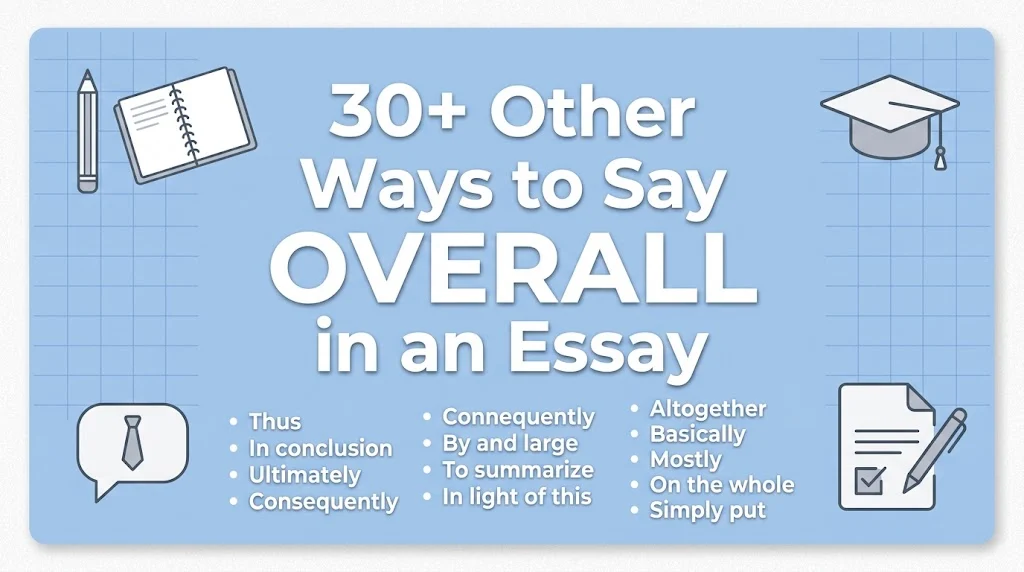
Top 5 alternatives: all in all, generally speaking, on the whole, in summary, by and large
The word “overall” is one of the most frequently used transition words in essay writing. It signals a summary, a general conclusion, or a big picture perspective. While it is clear and functional, overusing it can make your writing feel repetitive and less sophisticated.
Learning alternatives to “overall” helps you sound more fluent, confident, and polished. Whether you are writing an academic paper, a business report, or a casual email, having a range of phrases at your disposal allows you to choose the right tone for every situation. Mastering other ways to say “overall” will elevate your English to a professional level.
Quick Categories
Formal Alternatives to “Overall”
- In summary
- In conclusion
- To sum up
- In essence
- On balance
- Taking everything into consideration
Casual Alternatives
- All in all
- At the end of the day
- In a nutshell
- When all is said and done
Professional Alternatives
- As a whole
- Generally speaking
- By and large
- For the most part
- In general
Informal Expressions
- Basically
- More or less
- All told
- In the grand scheme of things
💡 Pro Tip: Match your alternative to your audience. Use formal phrases for academic essays and professional reports. Save casual expressions for blog posts, emails to colleagues, or everyday conversation.
Common Mistakes Using “Overall”
| Mistake | Example |
| ❌ Using “overall” too frequently in one paragraph | Overall, the data is clear. Overall, the results are positive. |
| ❌ Using “in overall” instead of “overall” | In overall, the project succeeded. (Incorrect — use “Overall” alone) |
| ❌ Using “overall” when a more precise word fits better | The overall cost is high. (Better: The total cost is high.) |
| ❌ Starting every conclusion sentence with “overall” | Overall, I think… Overall, we can see… |
| ❌ Using “overall” as an adjective when an adverb is needed | Overall, the team performed well. (Adverb) vs. The overall performance was good. (Adjective) |
What Does “Overall” Mean?
Overall means considering everything together or taking a general view of a situation. It can function as both an adjective (describing a total or comprehensive view) and an adverb (summarizing or concluding).
- Example: Overall, the conference was a great success.
When to Use “Overall”
- Summarizing key points in a conclusion
- Giving a general opinion after presenting evidence
- Transitioning from specific details to a broad perspective
- Spoken English: Common and natural in conversation
- Written English: Widely used but often overused in essays
- Formal contexts: Acceptable but better replaced with more precise alternatives
- Informal contexts: Perfectly fine and commonly used
Is It Professional or Polite to Say “Overall”?
| Aspect | Verdict |
| Polite? | ✔️ Yes — it is neutral and considerate |
| Professional? | ❌ No — in most formal writing, it is considered overused and vague |
Business style example (better alternative):
“As a whole, the quarterly results indicate steady growth.”
Pros and Cons of Using “Overall”
Pros:
- Simple and natural
- Friendly and approachable tone
- Commonly understood by all English speakers
- Easy to use in both spoken and written English
Cons:
- Too informal for academic or professional writing
- Overused and repetitive
- Limited emotional range — does not convey nuance
- Not suitable for formal or high stakes documents
Other Ways to Say “Overall” (With Examples)
These 30 alternatives will help you sound more fluent, confident, and natural in different situations. Use them according to tone, context, and audience to express excitement in English or convey professionalism.
Formal & Academic Alternatives
1. Phrase: In summary
- Meaning: A concise way to present the main points.
- Explanation: Signals the beginning of a conclusion or recap.
- Example Sentence: In summary, the research supports the initial hypothesis.
- Best Use: Academic essays
- Worst Use: Casual conversation
- Tone: Formal, structured
- Context Variability: Professional / written
2. Phrase: In conclusion
- Meaning: Used to introduce the final remarks.
- Explanation: A classic transition for ending an argument or presentation.
- Example Sentence: In conclusion, we must prioritize sustainable practices.
- Best Use: Formal papers
- Worst Use: Everyday speech
- Tone: Formal, decisive
- Context Variability: Professional / written
3. Phrase: To sum up
- Meaning: To give a brief statement of the main points.
- Explanation: Direct and clear for recapping ideas.
- Example Sentence: To sum up, the benefits far outweigh the risks.
- Best Use: Business reports
- Worst Use: Creative writing
- Tone: Professional, straightforward
- Context Variability: Professional / written
4. Phrase: In essence
- Meaning: The most important or fundamental aspect.
- Explanation: Highlights the core idea without extra details.
- Example Sentence: In essence, the policy aims to reduce emissions.
- Best Use: Analytical writing
- Worst Use: Informal chats
- Tone: Sophisticated, concise
- Context Variability: Professional / written
5. Phrase: On balance
- Meaning: After weighing all factors.
- Explanation: Suggests careful consideration of pros and cons.
- Example Sentence: On balance, the new strategy appears more effective.
- Best Use: Decision making contexts
- Worst Use: Casual remarks
- Tone: Thoughtful, measured
- Context Variability: Professional / written
6. Phrase: Taking everything into consideration
- Meaning: Including all relevant factors before concluding.
- Explanation: Emphasizes thoroughness and completeness.
- Example Sentence: Taking everything into consideration, the project was a success.
- Best Use: Formal evaluations
- Worst Use: Quick summaries
- Tone: Comprehensive, deliberate
- Context Variability: Professional / written
7. Phrase: As a whole
- Meaning: Viewed in its entirety.
- Explanation: Focuses on the complete picture rather than parts.
- Example Sentence: As a whole, the organization performed admirably.
- Best Use: Business and academic writing
- Worst Use: Casual conversation
- Tone: Professional, authoritative
- Context Variability: Professional / written
8. Phrase: Generally speaking
- Meaning: In most cases; broadly.
- Explanation: A safe and widely accepted alternative.
- Example Sentence: Generally speaking, students prefer interactive learning.
- Best Use: General observations
- Worst Use: Specific data summaries
- Tone: Neutral, balanced
- Context Variability: Professional / spoken
9. Phrase: In general
- Meaning: Usually or broadly.
- Explanation: One of the most direct substitutes for “overall”.
- Example Sentence: In general, the feedback has been positive.
- Best Use: Any professional context
- Worst Use: None — very versatile
- Tone: Neutral, clear
- Context Variability: Professional / spoken
10. Phrase: By and large
- Meaning: Mostly; for the most part.
- Explanation: A classic phrase that conveys general agreement.
- Example Sentence: By and large, the new system is working well.
- Best Use: Professional reports
- Worst Use: Highly formal legal writing
- Tone: Confident, slightly informal
- Context Variability: Professional / spoken
Professional & Business Alternatives
11. Phrase: For the most part
- Meaning: Mostly; in the majority of cases.
- Explanation: Highlights that exceptions exist but are minor.
- Example Sentence: For the most part, employees are satisfied with the changes.
- Best Use: Business communication
- Worst Use: Academic conclusions
- Tone: Practical, balanced
- Context Variability: Professional / spoken
12. Phrase: All things considered
- Meaning: After evaluating all aspects.
- Explanation: Suggests a fair and balanced judgment.
- Example Sentence: All things considered, it was a worthwhile investment.
- Best Use: Reflective writing
- Worst Use: Brief summaries
- Tone: Thoughtful, fair
- Context Variability: Professional / spoken
13. Phrase: On the whole
- Meaning: Considering everything.
- Explanation: Similar to “overall” but slightly more formal.
- Example Sentence: On the whole, the initiative achieved its objectives.
- Best Use: Professional evaluations
- Worst Use: Casual speech
- Tone: Professional, measured
- Context Variability: Professional / written
14. Phrase: In the final analysis
- Meaning: After all factors have been examined.
- Explanation: Emphasizes a definitive conclusion.
- Example Sentence: In the final analysis, the data supports the theory.
- Best Use: Academic papers
- Worst Use: Everyday conversation
- Tone: Formal, conclusive
- Context Variability: Professional / written
15. Phrase: From a broad perspective
- Meaning: Looking at the larger view.
- Explanation: Encourages thinking beyond minor details.
- Example Sentence: From a broad perspective, the policy is beneficial.
- Best Use: Strategic discussions
- Worst Use: Simple summaries
- Tone: Analytical, strategic
- Context Variability: Professional / written
16. Phrase: Universally
- Meaning: In all cases; without exception.
- Explanation: A strong word for general truths.
- Example Sentence: Universally, the findings have been replicated.
- Best Use: Scientific writing
- Worst Use: Casual conversation
- Tone: Authoritative, absolute
- Context Variability: Professional / written
17. Phrase: Predominantly
- Meaning: Mostly; mainly.
- Explanation: Indicates a strong majority.
- Example Sentence: The respondents were predominantly in favor of the change.
- Best Use: Data analysis
- Worst Use: Informal speech
- Tone: Precise, academic
- Context Variability: Professional / written
18. Phrase: In the main
- Meaning: For the most part; generally.
- Explanation: A more formal way to say “mostly”.
- Example Sentence: In the main, the recommendations were implemented.
- Best Use: Formal reports
- Worst Use: Everyday English
- Tone: Formal, refined
- Context Variability: Professional / written
Casual & Conversational Alternatives
19. Phrase: All in all
- Meaning: Considering everything together.
- Explanation: A friendly, natural way to summarize.
- Example Sentence: All in all, it was a fantastic trip.
- Best Use: Personal reflections
- Worst Use: Academic essays
- Tone: Warm, conversational
- Context Variability: Casual / spoken
20. Phrase: At the end of the day
- Meaning: When everything is considered.
- Explanation: A common idiom for final conclusions.
- Example Sentence: At the end of the day, what matters is customer satisfaction.
- Best Use: Business conversations
- Worst Use: Formal writing
- Tone: Relatable, informal
- Context Variability: Casual / spoken
21. Phrase: In a nutshell
- Meaning: In a few words; briefly.
- Explanation: A vivid and memorable way to summarize.
- Example Sentence: In a nutshell, the plan is to expand globally.
- Best Use: Quick explanations
- Worst Use: Academic papers
- Tone: Informal, accessible
- Context Variability: Casual / spoken
22. Phrase: When all is said and done
- Meaning: After everything is finished or considered.
- Explanation: Emphasizes the final outcome.
- Example Sentence: When all is said and done, we learned a lot.
- Best Use: Reflective moments
- Worst Use: Professional reports
- Tone: Reflective, informal
- Context Variability: Casual / spoken
23. Phrase: Basically
- Meaning: Simply put; in essence.
- Explanation: A common and easy way to simplify.
- Example Sentence: Basically, we need more time.
- Best Use: Everyday speech
- Worst Use: Formal writing
- Tone: Simple, direct
- Context Variability: Casual / spoken
24. Phrase: More or less
- Meaning: Approximately; generally.
- Explanation: Indicates a general approximation.
- Example Sentence: More or less, the project is on track.
- Best Use: Informal updates
- Worst Use: Precise data
- Tone: Relaxed, approximate
- Context Variability: Casual / spoken
25. Phrase: All told
- Meaning: With everything included.
- Explanation: A concise way to sum up totals or overall impressions.
- Example Sentence: All told, we visited ten cities in two weeks.
- Best Use: Travel or personal stories
- Worst Use: Academic writing
- Tone: Friendly, narrative
- Context Variability: Casual / spoken
26. Phrase: In the grand scheme of things
- Meaning: Looking at the larger, long term picture.
- Explanation: Puts a situation into broader context.
- Example Sentence: In the grand scheme of things, this setback is minor.
- Best Use: Perspective giving
- Worst Use: Technical writing
- Tone: Philosophical, informal
- Context Variability: Casual / spoken
27. Phrase: Altogether
- Meaning: Taken as a whole.
- Explanation: A simple one word alternative.
- Example Sentence: Altogether, the event was a huge success.
- Best Use: General summaries
- Worst Use: Formal documents
- Tone: Neutral, casual
- Context Variability: Casual / spoken
28. Phrase: Collectively
- Meaning: As a group or whole.
- Explanation: Emphasizes the combined effect.
- Example Sentence: Collectively, the team achieved outstanding results.
- Best Use: Team or group contexts
- Worst Use: Individual reflections
- Tone: Collaborative, positive
- Context Variability: Professional / spoken
29. Phrase: For all practical purposes
- Meaning: In reality; essentially.
- Explanation: Suggests that something is true in practice.
- Example Sentence: For all practical purposes, the system is complete.
- Best Use: Practical discussions
- Worst Use: Theoretical writing
- Tone: Pragmatic, grounded
- Context Variability: Professional / spoken
30. Phrase: To a large extent
- Meaning: Mostly; significantly.
- Explanation: Indicates a high degree of agreement or applicability.
- Example Sentence: To a large extent, the success depended on preparation.
- Best Use: Analytical writing
- Worst Use: Casual remarks
- Tone: Measured, academic
- Context Variability: Professional / written
“The right transition word can transform a good essay into a great one. Choose wisely.”
Comparison Table: Top 10 Alternatives
| Phrase | Tone | Best Use |
| In summary | Formal | Academic conclusions |
| In conclusion | Formal | Final remarks |
| As a whole | Professional | Business reports |
| Generally speaking | Neutral | General observations |
| On balance | Formal | Weighing options |
| All things considered | Professional | Balanced judgments |
| By and large | Professional | General statements |
| For the most part | Neutral | Acknowledging exceptions |
| All in all | Casual | Personal summaries |
| In a nutshell | Informal | Quick explanations |
“Professional English is not about using big words — it’s about using the right words for the right context.”
Mini Quiz / Self Check
1. Which alternative is most appropriate for an academic essay conclusion?
- A) At the end of the day
- B) In summary
- C) Basically
- D) In a nutshell
Answer: B — In summary is formal and academic.
2. You are writing a casual email to a colleague. Which phrase fits best?
- A) In the final analysis
- B) Taking everything into consideration
- C) All in all
- D) Universally
Answer: C — All in all is friendly and conversational.
3. Which phrase suggests that exceptions exist but are minor?
- A) Universally
- B) For the most part
- C) In essence
- D) Altogether
Answer: B — For the most part acknowledges exceptions.
4. You are presenting quarterly results to executives. Which is the best choice?
- A) Basically
- B) In a nutshell
- C) As a whole
- D) More or less
Answer: C — As a whole is professional and clear.
FAQs
1. What is the best alternative to “overall” in an academic essay?
In summary or in conclusion are excellent formal choices for academic writing.
2. Can I use “overall” in professional emails?
Yes, but consider using as a whole, in general, or generally speaking for a more polished tone.
3. Is “overall” considered formal or informal?
“Overall” is neutral but often overused in formal writing. For highly formal contexts, choose more precise alternatives.
4. What is a casual way to say “overall”?
All in all, at the end of the day, and in a nutshell are great casual options.
5. How can I avoid overusing “overall” in my writing?
Vary your transitions with synonyms like on the whole, by and large, and all things considered. Also, consider whether you need a transition at all sometimes a direct statement is stronger.
Conclusion
Learning alternatives to “overall” is a simple yet powerful way to improve your English fluency and writing sophistication. Whether you are crafting an academic essay, a business report, or a casual email, having a diverse vocabulary allows you to choose the perfect phrase for every situation.
Start by practicing two or three new alternatives each week. Pay attention to the tone and context of your writing, and soon you will naturally reach for the right word without hesitation. Express excitement in English with confidence and make every piece of writing you produce sound professional and polished.

Sally Rooney is an American writer who contributes to QuickResponsess.com, creating clear and practical content for English learners. Her articles help readers build confidence in using words and expressions accurately in everyday and professional communication.