Quick Answer Box 🔥
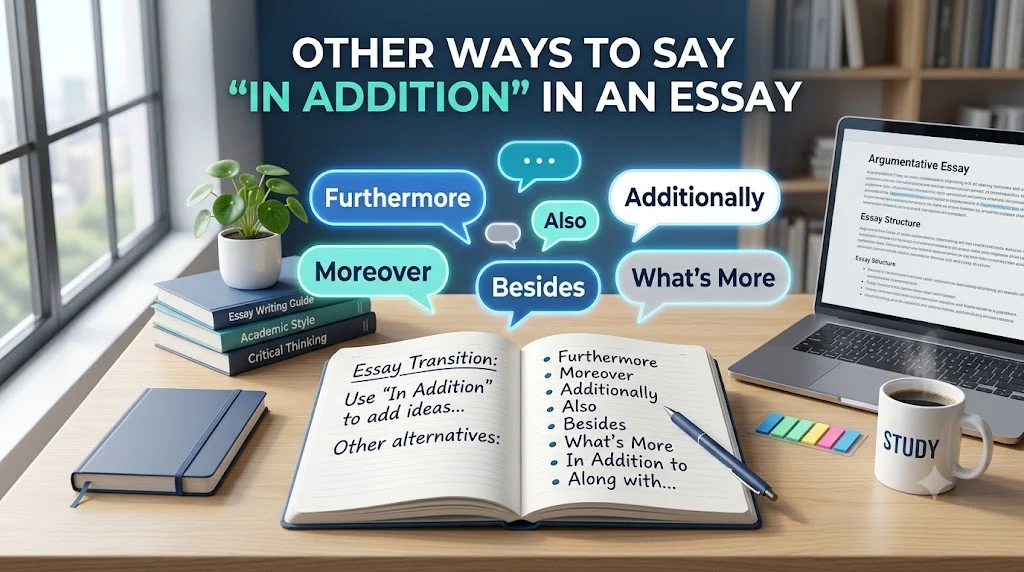
The best alternatives to in addition include furthermore, moreover, additionally, besides, and along with. For essays, choose furthermore or moreover for formal arguments, additionally for neutral transitions, and besides for a more conversation
The phrase in addition is a staple of essay writing. It’s used to introduce extra information, support a point, or continue a list of ideas. While this phrase is perfectly correct and useful, relying on it repeatedly can make your writing sound repetitive and less sophisticated.
Learning alternatives to in addition will help you express your ideas with greater precision and variety, enhancing the overall flow of your writing. Whether you are aiming for a formal academic tone or want to express excitement in English effectively, using varied vocabulary is the key to confident and professional communication.
Quick Categories
Formal Alternatives
- Furthermore
- Moreover
- Additionally
- In conjunction with
- Equally important
Professional Alternatives
- Furthermore
- Additionally
- Over and above
- Another point to consider
Casual Alternatives
- Plus
- What’s more
- On top of that
- Also
Informal Expressions
- Too
- As well
- Not to mention
- To boot
Common Mistakes Section
- Overusing “and”: Using “and” to link ideas in formal paragraphs is not academic style .
- ❌ The experiment was successful, and there was a significant increase in data.
- ✅ The experiment was successful; furthermore, there was a significant increase in data.
- Using casual terms in formal essays: Phrases like plus and on top of that are too informal for academic writing .
- ❌ The results were conclusive, plus the sample size was adequate.
- ✅ The results were conclusive; moreover, the sample size was adequate.
- Using “besides” incorrectly: Besides often adds a dismissive or parenthetical point rather than strengthening an argument . It can be too casual for developing a point.
- ❌ The solution is cost effective. Besides, it’s quick.
- ✅ The solution is cost effective. Furthermore, it is quick to implement.
- Lack of variety: Using the same transition repeatedly makes writing monotonous and shows a limited vocabulary.
- ❌ In addition, the study found X. In addition, it discovered Y. In addition, Z was confirmed.
- ✅ The study found X. Additionally, it discovered Y. Furthermore, Z was confirmed.
- Failing to place “also” correctly: While also is versatile, placing it at the end of a sentence can sound informal.
- ❌ She is a great leader. She is an excellent communicator also.
- ✅ She is a great leader. She is also an excellent communicator.
What Does “In Addition” Mean?
“In addition” is a phrase used to introduce an extra piece of information, an added point, or an item that is being included with another . It serves as a transition to connect ideas, signaling that you are about to provide supplementary details to support your argument .
- Example: The training provides foundational knowledge. In addition, it offers practical experience in a real world setting.
When to Use “In Addition”
- ✔️ To introduce supporting evidence for a previously stated claim.
- ✔️ To list multiple points or advantages in a structured argument.
- ✔️ To continue a line of thought without starting a new paragraph.
- ✔️ To signal a transition between related but distinct ideas.
Spoken vs. Written: Common in formal and neutral writing. While it can be used in spoken English, it is often replaced by more concise terms like also or too in casual conversation .
Formal vs. Informal: It is a formal and academic phrase, making it suitable for essays, reports, and professional communication .
Is It Professional or Polite to Say “In Addition”?
- Polite? ✔️ Yes, it is a polite and neutral way to add information.
- Professional? ❌ Not ideal in most cases, while not incorrect, it is overused. Relying on it can make your writing sound basic and less professional . More sophisticated alternatives like furthermore or moreover demonstrate a stronger command of the English language and create a more persuasive and professional tone .
- Business Example: The quarterly report showed a 15% increase in sales. In addition, customer satisfaction scores have improved by 10%.
Pros and Cons of Using “In Addition”
Pros
- Simple and natural
- Friendly tone
- Common usage
- Easy to understand
Cons
- Too informal for work
- Overused
- Limited emotional range
- Not suitable for formal writing
Other Ways to Say “In Addition” (With Examples)
These alternatives will help you sound more fluent, confident, and natural in different situations. Use them according to tone, context, and audience.
1. Phrase: Furthermore
Meaning: Adds a point that supports what you just said.
Explanation: It indicates a continuation of the same line of reasoning .
Example Sentence: The new policy will reduce costs. Furthermore, it is expected to improve overall efficiency.
Best Use: Formal essays
Worst Use: Casual conversation
Tone: Formal, academic
2. Phrase: Moreover
Meaning: Introduces a stronger or more important point than what was mentioned before .
Explanation: It adds weight to an argument, making it ideal for persuasive writing .
Example Sentence: The candidate has the necessary experience. Moreover, their leadership skills are exceptional.
Best Use: Persuasive arguments
Worst Use: Informal writing
Tone: Formal, emphatic
3. Phrase: Additionally
Meaning: An extra point or item is being added.
Explanation: It is a neutral and direct synonym that is versatile enough for most contexts .
Example Sentence: The course covers theoretical concepts. Additionally, it includes a practical workshop.
Best Use: Neutral contexts
Worst Use: Adding extra details
Tone: Neutral, formal
4. Phrase: Along with
Meaning: Used to indicate that something is included together with something else .
Explanation: It connects two items or ideas as being part of the same group .
Example Sentence: You will need to bring your laptop along with a notebook for the meeting.
Best Use: Listing items
Worst Use: Formal writing
Tone: Neutral, descriptive
5. Phrase: Also
Meaning: Adds a simple, related point.
Explanation: It is a versatile choice that fits comfortably in both formal and informal settings .
Example Sentence: She is a talented writer and also an excellent editor.
Best Use: General use
Worst Use: Transitioning between arguments
Tone: Neutral
6. Phrase: Plus
Meaning: Adds an extra benefit or point in a simple way.
Explanation: It is a concise, colloquial option that makes adding information sound easy .
Example Sentence: The job is interesting, plus it offers great benefits.
Best Use: Spoken English
Worst Use: Academic writing
Tone: Casual, conversational
7. Phrase: What’s More
Meaning: Introduces surprising or extra information, often for emphasis .
Explanation: It is an engaging way to present a point that adds to a narrative or argument .
Example Sentence: They offered a full refund. What’s more, they gave us a free upgrade.
Best Use: Engaging narratives
Worst Use: Formal reports
Tone: Conversational, engaging
8. Phrase: Not to Mention
Meaning: Adds an obvious or unmissable point to emphasize its importance .
Explanation: It is often used to add a point that almost goes without saying, but reinforces the topic .
Example Sentence: The hotel is in a fantastic location, not to mention the amazing views.
Best Use: Spoken emphasis
Worst Use: Academic essays
Tone: Informal, expressive
9. Phrase: On Top of That
Meaning: Adds another point, often emphasizing an additional burden or benefit .
Explanation: It is a more casual way of saying “in addition” and is common in informal speech .
Example Sentence: I’ve got a huge project to finish, and on top of that, I have to prepare for the conference.
Best Use: Informal conversations
Worst Use: Professional writing
Tone: Informal, conversational
10. Phrase: Equally Important
Meaning: Adds a point of equal value to the one just made .
Explanation: It is a professional way to signal that the next piece of information carries the same weight .
Example Sentence: Equally important, we must not overlook the ethical considerations of this decision.
Best Use: Professional arguments
Worst Use: Listing minor details
Tone: Professional, emphatic
11. Phrase: In Conjunction With
Meaning: Indicates two or more things are happening together.
Explanation: It is a formal way to add information, often used in professional or academic contexts .
Example Sentence: The training program will be held in conjunction with the annual conference.
Best Use: Formal reports
Worst Use: Casual writing
Tone: Formal, technical
12. Phrase: Over and Above
Meaning: Adds something extra beyond expectations .
Explanation: It is a professional phrase that indicates added effort or contribution .
Example Sentence: His work on the project went over and above what was required.
Best Use: Professional contexts
Worst Use: Casual conversation
Tone: Formal, professional
13. Phrase: Too
Meaning: Adds another item or person to a list .
Explanation: It is a concise way to show inclusion.
Example Sentence: I’d like to come along to the meeting too.
Best Use: Informal contexts
Worst Use: Formal writing
Tone: Informal, conversational
14. Phrase: As Well
Meaning: Adds information in a simple, casual way .
Explanation: It is a common term that works well in spoken English.
Example Sentence: We are looking at the budget as well.
Best Use: Spoken English
Worst Use: Professional emails
Tone: Neutral, conversational
15. Phrase: Another Point to Consider
Meaning: Introduces a new supporting idea.
Explanation: It is an excellent transition for essays and presentations that require structured arguments .
Example Sentence: Another point to consider is the long term impact on the environment.
Best Use: Essays
Worst Use: Short notes
Tone: Formal, organized
16. Phrase: It is Important to Note That
Meaning: Draws attention to a key detail that supports your argument .
Explanation: This emphasizes that the added information is crucial to the point being discussed.
Example Sentence: It is important to note that the results may not be universally applicable.
Best Use: Formal writing
Worst Use: Casual speech
Tone: Formal, instructive
17. Phrase: Alongside That
Meaning: Adds something that goes together with the first point .
Explanation: It feels organized but friendly, making it suitable for collaborative contexts .
Example Sentence: We’ll work on the design; alongside that, we’ll need to finalize the budget.
Best Use: Professional contexts
Worst Use: Academic essays
Tone: Neutral, friendly
18. Phrase: By the Same Token
Meaning: Used to introduce a related or similar point in an argument.
Explanation: It is a formal term that helps build a logical case .
Example Sentence: We must cut costs. By the same token, we should look for ways to increase revenue.
Best Use: Formal arguments
Worst Use: Casual conversation
Tone: Formal, analytical
19. Phrase: Likewise
Meaning: Adds a similar idea or action .
Explanation: It is best used when the ideas you are adding are parallel in nature .
Example Sentence: The first policy is beneficial for staff; likewise, it helps management.
Best Use: Formal writing
Worst Use: Short notes
Tone: Formal, professional
20. Phrase: Further
Meaning: A concise way of saying “in addition.
Explanation: It is a very common and shorter version of “furthermore,” often used in formal writing .
Example Sentence: The proposal needs revision; further, we must get client approval.
Best Use: Formal writing
Worst Use: Informal speech
Tone: Formal, concise
21. Phrase: To Say Nothing Of
Meaning: Adds emphasis to a major issue .
Explanation: This phrase subtly suggests the added point is so obvious it almost doesn’t need saying, but reinforces the argument .
Example Sentence: He’s struggling with the workload, to say nothing of the stress it’s causing.
Best Use: Emphatic contexts
Worst Use: Formal essays
Tone: Informal, expressive
22. Phrase: Not Only That
Meaning: Highlights an added point for emphasis .
Explanation: It often proceeds a “but also” clause, highlighting a follow up detail.
Example Sentence: She won the case. Not only that, she got the other side to pay the fees.
Best Use: Persuasive writing
Worst Use: Formal reports
Tone: Conversational, emphatic
23. Phrase: As an Added Bonus
Meaning: Adds a positive extra benefit .
Explanation: It is a friendly way to add a benefit to a list.
Example Sentence: The software is free, as an added bonus, it comes with lifetime support.
Best Use: Casual descriptions
Worst Use: Academic essays
Tone: Informal, promotional
24. Phrase: To Boot
Meaning: Adds an extra item in a fun or surprising way .
Explanation: It is a playful, informal addition often used to emphasize a final point.
Example Sentence: He’s a great chef to boot!
Best Use: Casual contexts
Worst Use: Professional writing
Tone: Informal, fun
25. Phrase: Beyond That
Meaning: Adds a point that is the next logical step or extension .
Explanation: It is useful for introducing additional considerations that go further than the first point .
Example Sentence: We’ve finished the analysis. Beyond that, we need to start the implementation phase.
Best Use: Professional presentations
Worst Use: Conversation
Tone: Professional, structured
26. Phrase: Supplementarily
Meaning: Adds supporting information.
Explanation: It is a highly formal and technical term for providing extra details .
Example Sentence: Supplementarily, the data can be found in Appendix B.
Best Use: Technical writing
Worst Use: Everyday use
Tone: Formal, technical
27. Phrase: As Well As
Meaning: Indicates that two or more items are being included.
Explanation: It is a neutral way to combine or add items .
Example Sentence: The course covers theory as well as practical skills.
Best Use: Neutral descriptions
Worst Use: Formal arguments
Tone: Neutral, clear
28. Phrase: In the Same Vein
Meaning: Adds a similar supporting idea .
Explanation: It is an analytical term useful for academic writing when ideas are closely related.
Example Sentence: The author focuses on symbolism; in the same vein, the chapter on metaphors is also vital.
Best Use: Academic writing
Worst Use: Casual conversation
Tone: Formal, analytical
29. Phrase: Together With
Meaning: Shows combination or inclusion .
Explanation: It is a descriptive phrase used to connect two related items .
Example Sentence: The package comes together with a manual and installation guide.
Best Use: Descriptive writing
Worst Use: Formal reports
Tone: Neutral, descriptive
30. Phrase: Another Thing Is
Meaning: An informal way to introduce another idea .
Explanation: It is a very conversational phrase often used when speaking.
Example Sentence: The idea sounds good. Another thing is, do we have the budget for it?
Best Use: Spoken English
Worst Use: Academic writing
Tone: Informal, conversational
31. Phrase: Besides
Meaning: Adds extra information or another reason .
Explanation: Often used in spoken and informal written English to tack on an extra point .
Example Sentence: We need to get there early. Besides, it’s better to avoid the traffic.
Best Use: Casual contexts
Worst Use: Formal essays
Tone: Casual, conversational
“Variety in your vocabulary is the bridge between repetitive writing and persuasive, professional prose.”
Mini Quiz / Self Check
- Scenario: You are writing an academic essay. Which alternative is the most appropriate to use as a formal transition?
a. On top of that
b. Plus
c. Furthermore
d. To boot - Scenario: You are explaining a multi step process to a colleague. Which phrase suggests the next point is of equal importance?
a. What’s more
b. Not to mention
c. Equally important
d. As an added bonus - Scenario: You are speaking with a friend about a great new job. Which phrase would sound natural and not overly formal?
a. Moreover
b. Additionally
c. In addition
d. What’s more - Scenario: You are writing a persuasive business proposal. Which phrase would add a strong, convincing point to your argument?
a. I’d also like to say
b. Plus
c. Moreover
d. Another thing is
Answer Key:
- c.
- c.
- d.
- c.
Comparison Table: Top Alternatives
| Phrase | Tone | Best Use |
| Furthermore | Formal, academic | Strengthening an argument |
| Moreover | Formal, persuasive | Adding a stronger point |
| Additionally | Formal, neutral | Providing extra information |
| Also | Neutral, simple | General use, adding simple points |
| Along with | Neutral, descriptive | Listing items |
| Plus | Informal, casual | Spoken English, simple additions |
| What’s more | Casual, engaging | Emphasizing a bonus point |
| Not to mention | Informal, emphatic | Adding an obvious point |
| On top of that | Informal, conversational | Adding a burden or benefit |
| Equally important | Professional, emphatic | Adding a point of equal weight |
FAQs
1. What is the most formal way to say “in addition” in an essay?
Furthermore and moreover are the most formal and academic alternatives. They are designed to add weight and strengthen an argument in professional and academic writing .
2. Can I use “plus” in a formal essay?
No, plus is considered too informal and conversational for an academic or formal essay. It’s best reserved for everyday speech or informal writing .
3. How do I avoid repeating “in addition” in an essay?
Vary your transitions with words like additionally, furthermore, moreover, also, and besides. The key is to choose a synonym that fits the formality of your text and the specific point you are making .
4. Is “as well” a good synonym for “in addition”?
Yes, as well is a good synonym, but it is more casual. It is better suited for spoken English or informal writing rather than formal essays .
5. What is the meaning of “in addition”?
“In addition” is a linking phrase used to introduce extra information, a new point, or an item included with another. It helps connect ideas in a sentence .
Conclusion
Mastering alternatives to in addition is a powerful way to elevate your writing. By building a strong vocabulary of transitions, you can add nuance and precision to your arguments, avoid repetition, and sound more like a native or advanced speaker. The phrases you choose dramatically influence how your message is received, whether you’re writing a casual text or a formal report.
Start by replacing one or two instances of in addition in your next piece of writing with a phrase like furthermore or additionally. With consistent practice, these other ways to say in addition will become a natural and effortless part of your vocabulary, allowing you to communicate with greater confidence and clarity.

John Green is an American writer who contributes to QuickResponsess.com, creating clear and practical content on English grammar, vocabulary and everyday language. His goal is to make learning English simple, engaging and easy to apply.