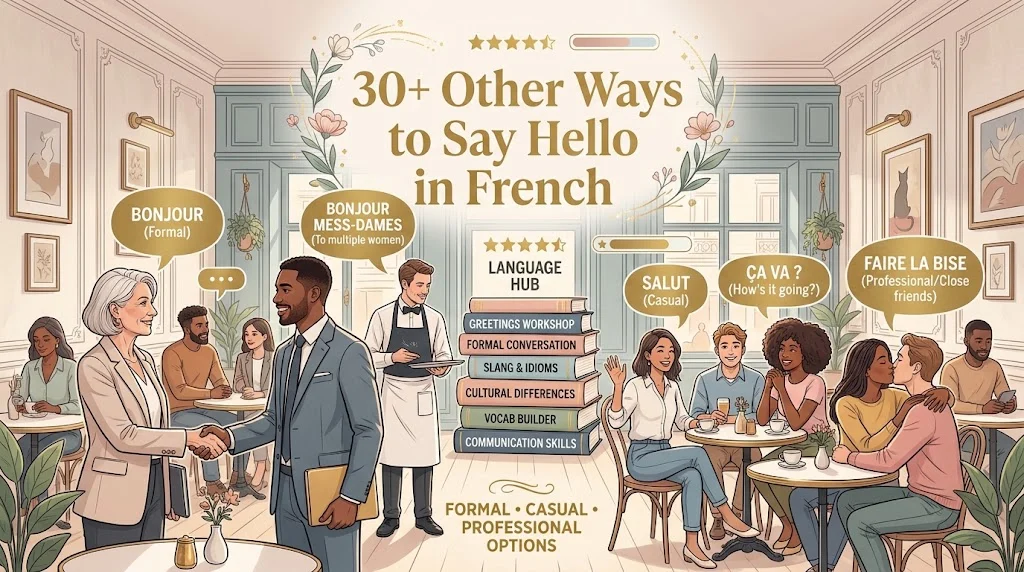
Quick Answer 🔥
The most common ways to say hello in French are bonjour (good morning/day), bonsoir (good evening), salut (hi/informal), coucou (hey there/affectionate), and allô (hello on the phone). Choose based on time of day, formality, and your relationship with the person.
If you are learning French, you already know that bonjour is the standard greeting. But did you know there are dozens of other ways to say hello in French that can instantly make you sound more like a local? From casual slang to professional salutations, mastering these variations will transform your spoken French and help you navigate social situations with confidence.
French culture places immense value on politeness, and greetings are non negotiable. Walking into a shop, café, or office without saying bonjour is considered rude. Learning alternatives to bonjour is not just about vocabulary it is about understanding French social etiquette. Whether you want to express excitement in English when greeting a friend or maintain professionalism in a business meeting, the right greeting sets the tone for the entire interaction.
This guide gives you 30 powerful alternatives to say hello in French, organized by formality, so you can choose the perfect greeting for every situation.
Quick Categories
Formal Alternatives to “Hello in French”
- Bonjour
- Bonsoir
- Enchanté(e)
- Ravi(e) de vous rencontrer
- Bonjour Monsieur/Madame
Casual Alternatives
- Salut
- Coucou
- Salut toi
- Rebonjour
- Bonjour à tous
Professional Alternatives
- Bonjour Madame Dupont
- Bonjour à tous
- Comment allez vous ?
- Bonsoir (in professional evening settings)
- Enchanté(e) de faire votre connaissance
Informal Expressions
- Quoi de neuf ?
- Ça va ?
- Wesh
- Tiens
- Ça baigne ?
“The right greeting in French is not just about words it is about respect, timing, and understanding the unspoken rules of politeness.”
Common Mistakes
1. Using “salut” with strangers or superiors
Example: Saying Salut, Monsieur to your boss. Use Bonjour instead.
2. Saying “bonjour” twice to the same person in one day
Example: Greeting a colleague with Bonjour at 9 AM and again at 2 PM. Use Rebonjour the second time.
3. Using “bon matin” in France
Example: Saying Bon matin in Paris. This is an anglicism; stick with bonjour. (Note: Bon matin is used in Canadian French.)
4. Skipping the greeting entirely before making a request
Example: Walking into a bakery and saying Je voudrais une baguette without bonjour first. Always greet first.
5. Using “comment ça va” in very formal written communication
Example: Opening a formal email with Comment ça va ? Use Bonjour or Comment allez vous ? instead.
What Does “Hello in French” Mean?
The most common way to say hello in French is bonjour, which literally translates to “good day” (bon = good, jour = day). It is used as a greeting from morning until early evening. Bonsoir (bon + soir = good evening) takes over after sunset, typically around 6 PM.
Example: Bonjour, comment allez vous aujourd’hui ? (Hello, how are you today?)
When to Use “Hello in French”
- Morning until early evening: Use bonjour
- Evening and night: Use bonsoir
- With friends and family: Use salut or coucou
- In professional settings: Use bonjour + title (Monsieur, Madame)
- On the phone: Use allô
- When greeting someone again the same day: Use rebonjour
Is It Professional or Polite to Say “Hello in French”?
Polite? ✔️ Yes bonjour and bonsoir are universally polite.
Professional? ✔️ Yes when used with titles (Monsieur, Madame) and in formal contexts.
Business example: Bonjour Madame, je vous écris pour discuter de notre projet. (Hello Madam, I am writing to discuss our project.)
Pros and Cons of Using “Bonjour”
Pros:
- Simple and universally understood
- Works in almost every situation
- Safe choice for beginners
- Always polite and respectful
Cons:
- Does not work in the evening (use bonsoir)
- Cannot be used twice with the same person in one day
- May sound too formal among close friends
- Does not convey warmth or familiarity
30 Other Ways to Say Hello in French (With Examples)
These alternatives will help you sound more fluent, confident, and natural in different situations. Use them according to tone, context, and audience to greet people appropriately.
Formal Greetings
1. Phrase: Bonjour
Meaning: Good morning or good afternoon.
Explanation: The most common and versatile French greeting, used from morning until early evening.
Example Sentence: Bonjour, je suis ravi de vous rencontrer. (Hello, I am delighted to meet you.)
Best Use: Any formal situation
Worst Use: Evening hours
Tone: Neutral, polite, respectful
Context Variability: Works in all formal and most informal settings
2. Phrase: Bonsoir
Meaning: Good evening.
Explanation: Used after sunset, typically from 6 PM onward.
Example Sentence: Bonsoir, Madame. Avez vous une réservation ? (Good evening, Madam. Do you have a reservation?)
Best Use: Evening meetings, restaurants
Worst Use: Morning or afternoon
Tone: Polite, formal, warm
Context Variability: Formal and informal evening greetings
3. Phrase: Enchanté(e)
Meaning: Nice to meet you (delighted).
Explanation: Used when meeting someone for the first time; add an extra *e* if you are female.
Example Sentence: Enchantée, je suis Marie. (Nice to meet you, I am Marie.)
Best Use: First introductions
Worst Use: Casual settings with friends
Tone: Formal, polite, warm
Context Variability: Formal introductions
4. Phrase: Ravi(e) de vous rencontrer
Meaning: Pleased to meet you.
Explanation: A slightly more formal way to express pleasure at meeting someone.
Example Sentence: Ravi de vous rencontrer, Monsieur. (Pleased to meet you, Sir.)
Best Use: Business introductions
Worst Use: Informal gatherings
Tone: Professional, courteous
Context Variability: Formal first meetings
5. Phrase: Bonjour Monsieur/Madame
Meaning: Hello Sir/Madam.
Explanation: Adds a title for extra respect and formality.
Example Sentence: Bonjour Madame, comment puis je vous aider ? (Hello Madam, how can I help you?)
Best Use: Customer service, formal emails
Worst Use: Among friends
Tone: Very formal, respectful
Context Variability: Professional, formal situations
6. Phrase: Bonjour à tous
Meaning: Hello everyone.
Explanation: Used when addressing a group formally or semi formally.
Example Sentence: Bonjour à tous, bienvenue à la réunion. (Hello everyone, welcome to the meeting.)
Best Use: Meetings, presentations
Worst Use: One on one conversations
Tone: Professional, inclusive
Context Variability: Group settings, professional
7. Phrase: Comment allez vous ?
Meaning: How are you? (formal)
Explanation: The formal way to ask how someone is doing.
Example Sentence: Bonjour, comment allez vous aujourd’hui ? (Hello, how are you today?)
Best Use: Formal conversations, professional settings
Worst Use: Close friends
Tone: Formal, polite
Context Variability: Formal spoken French
“Saying bonjour before anything else in France is not optional it is a social contract.”
Casual Greetings
8. Phrase: Salut
Meaning: Hi or Hey.
Explanation: The informal cousin of bonjour, used with friends, family, and peers.
Example Sentence: Salut ! Ça fait longtemps ! (Hi! Long time no see!)
Best Use: Friends, family, casual settings
Worst Use: Professional environments, strangers
Tone: Friendly, casual, warm
Context Variability: Informal spoken French
9. Phrase: Coucou
Meaning: Hey there.
Explanation: A playful, affectionate greeting used with close friends and family.
Example Sentence: Coucou ! Tu es prêt ? (Hey there! Are you ready?)
Best Use: Close friends, children, loved ones
Worst Use: Professional settings
Tone: Affectionate, playful, warm
Context Variability: Very informal, intimate
10. Phrase: Salut toi
Meaning: Hey you.
Explanation: A friendly, familiar way to greet someone you know well.
Example Sentence: Salut toi ! Comment ça va ? (Hey you! How’s it going?)
Best Use: Close friends, romantic partners
Worst Use: Professional contexts
Tone: Playful, familiar
Context Variability: Informal, intimate
11. Phrase: Rebonjour
Meaning: Hello again.
Explanation: Used when greeting someone you have already greeted earlier in the day.
Example Sentence: Rebonjour, je reviens pour poser une question. (Hello again, I’m back to ask a question.)
Best Use: Second encounter same day
Worst Use: First greeting of the day
Tone: Polite, practical
Context Variability: Both formal and informal
12. Phrase: Salut tout le monde
Meaning: Hi everyone.
Explanation: An informal way to greet a group.
Example Sentence: Salut tout le monde ! On commence ? (Hi everyone! Shall we start?)
Best Use: Casual group settings
Worst Use: Formal meetings
Tone: Friendly, inclusive
Context Variability: Informal group greetings
13. Phrase: Tiens
Meaning: Oh, hello (expressing surprise).
Explanation: Used when you are surprised to see someone.
Example Sentence: Tiens ! Je ne t’attendais pas. (Oh hello! I wasn’t expecting you.)
Best Use: Unexpected encounters
Worst Use: Planned meetings
Tone: Surprised, friendly
Context Variability: Informal, spontaneous
Professional & Business Greetings
14. Phrase: Bonjour [First Name]
Meaning: Hello [First Name].
Explanation: Used in workplace emails and conversations with colleagues you know well.
Example Sentence: Bonjour Pierre, peux tu regarder ce document ? (Hello Pierre, can you look at this document?)
Best Use: Workplace with colleagues
Worst Use: Very formal external communications
Tone: Professional but friendly
Context Variability: Semi formal professional
15. Phrase: Bien le bonjour
Meaning: A very good day to you.
Explanation: A warm, slightly old fashioned formal greeting.
Example Sentence: Bien le bonjour, cher ami ! (A very good day to you, dear friend!)
Best Use: Warm formal greetings
Worst Use: Casual conversations
Tone: Warm, formal, courteous
Context Variability: Formal, often written
16. Phrase: Bonsoir Messieurs/Dames
Meaning: Good evening gentlemen/ladies.
Explanation: Formal evening greeting addressing a group.
Example Sentence: Bonsoir Messieurs, veuillez vous asseoir. (Good evening gentlemen, please sit down.)
Best Use: Formal evening events, conferences
Worst Use: Casual settings
Tone: Very formal, respectful
Context Variability: Formal professional
Informal & Slang Greetings
17. Phrase: Quoi de neuf ?
Meaning: What’s up? / What’s new?
Explanation: A familiar way to ask what is happening in someone’s life.
Example Sentence: Salut ! Quoi de neuf ? (Hi! What’s up?)
Best Use: Friends, casual conversations
Worst Use: Professional settings
Tone: Casual, friendly
Context Variability: Informal spoken French
18. Phrase: Quoi de beau ?
Meaning: What’s new? (literally “what’s beautiful?”)
Explanation: A slightly more playful version of quoi de neuf.
Example Sentence: Quoi de beau depuis la dernière fois ? (What’s new since last time?)
Best Use: Friends, casual chats
Worst Use: Formal contexts
Tone: Playful, casual
Context Variability: Informal
19. Phrase: Ça va ?
Meaning: How’s it going? / You okay?
Explanation: The most common informal way to ask how someone is.
Example Sentence: Salut ! Ça va ? (Hi! How’s it going?)
Best Use: Friends, family, everyday
Worst Use: Formal situations
Tone: Casual, friendly
Context Variability: Informal
20. Phrase: Comment ça va ?
Meaning: How’s it going?
Explanation: A slightly more complete version of ça va.
Example Sentence: Comment ça va aujourd’hui ? (How’s it going today?)
Best Use: Acquaintances, casual
Worst Use: Very formal
Tone: Neutral casual
Context Variability: Semi formal to informal
21. Phrase: Wesh
Meaning: Yo / Hey (slang).
Explanation: A very informal greeting borrowed from Arabic, popular among young people.
Example Sentence: Wesh, ça va ? (Yo, how’s it going?)
Best Use: Young people, very casual
Worst Use: Professional, with elders
Tone: Slang, urban, casual
Context Variability: Very informal
22. Phrase: Ça baigne ?
Meaning: How’s it going? (slang)
Explanation: Literally “is it bathing?” a very casual slang question.
Example Sentence: Ça baigne, et toi ? (How’s it going, and you?)
Best Use: Close friends
Worst Use: Any formal context
Tone: Slang, playful
Context Variability: Very informal
23. Phrase: Eh, ça va
Meaning: Hey, how’s it going?
Explanation: A casual interjection to get someone’s attention.
Example Sentence: Eh, ça va, tu viens ? (Hey, how’s it going, are you coming?)
Best Use: Friends, casual encounters
Worst Use: Professional
Tone: Casual, direct
Context Variability: Informal
“Using the right greeting in French instantly signals that you understand and respect the culture not just the language.”
Context Specific Greetings
24. Phrase: Allô
Meaning: Hello (on the phone).
Explanation: Used exclusively when answering the telephone.
Example Sentence: Allô ? Oui, je vous écoute. (Hello? Yes, I’m listening.)
Best Use: Phone calls
Worst Use: In person greetings
Tone: Neutral, practical
Context Variability: Telephone only
25. Phrase: Bienvenue
Meaning: Welcome.
Explanation: Used to welcome someone to a place.
Example Sentence: Bienvenue à Paris ! (Welcome to Paris!)
Best Use: Welcoming guests, arrivals
Worst Use: Casual greetings
Tone: Warm, hospitable
Context Variability: Welcoming contexts
26. Phrase: Bonjour chez vous
Meaning: Hello to your household.
Explanation: A warm greeting used when visiting someone’s home.
Example Sentence: Bonjour chez vous ! (Hello to your household!)
Best Use: Visiting someone’s home
Worst Use: Professional contexts
Tone: Warm, respectful
Context Variability: Social visits
27. Phrase: Salut la compagnie
Meaning: Hi everyone (informal).
Explanation: A playful way to greet a group of friends.
Example Sentence: Salut la compagnie ! On sort ce soir ? (Hi everyone! Are we going out tonight?)
Best Use: Groups of friends
Worst Use: Formal or professional
Tone: Playful, inclusive
Context Variability: Informal group
28. Phrase: Comment vas tu ?
Meaning: How are you? (informal)
Explanation: The informal version of comment allez vous.
Example Sentence: Salut, comment vas tu ? (Hi, how are you?)
Best Use: Friends, family
Worst Use: Formal situations
Tone: Friendly, caring
Context Variability: Informal
29. Phrase: Ça fait longtemps
Meaning: Long time no see.
Explanation: Used when you haven’t seen someone in a while.
Example Sentence: Ça fait longtemps ! Comment ça va ? (Long time no see! How are you?)
Best Use: Reunions with friends
Worst Use: First time meetings
Tone: Warm, friendly
Context Variability: Informal
30. Phrase: Bonjour, je suis…
Meaning: Hello, I am…
Explanation: A self introduction greeting.
Example Sentence: Bonjour, je suis Jean Dupont. (Hello, I am Jean Dupont.)
Best Use: Introductions
Worst Use: With people you know
Tone: Neutral, polite
Context Variability: Formal and informal
“Mastering greetings is the first step to sounding like a native French speaker not just memorizing words, but knowing when and how to use them.”
Mini Quiz / Self Check
1. You are meeting your new boss for the first time at 10 AM. Which greeting should you use?
- A) Salut
- B) Coucou
- C) Bonjour, Monsieur
- D) Wesh
Answer: C) Bonjour, Monsieur formal and respectful.
2. You run into a close friend at a café in the evening. Which greeting fits best?
- A) Bonsoir, Madame
- B) Salut ! Ça va ?
- C) Enchanté(e)
- D) Allô
Answer: B) Salut ! Ça va ? informal and friendly.
3. You are answering a phone call from a client. What do you say?
- A) Coucou
- B) Quoi de neuf ?
- C) Allô
- D) Salut
Answer: C) Allô the standard phone greeting.
4. You already greeted your colleague this morning. You see them again after lunch. What should you say?
- A) Bonjour (again)
- B) Rebonjour
- C) Salut
- D) Coucou
Answer: B) Rebonjour to acknowledge you have already greeted them today.
Comparison Table: Top 10 Alternatives
| Phrase | Tone | Best Use |
| Bonjour | Formal/neutral | Any daytime situation |
| Bonsoir | Formal/neutral | Evening greetings |
| Salut | Informal | Friends and family |
| Coucou | Affectionate | Close friends, children |
| Enchanté(e) | Formal | First introductions |
| Comment allez vous ? | Formal | Professional how are you |
| Quoi de neuf ? | Informal | Casual what’s up |
| Allô | Neutral | Phone calls |
| Rebonjour | Neutral | Second greeting same day |
| Wesh | Slang | Very casual, young people |
FAQs
1. What is the most common way to say hello in French?
The most common way to say hello in French is bonjour, which means “good morning” or “good afternoon.” It is used from morning until early evening and works in both formal and informal settings.
2. Is it rude to say “salut” in France?
It is not rude, but salut is informal. Using it with strangers, superiors, or in professional settings can be seen as too casual or disrespectful. Stick with bonjour unless you know the person well.
3. What is the difference between “bonjour” and “bonsoir”?
Bonjour is used during the day (morning to early evening), while bonsoir is used in the evening, typically after 6 PM. Both are polite and can be used formally or informally.
4. Can I say “bon matin” in French?
In France, bon matin is not commonly used and is considered an anglicism. Stick with bonjour. However, bon matin is used in Canadian French.
5. Why do the French always say “bonjour” before asking for something?
In French culture, greeting someone before making a request is a fundamental rule of politeness. Skipping bonjour is considered rude and can negatively affect the interaction.
Conclusion
Learning other ways to say hello in French transforms your communication from basic to brilliant. Whether you are navigating a professional meeting with Bonjour Monsieur, greeting a friend with Salut, or surprising someone with Tiens, each greeting carries its own tone and cultural weight. The key is not just memorizing the words but understanding when and how to use them.
Practice one or two new greetings each day. Pay attention to the context, the person you are speaking to, and the time of day. Soon, choosing the right French greeting will feel as natural as breathing and you will sound more fluent, confident, and culturally aware every time you speak.

Sally Rooney is an American writer who contributes to QuickResponsess.com, creating clear and practical content for English learners. Her articles help readers build confidence in using words and expressions accurately in everyday and professional communication.