Quick Answer
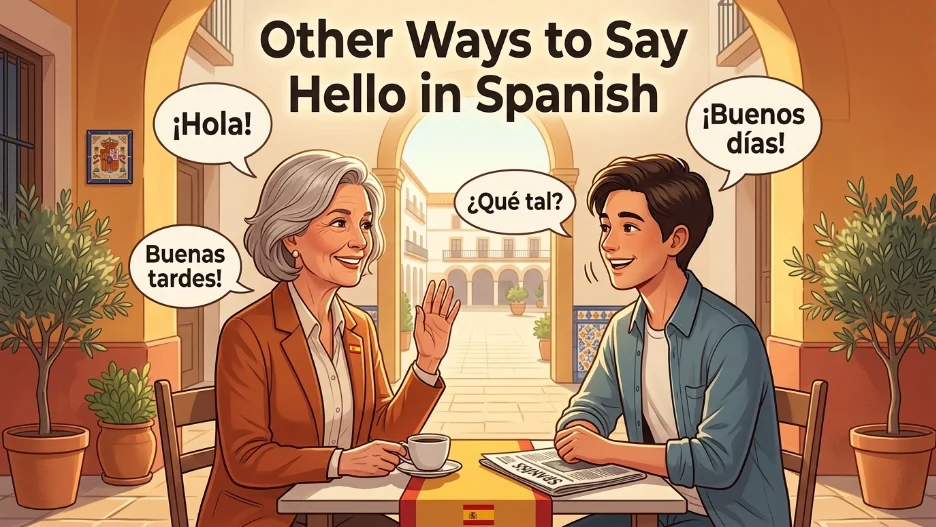
The most common ways to say hello in Spanish include ¡Hola!, Buenos días, Buenas tardes, Buenas noches, and ¿Qué tal? These greetings range from universal and neutral to time specific and casual, allowing you to adapt to any social situation.
“Hello” is often the first word we learn in a new language, but in Spanish, it is just the beginning. While ¡Hola! serves as a friendly and universal greeting, limiting yourself to this single word can make your speech feel repetitive and mark you as a beginner . Mastering a variety of alternatives to hello in Spanish is essential for achieving fluency and making authentic connections with native speakers.
Understanding when to use formal greetings like Buenos días versus casual expressions like ¿Qué onda? is key to navigating different social contexts. Whether you are entering a business meeting, meeting friends for coffee, or answering the phone, selecting the appropriate greeting shows cultural awareness and respect . By expanding your repertoire, you can express excitement in English and Spanish more naturally.
Quick Categories
- Buenos días
- Buenas tardes
- Buenas noches
- ¿Cómo está? (usted)
- Mucho gusto
- Encantado/a
- ¿Qué tal?
- ¿Cómo estás?
- ¡Buenas!
- ¿Cómo te va?
Professional Alternatives
- Buenos días / Buenas tardes (with titles)
- Hola, soy [Name]
- Mi nombre es [Name]
- Me presento
Informal Expressions
- ¿Qué onda?
- ¿Qué pasa?
- ¡Ey! / ¡Hey!
- ¿Qué hubo?
- ¡Epale!
Pro Tip: In Spain, use tú for almost all social situations, while in Latin America, usted is more common for formal interactions and showing respect to elders .
Common Mistakes
- Using “¿Cómo está?” informally
“¿Cómo está, amigo?” – Incorrect for a friend. Use ¿Cómo estás? for informal settings. - Saying “Buenas noches” as a goodbye only
“Buenas noches” – It can be a greeting in the evening. It is not just for saying goodbye. - Using “introducir” to introduce someone
“Te introduzco a María” – Incorrect. The correct verb is presentar. - Misusing “¿Qué pasa?”
“¿Qué pasa con el proyecto?” – Can imply something is wrong. Use ¿Cómo va? for a neutral check in. - Overusing “¡Hola!” in professional emails
“¡Hola! Quería…” – Too informal for a first contact. Use Estimado/a or Buenos días.
What Does “Hello” Mean in Spanish?
The Spanish word hola is the most basic greeting, equivalent to the English “hello” or “hi.” It is pronounced with a silent “h,” sounding like “oh la.”
Example: ¡Hola! ¿Cómo estás? (Hello! How are you?)
The term “hello” serves multiple functions in both languages: it initiates conversation, acknowledges another person’s presence, and signals a friendly or polite tone. In Spanish, you often combine hola with time specific greetings for added warmth, as in Hola, buenos días .
When to Use Different Spanish Greetings
Greetings in Spanish fall along a formality continuum . This allows you to adapt your language to various contexts.
Spoken vs. Written
- Spoken: Used for face to face interactions and phone calls
- Written: Formal greetings appear in emails; informal via WhatsApp or text
Formal vs. Informal
- Formal: Reserved for professionals, strangers, and showing respect
- Informal: Appropriate for friends, family, and casual encounters
You can use ¡Hola! in nearly any situation, but combining it with additional phrases demonstrates cultural competence .
Is It Professional or Polite to Say “Hello”?
Polite? Yes
Professional? It depends on the context
Using ¡Hola! in a formal business email is generally too casual. Professional alternatives like Buenos días, estimado Sr. or Buenas tardes demonstrate respect and competence .
Example: Buenos días, señor García. Me presento, soy Miguel, el nuevo asistente. (Good morning, Mr. García. Let me introduce myself. I am Miguel, the new assistant.)
Pros and Cons of Using ¡Hola!
Pros
- Simple and natural
- Friendly tone
- Common usage
- Easy to understand
Cons
- Too informal for work
- Overused
- Limited emotional range
- Not suitable for formal writing
Other Ways to Say “Hello” in Spanish (With Examples)
These alternatives will help you sound more fluent, confident, and natural in different situations. Use them according to tone, context, and audience to express excitement, admiration, or approval.
1. ¡Buenos días!
- Meaning: Good morning.
- Explanation: Used from sunrise until midday to wish someone a good day.
- Example: Buenos días, ¿cómo amaneció? (Good morning, how did you wake up?)
- Best Use: Morning greetings
- Worst Use: Afternoon/evening
- Tone: Formal, warm
- Context Variability: Professional and formal settings
2. ¡Buenas tardes!
- Meaning: Good afternoon.
- Explanation: This greeting is used from midday until evening.
- Example: Buenas tardes, ¿en qué puedo ayudarle? (Good afternoon, how can I help you?)
- Best Use: Afternoon greetings
- Worst Use: Early morning
- Tone: Polite, professional
- Context Variability: Formal and service encounters
3. ¡Buenas noches!
- Meaning: Good evening / Good night.
- Explanation: Used as a greeting upon arrival in the evening and as a farewell when leaving .
- Example: Buenas noches, bienvenidos al evento. (Good evening, welcome to the event.)
- Best Use: Evening greetings
- Worst Use: Greeting in the morning
- Tone: Respectful, warm
- Context Variability: Formal events and social gatherings
4. ¿Cómo está? (usted)
- Meaning: How are you? (Formal)
- Explanation: This expresses interest in the well being of a person you do not know well or who deserves respect .
- Example: Hola, ¿cómo está usted hoy? (Hello, how are you today?)
- Best Use: Professional settings
- Worst Use: With friends
- Tone: Formal, polite
- Context Variability: Business meetings and formal interactions
5. ¿Cómo estás? (tú)
- Meaning: How are you? (Informal)
- Explanation: A casual way to ask about someone’s well being, used with friends and peers .
- Example: ¿Cómo estás? ¡Tanto tiempo sin verte! (How are you? Long time no see!)
- Best Use: Friends and family
- Worst Use: Professional emails
- Tone: Warm, friendly
- Context Variability: Casual social situations
6. ¿Qué tal?
- Meaning: What’s up? / How’s it going?
- Explanation: A very common informal greeting that inquires about the other person’s state .
- Example: ¿Qué tal? ¿Cómo te fue en el examen? (What’s up? How did the exam go?)
- Best Use: General check ins
- Worst Use: Formal events
- Tone: Casual, friendly
- Context Variability: Informal situations
7. ¡Buenas!
- Meaning: Hi there!
- Explanation: A shortened, informal version of time based greetings, used for quick hellos .
- Example: ¡Buenas! ¿Qué hay de nuevo? (Hi there! What’s new?)
- Best Use: Quick greetings
- Worst Use: Written communication
- Tone: Casual, efficient
- Context Variability: Passing acquaintances or quick encounters
8. ¿Qué pasa?
- Meaning: What’s happening? / What’s up?
- Explanation: This is popular among young people and in casual conversation to ask what is going on .
- Example: ¿Qué pasa, amigos? (What’s up, friends?)
- Best Use: Friends and social gatherings
- Worst Use: Professional settings
- Tone: Energetic, informal
- Context Variability: Social and casual settings
9. ¡Saludos!
- Meaning: Greetings!
- Explanation: A general, friendly greeting often used in writing or when addressing a group .
- Example: ¡Saludos a todos desde Madrid! (Greetings to everyone from Madrid!)
- Best Use: Group greetings
- Worst Use: One on one formal meetings
- Tone: Neutral, friendly
- Context Variability: Written and group settings
10. ¡Aló!
- Meaning: Hello? (Phone)
- Explanation: Used to answer the phone in many Spanish speaking countries .
- Example: ¿Aló? ¿Quién habla? (Hello? Who’s speaking?)
- Best Use: Answering phone calls
- Worst Use: Face to face greetings
- Tone: Neutral, practical
- Context Variability: Phone conversations
11. ¡Diga! / ¡Dígame!
- Meaning: Speak! / Tell me!
- Explanation: A common way to answer the phone in Spain, inviting the caller to speak .
- Example: ¡Dígame! (Hello! / Tell me!)
- Best Use: Answering phone calls
- Worst Use: Formal written communication
- Tone: Direct, neutral
- Context Variability: Phone greetings
12. ¿Cómo te va?
- Meaning: How’s it going?
- Explanation: An informal way to ask about someone’s progress or general state .
- Example: ¿Cómo te va en el trabajo? (How’s it going at work?)
- Best Use: Friends and acquaintances
- Worst Use: Formal business meetings
- Tone: Casual, friendly
- Context Variability: Informal interactions
13. ¿Qué hay de nuevo?
- Meaning: What’s new?
- Explanation: A conversational opener that asks for updates or news .
- Example: ¿Qué hay de nuevo? (What’s new?)
- Best Use: Catching up with friends
- Worst Use: Professional settings
- Tone: Casual, curious
- Context Variability: Reunions and social encounters
14. ¡Buen día!
- Meaning: Good day!
- Explanation: A slightly shorter version of “buenos días,” commonly used in Latin America .
- Example: ¡Buen día! (Good day!)
- Best Use: Morning greetings
- Worst Use: Evening encounters
- Tone: Cheerful, courteous
- Context Variability: Both formal and informal settings
15. ¡Bienvenido/a!
- Meaning: Welcome!
- Explanation: A warm greeting used to welcome someone into a place .
- Example: ¡Bienvenidos a mi casa! (Welcome to my house!)
- Best Use: Welcoming guests
- Worst Use: Passing greetings
- Tone: Friendly, hospitable
- Context Variability: Home and event settings
16. Mucho gusto
- Meaning: Nice to meet you.
- Explanation: A courteous greeting for first meetings .
- Example: Mucho gusto, soy Laura. (Nice to meet you, I’m Laura.)
- Best Use: First meetings
- Worst Use: People you already know
- Tone: Formal, polite
- Context Variability: Introductions
17. Encantado/a
- Meaning: Pleased to meet you.
- Explanation: A formal introduction phrase meaning “delighted” .
- Example: Encantado de conocerle. (Pleased to meet you.)
- Best Use: Formal introductions
- Worst Use: Casual situations
- Tone: Formal, respectful
- Context Variability: Professional settings
18. Mi casa es su casa
- Meaning: My house is your house.
- Explanation: A warm, welcoming phrase to make guests feel comfortable .
- Example: ¡Pasen! Mi casa es su casa. (Come in! Make yourselves at home.)
- Best Use: Hosting guests
- Worst Use: Formal office settings
- Tone: Warm, generous
- Context Variability: Social and hospitality settings
19. ¿Cómo andas?
- Meaning: How are you doing? (Informal)
- Explanation: A casual phrase literally asking “How are you walking?”
- Example: ¿Cómo andas? (How are you doing?)
- Best Use: Friends and close peers
- Worst Use: Professional environments
- Tone: Casual, familiar
- Context Variability: Social situations
20. ¿Qué hubo? / ¿Quiubo?
- Meaning: What’s up? (Colombia/Mexico)
- Explanation: A regional slang greeting, short for “¿Qué ha habido?”
- Example: ¿Quiubo? ¿Cómo va todo? (What’s up? How’s everything?)
- Best Use: Casual greetings in Latin America
- Worst Use: Formal settings or outside the region
- Tone: Regional, casual
- Context Variability: Latin American casual conversation
21. ¿Qué onda?
- Meaning: What’s up? (Mexico/Chile)
- Explanation: A very popular slang greeting in Mexico and Chile .
- Example: ¿Qué onda, microonda? (What wave, microwave?)
- Best Use: Friends and younger peers
- Worst Use: Professional settings
- Tone: Slang, casual
- Context Variability: Latin American social settings
22. ¡Ey! / ¡Hey!
- Meaning: Hey!
- Explanation: A borrowed English word, used to get attention or greet casually .
- Example: ¡Ey! ¿Qué tal? (Hey! What’s up?)
- Best Use: Attention grabbing
- Worst Use: Formal situations
- Tone: Quick, casual
- Context Variability: Social interactions
23. ¡Epale!
- Meaning: Hello! / Hey! (Venezuela)
- Explanation: A Venezuelan slang greeting used to get someone’s attention .
- Example: ¡Epale! ¿Cómo estás? (Hey! How are you?)
- Best Use: Venezuelan or Latin American casual interactions
- Worst Use: Formal contexts
- Tone: Regional, energetic
- Context Variability: Casual social interactions
24. Estimado/a…
- Meaning: Dear…
- Explanation: A common opening for formal letters and emails .
- Example: Estimado Sr. Pérez: (Dear Mr. Pérez,)
- Best Use: Formal written correspondence
- Worst Use: Spoken greetings
- Tone: Formal, respectful
- Context Variability: Professional writing
25. A quien corresponda:
- Meaning: To whom it may concern:
- Explanation: Used in formal communication when the recipient’s name is unknown .
- Example: A quien corresponda: (To whom it may concern:)
- Best Use: Formal letters and emails
- Worst Use: Spoken or informal contexts
- Tone: Formal, impersonal
- Context Variability: Official written communication
26. Hola, soy…
- Meaning: Hello, I am…
- Explanation: A concise, professional way to introduce yourself in meetings .
- Example: Hola, soy el nuevo gerente. (Hello, I am the new manager.)
- Best Use: Self introductions at work
- Worst Use: Very formal written documents
- Tone: Friendly, professional
- Context Variability: Workplace and social introductions
27. Buenos días, soy…
- Meaning: Good morning, I am…
- Explanation: A professional introduction that combines a time based greeting with your name .
- Example: Buenos días, soy Ana, su nueva asesora. (Good morning, I am Ana, your new advisor.)
- Best Use: Professional self introductions
- Worst Use: Casual meetings
- Tone: Professional, formal
- Context Variability: Business settings
28. Me presento…
- Meaning: Let me introduce myself…
- Explanation: A polite phrase used to introduce yourself formally .
- Example: Me presento, soy el director de ventas. (Let me introduce myself, I am the sales director.)
- Best Use: Formal introductions
- Worst Use: Casual social settings
- Tone: Formal, professional
- Context Variability: Professional introductions
29. ¿Qué hay? (informal)
- Meaning: What’s up? (Spain)
- Explanation: A shortened, informal greeting common in Spain .
- Example: ¿Qué hay, tío? (What’s up, dude?)
- Best Use: Friends in Spain
- Worst Use: Formal or written contexts
- Tone: Casual, European
- Context Variability: Social interactions in Spain
30. ¿Qué es la que hay?
- Meaning: What’s going on? (Very informal)
- Explanation: A very informal greeting used in some regions to ask what is happening .
- Example: ¿Qué es la que hay? (What’s going on?)
- Best Use: Close friends
- Worst Use: Anyone unfamiliar
- Tone: Very informal, slang
- Context Variability: Casual, very informal situations
Pro Tip: Paying attention to cultural norms like handshakes in professional settings versus the two kiss greeting in Spain and parts of Latin America will make your interactions more polished.
Mini Quiz / Self Check
1. You are meeting a potential client for the first time. What greeting should you use?
A) ¿Qué onda?
B) Buenos días, mucho gusto.
C) ¡Ey! ¿Qué tal?
D) ¿Qué pasó?
Answer: B
2. Which greeting is most appropriate for a casual phone call with a friend?
A) Aló, ¿Cómo está?
B) Buenos días, soy…
C) Hola, ¿Qué tal?
D) Estimado amigo
Answer: C
3. You are answering a phone call in Spain. What should you say?
A) ¿Aló?
B) ¿Dígame?
C) ¿Qué onda?
D) Good morning
Answer: B
4. Your colleague in Mexico says “¿Qué onda?”. What is the best response?
A) Mucho gusto.
B) ¿Cómo está usted?
C) ¡Hola! ¿Qué más?
D) A quien corresponda.
Answer: C
Comparison Table: Top Alternatives
| Phrase | Tone | Best Use |
| Buenos días | Formal | Morning business meetings |
| Buenas tardes | Formal | Afternoon professional encounters |
| ¿Cómo está? | Formal | Speaking with authority figures |
| ¡Hola! | Universal | Any situation |
| ¿Qué tal? | Casual | General check ins with friends |
| ¡Buenas! | Casual | Quick, informal greetings |
| ¿Qué onda? | Slang | Latin American casual interaction |
| ¡Aló! | Neutral | Answering phone calls |
| Mucho gusto | Formal | First time introductions |
| Estimado/a | Formal | Professional email openings |
FAQs
1. What is the most formal way to say hello in Spanish?
The most formal greetings are time based: Buenos días, Buenas tardes, and Buenas noches, often combined with titles like Señor or Señora. ¿Cómo está usted? is also a respectful formal greeting .
2. Can I use “¡Hola!” in professional settings?
Yes, but it depends on context. While ¡Hola! works for colleagues you know, it is too informal for first time business contacts or formal emails. Buenos días or Estimado/a are safer options .
3. What is the difference between “¿Cómo estás?” and “¿Cómo está?”
¿Cómo estás? is informal, using the tú form for friends and peers. ¿Cómo está? is formal, using the usted form for showing respect to strangers, elders, or authority figures .
4. What do you say on the phone in Spanish?
Common phone greetings include ¡Aló! (Latin America), ¡Diga! or ¡Dígame! (Spain), and ¿Sí? or simply ¿Hola? . The best choice depends on the region.
5. What is the greeting “¿Qué onda?” and where is it used?
¿Qué onda? is a very informal slang greeting meaning “What’s up?” It is primarily used in Mexico, Chile, and parts of Latin America among friends and younger people. It is inappropriate for professional settings .
Conclusion
Mastering other ways to say hello in Spanish is more than vocabulary building; it is the key to connecting with people across different cultures and contexts. From the professional formality of Buenos días to the casual warmth of ¿Qué tal?, each greeting carries its own tone and appropriateness. A diverse vocabulary helps you express excitement in English and Spanish, showing you are fluent and culturally aware.
Try incorporating two or three new greetings into your conversations each week. Pay attention to the situation and the person you are speaking to, and you will naturally choose the right word. The more you practice, the more confident you will become in all your Spanish interactions.

Sally Rooney is an American writer who contributes to QuickResponsess.com, creating clear and practical content for English learners. Her articles help readers build confidence in using words and expressions accurately in everyday and professional communication.