Quick Answer
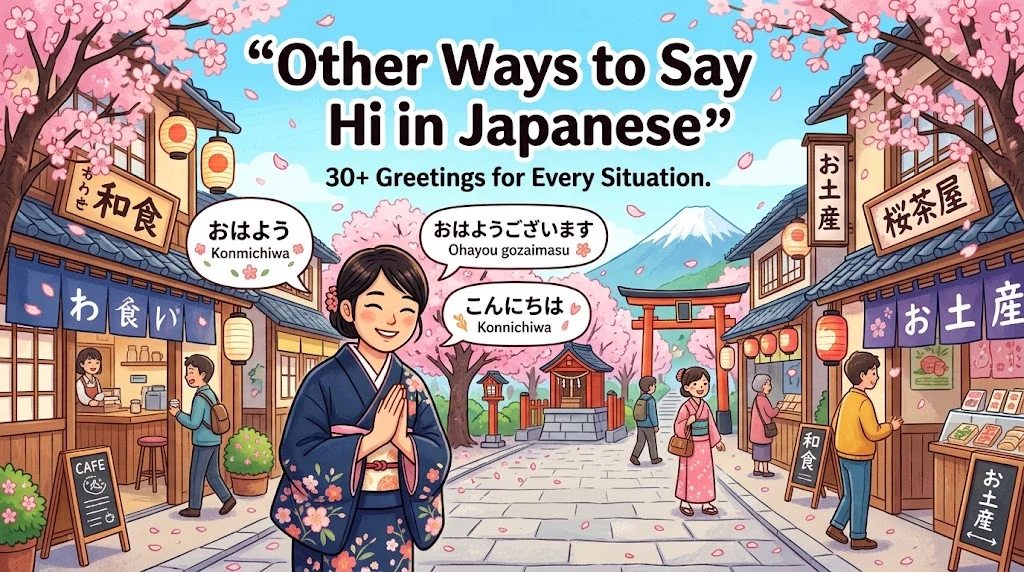
Japanese has many ways to say hi, each depending on time of day, formality, and relationship. Common alternatives include “Konnichiwa” (hello), “Ohayou gozaimasu” (good morning), “Konbanwa” (good evening), “Doumo” (casual hi), and “Moshi moshi” (hello on the phone).
Japanese greetings are far more nuanced than a simple “hi.” The language has distinct expressions for morning, afternoon, and evening, as well as different levels of politeness depending on who you are speaking to. Choosing the wrong greeting can sound rude or overly stiff.
Learning ways to say hi in Japanese gives you the ability to navigate any social situation with confidence. You can greet a colleague formally in the morning, casually greet a friend in the afternoon, or answer the phone politely at work. You can also express excitement in English when you finally master the correct tone and pitch of a Japanese greeting.
This guide presents 30 practical greetings with pronunciation guidance, meaning, and clear notes on formality. Whether you are travelling to Japan, studying the language, or working with Japanese colleagues, these options will help you sound natural and respectful.
Pull Quote: “In Japanese, how you say hello matters as much as the word itself.”
Quick Categories
Formal alternatives to “Hi” in Japanese
- Ohayou gozaimasu (おはようございます)
- Konnichiwa (こんにちは)
- Konbanwa (こんばんは)
- Yoroshiku onegaishimasu (よろしくお願いします)
Pro Tip: Formal greetings suit business meetings, first introductions, and speaking with seniors.
Casual alternatives
- Ohayou (おはよう)
- Doumo (どうも)
- Yaa (やあ)
- Ossu (おっす)
Pro Tip: Casual options work with close friends and family, never with strangers or superiors.
Professional alternatives
- Moshi moshi (もしもし)
- Irasshaimase (いらっしゃいませ)
- Youkoso (ようこそ)
- Gokigenyou (ごきげんよう)
Pro Tip: Professional greetings suit workplace phone calls, customer service, and formal events.
Informal expressions
- Genki? (元気?)
- Hisashiburi (久しぶり)
- Saikin dou? (最近どう?)
- Chousu wa dou? (調子はどう?)
Pro Tip: Informal expressions belong in conversations with close friends and people your own age.
Pull Quote: “The right tone makes your English sound professional and confident.”
Common Mistakes
- Using “Konnichiwa” in the morning.
Example: Saying “Konnichiwa” at 8 am. Use “Ohayou gozaimasu” instead. - Using casual greetings with strangers.
Example: Saying “Ossu” to your boss. It sounds rude and overly familiar. - Forgetting to bow when greeting.
Example: Saying “Konnichiwa” without a bow. A slight bow accompanies almost every Japanese greeting. - Using “Moshi moshi” in person.
Example: Saying “Moshi moshi” face to face. This phrase is used only on the phone. - Assuming one greeting works all day.
Example: Using “Konnichiwa” at night. Japanese greetings change with the time of day.
What Does “Hi” Mean in Japanese?
Definition
There is no single direct equivalent of “hi” in Japanese. Instead, the language uses a set of greetings that change based on time of day, formality, and relationship.
Grammar Explanation
Japanese greetings are fixed expressions that do not change grammatically. The main variation is politeness level, marked by whether the formal “gozaimasu” or “desu” is attached.
Example Sentence
“Konnichiwa, ogenki desu ka?” meaning “Hello, how are you?”
When to Use “Hi” in Japanese
Common Contexts
- Morning: Ohayou gozaimasu before about 10 or 11 am.
- Afternoon: Konnichiwa from late morning until early evening.
- Evening: Konbanwa after sunset.
- Phone calls: Moshi moshi when answering.
- First meetings: Hajimemashite and Yoroshiku onegaishimasu.
Spoken vs Written
- Spoken: Greetings are essential and always accompanied by a bow.
- Written: Common in emails, letters, and messages with set formulas.
Formal vs Informal
- Formal: Use full forms with gozaimasu and desu.
- Informal: Use shortened forms with close friends and family.
Is It Professional or Polite to Say “Hi” in Japanese?
Politeness vs Professionalism
Japanese greetings are highly context dependent. Using the correct politeness level is essential in professional settings. A casual greeting to a senior colleague can be seen as disrespectful, while an overly formal greeting to a close friend can feel distant.
Business-Style Example
“Ohayou gozaimasu. Honjitsu wa yoroshiku onegaishimasu.” meaning “Good morning. I look forward to working with you today.”
Polite? Yes, when the correct form is used
Professional? Yes, when formality matches the relationship
Pull Quote: “In Japanese, politeness is not optional. It is built into every greeting.”
Pros and Cons of Using “Hi” in Japanese
Pros
- Simple and natural: Greetings are short and easy to learn.
- Friendly tone: Shows warmth and respect.
- Common usage: Every Japanese speaker uses these daily.
- Easy to understand: Context makes meaning clear.
Cons
- Too informal for work: Casual forms are inappropriate in professional settings.
- Overused: Repeated use of the same greeting can sound robotic.
- Limited emotional range: Greetings cannot convey complex meaning.
- Not suitable for formal writing: Formal letters use different set phrases.
Other Ways to Say “Hi” in Japanese (With Examples)
These alternatives will help you sound more fluent, confident, and natural in different situations. Use them according to tone, context, and audience to express excitement, admiration, or approval.
1. Konnichiwa (こんにちは)
Meaning: Hello or good afternoon.
Explanation: The most common daytime greeting in Japan.
Example Sentence: “Konnichiwa, ogenki desu ka?”
Best Use: Daytime greetings
Worst Use: Morning or night
Tone: Neutral, polite, standard
Context Variability: Formal and casual
2. Ohayou gozaimasu (おはようございます)
Meaning: Good morning in formal Japanese.
Explanation: Used until around 10 or 11 am.
Example Sentence: “Ohayou gozaimasu, sensei.”
Best Use: Morning, formal
Worst Use: Afternoon
Tone: Formal, respectful, polite
Context Variability: Formal and spoken
3. Ohayou (おはよう)
Meaning: Good morning in casual Japanese.
Explanation: Used with friends and family.
Example Sentence: “Ohayou, genki?”
Best Use: Morning, casual
Worst Use: Formal meetings
Tone: Casual, friendly, warm
Context Variability: Casual and spoken
4. Konbanwa (こんばんは)
Meaning: Good evening.
Explanation: Used after sunset.
Example Sentence: “Konbanwa, ogenki desu ka?”
Best Use: Evening greetings
Worst Use: Morning
Tone: Neutral, polite, standard
Context Variability: Formal and casual
5. Doumo (どうも)
Meaning: Hi or thanks in casual Japanese.
Explanation: Very short and informal.
Example Sentence: “Doumo, hisashiburi.”
Best Use: Casual greetings
Worst Use: Formal settings
Tone: Casual, friendly, brief
Context Variability: Casual and spoken
6. Yaa (やあ)
Meaning: Hey in casual Japanese.
Explanation: Very informal and mostly used by men.
Example Sentence: “Yaa, genki sou da ne.”
Best Use: Close friends
Worst Use: Professional contexts
Tone: Very casual, informal, friendly
Context Variability: Casual and spoken
7. Ossu (おっす)
Meaning: Hey in very casual male Japanese.
Explanation: Common among young men and in sports clubs.
Example Sentence: “Ossu, chousu wa dou?”
Best Use: Close male friends
Worst Use: Formal settings
Tone: Very casual, masculine, informal
Context Variability: Casual and spoken
8. Uissu (ういっす)
Meaning: Hey in extremely casual Japanese.
Explanation: A shortened version of “ossu.”
Example Sentence: “Uissu, genki?”
Best Use: Very close friends
Worst Use: Any formal context
Tone: Extremely casual, masculine
Context Variability: Casual and spoken
9. Moshi moshi (もしもし)
Meaning: Hello on the phone.
Explanation: Used only when answering a phone call.
Example Sentence: “Moshi moshi, Tanaka desu.”
Best Use: Phone calls
Worst Use: In person
Tone: Neutral, standard, functional
Context Variability: Professional and spoken
10. Hajimemashite (はじめまして)
Meaning: Nice to meet you.
Explanation: Used when meeting someone for the first time.
Example Sentence: “Hajimemashite, Watashi wa Sarah desu.”
Best Use: First meetings
Worst Use: Familiar contacts
Tone: Formal, polite, standard
Context Variability: Formal and spoken
11. Yoroshiku onegaishimasu (よろしくお願いします)
Meaning: Please treat me well.
Explanation: Said after introducing yourself.
Example Sentence: “Hajimemashite, yoroshiku onegaishimasu.”
Best Use: First meetings
Worst Use: Close friends
Tone: Formal, respectful, polite
Context Variability: Formal and spoken
12. Hisashiburi (久しぶり)
Meaning: Long time no see.
Explanation: Used when meeting someone after a long time.
Example Sentence: “Hisashiburi, genki datta?”
Best Use: Friends, family
Worst Use: First meetings
Tone: Warm, casual, friendly
Context Variability: Casual and spoken
13. Ohisashiburi desu (お久しぶりです)
Meaning: Long time no see in formal Japanese.
Explanation: Polite version of “hisashiburi.”
Example Sentence: “Ohisashiburi desu, ogenki desu ka?”
Best Use: Formal reunions
Worst Use: Close friends
Tone: Formal, polite, warm
Context Variability: Professional and spoken
14. Genki? (元気?)
Meaning: You good? or How are you?
Explanation: Very casual greeting among friends.
Example Sentence: “Genki? Saikin dou?”
Best Use: Close friends
Worst Use: Formal settings
Tone: Casual, friendly, warm
Context Variability: Casual and spoken
15. Saikin dou? (最近どう?)
Meaning: How have you been lately?
Explanation: Casual check in phrase.
Example Sentence: “Saikin dou? Shigoto wa isogashii?”
Best Use: Friends, colleagues
Worst Use: Formal meetings
Tone: Casual, friendly, curious
Context Variability: Casual and spoken
16. Chousu wa dou? (調子はどう?)
Meaning: How are things?
Explanation: Common casual greeting.
Example Sentence: “Chousu wa dou? Genki sou da ne.”
Best Use: Friends, colleagues
Worst Use: Formal settings
Tone: Casual, friendly, practical
Context Variability: Casual and spoken
17. Gokigenyou (ごきげんよう)
Meaning: Good day in refined Japanese.
Explanation: Very formal and elegant, often used by women.
Example Sentence: “Gokigenyou, ogenki de.”
Best Use: Formal settings
Worst Use: Casual chats
Tone: Formal, refined, elegant
Context Variability: Formal and spoken
18. Irasshaimase (いらっしゃいませ)
Meaning: Welcome to a shop or establishment.
Explanation: Used by staff to greet customers.
Example Sentence: “Irasshaimase, nanika osagashi desu ka?”
Best Use: Retail, service
Worst Use: Personal greetings
Tone: Formal, welcoming, professional
Context Variability: Professional and spoken
19. Youkoso (ようこそ)
Meaning: Welcome.
Explanation: Used to welcome guests or visitors.
Example Sentence: “Youkoso, Nihon e.”
Best Use: Events, hospitality
Worst Use: Casual chats
Tone: Warm, formal, welcoming
Context Variability: Professional and spoken
20. Okaeri (おかえり)
Meaning: Welcome home.
Explanation: Said when someone returns home.
Example Sentence: “Okaeri, osoku natta ne.”
Best Use: Family
Worst Use: Formal settings
Tone: Warm, casual, familial
Context Variability: Casual and spoken
21. Tadaima (ただいま)
Meaning: I am home.
Explanation: Said when returning home.
Example Sentence: “Tadaima, okaasan.”
Best Use: Family
Worst Use: Formal settings
Tone: Warm, casual, familial
Context Variability: Casual and spoken
22. Oi (おい)
Meaning: Hey in casual Japanese.
Explanation: Can sound rude if used wrongly.
Example Sentence: “Oi, matte yo.”
Best Use: Close friends
Worst Use: Formal settings
Tone: Very casual, blunt, masculine
Context Variability: Casual and spoken
23. Nee (ねえ)
Meaning: Hey, used to get attention.
Explanation: Common and slightly softer than “oi.”
Example Sentence: “Nee, chotto ii?”
Best Use: Friends, family
Worst Use: Formal settings
Tone: Casual, friendly, attention seeking
Context Variability: Casual and spoken
24. Anoo (あのう)
Meaning: Um, excuse me.
Explanation: Used to get attention politely.
Example Sentence: “Anoo, sumimasen.”
Best Use: Polite attention
Worst Use: Close friends
Tone: Polite, hesitant, gentle
Context Variability: Professional and spoken
25. Sumimasen (すみません)
Meaning: Excuse me or sorry.
Explanation: Used to get attention or apologize.
Example Sentence: “Sumimasen, michi o oshiete kudasai.”
Best Use: Public settings
Worst Use: Close friends
Tone: Polite, respectful, neutral
Context Variability: Professional and spoken
26. Konnichiwa minna (こんにちはみんな)
Meaning: Hi everyone.
Explanation: Used when greeting a group.
Example Sentence: “Konnichiwa minna, kyou wa yoroshiku.”
Best Use: Group greetings
Worst Use: One on one
Tone: Friendly, casual, group oriented
Context Variability: Casual and spoken
27. A, konnichiwa (あ、こんにちは)
Meaning: Ah, hello.
Explanation: Used when you suddenly meet someone.
Example Sentence: “A, konnichiwa, hisashiburi desu ne.”
Best Use: Surprise meetings
Worst Use: Planned meetings
Tone: Casual, surprised, friendly
Context Variability: Casual and spoken
28. Hai, doumo (はい、どうも)
Meaning: Yes, hello or thanks.
Explanation: Quick acknowledgement.
Example Sentence: “Hai, doumo, onegaishimasu.”
Best Use: Quick greetings
Worst Use: Formal introductions
Tone: Casual, brief, functional
Context Variability: Casual and spoken
29. Osu (おす)
Meaning: Hey in martial arts and casual male speech.
Explanation: Common in sports and among young men.
Example Sentence: “Osu, senpai.”
Best Use: Sports, dojo
Worst Use: Formal meetings
Tone: Casual, masculine, athletic
Context Variability: Casual and spoken
30. Yosha (よしゃ)
Meaning: Alright, here we go.
Explanation: Used as a self greeting or ready phrase.
Example Sentence: “Yosha, ganbaru zo.”
Best Use: Self motivation
Worst Use: Greeting others
Tone: Casual, energetic, self directed
Context Variability: Casual and spoken
Pull Quote: “Professional reaction phrases and cultural greetings both show the same thing: you made an effort to connect.”
Mini Quiz / Self-Check
- Scenario: You are greeting your Japanese boss at 9 am. Which fits best?
- A) Ossu.
- B) Ohayou gozaimasu.
- C) Yaa.
- Scenario: You are answering a phone call in Japan. Which is correct?
- A) Konnichiwa.
- B) Moshi moshi.
- C) Ohayou.
- Scenario: You are meeting a Japanese colleague for the first time. Which is most appropriate?
- A) Hajimemashite, yoroshiku onegaishimasu.
- B) Genki?
- C) Uissu.
- Scenario: Which greeting is used only at night?
- A) Ohayou gozaimasu.
- B) Konbanwa.
- C) Konnichiwa.
Comparison Table: Top Alternatives
| Phrase | Tone | Best Use |
| Konnichiwa | Neutral, polite | Daytime greetings |
| Ohayou gozaimasu | Formal, respectful | Morning, formal |
| Ohayou | Casual, friendly | Morning, casual |
| Konbanwa | Neutral, polite | Evening greetings |
| Doumo | Casual, brief | Casual greetings |
| Moshi moshi | Neutral, functional | Phone calls |
| Hajimemashite | Formal, polite | First meetings |
| Yoroshiku onegaishimasu | Formal, respectful | After introductions |
| Hisashiburi | Warm, casual | Reunions |
| Genki? | Casual, friendly | Close friends |
FAQs
1. What is the most common way to say hi in Japanese?
“Konnichiwa” is the most common daytime greeting, used from late morning until early evening.
2. How do you say hi in Japanese in the morning?
Use “Ohayou gozaimasu” in formal settings and “Ohayou” with close friends and family.
3. What does “Moshi moshi” mean?
It means hello and is used only when answering the phone in Japan.
4. Is it rude to say “Konnichiwa” at night?
Yes. At night, use “Konbanwa” instead, as Japanese greetings change with the time of day.
5. What is the difference between “Ohayou” and “Ohayou gozaimasu”?
“Ohayou” is casual and used with friends and family, while “Ohayou gozaimasu” is the polite form used in formal and professional settings.
Conclusion
Learning other ways to say hi in Japanese gives you the ability to greet anyone respectfully and naturally in Japan. Whether you are speaking to a boss, a friend, or a stranger, the right greeting shows cultural awareness and genuine effort. These alternatives to hi in Japanese help you move beyond one phrase and into a deeper understanding of the language.
Practise by choosing one greeting each day and using it in a real conversation or message. Pay close attention to time of day, formality, and relationship, because the right phrase depends entirely on context. With steady practice, these informal expressions in English and their Japanese counterparts will become part of your everyday fluency.

John Green is an American writer who contributes to QuickResponsess.com, creating clear and practical content on English grammar, vocabulary and everyday language. His goal is to make learning English simple, engaging and easy to apply.